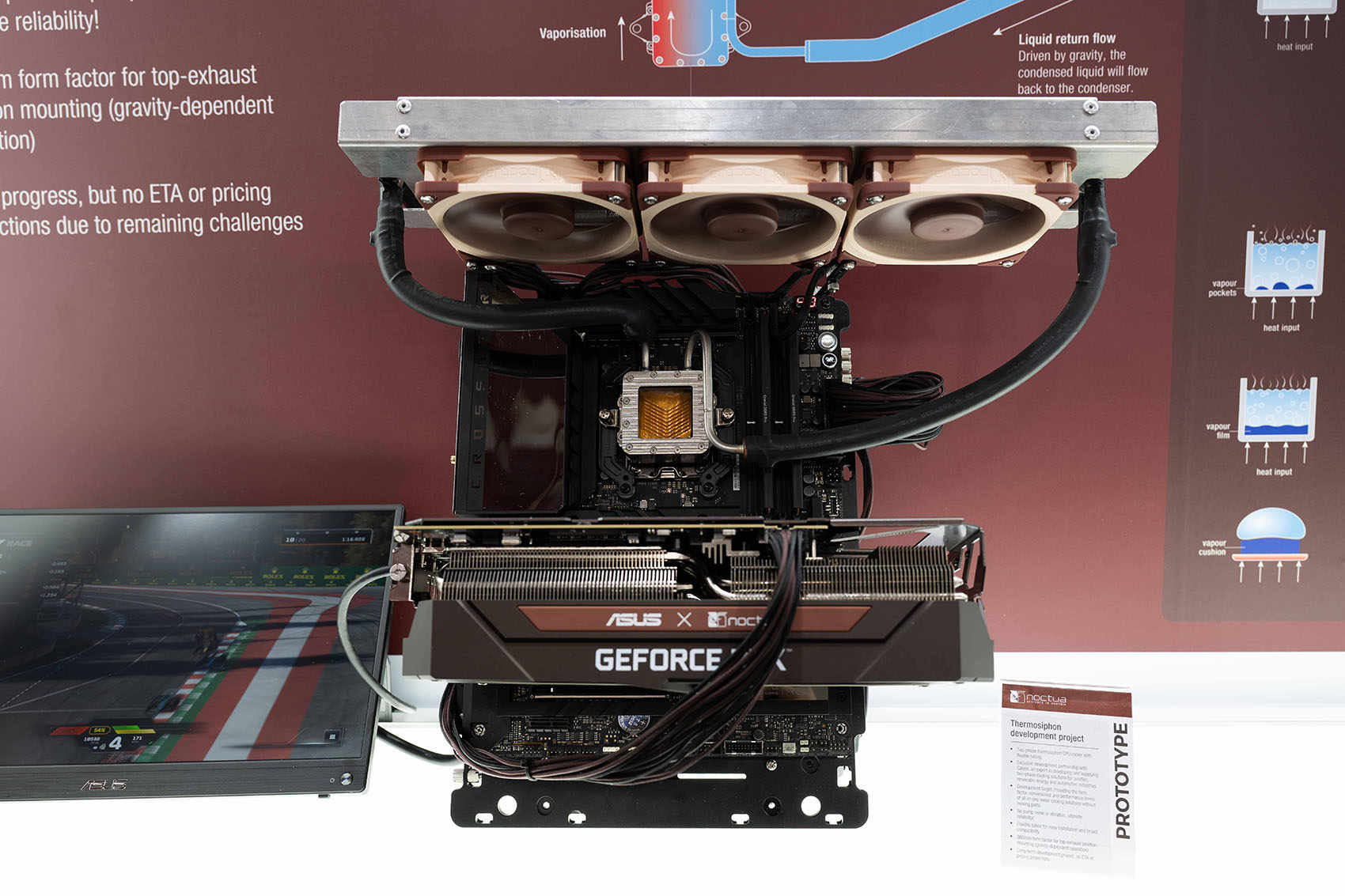
Noctua is working on one of the more interesting PC cooling upgrades on the horizon: a liquid CPU cooler that does not use a pump at all. The project is called a two-phase thermosiphon, and the short version is simple: CPU heat makes the working fluid evaporate, the vapor rises to the radiator, the radiator condenses it back into liquid, and gravity returns the liquid to the CPU block.
That matters because the pump is one of the parts that separates a normal all-in-one liquid cooler from a big air cooler. Pumps can add noise, vibration, control complexity, and another moving part that can eventually fail. Noctua’s goal is to keep the convenience and performance range of a 360mm AIO while removing the pump entirely.
In this article
- What Noctua’s pump-free cooler is
- How the thermosiphon loop works
- What changed in the newer prototype
- How this could benefit customers
- Upgrade cautions before planning around it
- Our practical buying advice
What Noctua’s Pump-Free Cooler Is
Noctua’s thermosiphon project looks a lot like an all-in-one liquid cooler from the outside. It has a CPU-side evaporator block, flexible tubing, and a radiator-like condenser with fans. The difference is what is missing: there is no pump moving liquid through the loop.
In a normal AIO, the pump actively pushes coolant from the CPU block to the radiator and back. In Noctua’s thermosiphon, the heat from the CPU is part of the engine. The working fluid boils at the CPU-side evaporator, vapor rises into the condenser, fans move air through the condenser, and the condensed liquid returns downward by gravity.
Noctua has been developing the design with Calyos, a Belgian company that specializes in two-phase cooling for demanding industries. Noctua’s 2025 press material described the goal as a 360mm top-exhaust cooler with AIO-like form factor, convenience, and performance, but without moving parts inside the loop. The fans still move, of course, so this is not silent or fully passive. It is pump-free.
How The Thermosiphon Loop Works
The cooling process has four practical stages:
- The CPU heats the evaporator. Heat from the processor enters the cold plate and evaporator surface.
- The working fluid vaporizes. Instead of simply warming up and being pumped away, part of the fluid changes phase into vapor.
- The vapor rises to the condenser. Vapor is less dense than liquid, so it naturally moves upward through the loop.
- The condenser turns vapor back into liquid. The radiator section sheds heat into the case airflow, the vapor condenses, and gravity returns the liquid to the evaporator.
This is why the cooler is orientation-sensitive. Noctua’s earlier material listed a 360mm top-exhaust mounting position because the liquid return path depends on gravity. A front-mounted or bottom-mounted radiator layout that works with a normal pump-based AIO may not be appropriate for a thermosiphon.
What Changed In The Newer Prototype
The Computex 2026 updates are the reason this is worth writing about now. Multiple current reports say Noctua’s newer prototype is no longer just a curiosity. In PC Gamer’s booth coverage, Noctua described a test using an AMD Ryzen 9 9950X3D running at a 230W load. The thermosiphon reportedly showed roughly 81.4 degrees C, while Noctua’s upcoming NL-LC1 AIO beside it showed roughly 79.4 degrees C. That is close enough to make the design look realistic for future high-end builds.
Tom’s Hardware reported a similar side-by-side 230W Ryzen 9 9950X3D demonstration and said both systems were just over 80 degrees C, suggesting the passively circulated thermosiphon is moving toward AIO-class cooling performance. That is a major step up from Noctua’s 2025 public demo, which used a Ryzen 7 9800X3D during an F1 24 gameplay demo.
The engineering changes also sound meaningful, not cosmetic. Current coverage points to a refined evaporator, better control of liquid and vapor flow, a sintered copper micro-layer to improve liquid contact at the hot surface, a U-flow condenser with single-side inlet and outlet, improved tubing material, better sealing, and work to reduce non-condensable gases in the loop. Igor’sLAB reports that Noctua has tested more than 400 evaporator prototypes and 25 condenser prototypes in the last twelve months.
| Current status | Prototype / development project, not a retail product yet. |
|---|---|
| Expected timing | Current Computex 2026 coverage points to a tentative Q3 2027 target. |
| Cooling format | Two-phase thermosiphon with CPU evaporator, flexible tubes, and a 360mm condenser/radiator section. |
| What it removes | The pump, pump noise, pump vibration, and one major moving wear component inside a normal AIO loop. |
| What remains | Radiator fans, tubing, a sealed working fluid loop, case fit requirements, and orientation requirements. |
| Best-fit customer | Quiet-PC builders, high-end workstation or gaming PC owners, and customers who want liquid-cooling-class performance with fewer moving parts. |
How This Could Benefit Customers
Good points
- No pump whine: The pump is often the one sound you cannot tune away with normal fan curves.
- Less vibration: Removing a motorized pump removes another vibration source from the CPU block area.
- Potentially better long-term reliability: Fewer moving parts usually means fewer mechanical failure points.
- AIO-like layout: The target is still a familiar radiator-and-block setup, not a giant exotic tower.
- Strong performance target: The 2026 230W Ryzen 9 demo suggests this may be realistic for high-end CPUs.
Bad points
- Not available yet: This is future planning, not a current shopping recommendation.
- Likely premium pricing: Noctua and niche cooling engineering rarely land in budget territory.
- Top-mount requirement: Gravity-dependent return flow limits case compatibility.
- Still has fans: It removes pump noise, not all noise.
- Retail consistency still matters: Noctua still has to make prototype performance repeatable in mass production.
For a home customer, the biggest practical benefit would be a powerful PC that is less annoying to sit beside. Pump whine is not always loud, but when it is present, it can be a sharp or tonal sound that stands out more than fan airflow. A pump-free design could make a high-end PC sound more like a carefully tuned air-cooled system while keeping the radiator placement benefits of liquid cooling.
For a small business customer, the reliability angle may be more important. Workstations used for CAD, video editing, development, accounting databases, signage, or production control should not be built only for benchmark numbers. They should be built so they run quietly, consistently, and predictably for years. Removing a pump does not make a cooler immortal, but it does remove one important active component from the failure list.
Upgrade Cautions Before Planning Around It
The first caution is timing. If a customer needs a PC this summer, do not wait for this cooler. Noctua’s normal NL-LC1 AIO is the nearer-term liquid cooler, while the thermosiphon is a longer-term project. The current reporting points to Q3 2027 for the pump-free design, and prototype timelines can slip.
The second caution is case fit. Because the thermosiphon depends on vapor rising and liquid returning by gravity, it is not as flexible as a pump-based AIO. A normal AIO can often be mounted at the top or front of a case if tube orientation is sensible. A thermosiphon needs the condenser in the correct position, which means a case with proper 360mm top radiator support will matter.
The third caution is serviceability. Traditional air coolers have a major advantage: a heatsink does not leak, permeate, or depend on a sealed fluid charge. Noctua is reportedly working on tubing materials, connector sealing, and non-condensable gas control, but those details need retail reviews over time. If maximum long-term simplicity is the priority, a quality air cooler may still be the better answer for many customers.
Our Practical Buying Advice
If you are building or upgrading a PC in the near future, treat Noctua’s thermosiphon as a technology to watch, not a part to wait on. A good Noctua air cooler, a well-reviewed conventional AIO, or Noctua’s upcoming NL-LC1 may make more sense depending on the CPU, case, workload, and noise target.
If you are planning a higher-end 2027 workstation or gaming build, this is where the thermosiphon becomes interesting. Before buying the case, check for real 360mm top radiator support, enough motherboard clearance around the CPU socket, good case airflow, and a layout that does not force the condenser into the front or bottom of the case. The cooler may be pump-free, but the whole PC still needs intelligent airflow.
For The IT Guys customers, the practical recommendation is this: do not upgrade just because a cooling product sounds futuristic. Upgrade when the whole system benefits. If your current PC is loud, thermally limited, or due for a CPU/platform refresh, this kind of cooler could become a strong option once it is available and independently reviewed. If your current system is stable, quiet, and fast enough, there is no reason to chase a prototype.
FAQ
Is Noctua’s pump-free cooler available to buy now?
No. Current Computex 2026 reporting describes it as a prototype with a tentative Q3 2027 target.
Does pump-free mean silent?
No. The pump is gone, but the condenser still uses fans. The realistic benefit is less pump whine and vibration, not total silence.
Can it go in any case that supports a 360mm radiator?
Probably not. Because the system depends on vapor rising and liquid returning by gravity, a proper top-exhaust radiator position is expected to be important.
Should I wait for this before upgrading my PC?
Most customers should not wait. If you need a PC soon, buy based on available parts and verified reviews. If you are planning a future premium quiet build, keep this project on the watch list.
Sources
- Noctua Computex 2025 thermosiphon development project
- Noctua press and media terms
- Tom’s Hardware Computex 2026 thermosiphon coverage
- PC Gamer Computex 2026 thermosiphon demo coverage
- Club386 Computex 2026 pump-free cooler details
- Igor’sLAB Computex 2026 Noctua overview
- Asetek and Noctua NL-LC1 AIO production validation announcement