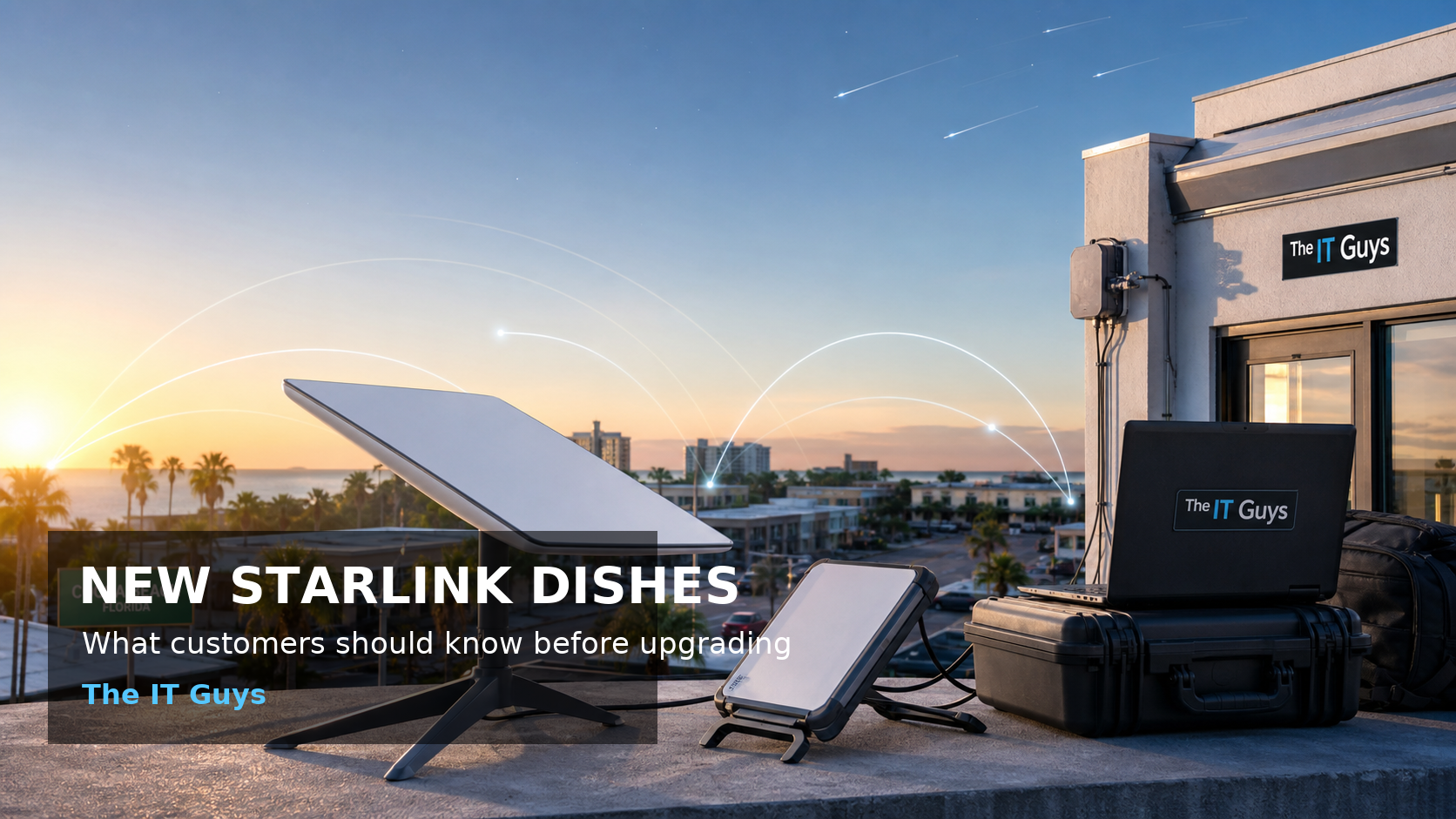
SpaceX has shown two newer Starlink customer terminals, and they look like the next step toward smaller, easier-to-carry satellite internet kits. That is good news for travelers, remote workers, backup-internet planning, and businesses that need temporary connectivity at job sites or events. It is also a reminder to slow down before buying or replacing equipment: as of June 11, 2026, Starlink has not posted final public pricing, retail availability, or full official specification sheets for these newly shown models.
The short version: the new dishes appear thinner and more portable than current Starlink hardware, one model looks like a next-generation standard terminal, and the other appears to be a smaller rugged portable unit. Elon Musk described them in a SpaceX video as new Starlink terminals being made in much higher volume than current terminals. PCMag also connected the video to recent firmware references to a possible rev5 standard dish and a newer Mini-style model that may include travel-focused changes.
In this article
- What SpaceX showed
- Why smaller dishes matter
- Good points and bad points
- Buying advice before upgrading
- Business and backup-internet use
- FAQ
What was actually shown?
In the SpaceX video, Musk is seated near two new Starlink terminal designs. PCMag reports that he called them “the new Starlink terminals” and said SpaceX made them in much higher volume than the current terminals. That matters because Starlink hardware has often been limited by cost, availability, power draw, mounting needs, and the practical annoyance of carrying a full-size kit around.
What we can say carefully:
- There appear to be two newer terminal designs. One looks closer to a next-generation standard dish, and one looks closer to a smaller rugged portable dish.
- The new designs look thinner and more travel-friendly. PCMag noted they may be small enough to fit in a backpack, though final dimensions have not been officially published yet.
- Firmware references already hinted at this. PCMag previously reported that Starlink firmware mentioned a possible rev5 standard dish and another Mini-related model.
- Starlink has not published final retail details yet. No confirmed public price, launch date, order page, or full spec sheet was available on Starlink.com when this article was prepared.
That last point is important. The new hardware looks promising, but customers should avoid making a purchase decision based only on early video frames or firmware clues. For most homes and businesses, the real decision comes down to price, monthly plan rules, power draw, mounting options, weather rating, router capability, and whether the kit is meant for permanent or portable use.
Why smaller Starlink dishes matter
Current Starlink hardware already solves a major problem: it can bring usable broadband to places where cable, fiber, and cellular service are weak or unavailable. The tradeoff is that satellite internet still needs a clear view of the sky, power, a proper mounting location, and realistic expectations about weather, latency, service-plan limits, and congestion.
The current Starlink Standard kit specification sheet lists a dish measuring about 594 mm by 383 mm by 39.7 mm, with average power consumption around 75 to 100 watts. The Mini specification sheet is much smaller and lighter, with the dish listed around 298.5 mm by 259 mm by 38.5 mm and average power consumption around 25 to 40 watts. Those numbers explain why a newer portable design gets attention: every pound, watt, cable, and mount matters when the kit is being used from a truck, RV, job site, boat dock, emergency command table, or temporary office.
If SpaceX can make the newer dishes easier to carry while keeping performance strong, the practical customer benefit could be simple: less gear to pack, faster setup, lower battery demand, and better options for temporary connectivity. That does not automatically mean every customer should upgrade. It means the next buying cycle may be more interesting than usual.
Good points and bad points
Good points
- Portability appears to be improving. A thinner, lighter terminal is easier to move between locations and easier to store in a vehicle or travel bag.
- Higher-volume manufacturing could help availability. Musk said the new terminals are being made in much higher volume than current terminals, which may matter if Starlink demand keeps growing.
- A rugged Mini-style option would be useful. If the smaller model is truly more rugged and travel-focused, it could be a better fit for field work, travel, and backup connectivity than a full-size residential kit.
- Lower-power hardware would be valuable. The current Mini already draws much less power than the Standard kit. Any improvement in this area helps battery and generator planning.
Bad points and unknowns
- No final pricing yet. A great-looking dish can become less attractive if hardware, monthly fees, or plan restrictions change.
- No official public spec sheet yet. Until Starlink posts real dimensions, power numbers, weather ratings, and router details, the safest wording is “shown” and “expected,” not “confirmed.”
- Service plans still matter more than the dish alone. Residential, Roam, Priority, business, and mobility rules can affect where and how the kit can be used.
- Satellite internet is not magic. Trees, buildings, storms, poor mounting, blocked sky view, weak local Wi-Fi, and bad cable routing can all make a good dish feel unreliable.
Buying advice before you upgrade
If you already have working Starlink service, do not rush to replace your dish based only on the teaser. Wait for the official Starlink product page and compare these details:
- Hardware price: check whether the kit price changed and whether discounts apply only to new customers.
- Monthly service cost: the plan can matter more than the one-time dish price.
- Portability rules: confirm whether the new hardware is allowed on the plan you need, especially for travel, job-site, or business use.
- Power requirements: look for average wattage, peak draw, USB-C support if offered, and whether your battery bank or vehicle setup can handle it.
- Ethernet and router options: businesses should care about wired handoff, router placement, mesh compatibility, and whether the Starlink router can be bypassed or integrated cleanly.
- Mounting and weather rating: portable is convenient, but permanent outdoor service still needs proper mounting, cable protection, drip loops, surge protection, and safe routing.
For new customers, the decision is a little different. If you need internet now and Starlink is your best available option, waiting may not be worth the downtime. If this is a nice-to-have upgrade or a travel kit, waiting for the new dish pages may save you from buying hardware right before a better model appears.
What this could mean for small businesses
For local businesses, the most useful Starlink conversation is not “is it cool?” It is “where does it fit?” A smaller and more rugged dish could make sense for temporary offices, construction trailers, outdoor events, food trucks, remote camera systems, emergency response kits, and backup internet where wired service is unreliable.
For a permanent office, Starlink should usually be treated as one part of the network plan, not the whole plan. A business should think about failover, firewall rules, VPN reliability, payment-terminal behavior, VoIP phones, security cameras, and whether staff devices should use Starlink Wi-Fi directly or connect through the existing business router. The dish may be the visible part, but the network design decides whether the setup feels professional.
That is especially true in Florida. Storms, power outages, roof access, salt air, and tree coverage all affect reliability. A portable dish can help after an outage, but only if someone already tested the kit, labeled the cables, charged the battery, documented the setup steps, and confirmed that the business systems work over that connection.
Practical setup tips
- Test the sky view before mounting. Use the Starlink app or a real temporary setup to check obstructions before drilling holes or buying mounts.
- Do not rely on satellite internet as your only business plan without testing. Run your payment system, phones, VPN, cameras, and cloud apps through it before an emergency.
- Plan power first. A portable dish is only portable if the battery, inverter, USB-C adapter, or generator setup is sized correctly.
- Keep Wi-Fi separate from internet service. A faster dish will not fix poor indoor Wi-Fi coverage. Router placement and access points still matter.
- Label and pack the kit. For backup use, keep cables, mount, power supply, setup notes, and login details organized in one case.
Related reading
- SpaceX Starlink 10-43 Florida launch: what it adds to the network
- Check router security before it becomes the weak link
- Set up guest Wi-Fi before sharing your password
FAQ
Are the new Starlink dishes available to order now?
Not from the public information we could verify on June 11, 2026. SpaceX showed the terminals in a video, and reporting connects them to firmware references, but Starlink has not posted final public ordering pages or full official specs for the new models yet.
Should I wait before buying Starlink?
If you need internet now and Starlink is the best option available, waiting may not be practical. If you are buying a travel kit, backup kit, or optional upgrade, it may be worth waiting for the official new-hardware details so you can compare price, plan rules, power needs, and mounting options.
Will a smaller dish be slower?
Not necessarily, but smaller hardware can involve tradeoffs. Final performance depends on the antenna design, Starlink’s network capacity in your area, obstructions, service plan, router setup, and weather. Wait for Starlink’s official specs and independent testing before assuming the new models are faster or slower.
Can Starlink replace business internet?
Sometimes, especially where wired service is poor. For many businesses, Starlink is best used as backup internet or as a connection for remote sites. Payment terminals, phones, VPNs, cameras, and cloud systems should be tested before depending on it during an outage.