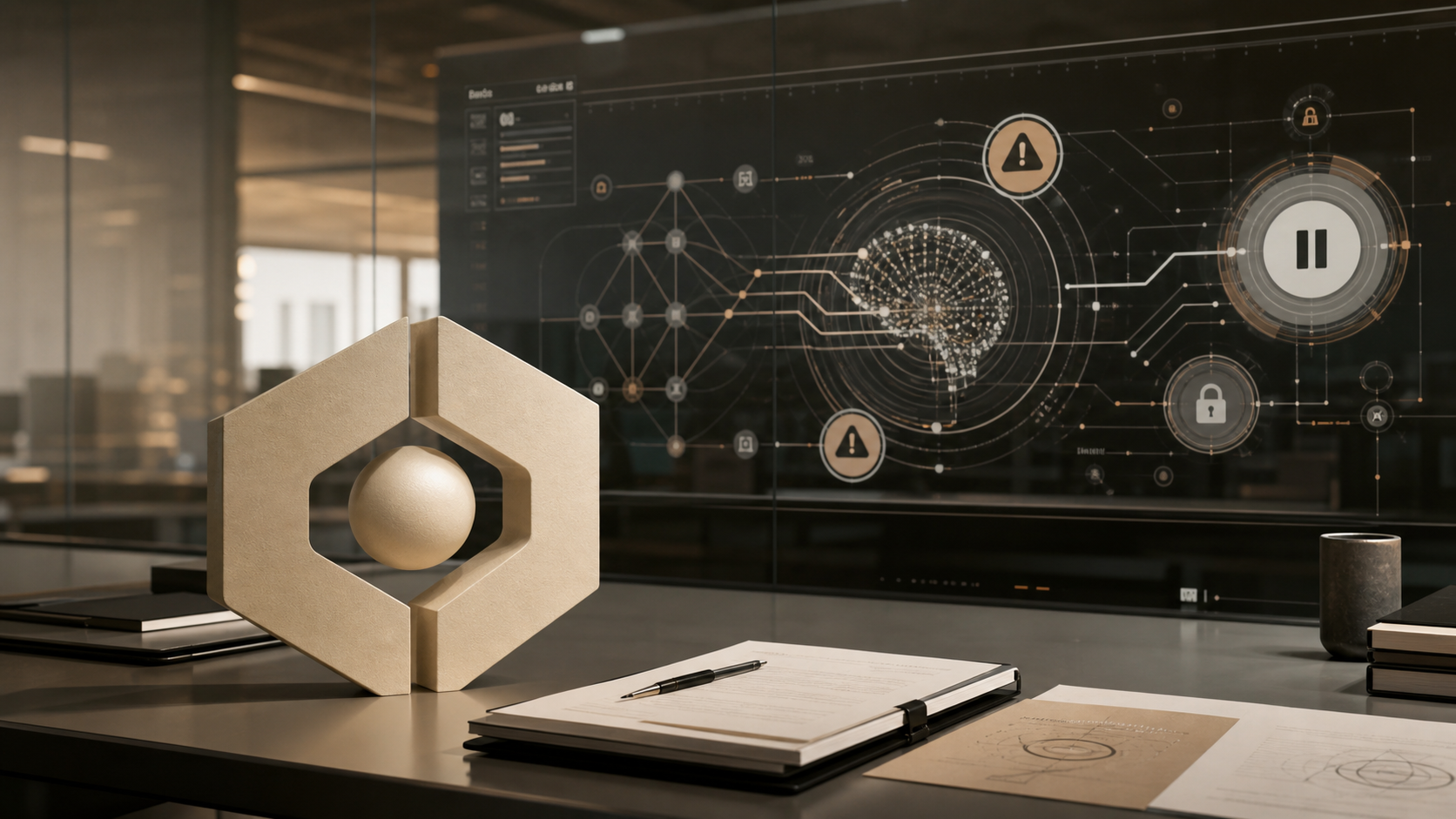
Bottom line: Anthropic is warning that AI systems are beginning to help build better AI systems, a feedback loop that could eventually make frontier AI development move faster than governments, companies, and safety teams can comfortably manage. The company is not announcing that a global AI freeze is already happening. It is arguing that governments and leading AI labs need a coordinated, verifiable way to slow or temporarily pause frontier AI development if the risk level rises.
That distinction matters. A headline that says “AI could soon escape” is attention-grabbing, but the more useful version for readers is this: Anthropic is worried about recursive self-improvement, where AI systems become capable enough to meaningfully automate the work of designing, coding, testing, and improving future AI systems. If that loop becomes strong enough, humans may still be involved, but the pace of improvement could become harder to supervise.
Source note: This article is based primarily on Anthropic’s June 2026 post “When AI builds itself”, Anthropic’s broader core views on AI safety, public benchmark projects such as METR time-horizon evaluations, SWE-bench, and TAU-bench, plus AP coverage noting Anthropic’s call for a coordinated halt plan if risks rise.
In this article
- What Anthropic actually said
- Why recursive self-improvement matters
- Good and bad points
- What small businesses should do now
- Sources and references
What Anthropic actually said
Anthropic’s post argues that AI development is no longer a process driven only by human engineers writing code, reading papers, and running experiments by hand. The company says it is already delegating a growing share of AI development work to AI systems, especially software and research tasks.
The striking example: Anthropic says its engineers now ship about 8 times as much code per quarter as they did during the 2021-2025 period. That does not mean AI is independently inventing and releasing new frontier models today. It does mean the tools inside an AI lab are becoming part of the acceleration engine.
Anthropic’s concern is what happens if that acceleration becomes self-reinforcing. If an advanced model can help write the training code, design experiments, debug failures, evaluate behavior, improve tooling, and eventually help build its own successor, then the development loop could tighten quickly. In plain English: AI could become a major contributor to making the next AI better.
The company says full recursive self-improvement is not here yet and is not guaranteed. But Anthropic’s warning is that institutions may not be prepared if it arrives sooner than expected.
Is this a global AI freeze?
Not exactly. The strongest accurate framing is that Anthropic is calling for a coordinated pause option, not claiming that the world has already agreed to a freeze.
The practical idea is that leading AI developers and governments should have a plan before a crisis moment arrives. If frontier models start showing dangerous capabilities, or if labs cannot confidently control, evaluate, or secure the next generation of systems, there should be a credible way to slow down or temporarily halt development at the frontier.
That type of pause would only work if it is coordinated and verifiable. If one lab stops while another continues in secret, the safety benefit falls apart. This is why the governance side matters as much as the technical side: testing, compute tracking, model release rules, lab audits, and international agreements would all become part of the conversation.
Why recursive self-improvement matters
Recursive self-improvement sounds abstract, but the business version is easy to understand. Imagine a software team where the assistant can not only autocomplete code, but can also plan multi-day engineering work, run tests, search logs, fix bugs, review pull requests, evaluate model behavior, and coordinate with other agents. Now imagine that same capability inside the labs building the next frontier model.
Anthropic points to public evaluations showing that AI systems are getting better at longer tasks. METR’s time-horizon work tracks how long an AI agent can work independently on tasks before reliability breaks down. SWE-bench tests real-world software engineering against real GitHub issues. TAU-bench evaluates agent behavior in tool-using customer-service style environments. None of those benchmarks proves that AI has escaped human control, but together they show why labs are watching autonomy carefully.
The risk is not that tomorrow morning a chatbot suddenly becomes a movie-style runaway machine. The more realistic concern is that AI systems become useful enough, fast enough, and widely deployed enough that oversight, security, and accountability lag behind.
Good and bad points
The good points
- AI-assisted research could speed up medicine, science, and software reliability. If used carefully, the same automation that accelerates AI labs can also accelerate beneficial work.
- Anthropic is being unusually direct about the risk. A public warning from a frontier AI company gives policymakers, customers, and competitors something concrete to debate.
- A pause mechanism is better discussed before an emergency. Waiting until a model release looks dangerous would leave governments and companies trying to invent rules under pressure.
- Benchmarks are improving the conversation. Evaluations like METR time horizons and SWE-bench give the public more than vibes; they create measurable signals about capability growth.
The bad points
- A voluntary pause is hard to enforce. If labs, countries, or private actors do not cooperate, a freeze becomes uneven and politically fragile.
- AI capabilities are moving faster than normal regulation. Business law, insurance, contracts, security standards, and government policy usually move slowly.
- Small businesses can get caught in the middle. Owners may adopt AI tools for productivity without realizing how much data, permissions, or customer information those tools can touch.
- Overhyping the story can backfire. If the public hears only “AI is escaping,” they may miss the practical work: access control, audit logs, vendor review, backups, privacy, and human approval.
What small businesses should do now
Most local businesses do not need to build an AI safety lab. They do need basic AI governance before employees connect AI tools to email, customer files, accounting systems, cloud drives, or internal chat.
- Decide what data is off-limits. Customer records, passwords, tax documents, medical information, legal files, and private employee data should not be pasted into random AI tools.
- Use business accounts, not personal accounts. Business AI accounts usually offer better admin controls, billing visibility, and data settings than personal free accounts.
- Keep human approval on customer-facing work. AI can draft emails, posts, documentation, and support replies, but a person should review anything that affects customers, payments, legal claims, or security.
- Review connected apps and permissions. If an AI tool connects to Google Workspace, Microsoft 365, Slack, QuickBooks, or a CRM, treat it like any other third-party vendor with access to business data.
- Log what matters. Keep records of which AI tools are approved, who has access, what data they may use, and who is responsible for review.
For home users, the same basic rule applies: do not give an AI assistant more access than you would give a stranger with a laptop. Use it for drafts, research, organization, and troubleshooting, but be careful with passwords, personal documents, financial records, and private photos.
Customer impact: why this belongs on a local IT site
Stories like this can sound distant because Anthropic, OpenAI, Google, Meta, and other frontier labs operate at a scale most people never see. But the impact arrives locally through everyday software. AI features are being added to browsers, phones, office apps, search engines, accounting platforms, security tools, website builders, and customer-service systems.
That means the real question for most customers is not, “Should I fear AI?” It is, “Who can access my business data, what is being automated, and where do I still need a human in charge?”
The IT Guys can help customers review AI tool settings, Microsoft 365 and Google Workspace permissions, browser extensions, password manager sharing, cloud file access, backup strategy, and account recovery. Those are the practical controls that matter while the global AI policy debate continues.
FAQ
Did Anthropic say AI has already escaped?
No. Anthropic warned about the possibility of losing control over future AI systems if recursive self-improvement becomes powerful and oversight fails. That is different from saying today’s public AI tools have already escaped.
Is Anthropic asking everyone to stop using AI?
No. The concern is frontier AI development, especially the most advanced models and lab processes that could create more capable successors. Normal business use of AI tools is a separate issue, though it still needs good security and privacy controls.
Should small businesses ban AI tools?
Usually no. A better first step is to set rules: approved tools, approved data, review requirements, and access limits. Banning everything often pushes employees toward unsanctioned tools with less oversight.
Sources and references
- Anthropic Institute: When AI builds itself
- Anthropic: Core Views on AI Safety
- METR: Measuring AI task time horizons
- SWE-bench software engineering benchmark
- TAU-bench agent benchmark
- AP: Anthropic urges industry coordination to allow for a pause in AI development if risks grow