By Jennifer Hudsen, The IT Guys. Last checked June 19, 2026.
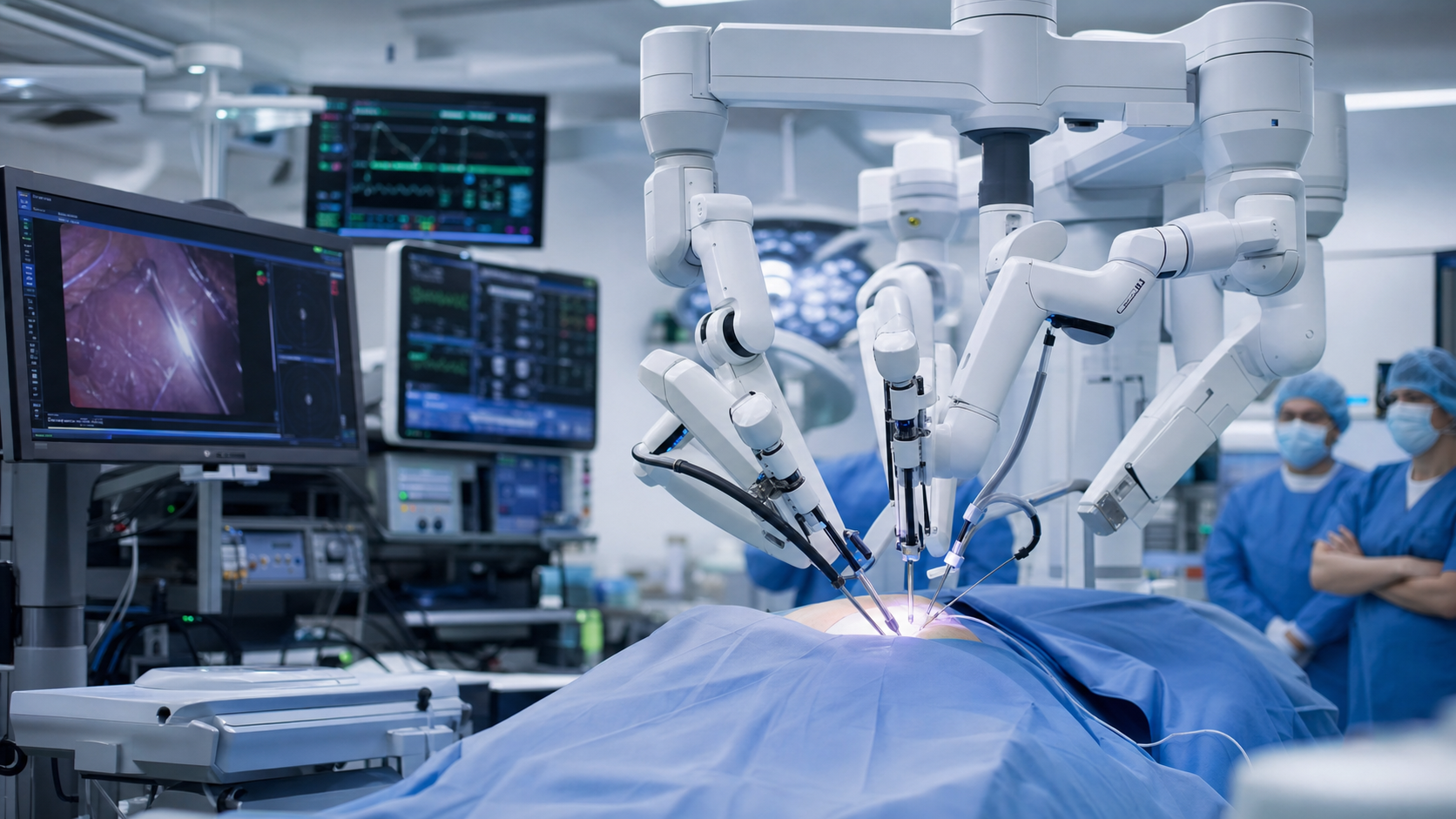
A surgical robot really did perform a highly complex gallbladder-removal task without direct human control. The verified story is the Johns Hopkins-led Surgical Robot Transformer-Hierarchy, or SRT-H, published in Science Robotics on July 9, 2025 and described by Johns Hopkins University.
The important boundary: this was not a live human operation. The robot was tested on ex vivo pig gallbladders, meaning real animal tissue outside a living body, in an experimental setup. It is still a serious milestone because the robot completed a long, multi-step surgical sequence across eight unseen gallbladders, with the research team reporting a 100% success rate across n=8 ex vivo gallbladders and autonomous operation without human intervention during the task.
The Good News And The Cautions
What is genuinely promising
- It handled more than a tiny scripted move. Johns Hopkins describes the gallbladder-removal work as a minutes-long sequence of 17 tasks, including identifying ducts and arteries, placing clips, and cutting tissue.
- It adapted when things changed. The researchers tested variation in anatomy, altered starting positions, and blood-like dye that changed the tissue appearance. SRT-H still completed the work in the reported trials.
- It used language as a steering layer. The project page says the system uses a high-level language policy and a low-level robot-control policy, so the robot can receive task instructions and corrective instructions in a way that resembles how a mentor guides a trainee.
- It shows how automation can become safer when it can recover. The project specifically highlights recovery behavior, such as correcting a missed grasp or a misaligned clip attempt.
What should keep everyone cautious
- It was not performed on a person. This was an ex vivo research test, not an FDA-cleared hospital robot operating autonomously on patients.
- It was not a full hospital workflow. A real surgery includes anesthesia, bleeding control, patient movement, emergency decisions, sterile workflow, staffing, documentation, networked systems, and legal accountability.
- Eight trials is a milestone, not proof of broad clinical readiness. The reported 100% success rate is impressive, but it applies to the specific test set and procedure step reported by the researchers.
- Current robotic surgery is still surgeon-controlled. Cleveland Clinic’s patient guide explains that today’s robotic surgery generally means a surgeon controls robotic arms from a console; the robot does not replace the surgeon.
- Cybersecurity and reliability become patient-safety issues. As medical devices become more connected and software-driven, patching, logging, access control, vendor trust, and incident response matter more, not less.
What Actually Happened
The research system is called SRT-H: Surgical Robot Transformer-Hierarchy. The paper title is SRT-H: A hierarchical framework for autonomous surgery via language-conditioned imitation learning. The authors include researchers from Johns Hopkins University, Stanford University, and Optosurgical, with Axel Krieger as senior author.
According to the Johns Hopkins release, SRT-H learned the gallbladder task by watching videos of Johns Hopkins surgeons performing the work on pig cadavers. The team reinforced the videos with language captions describing the surgical steps. The SRT-H project page says the team collected about 18,000 demonstrations across more than 30 pig gallbladders, then deployed the policy on eight unseen pig gallbladders.
The procedure was a key part of cholecystectomy, which is gallbladder removal. Specifically, the project page says the researchers focused on the clipping and cutting portions of the procedure. That matters because clipping and cutting the wrong structure is exactly the kind of mistake surgical teams work hard to avoid.
The reported result: SRT-H achieved a 100% success rate across eight different ex vivo gallbladders, operating fully autonomously without human intervention during those trials. The team also reported that the robot took longer than a human surgeon, but produced results comparable to an expert surgeon in the tested setting.
Why This Is Different From Normal Robotic Surgery
Most people hear “robotic surgery” and picture a robot operating by itself. That is usually not what happens in hospitals today. In a standard robot-assisted operation, the surgeon is still the person making the moves. Cleveland Clinic describes the basic setup as robotic arms, a high-definition camera, and a console where the surgeon controls the instruments and camera.
SRT-H is different because the robot was not simply mirroring a surgeon’s joystick movements in real time. The system used AI policies trained from surgical video and language-labeled demonstrations to plan and execute task sequences. In plain English: it watched how surgeons did the work, learned the steps, and then performed the task on its own in the research environment.
That is why this is a bigger deal than a robot holding a tool steady. It is also why the caveats matter so much. The more decision-making software takes on, the more we have to ask how it was trained, how it fails, how humans can intervene, and who is responsible when something goes wrong.
What “Autonomous” Means Here
For this story, autonomous means the robot executed the reported surgical task sequence without direct human intervention during the experimental trials. It does not mean a hospital can schedule a patient, wheel them into an operating room, and let a robot independently handle everything from incision to recovery.
A useful way to think about it:
- Confirmed: SRT-H autonomously performed the clipping-and-cutting portion of gallbladder removal on ex vivo pig gallbladders in a research setup.
- Confirmed: The researchers reported 100% success across eight unseen ex vivo gallbladders.
- Confirmed: The system was designed to recover from some suboptimal states and respond to language-based instructions or corrective guidance.
- Not confirmed: autonomous surgery on live human patients.
- Not confirmed: hospital-ready commercial deployment.
- Not confirmed: replacement of surgeons.
The Cybersecurity And Privacy Side People Should Not Ignore
When a medical robot becomes more software-defined, more networked, and more dependent on training data, the security conversation changes. This is not just “keep hackers out.” It is about protecting patient safety, clinical judgment, audit trails, and the chain of trust around every software update.
1. Connected medical devices need lifecycle security
The FDA’s February 2026 guidance, Cybersecurity in Medical Devices: Quality Management System Considerations and Content of Premarket Submissions, says manufacturers should address cybersecurity device design, labeling, and premarket documentation for devices with cybersecurity risk. That is the right direction because a surgical robot is not just hardware. It is software, sensors, data, update channels, credentials, logs, and vendor support.
2. Updates must be trusted, tested, and traceable
For a normal business computer, a bad update can break printing. For a medical robot, a bad update could affect calibration, camera processing, tool movement, recovery behavior, logging, or alerting. Hospitals and vendors need careful staged updates, rollback plans, signed software, documented testing, and clear accountability for emergency patches.
3. Logs become evidence
Autonomous systems need detailed logs: what the model saw, what action it chose, what warning fired, who approved the case, who could intervene, and what changed after a correction. Those logs help with safety reviews, liability questions, training improvement, and incident response. They also may contain sensitive patient information, so access controls and retention policies matter.
4. Training data and consent matter
SRT-H learned from surgical videos and labeled demonstrations. In the future, if hospitals use patient procedure videos to improve AI systems, patients and providers will need clear rules around consent, de-identification, retention, sharing, and vendor use. “It helps the AI” is not enough of an answer when the data may include anatomy, timestamps, surgeon behavior, and patient context.
5. Hospital networks are part of patient care
The HHS 405(d) Program focuses on strengthening the healthcare and public health sector’s cybersecurity posture. That matters because the operating room is not isolated from the rest of the hospital anymore. Imaging systems, EHR access, identity systems, vendor remote support tools, backups, and monitoring all become part of the practical safety picture.
What Small Businesses And Home Users Can Learn From This
You may never buy a surgical robot. But the same automation lessons apply to a small office, a repair shop, a medical practice, a dental office, or a home full of connected devices.
- Do not confuse automation with independence. A system can automate one job well and still need human oversight, fallback plans, and clear limits.
- Ask what happens when it fails. The impressive part of SRT-H is not just that it completed a task. It was designed to recover from some mistakes. Good business automation needs the same thinking.
- Keep humans in the loop where judgment matters. Automating invoices, backups, intake forms, scheduling, or device monitoring can save time. Approving money movement, deleting data, changing security settings, or making safety-critical decisions needs tighter controls.
- Vendors matter. Before trusting a system, ask how it is updated, how long it is supported, whether it has audit logs, whether it uses multi-factor authentication, and what happens if the vendor has an outage.
- Security basics still win. Segmented networks, patched devices, least-privilege accounts, tested backups, endpoint protection, and clear incident-response steps are not flashy, but they prevent small failures from becoming big ones.
That is where The IT Guys can help in a practical way: not by scaring people about hospital robots, but by making sure the technology already running your business is patched, backed up, segmented, monitored, and recoverable. If your office depends on connected devices, cloud accounts, payment systems, cameras, medical software, or remote access, the same trust questions apply.
What Patients Should Ask About Robotic Surgery
If your doctor recommends robot-assisted surgery today, do not assume it means an autonomous robot is operating alone. Ask direct, practical questions:
- Who controls the robot during the procedure?
- How many times has the surgeon performed this specific procedure robotically?
- What are the benefits compared with laparoscopic or open surgery for my case?
- What can cause a switch from robotic to open surgery?
- What happens if the robotic system has a technical problem?
- How are procedure images, video, and logs stored and protected?
FAQ
Did a robot perform surgery with no human help?
In the verified Johns Hopkins SRT-H research, the robot autonomously performed the reported gallbladder-removal task sequence without human intervention during ex vivo trials. It was not live human surgery.
Was it a real gallbladder?
Yes, the research involved pig gallbladders, but they were ex vivo, meaning outside a living body. That is very different from operating on a living patient with bleeding, movement, anesthesia, and emergency risk.
Was the robot 100% successful?
The paper and project page report a 100% success rate across eight unseen ex vivo gallbladders in the tested setting. That result should not be generalized to all surgeries or live patients.
Will robots replace surgeons soon?
No credible source here shows that. The likely near-term path is more automation inside surgeon-supervised workflows, not unsupervised robot surgeons replacing operating-room teams.
Why should non-medical businesses care?
Because autonomous surgery is an extreme example of a broader trend: more important work is being delegated to software-driven systems. That makes vendor trust, cybersecurity, logging, backups, privacy, and human fallback plans essential.
Sources
- Johns Hopkins University: Robot performs first realistic surgery without human help
- Science Robotics: SRT-H paper, DOI 10.1126/scirobotics.adt5254
- SRT-H project page
- arXiv preprint: SRT-H hierarchical framework
- EurekAlert / Johns Hopkins news release metadata
- Cleveland Clinic: Robotic Surgery overview
- FDA: Cybersecurity in Medical Devices guidance, February 2026
- HHS 405(d) Program: Healthcare cybersecurity practices