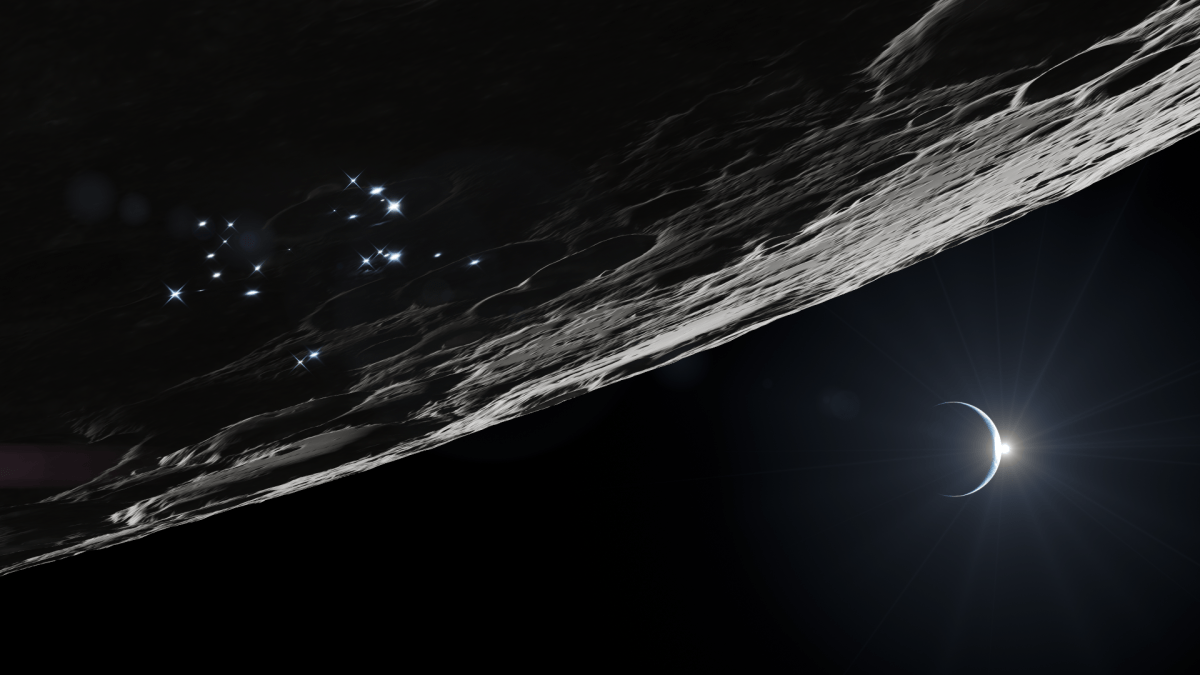
NASA is going back to the Moon, but this time the goal is not just to plant a flag and leave. The Artemis program is designed to turn short lunar visits into repeatable operations: crewed missions, cargo deliveries, lunar orbit staging, surface power, rovers, habitats, communications, robotics, science, and eventually the practical lessons needed for Mars.
For The IT Guys audience, the interesting part is not only the rocket. The real story is the technology stack behind a Moon base: networks, power systems, redundancy, robotics, cybersecurity, remote support, environmental monitoring, repair planning, data storage, and mission-critical operations. A lunar outpost is extreme IT infrastructure in the harshest possible branch office.
The Short Version: NASA Is Building Capability Before It Builds A Town
When people hear “Moon base,” it is easy to picture one finished building, like a science-fiction outpost dropped onto the surface. NASA’s public plan is more practical and more incremental. The agency is building a set of systems that can support repeated missions near the lunar South Pole. Those systems include the Space Launch System rocket, the Orion spacecraft, the Gateway lunar-orbit station, human landing systems, spacesuits, pressurized and unpressurized rovers, power systems, communications, science payloads, and surface habitats.
That matters because the first version of a sustainable lunar presence will probably not look like a large permanent city. It will look more like a growing job site: landers, power units, cargo pallets, rovers, habitats, antennas, science stations, spare parts, and carefully planned paths between them. Every mission adds capability, validates hardware, learns what breaks, and improves the next mission.
NASA’s public Moon-to-Mars planning documents are the closest thing to a current “blueprint” for this work. They are not construction drawings for a final building. They are architecture documents: what capabilities are needed, how missions connect, what systems must exist in lunar orbit and on the surface, and how the Moon work prepares NASA for Mars.
Why The Lunar South Pole Matters
The lunar South Pole is not just a dramatic location. It has practical advantages that make it a strong candidate for sustained operations. Some high areas near the poles can receive long periods of sunlight, which helps with solar power. Nearby permanently shadowed regions may preserve water ice, which could become one of the most important resources on the Moon.
Water is valuable for life support, but that is only the beginning. If future systems can extract and process lunar ice, water can support oxygen production and potentially fuel production. That does not mean NASA can immediately “live off the land” on day one. It means the South Pole gives NASA the best chance to test whether local resources can reduce how much mass has to be launched from Earth.
This is similar to how a business chooses a branch location. You do not pick a site only because it looks good. You look at power, access, communications, safety, future expansion, delivery routes, and what resources are nearby. NASA is doing the same thing, just with landing zones, sunlight, crater shadows, regolith, thermal cycles, communication geometry, and rover routes.
The Blueprint: What NASA Is Actually Building
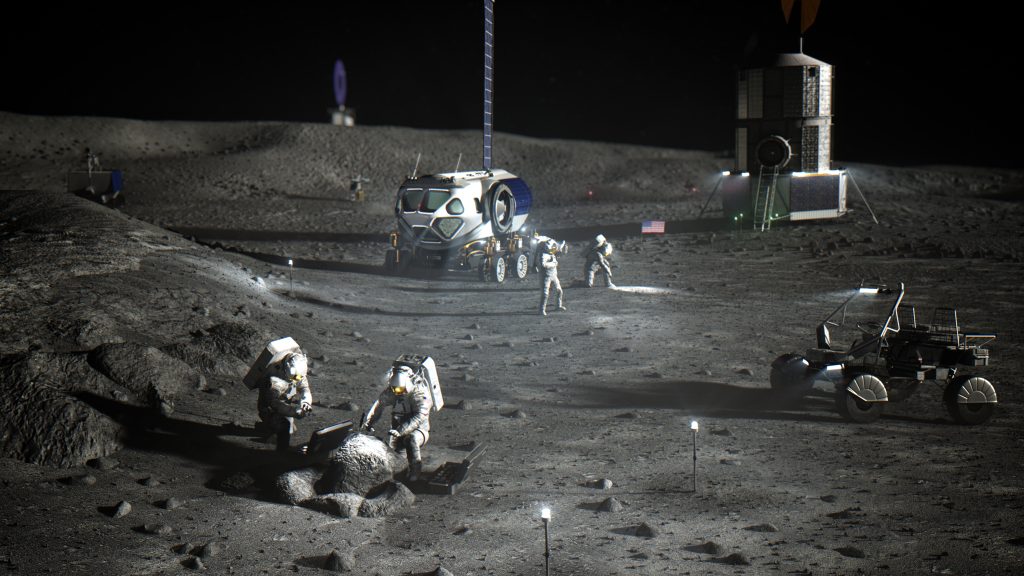
NASA’s public architecture points to a layered system. Think of it as a chain. Earth launches crew and cargo. Orion carries astronauts. Gateway provides a staging point in lunar orbit. Human landing systems move crew between orbit and the lunar surface. Surface systems keep astronauts alive and productive. Rovers extend their range. Power systems keep everything running. Communications and data systems tie it all together.
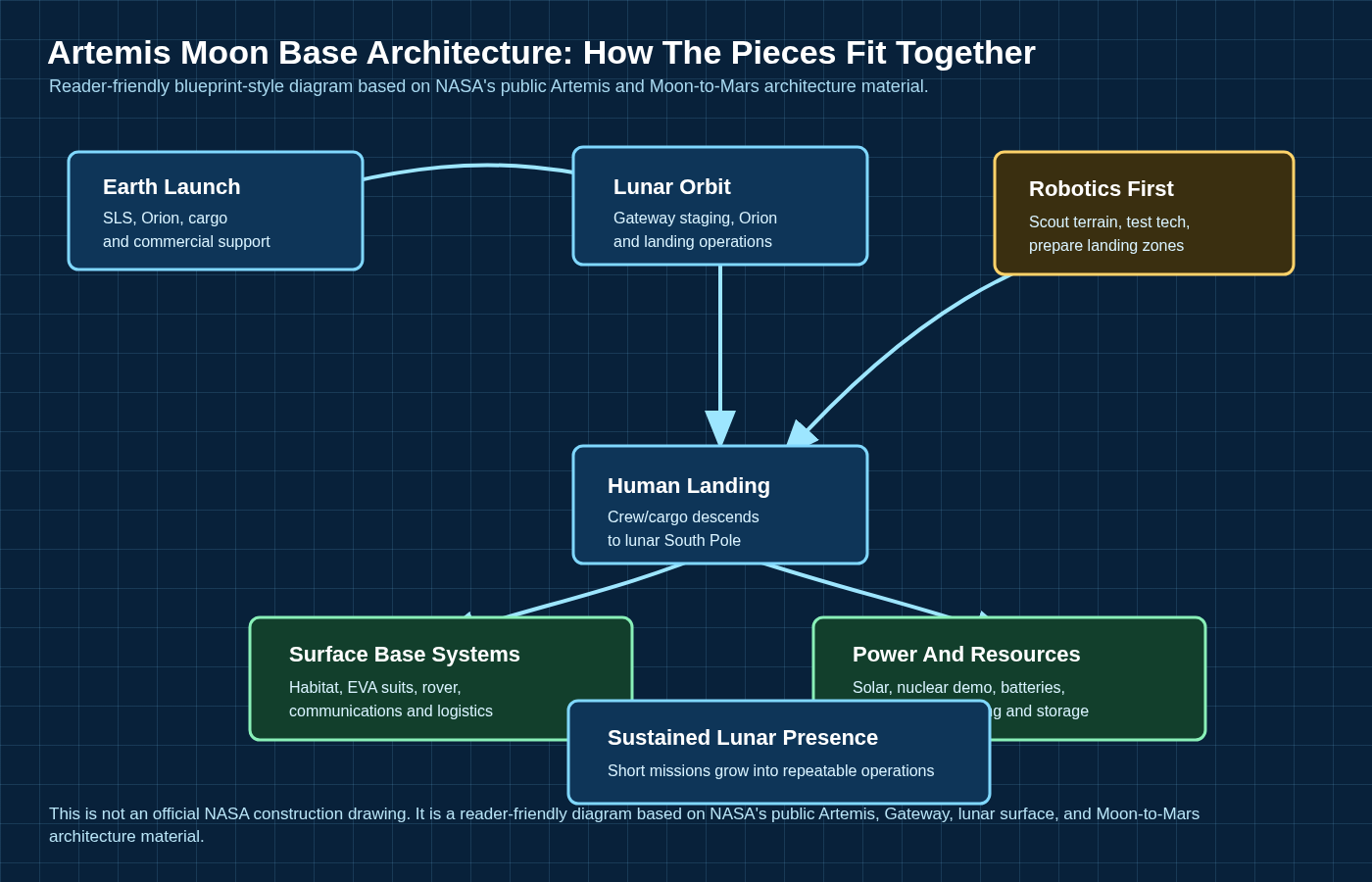
The important phrase is architecture. In IT terms, NASA is not just buying one device. It is building a complete system where every part depends on the others. A habitat without power is useless. A rover without navigation and communications is risky. A landing zone without logistics limits how long astronauts can stay. A science payload without data handling cannot deliver results. The Moon base is the sum of these connected systems.
1. SLS And Orion: Getting Astronauts Back To Lunar Space
The Space Launch System and Orion spacecraft are NASA’s crew transportation backbone for Artemis. SLS provides the heavy launch capability, and Orion carries astronauts beyond low Earth orbit. Artemis I tested Orion without crew. The next crewed missions are meant to move humans back into lunar mission operations and eventually support surface landings.
From a technology point of view, Orion is more than a capsule. It is a life-support, navigation, communications, computing, and emergency-return system. It has to keep people alive far from Earth, operate with extreme reliability, and integrate with other mission pieces. That is the same principle business IT follows at a smaller scale: the core system must be boringly reliable before fancy add-ons matter.
2. Gateway: The Lunar Orbit Staging Point
Gateway is NASA’s planned small space station in lunar orbit. It is not the Moon base itself. It is more like an orbital staging platform, communications point, science platform, and transfer node. Astronauts can arrive in Orion, interact with Gateway systems, and move between lunar orbit and surface missions.
Gateway matters because it gives NASA a reusable presence around the Moon instead of treating every mission as a completely separate camping trip. It can help with mission flexibility, international partnership, logistics, research, communications, and future Mars preparation. For readers who understand networks, Gateway is like a remote operations hub: not the customer site, not headquarters, but a critical point that connects both.
3. Human Landing Systems: The Elevator Between Orbit And The Surface
NASA’s human landing systems are the vehicles intended to carry astronauts from lunar orbit down to the Moon and back up again. This is one of the hardest parts of the plan. The lander has to handle descent, landing, crew support, ascent, docking, safety systems, navigation, and the reality that the lunar surface is dusty, uneven, and unforgiving.
For a Moon base, landing systems are logistics systems. If NASA wants a sustained presence, it must be able to deliver people, tools, science equipment, replacement parts, experiments, mobility hardware, and eventually larger surface systems. A base cannot grow if everything depends on one-off delivery methods that cannot be repeated safely.
4. Surface Habitats: The First Real Moon Base Buildings
The habitat is the part most people picture first, but it is only one part of the base. A lunar surface habitat must provide pressure, oxygen, temperature control, radiation protection, dust management, sleeping space, work space, medical support, communications, computing, storage, and emergency procedures. It also has to be maintainable by astronauts wearing gloves, under stress, far from immediate replacement parts.
NASA has explored multiple habitat concepts through public studies and partnerships. The final operational surface habitat will need to work with landers, power systems, rovers, spacesuits, and logistics deliveries. That is why public concept art may change over time. NASA is not designing a vacation cabin. It is designing a survivable service platform.
5. Rovers And Mobility: The Moon Base Needs Wheels
A Moon base is only as useful as the area astronauts and robots can reach. Rovers extend that range. NASA’s lunar mobility plans include unpressurized rover concepts for shorter trips and pressurized rover concepts for longer traverses. The Lunar Terrain Vehicle program is especially important because astronauts need a practical way to move tools, samples, equipment, and themselves across difficult ground.
Mobility is also a safety issue. If astronauts can travel farther, they need navigation, communication, route planning, rescue planning, power management, and spare capacity. This is where the Moon base begins to look like a rugged networked worksite. Every rover is a vehicle, a sensor platform, a communications node, a power consumer, and a maintenance responsibility.
6. Power: The Unseen Foundation Of The Moon Base
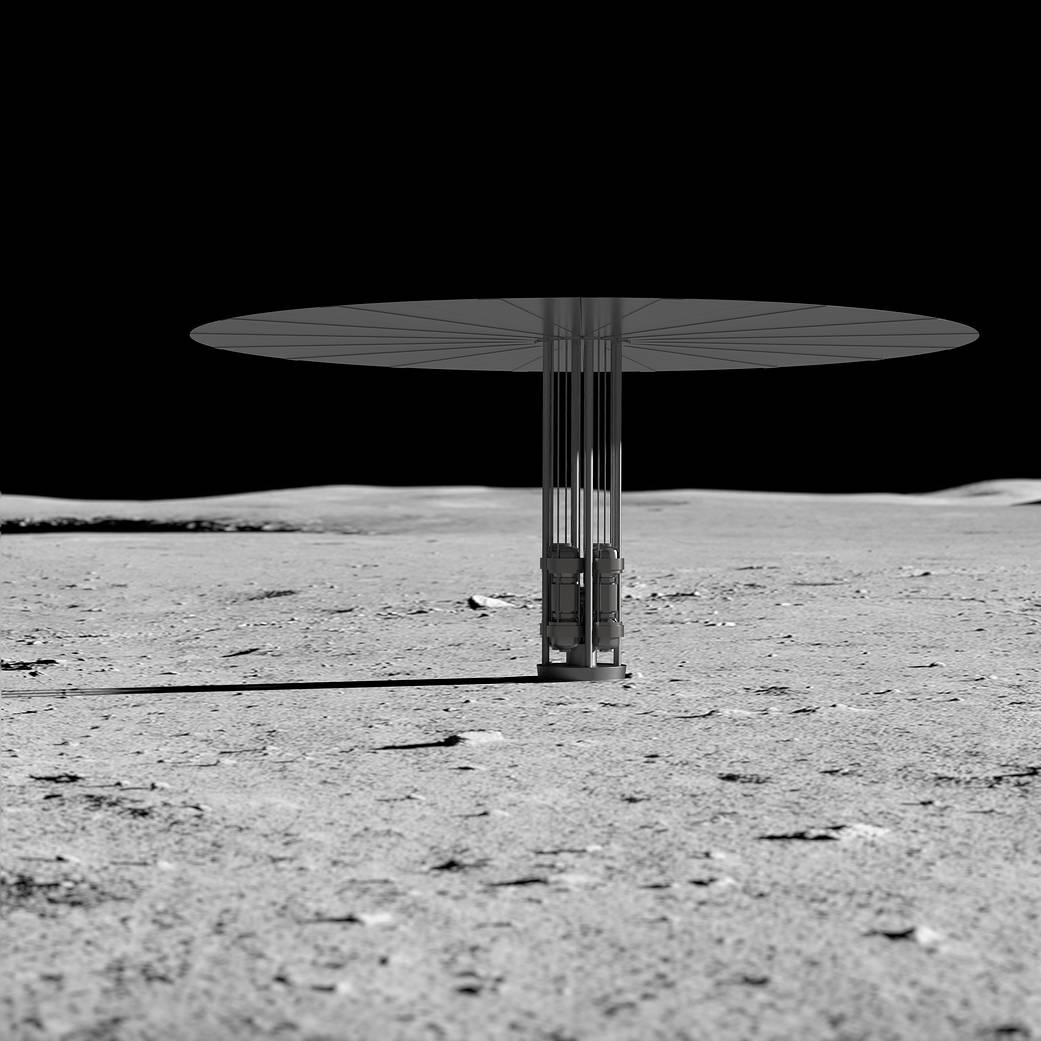
Power is one of the biggest make-or-break pieces. Solar power is useful, especially near areas with long sunlight exposure, but the Moon has extreme lighting conditions and harsh temperature swings. Batteries, power distribution, cables, connectors, dust resistance, thermal control, and backup systems all matter. NASA has also studied fission surface power because a compact nuclear power source could provide steady electricity independent of sunlight.
For The IT Guys readers, power is the most familiar lesson in the whole article. No business network is reliable if the power plan is weak. The same applies on the Moon. A lunar base needs generation, storage, distribution, monitoring, redundancy, and repair procedures. The Moon version is harder, but the principle is the same as protecting routers, servers, point-of-sale equipment, phones, and backup systems with clean power and UPS planning.
7. Communications, Data, And Cybersecurity
A Moon base needs reliable communications between astronauts, rovers, habitats, Gateway, mission control, science teams, and robotic systems. That means antennas, radios, routing, timing, data storage, compression, prioritization, monitoring, and procedures for when links are weak or delayed.
Cybersecurity also matters. Space systems are not ordinary office computers, but the same high-level risks exist: unauthorized access, bad commands, software defects, supply-chain concerns, spoofed signals, data integrity problems, and operational mistakes. NASA and its partners have to think about security from the hardware layer through mission operations.
This is where a Moon article ties directly back to local IT. The average small business will never run a lunar habitat, but it does run mission-critical systems: email, accounting, phones, backups, Wi-Fi, customer data, payment systems, and websites. The lesson is that reliability comes from planning the whole system, not just buying one impressive piece of equipment.
What Customers Should Take Away
NASA’s return to the Moon is not just a space story. It is a technology operations story. The agency is trying to build a repeatable system in a place with no breathable air, no easy repair shop, intense temperature swings, abrasive dust, communication delay, radiation exposure, and limited delivery windows. That forces serious thinking about redundancy, documentation, monitoring, remote support, and practical maintenance.
Those same principles scale down to homes and small businesses. Backups should be tested before disaster. Power should be protected before an outage. Networks should be documented before something breaks. Security should be designed before a phishing attack. Spare parts and recovery codes should exist before they are needed. NASA’s Moon base is extreme, but the habits behind it are very familiar.
Useful NASA Sources
- NASA Moon Base reference page
- NASA Artemis program
- NASA Gateway
- NASA Human Landing Systems
- NASA 2026 Artemis architecture update
- NASA Moon-to-Mars Architecture Definition Document PDF
- NASA Lunar Terrain Vehicle
- NASA Fission Surface Power
Related Reading
- German Researchers Warn Ordinary Wi-Fi Could Identify People With Near-Perfect Accuracy – related guidance from The IT Guys archive
- U.S.-Iran Conflict Cybersecurity Warning: How People and Small Businesses Can Protect Themselves From Hacking, Phishing, and Ransomware – related guidance from The IT Guys archive
- Quick Tech Tip: Set Up Guest Wi-Fi Before Sharing Your Password – a practical follow-up checklist readers can use right away
FAQ
Who is this guide for?
This article is written for regular home users and small businesses that want practical technology guidance without unnecessary jargon.
What should I check before following the steps?
Make sure the instructions match your device, account, software version, and business requirements. If something looks different, pause before guessing.
When should I ask for help?
If the device or account is important for work, contains sensitive data, or the change could affect backups, email, payments, or customer access, it is worth getting help first.