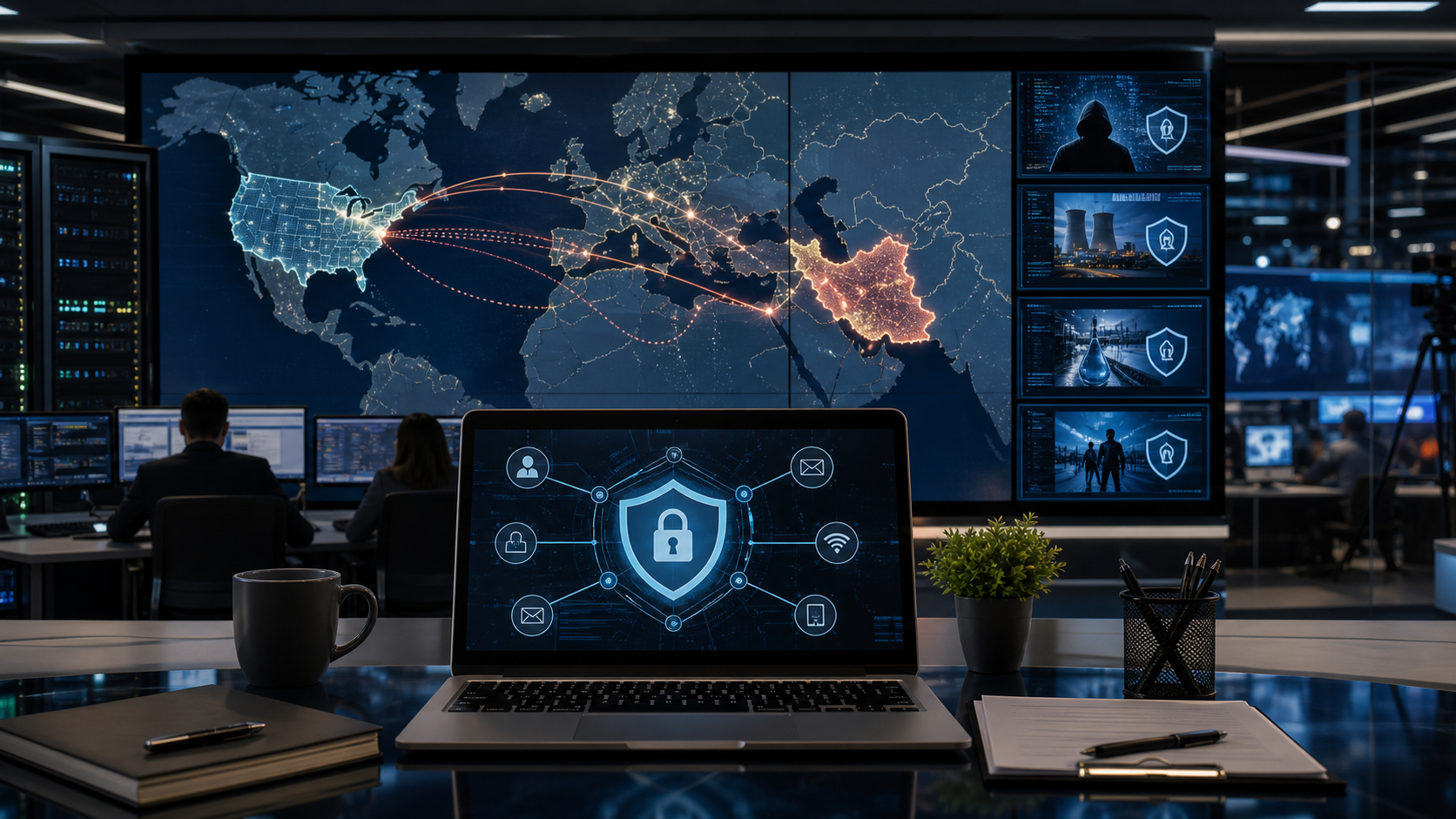
Updated May 26, 2026: The conflict involving the United States, Israel, and Iran has created a higher-risk cybersecurity environment. That does not mean every scam, breach, outage, or suspicious email is connected to Iran. It does mean that U.S. agencies have warned organizations to stay alert for Iranian-affiliated cyber activity, hacktivist activity, opportunistic attacks against poorly secured systems, and scams that exploit breaking news.
This article is intentionally practical and source-backed. The goal is not to scare people. The goal is to help households, small businesses, and local organizations reduce their risk while the news cycle is tense and attackers are looking for easy targets.
The Short Version
- The conflict is real news. The Associated Press reported on May 26, 2026 that Iran condemned U.S. strikes and began restoring internet access after a long shutdown.
- The cyber risk is also real, but it must be described carefully. CISA, FBI, DC3, and NSA have warned that Iranian-affiliated cyber actors may target vulnerable U.S. networks and entities of interest, especially in critical infrastructure and organizations connected to defense or Israel-related work.
- Most people will not be personally targeted by a nation-state. Most individuals and small businesses are more likely to be hit by opportunistic attacks: phishing emails, fake donation links, fake breaking-news videos, password reuse, exposed remote access, unpatched firewalls, and ransomware crews buying or stealing access.
- The best protection is not exotic. Patch systems, use multifactor authentication, remove default passwords, back up data offline or separately, lock down remote access, train staff against phishing, and report incidents quickly.
Why The U.S.-Iran Conflict Raises Cybersecurity Risk
International conflict often spills into the cyber world because hacking gives governments, affiliated groups, criminals, and hacktivists a way to disrupt opponents, embarrass organizations, steal information, or create confusion without the same visibility as a physical attack. In a tense news cycle, attackers also get better lures: fake videos, fake donation pages, fake government alerts, fake shipping notices, fake sanctions messages, and fake security warnings.
The Associated Press article published May 26, 2026 described Iran condemning U.S. strikes and restoring internet service after a long shutdown. That matters for cybersecurity because internet disruption, wartime messaging, retaliation fears, and public confusion all create conditions where malicious actors can move faster than normal users can verify information.
U.S. government cybersecurity agencies have already laid out the relevant risk pattern. CISA’s Iran threat overview says Iranian government-affiliated actors routinely target poorly secured U.S. networks and internet-connected devices. CISA highlights three basic priorities: rapidly mitigate external vulnerabilities, do not connect control systems directly to the public internet, and use strong unique passwords for accounts that monitor or change control systems.
The important phrase is “poorly secured.” In plain English, attackers do not need a movie-style hack when a business leaves remote access exposed, forgets to patch a firewall, keeps a default password on equipment, reuses an admin password, or has no working backup. In a conflict-driven threat environment, those weak spots become more attractive.
Sources: Associated Press reporting on Iran, U.S. strikes, and internet restoration; CISA Iran Threat Overview and Advisories.
What U.S. Agencies Have Actually Warned About
A joint CISA, FBI, DC3, and NSA fact sheet warned that Iranian-affiliated cyber actors may target vulnerable U.S. networks and entities of interest. The agencies specifically called out the need for vigilance by critical infrastructure and other U.S. entities. They also noted that defense industrial base companies, especially those with holdings or relationships involving Israeli research and defense firms, are at increased risk.
The same fact sheet described how Iranian-affiliated actors and aligned hacktivist groups often exploit targets of opportunity. That means unpatched software, known vulnerabilities, default passwords, common passwords, and internet-connected systems that should not be directly exposed. These are not rare problems. They are common in small offices, water systems, manufacturing environments, medical offices, construction companies, local governments, and any business that has grown faster than its security process.
CISA’s June 30, 2025 alert also made a careful point that is still useful for readers: at the time of that alert, CISA said it had not seen indications of a coordinated campaign of malicious cyber activity in the U.S. attributable to Iran. That sentence matters. Good security reporting should not claim that Iran is behind every hack. The credible way to frame the risk is this: the conflict increases concern, Iranian-affiliated actors have documented tactics and history, and weak systems are at higher risk during periods of geopolitical tension.
Sources: CISA fact sheet on Iranian cyber actors and vulnerable U.S. networks; CISA alert urging critical infrastructure vigilance in the geopolitical environment; NSA press release on the joint warning.
Documented Iranian-Affiliated Cyber Activity: What It Looks Like
One of the strongest examples is the joint advisory about IRGC-affiliated actors exploiting programmable logic controllers, or PLCs, in multiple sectors, including U.S. water and wastewater systems. PLCs are small industrial computers that control physical processes. They are used in water treatment, manufacturing, energy, transportation, healthcare facilities, food and beverage operations, and many other environments.
The advisory explained that IRGC-affiliated actors using the “CyberAv3ngers” persona targeted Unitronics Vision Series PLCs and human-machine interfaces. The agencies said the victims spanned multiple U.S. states and foreign countries. The targeted devices were often internet-facing, using default passwords or no password, and connected through default ports. Those basic weaknesses gave attackers an opening.
The lesson for normal businesses is not “you probably own a Unitronics PLC.” The lesson is broader: equipment that controls real-world operations should not be casually exposed to the internet, and default passwords are not a harmless shortcut. That applies to industrial controllers, security camera systems, HVAC controls, routers, firewalls, remote desktop tools, NAS devices, cloud consoles, and anything else reachable from the outside.
The advisory’s top mitigations are direct: address operational technology connected insecurely to the internet, implement multifactor authentication, use strong unique passwords, and check PLCs for default or missing passwords. That is also good advice for ordinary business systems.
Source: CISA joint advisory on IRGC-affiliated cyber actors exploiting PLCs.
Ransomware Risk: How Access Turns Into Damage
Another CISA advisory, published with the FBI and the Department of Defense Cyber Crime Center, warned about Iran-based cyber actors enabling ransomware attacks on U.S. organizations. The advisory said the actors had exploited U.S. and foreign organizations across sectors including education, finance, healthcare, defense, and local government. It also said FBI assessed that a significant percentage of the actors’ operations against U.S. organizations were intended to obtain and develop network access that could later be used with ransomware affiliate actors.
This is a key point for small businesses. The person who first gets into your network may not be the person who encrypts your data. Access can be stolen, sold, traded, or handed to another group. That means a neglected VPN, old firewall, exposed remote desktop service, or compromised email account can become the first step in a ransomware incident weeks or months later.
The same advisory described common initial access through public-facing networking devices, including Citrix Netscaler, F5 BIG-IP, Pulse Secure/Ivanti VPNs, Palo Alto Networks PAN-OS and GlobalProtect, and Check Point Security Gateways. Even if your business does not use those exact products, the pattern is what matters: attackers scan the internet for known vulnerable remote-access and network-edge devices, then use the device as the front door.
Source: CISA advisory on Iran-based cyber actors enabling ransomware attacks on U.S. organizations.
Why People Are Getting Hacked During High-Stress News Events
Most people do not get hacked because a foreign intelligence service personally selected them. They get hacked because the news cycle gives criminals better timing and better excuses. A fake “urgent security update” feels more believable during a cyber warning. A fake “donation for victims” feels more believable during a war. A fake “account locked due to suspicious activity” feels more believable when people are already hearing about cyberattacks.
The Federal Trade Commission warns that scammers use email and text messages to trick people into giving up passwords, account numbers, Social Security numbers, and financial information. The FTC also notes that scammers often update their tactics to match current news or trends. That is exactly why geopolitical conflict creates more phishing risk even for people who have no direct connection to the conflict.
Common scams to watch for right now include:
- Fake breaking-news links that lead to credential theft or malware.
- Fake donation pages claiming to support civilians, soldiers, journalists, or refugees.
- Fake bank fraud alerts that claim your account is locked because of “international cyber activity.”
- Fake Microsoft, Google, Apple, or antivirus warnings asking you to “verify” your account.
- Fake invoices or wire-transfer changes that blame “sanctions,” “shipping delays,” or “regional instability.”
- Fake QR codes in emails that send users to credential-harvesting pages.
- Social media posts pushing sensational claims and then linking to malicious pages.
Source: FTC guide on recognizing and avoiding phishing scams.
The Most Important Protection Steps For Home Users
1. Turn On Multifactor Authentication
Start with email, banking, cloud storage, social media, Microsoft, Google, Apple, and password manager accounts. MFA makes it much harder for a stolen password to become a stolen account. If available, use an authenticator app or security key instead of SMS text codes.
2. Stop Reusing Passwords
Password reuse is one of the fastest ways a small breach turns into a big personal disaster. If one shopping site or forum leaks your password, attackers will try that same password against your email, bank, Facebook, Microsoft 365, Google, and Apple accounts. Use a password manager and make every important password unique.
3. Treat Breaking-News Links With Suspicion
If a message is designed to make you angry, scared, rushed, or curious, slow down. Go directly to the news site, bank, charity, or company using a known address. Do not trust links in random texts, social posts, forwarded messages, or emails.
4. Keep Devices Updated
Update Windows, macOS, iOS, Android, browsers, Microsoft Office, Adobe Reader, and security software. Updates are not just feature changes; many close vulnerabilities that attackers actively exploit.
5. Back Up Important Files
Use a real backup strategy, not just “I think my files are in the cloud.” Keep important files backed up to a separate device or cloud backup service. Test that you can restore at least a sample of files. CISA’s StopRansomware guidance emphasizes offline, encrypted backups and regular backup testing because ransomware can severely disrupt both people and organizations.
Sources: CISA Secure Our World; CISA StopRansomware resources.
The Most Important Protection Steps For Small Businesses
1. Patch Internet-Facing Systems First
Firewalls, VPNs, remote desktop gateways, web servers, email servers, cloud admin portals, NAS devices, and remote monitoring tools should be treated as priority systems. Attackers scan the internet for known vulnerable devices. If your firewall or VPN is behind on security updates, it can become the easiest way in.
2. Review CISA’s Known Exploited Vulnerabilities Catalog
CISA’s Known Exploited Vulnerabilities catalog is a practical list of vulnerabilities known to be exploited in the wild. CISA says all organizations should use the catalog as an input to vulnerability management. On May 22, 2026, CISA added a Drupal Core SQL injection vulnerability to the catalog and urged all organizations to prioritize timely remediation of KEV catalog vulnerabilities. This matters because website software, endpoint tools, PDF software, old Microsoft components, and business applications often appear in real attacks.
Sources: CISA Known Exploited Vulnerabilities Catalog; CISA May 22, 2026 KEV catalog alert.
3. Lock Down Remote Access
Remote desktop should not be open directly to the internet. Admin portals should not be reachable by anyone in the world. VPNs and remote tools should require MFA. Old accounts should be disabled. Vendor access should be limited, documented, and reviewed. If a remote access system is exposed, attackers will find it.
4. Remove Default Passwords From Equipment
Default passwords are a recurring theme in government advisories. Change default passwords on routers, firewalls, cameras, printers, NAS devices, controllers, phone systems, remote management tools, and line-of-business equipment. If equipment cannot support strong authentication, isolate it and consider replacement planning.
5. Separate Backups From The Network
A backup that ransomware can encrypt is not enough. Keep at least one backup separated from the normal network or protected by immutable/cloud-retention controls. Test restore procedures before an emergency. Document who can start a restore and how long it should take.
6. Train Staff On War-Themed Phishing
Do not just say “watch out for phishing.” Give examples. Show staff fake donation messages, fake bank alerts, fake Microsoft sign-in pages, QR-code phishing, fake shipping notices, and fake invoice changes. Give employees a safe way to report suspicious messages without blame.
7. Check Email Security Settings
For Microsoft 365 and Google Workspace, review MFA status, inactive accounts, admin roles, forwarding rules, mailbox delegation, risky sign-ins, and legacy authentication. A compromised mailbox can be used to steal money, impersonate staff, reset passwords, and launch trusted-looking attacks against customers.
8. Prepare An Incident Response Contact List
Do not wait until systems are encrypted to decide who to call. Keep a short incident plan with your IT provider, cyber insurance contact, bank fraud contact, legal contact if needed, CISA report link, FBI field office or IC3 information, and internal decision makers. The joint Iran fact sheet recommends reporting suspicious or criminal activity to CISA and the FBI, and CISA provides an incident reporting path at cisa.gov/report.
Special Warning For Critical Infrastructure And Industrial Systems
Water systems, utilities, manufacturers, healthcare facilities, transportation operators, food and beverage operations, local governments, and facilities with operational technology should treat this risk more seriously than a normal office. If equipment controls physical processes, downtime or manipulation can affect safety, service delivery, and public trust.
Industrial and facility operators should verify that control systems are not directly internet-exposed, confirm that remote access requires MFA, remove default passwords, document vendor access, segment operational technology from office networks, keep tested offline backups of controller configurations, and review logs for unusual remote access attempts.
CISA’s red team assessment of a U.S. critical infrastructure sector organization is also worth reading. It found that leadership had minimized business risk from known attack vectors and that the organization relied too heavily on endpoint detection without enough network-layer protection. That lesson applies widely: good security is not one tool. It is layered defense, patching, visibility, response practice, and leadership support.
Source: CISA red team assessment advisory for critical infrastructure cyber resilience.
What Not To Do
- Do not blame every hack on Iran. Attribution is hard, and bad attribution can lead to bad decisions.
- Do not click “urgent security” links from emails or texts. Go directly to the known website or app.
- Do not expose remote desktop to the internet. Use VPN, MFA, and access controls.
- Do not assume antivirus alone is enough. Attackers often steal credentials, abuse remote tools, and exploit unpatched systems before malware is obvious.
- Do not keep backups only on the same network. Ransomware often targets backups first.
- Do not ignore small warning signs. Unexpected MFA prompts, password reset emails, mailbox rules you did not create, new admin accounts, and strange remote logins deserve attention.
A Practical 24-Hour Checklist
- Turn on MFA for email, banking, cloud storage, remote access, and admin accounts.
- Update routers, firewalls, VPNs, Windows, macOS, browsers, phones, and major business applications.
- Change default passwords on routers, cameras, printers, NAS devices, and controllers.
- Disable unused accounts and remove old employees or vendors from cloud services.
- Review email forwarding rules and admin roles.
- Confirm backups completed successfully and test restoring at least one file.
- Check whether remote desktop, cameras, NAS devices, or control panels are exposed to the internet.
- Send staff a short phishing warning with examples tied to the current news.
- Review CISA’s KEV catalog for systems you actually use.
- Write down who to call if you suspect a compromise.
When To Call For Help
Call your IT provider or a trusted security professional if you see unusual MFA prompts, unexpected password reset messages, unknown email forwarding rules, new admin accounts, strange remote access, antivirus alerts you do not understand, missing files, disabled backups, changed payment instructions, or systems that suddenly become slow or unavailable.
If you believe a business email account, bank account, network, or server has been compromised, move quickly. Disconnect affected systems only if you can do so safely, preserve logs and suspicious emails, contact your bank for financial fraud, contact your IT support team, and report cyber incidents through the appropriate channels. CISA’s incident reporting page is cisa.gov/report, and cybercrime can also be reported to the FBI through IC3.gov.
Bottom Line
The U.S.-Iran conflict has increased the need for cyber vigilance, but the right response is not panic. The right response is disciplined security: patch exposed systems, use MFA, remove default passwords, protect backups, train staff, verify links before clicking, and report incidents quickly.
For small businesses, this is the moment to handle the basics properly. Most attackers do not need to defeat perfect security. They look for the easiest door. Close the easy doors first.
Sources And Further Reading
- Associated Press: Iran condemns U.S. strikes and begins restoring internet
- CISA: Iran Threat Overview and Advisories
- CISA/FBI/DC3/NSA: Iranian Cyber Actors May Target Vulnerable U.S. Networks and Entities of Interest
- NSA press release on Iranian-affiliated cyber risk
- CISA: Critical infrastructure vigilance in the current geopolitical environment
- CISA joint advisory: IRGC-affiliated cyber actors exploit PLCs
- CISA advisory: Iran-based cyber actors enabling ransomware attacks
- CISA Known Exploited Vulnerabilities Catalog
- CISA StopRansomware resources
- FTC: How to recognize and avoid phishing scams
Related Reading
- German Researchers Warn Ordinary Wi-Fi Could Identify People With Near-Perfect Accuracy – related guidance from The IT Guys archive
- NASA Is Going Back to the Moon: How Artemis Could Build the New Moon Base – related guidance from The IT Guys archive
- Latest Security Threats for May 26, 2026: Microsoft Defender, Website Attacks, Data Breaches, and How to Protect Yourself – related guidance from The IT Guys archive
FAQ
Who should act on this first?
Start with accounts, devices, or servers that handle email, banking, payroll, customer data, administrator access, or remote access.
What is the safest first step?
Verify the source, update affected software, enable MFA where available, review account activity, and avoid clicking links in suspicious messages.
When should a business get help?
If customer data, payment systems, Microsoft 365, website admin access, or server access may be involved, treat it as a business security issue and get help quickly.