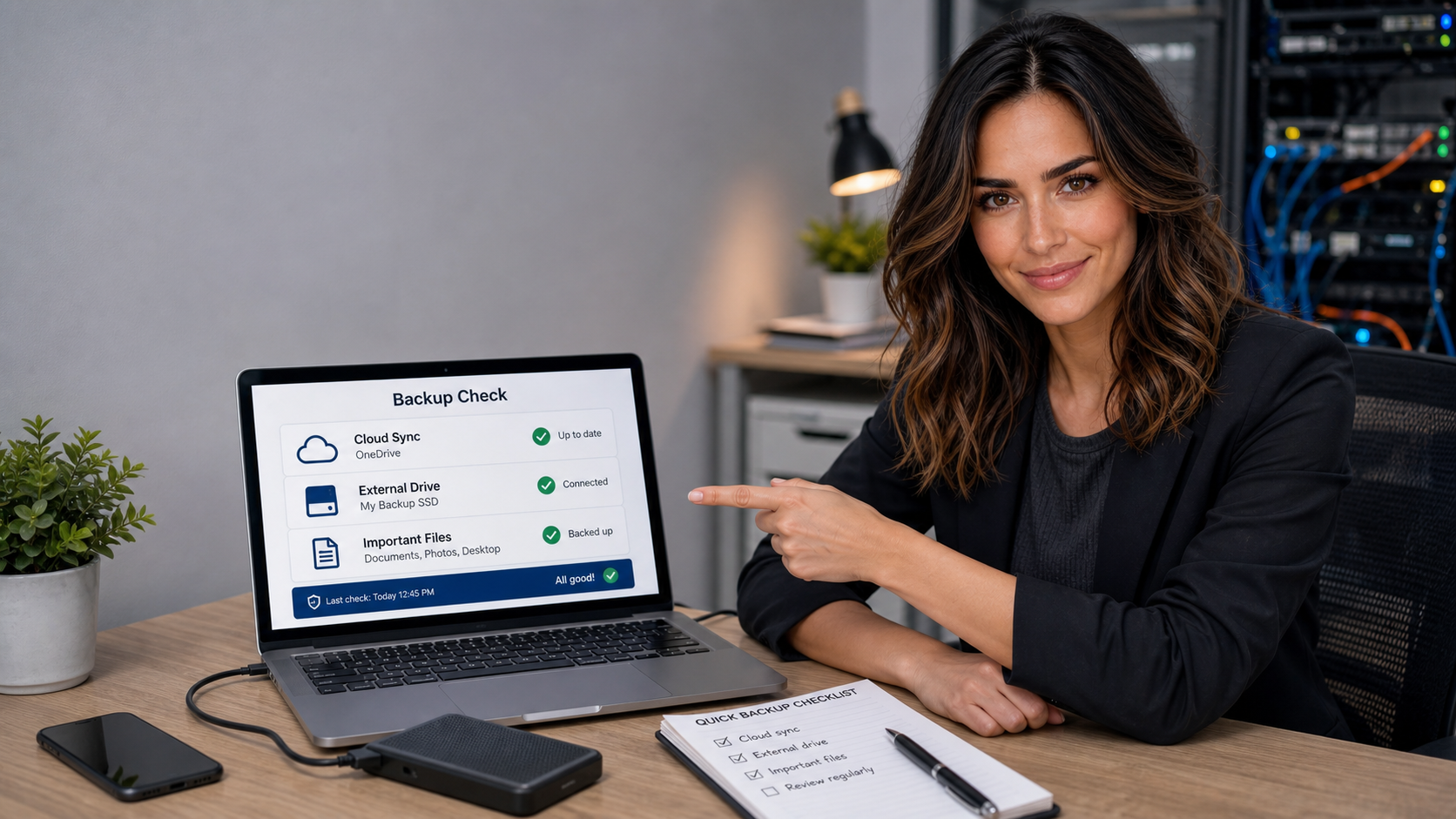
A backup that has never been checked is more of a hope than a plan. Today’s practical tech tip is simple: take ten minutes and confirm that your most important files are actually being backed up, can be opened, and are not only sitting in one cloud-sync folder that could fail, fill up, or be changed by mistake.
This matters for home users, but it matters even more for small businesses. A failed laptop, accidental deletion, ransomware infection, Microsoft 365 or Google Workspace account problem, or damaged external drive can quickly turn into lost invoices, photos, contracts, tax files, QuickBooks exports, customer lists, and job notes. The goal is not to build a complicated backup system today. The goal is to verify the backup you think you already have.
The 10-Minute Backup Check
Pick the computer or account you rely on most during the workday. Then walk through this checklist.
1. Find Your Most Important Files First
Before opening any backup app, make a short list of the files you would be upset to lose. For most people and small offices, that list includes:
- Documents, Desktop, and Pictures folders.
- Accounting files, tax records, estimates, invoices, and payroll exports.
- Customer lists, job folders, forms, scanned documents, and signed PDFs.
- Browser bookmarks, password manager recovery information, and MFA backup codes.
- Photos, videos, design files, and anything stored outside the usual Documents folder.
The key detail is location. If your estimating program saves to C:\CompanyData, if QuickBooks exports live in Downloads, or if a scanner saves to a shared folder, those files may not be covered by a basic Desktop/Documents backup.
2. Check the Backup Status, Not Just the Icon
Open the backup or sync tool you use and check the last successful backup or sync time.
- Windows and OneDrive: Open OneDrive from the cloud icon, check for errors, and confirm important folders such as Desktop, Documents, and Pictures are included. Microsoft’s Windows Backup and OneDrive guidance explains that folder backup depends on OneDrive sign-in, available storage, and resolving OneDrive errors.
- Google Drive for desktop: Open Drive for desktop and confirm the folders you expect are syncing or backing up. Google’s support page explains that Drive for desktop can sync computer files with Google Drive and back up photos and videos to Google Photos.
- Mac Time Machine: Open System Settings and check Time Machine’s most recent backup. Apple recommends Time Machine as the built-in way to automatically back up Mac files and restore deleted or older files.
- External drive or NAS backup: Confirm the drive is connected, the backup software is not paused, and the newest backup date is recent.
If the last backup was weeks ago, the icon has a warning symbol, or storage is full, treat that as a real problem. A backup that stopped quietly is one of the most common ways people discover they were unprotected only after something breaks.
3. Open One File From the Backup
Do not only check that files are listed. Open one small, harmless file from the backed-up location and confirm it works. A PDF, photo, spreadsheet, or Word document is fine.
- Open the cloud web portal or backup restore screen.
- Find a file from today or this week.
- Download or preview it.
- Confirm it opens and contains what you expect.
This tiny restore test catches a lot: wrong folders, stalled sync, permission errors, empty files, old external drives, and accounts that look signed in but are not actually protecting the files you care about.
4. Make Sure You Have More Than One Layer
Cloud sync is useful, but sync and backup are not always the same thing. If a file is deleted, overwritten, encrypted by malware, or changed by mistake, the bad change may sync too. Many cloud services have recycle bins and version history, but those features have limits and retention windows.
A practical small-business setup usually has at least two layers:
- Daily convenience layer: OneDrive, Google Drive, iCloud Drive, SharePoint, Dropbox, or another managed cloud file service.
- Recovery layer: Time Machine, Windows backup software, a managed business backup product, an encrypted external drive, or a properly configured NAS/cloud backup system with versioning.
The UK National Cyber Security Centre’s small-business guidance also recommends backing up important data so a business can recover if files are lost, damaged, or stolen. That is practical advice because ransomware and account compromise are not only technical problems; they are business continuity problems.
5. Write Down the Recovery Path
In a real emergency, people forget where the backup lives and who has access. Write down a short recovery note and keep it somewhere safe:
- Which service or drive protects the files.
- Which folders are included.
- Who has the admin login.
- Where the recovery key, drive password, or MFA backup codes are stored.
- When the last restore test was done.
For a business, do not leave this knowledge with only one person. The owner or manager should know the basics even if an IT provider manages the technical setup.
Important Cautions
- Do not assume Downloads is backed up. Many people leave important files in Downloads, but basic folder backup often focuses on Desktop, Documents, and Pictures.
- Do not rely on one external drive that stays plugged in forever. It can fail, be stolen with the computer, or be affected by malware if it is always connected.
- Do not ignore storage warnings. Cloud storage that is full may stop syncing new files. External drives that are full may stop completing backup jobs.
- Do not confuse “available on this device” with “safely backed up.” A file can be local-only, cloud-only, or synced. Know which one applies before deleting anything.
- Do not test by deleting important files. Use a harmless test file or restore a copy to a temporary folder.
When to Call an IT Professional
Call an IT professional if backup errors will not clear, you are not sure where business-critical files are stored, multiple employees share files from one computer, your Microsoft 365 or Google Workspace storage is full, you use QuickBooks or line-of-business software, or you need protection from ransomware. You should also get help before changing OneDrive, Google Drive, iCloud, or Time Machine settings if you are not sure whether files are local, cloud-only, or shared with coworkers.
A good backup plan does not need to be fancy, but it does need to be verified. Ten minutes today can prevent hours or days of panic later.
Useful Official Sources
- Microsoft Support: Back up and restore with Windows Backup
- Microsoft Support: Back up folders with OneDrive
- Google Drive Help: Use Google Drive for desktop
- Apple Support: How to back up your Mac
- National Cyber Security Centre: Small Business Guide, backing up your data
Related Reading
- 15-Minute Account Recovery Check: Avoid Getting Locked Out of Email, MFA, and Business Accounts – useful account-security guidance for home users and small businesses
- Quick Tech Tip: Set Up Guest Wi-Fi Before Sharing Your Password – a practical follow-up checklist readers can use right away
- Quick Tech Tip: Check Your Browser Extensions Before They Cause Trouble – a practical follow-up checklist readers can use right away
FAQ
How often should I check backups?
For important personal or business files, check backups at least monthly and before storms, trips, device repairs, or major software updates.
Is cloud sync the same as a backup?
Not always. Sync can copy deletions, corruption, or ransomware changes. A safer plan includes version history, offline or separate backup copies, and a recovery test.
What is the most important backup test?
Make sure you can restore a real file. A backup you have never restored is only a hope, not a proven recovery plan.