[no-ez-toc]
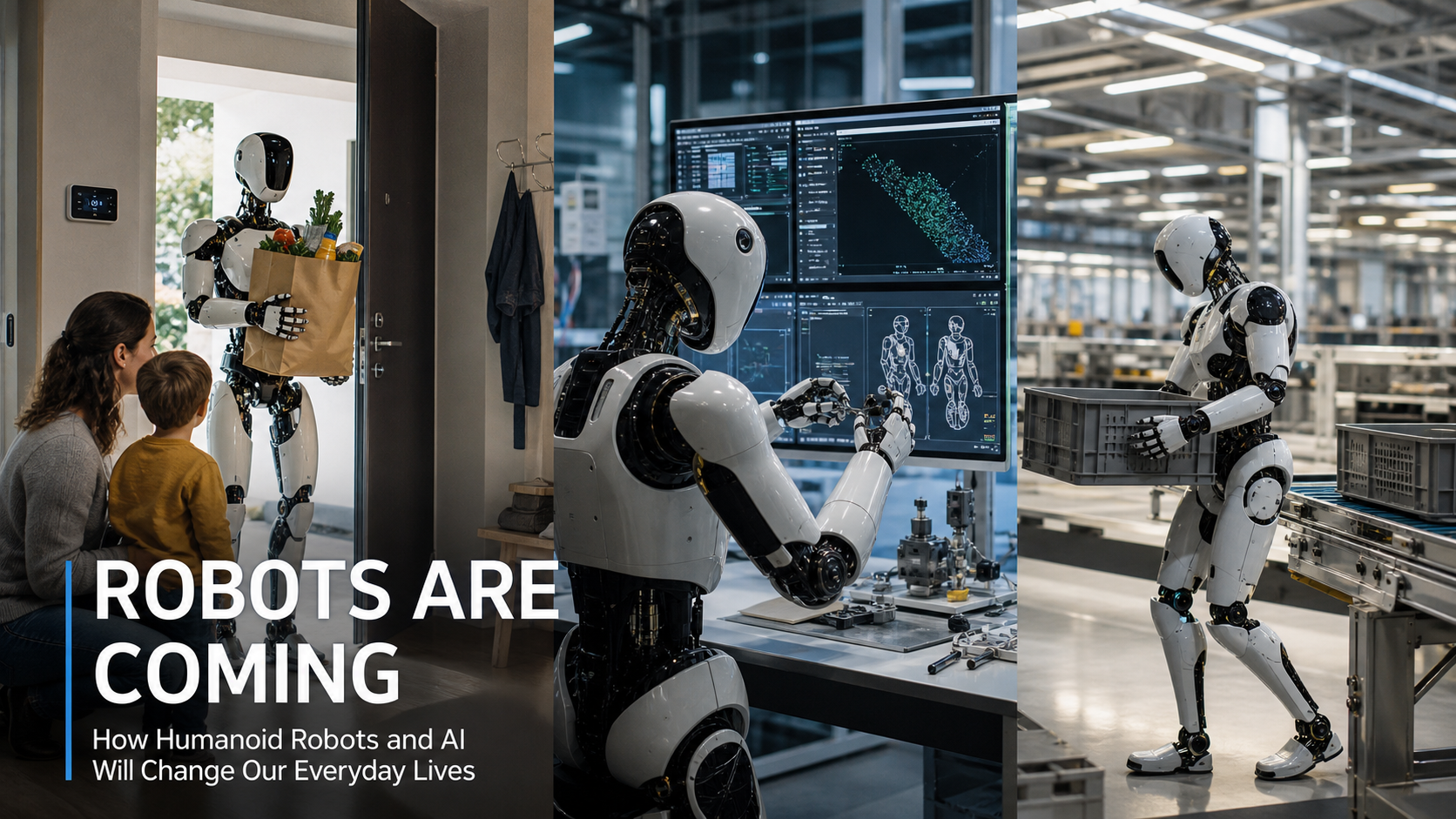
Robots are moving from science-fiction demos into real factories, research labs, warehouses, and eventually homes. The three names worth watching right now are Tesla Optimus, NVIDIA Isaac GR00T, and Boston Dynamics Atlas. They are often talked about together, but they are not the same thing: Tesla is trying to build a general-purpose humanoid robot, NVIDIA is building the AI development stack that can help many humanoid robots learn, and Boston Dynamics is turning decades of mobility research into an electric industrial humanoid product.
For customers, the practical question is not “Will a robot replace every job tomorrow?” It is “Where will physical AI become useful first, and what should families and small businesses expect?” The honest answer is that the earliest wave is likely to help with repetitive, structured work: moving bins, sorting parts, warehouse tasks, factory inspection, dangerous environments, simple delivery, and eventually some household chores. The home-helper version will take longer because homes are messy, unpredictable, and full of people, pets, stairs, clutter, and fragile objects.
Quick comparison
| Robot effort | What it is | What it is best positioned for first | Timeline signals |
|---|---|---|---|
| Tesla Optimus | Tesla’s humanoid robot project | Tesla factories first, then commercial/home ambitions later | Tesla says it is investing in and preparing for large-scale Optimus production; public customer timing remains a target, not a guaranteed ship date. |
| NVIDIA Isaac GR00T | A robot foundation-model and simulation/training platform | Helping many humanoid robot makers train robots faster | NVIDIA announced GR00T N1/N1.5, simulation tools, and a reference humanoid robot design with partners. |
| Boston Dynamics Atlas | Electric humanoid robot from Boston Dynamics | Industrial work, manufacturing, logistics, and mobility-heavy tasks | Boston Dynamics introduced the all-electric Atlas and has shown product-focused demonstrations; Hyundai’s robotics roadmap points toward large industrial deployment later this decade. |
Tesla Optimus: the robot Tesla wants to manufacture at scale
Tesla Optimus is the most familiar name to regular customers because Tesla is already known for turning software, batteries, motors, sensors, and manufacturing into consumer products. Optimus is Tesla’s attempt to apply that same mindset to a humanoid robot: a bipedal machine with hands, arms, onboard compute, cameras, and AI systems that can learn useful physical tasks.
The basic idea is simple to explain and hard to build. A humanoid robot must see the world, understand the task, plan movements, balance, manipulate objects with force control, recover from mistakes, and do it all safely around humans. Tesla’s advantage is that it already works on real-time perception, inference, manufacturing, actuators, battery systems, and fleet learning for vehicles. But a robot in a home or factory has to physically touch the world, which is harder than only steering through it.
What to watch: Tesla’s official materials point to continued Optimus development and preparation for production, but public rollout dates should be treated carefully. Tesla can use Optimus inside its own factories before it sells a home robot to customers. That internal-factory path is important because it lets Tesla test tasks in a controlled environment, collect failure data, improve reliability, and reduce cost before trying broader use.
- Near-term use: Tesla factory tasks, parts movement, repetitive material handling, and supervised demonstrations.
- Customer impact: If successful, Optimus could eventually help with household chores, elder-assist tasks, retail/backroom work, warehouse movement, and facility support.
- Big unresolved questions: safety certification, cost, battery life, hand dexterity, repairability, privacy, insurance, and whether it can handle messy real-world homes.
NVIDIA GR00T: the AI brain and training stack behind future robots
NVIDIA GR00T is different from Tesla Optimus. GR00T is not a single consumer robot you can buy. It is NVIDIA’s foundation-model and development platform for humanoid robots. Think of it as part of the “brain training system” that can help robot builders teach robots how to perceive, reason, and act.
NVIDIA’s strategy is built around physical AI: models that understand language, video, motion, and robot actions, plus simulation tools that let developers train robots in virtual worlds before testing on expensive real hardware. That matters because real robot training is slow, dangerous, and costly. If a robot can learn thousands or millions of task variations in simulation, developers can move faster and reduce damage to physical prototypes.
GR00T matters because every humanoid robot company faces the same hard problem: teaching the robot what to do in the real world. A robot needs to recognize objects, understand instructions, predict how objects move, use both arms, grip without crushing things, and adapt when reality does not match the script. NVIDIA is trying to provide the software, simulation, data-generation, and compute layers that make that possible for many companies, not just one robot brand.
- Near-term use: robot labs, humanoid developers, simulation training, synthetic data, and foundation-model research.
- Customer impact: GR00T could indirectly speed up robots used in warehouses, healthcare support, manufacturing, and service industries.
- Big unresolved questions: safety validation, model reliability, data privacy, vendor lock-in, and how well simulation transfers into messy real-world environments.
Boston Dynamics Atlas: the industrial athlete becoming a product
Boston Dynamics is the company many people remember from viral robot videos: walking, jumping, running, dancing, carrying boxes, and recovering from pushes. The new Atlas is important because Boston Dynamics retired the old hydraulic Atlas research platform and moved to an all-electric humanoid robot built for product development.
Atlas is not trying to look like a home assistant first. It is built around mobility, whole-body control, balance, and useful manipulation in industrial spaces. That means factories, warehouses, logistics environments, and dangerous or repetitive work are more realistic early targets than folding everyone’s laundry at home.
The Boston Dynamics/Hyundai connection is worth watching. Hyundai owns Boston Dynamics, and Hyundai’s robotics strategy points toward using advanced robots in manufacturing and mobility ecosystems. That makes Atlas less of a lab curiosity and more of a potential industrial platform. The rollout will likely be staged: internal tests, controlled pilot programs, manufacturing/logistics deployments, then broader commercial availability if reliability and cost make sense.
- Near-term use: manufacturing support, material handling, industrial inspection, and physically demanding logistics tasks.
- Customer impact: better automation in factories and warehouses may eventually reduce costs, improve worker safety, and make product availability more reliable.
- Big unresolved questions: purchase price, service contracts, workplace safety rules, job redesign, liability, and whether humanoid form is better than specialized robots for many tasks.
How these robots actually work
Modern humanoid robots combine several technologies at once. The body is only one part. The real progress comes from the combination of sensors, AI models, simulation, actuators, batteries, and safety systems.
- Perception: cameras, depth sensing, force sensors, and software help the robot understand where people, objects, floors, shelves, doors, and hazards are.
- Planning: the robot turns a goal like “pick up that tote” or “bring groceries inside” into smaller steps.
- Control: motors and actuators move joints while the robot balances, avoids collisions, and adjusts grip force.
- Manipulation: hands and arms must handle objects with the right pressure, angle, and timing.
- Training: developers use real demonstrations, teleoperation, reinforcement learning, simulation, and synthetic data to teach skills.
- Safety: robots need speed limits, emergency stops, collision detection, restricted zones, logging, and human override controls.
What the rollout timeline probably looks like
The biggest mistake is expecting a single “robot release day” where humanoids suddenly show up everywhere. The rollout will be uneven. Some robots will work in factories years before they are practical in homes.
- 2026: more prototypes, factory pilots, developer tools, simulation improvements, and public demonstrations. Tesla continues Optimus production preparation; NVIDIA expands GR00T and robotics tooling; Boston Dynamics shows product-focused Atlas development.
- 2027-2028: more controlled commercial pilots in warehouses, factories, logistics, and manufacturing. Hyundai’s roadmap and Boston Dynamics’ product work make this period important for Atlas-style deployments.
- 2029 and beyond: broader commercial use if reliability improves and cost comes down. Home robots may start in limited, expensive, supervised roles before becoming ordinary household products.
How robots could change daily life
The best case is not just “robots replace people.” The better outcome is that robots take over dull, dirty, dangerous, or physically exhausting tasks while people move into supervision, maintenance, customer service, skilled trades, programming, logistics planning, and higher-value work. That does not mean there will be no disruption. There will be. Any technology that can do physical work at scale will change hiring, training, wages, workplace safety, insurance, and customer expectations.
For homes, the dream is assistance: carrying groceries, helping older adults with simple tasks, cleaning up, fetching objects, basic monitoring, and eventually helping people live independently longer. For businesses, the first practical uses are likely inventory movement, repetitive machine loading, warehouse support, facility checks, and after-hours tasks where labor is hard to schedule.
What small businesses should do now
- Do not buy hype blindly. Wait for real pilots, safety data, support contracts, and total-cost numbers.
- Start documenting repetitive physical tasks. The businesses that benefit first will know exactly which tasks are frequent, measurable, and hard to staff.
- Improve networks and security. Robots will need strong Wi-Fi, segmented networks, software updates, monitoring, and access controls.
- Think about privacy. A robot with cameras and microphones inside a business or home is also a moving sensor platform.
- Plan for maintenance. Robots will need charging, parts, calibration, software support, and safe operating procedures.
Related Reading
- Important Tech News Roundup for June 4, 2026: npm Malware, Cisco Patches, Windows Drivers, Android Security, and AI Controls
- Important Tech News Roundup for June 1, 2026: Windows Netlogon Attacks, Dashlane Lockouts, Android AI, and WWDC
- Important Tech News Roundup for May 31, 2026: WordPress Attacks, AI Guardrails, Chrome Protection, and Supply Chain Security
Sources and official references
- Tesla AI and Optimus information
- Tesla: Optimus Gen 2 video
- NVIDIA Isaac GR00T developer page
- NVIDIA humanoid robot reference design announcement
- NVIDIA Isaac GR00T N1 official video
- Boston Dynamics Atlas product page
- Boston Dynamics: An Electric New Era for Atlas
- Boston Dynamics Atlas product features video
- Hyundai Motor Group AI robotics strategy at CES 2026
Bottom line: Robots are coming, but not all at once. The next few years will likely be about controlled business use, factory pilots, and developer tooling. Home robots are the bigger dream, but they need major progress in cost, safety, reliability, and trust before they become normal appliances.