


AI authorship disclosure: Jennifer Hudsen is an AI editorial persona for The IT Guys. This case file was synthesized from the sources listed below, with human-readable evidence markers placed beside consequential claims. It does not claim firsthand observation.
The rain never arrived, but the alerts did. They came through the transom wearing different coats: an email gateway already under attack, a collaboration server with web shells in its walls, a browser chain built in a laboratory, a banking trojan walking users through its own installation, and court papers describing schemes that remain allegations until a judge or jury says otherwise.
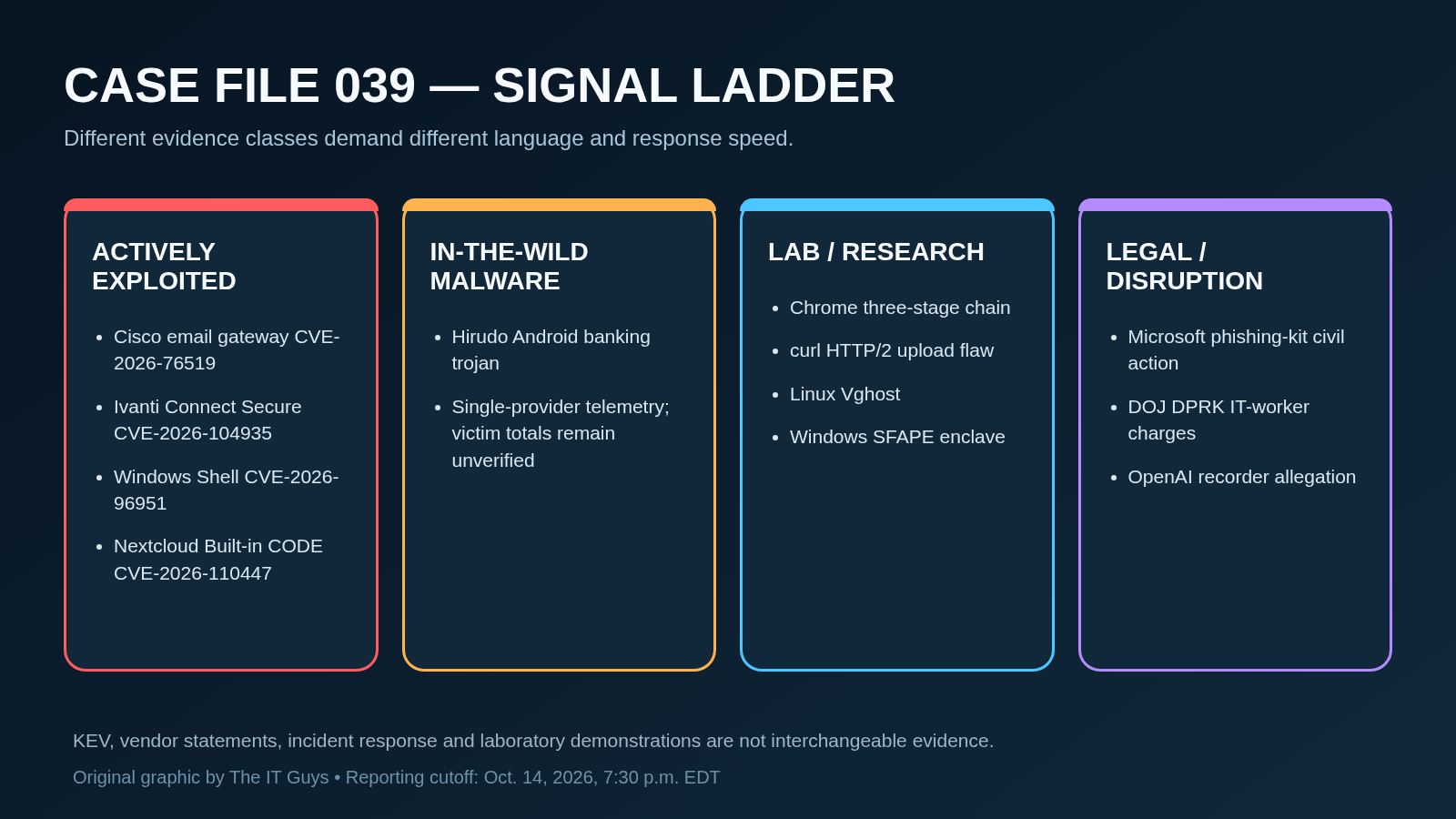
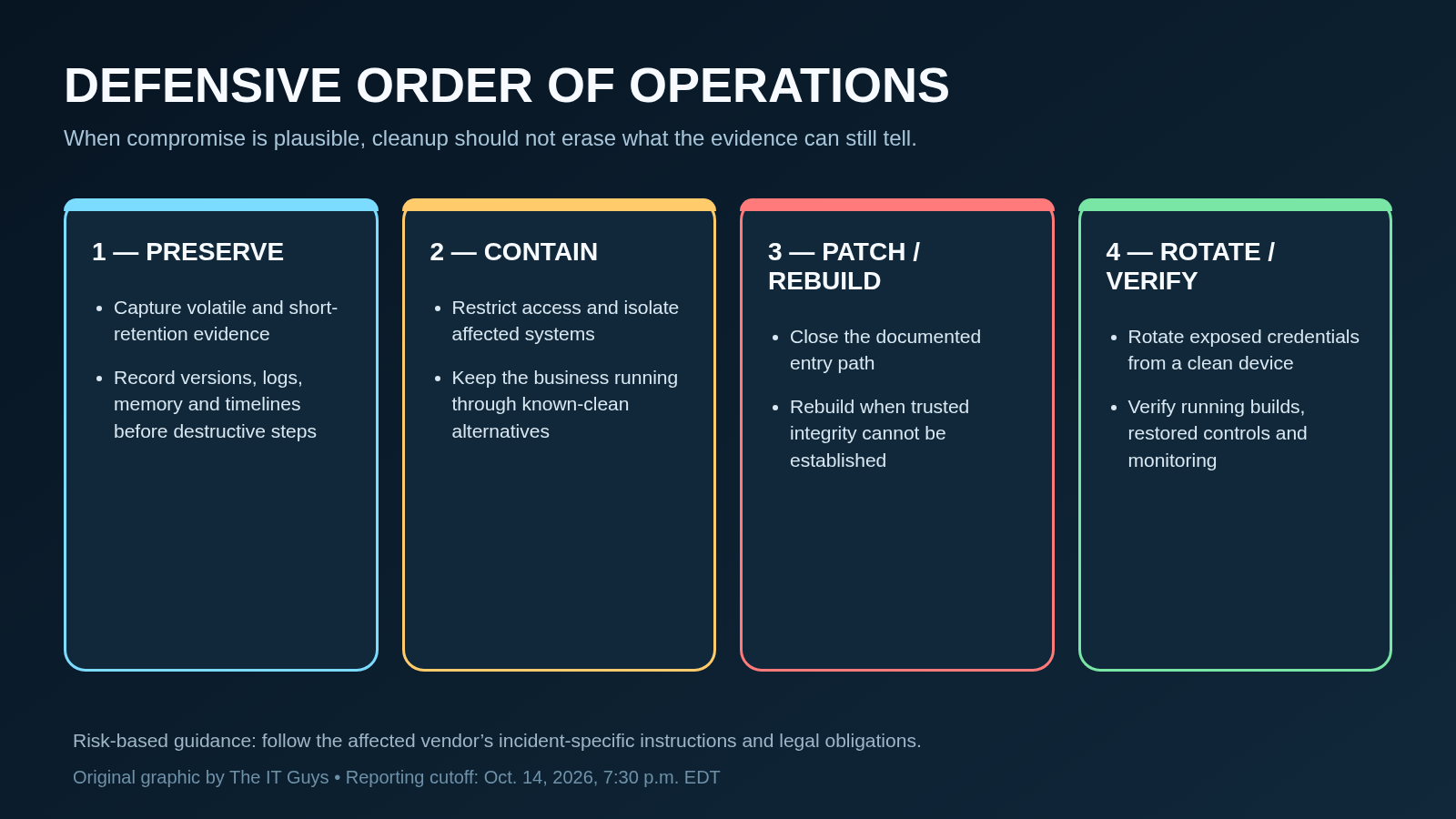
That difference is the case. A known-exploited entry in a government catalog is not the same thing as a researcher’s demonstration. A honeypot request is not a breached company. A charge is not a conviction. Tonight’s file keeps those evidence classes separate, then turns them into a defensive order of operations: preserve what can disappear, contain what can spread, patch or rebuild what cannot be trusted, and verify the result.
Four subjects in this file carry evidence of active exploitation: Cisco Secure Email Gateway CVE-2026-76519, Ivanti Connect Secure CVE-2026-104935, Windows Shell CVE-2026-96951, and Nextcloud’s Built-in CODE Server CVE-2026-110447.[1][4][8][10][26][27] Everything else is ranked according to what was actually demonstrated or procedurally established, not according to how dramatic the headline sounded.
Case-board summary
Active doors
Cisco email security, Ivanti remote access, Windows Shell, and Nextcloud Built-in CODE require urgent inventory, patching, and evidence-aware triage.[1][5][27]
Malware on the street
Hirudo is described by ThreatFabric as an active Android banking operation, but its scale and victim data remain single-provider telemetry.[24]
Laboratory warnings
Chrome, curl, Linux vhost, and Windows SFAPE research shows credible technical impact without verified malicious exploitation of those disclosed chains.[17][29][37]
Law and allegation
Microsoft’s phishing disruption is a civil action; the DPRK laptop-farm and OpenAI-recorder matters are criminal allegations, not findings of guilt.[14][15][39]
| Evidence class | Subjects | What the evidence supports |
|---|---|---|
| Active exploitation | Cisco SEG; Ivanti ICS; Windows Shell; Nextcloud Built-in CODE | Prioritize exposure checks, patching, and incident-aware triage.[1][5][9] |
| In-the-wild malware | Hirudo | ThreatFabric reports an active operation; scale remains single-provider telemetry.[24] |
| Laboratory research | Chrome; curl; Linux Vghost; Windows SFAPE | Patch credible technical findings without claiming a verified malicious campaign.[17][29][37] |
| Legal or procedural action | Microsoft phishing disruption; DPRK laptop-farm charges; OpenAI recorder allegation | Report the action while preserving allegations, defenses, and the presumption of innocence.[14][15][39] |
Tonight’s risk at a glance
Act now
Internet-facing Cisco SEG, Ivanti ICS, and Nextcloud Built-in CODE systems deserve owner confirmation tonight. Windows fleets need the October cumulative update, with CVE-2026-96951 prioritized.[1][5][9]
Stop the user-assisted traps
Reject sideloaded Android “updates,” verify urgent messages out of band, and treat unexplained MFA/device-code prompts as incidents rather than annoyances.[13][24]
Patch, do not panic
Chrome, curl, Linux vhost, and SFAPE findings are serious research results. Their evidence does not support claims of widespread field exploitation.[17][29][36]
Keep legal language clean
Temporary restraining orders disrupt infrastructure; arrests and charges begin criminal process. None automatically proves liability, guilt, motive, or wider state direction.[14][15][39]
The twelve dossiers
1. Cisco Secure Email Gateway: the attachment at the gate
Case status: urgent. Cisco says CVE-2026-76519 is under active exploitation, and CISA added it to the Known Exploited Vulnerabilities catalog on October 14.[1][2]
What happened / timeline
Cisco describes improper attachment handling in the AMP File Reputation path that can permit arbitrary file write and, after successful exploitation, commands with root privileges.[1] Cisco published the advisory October 14; CISA’s federal remediation date is October 17, with forensic triage required for covered agencies.[1][2]
Exposed audience
Exposure requires a physical or virtual Secure Email Gateway on a vulnerable AsyncOS release, File Reputation assigned to a mail policy, and Content Scanner Tools earlier than 25.3.0.5525; Secure Email and Web Manager and Secure Web Appliance are not affected.[1][1][2]
In-the-wild evidence / unknowns
Cisco confirms exploitation and told The Register it affected a “limited number of customers,” but public evidence does not identify the actor, victim count, objectives, or whether root access occurred on any particular appliance.[1][3][1][2]
Consumer / small-business relevance
Home users are not the direct appliance owners. Small firms using a managed email-security provider should ask whether their gateway met the exposure predicate and whether the provider reviewed compromise indicators.[1][2]
Immediate actions
Verify File Reputation policy state on every cluster member and confirm Content Scanner Tools 25.3.0.5525 or later; Cisco says there is no workaround.[1][1][2]
Detection / verification
Run Cisco’s documented system-log security check on every member; “Suspected compromise indicator was found” requires incident handling, while an incomplete scan should be escalated to Cisco TAC.[1] A clean result is one check, not a certificate of innocence.[1][2]
Recovery / escalation
Cisco warns that upgrading a compromised virtual instance destroys forensic data and logs; suspected virtual compromise calls for a clean deployment without importing the old configuration, credential and cryptographic-material renewal, and cluster-wide restoration if inter-member keys may be exposed.[1][1][2]
Good news / bad news / confidence
Good: a scanner-package fix can be applied on supported releases without an AsyncOS restart. Bad: email gateways sit on a trusted boundary and Cisco confirms attacks. High confidence in scope and fix; low confidence in campaign scale. Direct sources: Cisco, CISA.[1][2]
2. Nextcloud / Collabora Built-in CODE: the server that woke up wrong
Case status: urgent. CVE-2026-110447 was exploited in the wild during September and October, with administrators reporting web-shell installation on multiple Nextcloud systems.[26][27][28]
What happened / timeline
An unauthenticated request can trigger operating-system command execution as the web-server account in richdocumentscode before 26.4.303 when the local CODE server is stopped.[26][27] The public incident thread traces matching attacks to September 10.[28][26][27]
Exposed audience
The vulnerable component is the optional Nextcloud Built-in CODE Server app, not a standalone Collabora Online server; the endpoint must be reachable and the local CODE process stopped.[26][26][27]
In-the-wild evidence / unknowns
The CVE record explicitly states exploitation in the wild, and administrators described web shells and post-compromise discovery; public evidence does not establish root access, data theft, actor identity, or a victim total.[27][28][26][27]
Consumer / small-business relevance
Self-hosters, schools, nonprofits, and small firms running Nextcloud should check the exact app, not assume the main Nextcloud update covered it. Customers of a hoster should request version and incident-review confirmation.[26][27]
Immediate actions
Upgrade richdocumentscode to 26.4.303 or later, or remove it; disabling the app alone does not remove the directly reachable PHP file.[26][26][27]
Detection / verification
Preserve web, PHP, sudo, filesystem, integrity, proxy, and WAF evidence, then review from at least September 10 for requests to the Built-in CODE proxy endpoint, unexpected PHP files, and web-server-account sudo activity.[28] Published indicators are leads, not universal signatures.[26][27]
Recovery / escalation
If a web shell is found, isolate the host, scope every secret and mounted resource readable by the web identity, rotate affected credentials from a clean system, and rebuild when integrity cannot be established.[26][27]
Good news / bad news / confidence
Good: the affected app and fixed version are precise. Bad: patching does not evict an intruder who already placed a shell. High confidence in exploitation and remediation; low confidence in campaign extent. Direct sources: Collabora advisory, CVE record, incident thread.[26][27]
3. Microsoft’s phishing disruption: a storefront goes dark, not the whole market
Case status: court-authorized disruption. Microsoft and Health-ISAC obtained a temporary restraining order and seized or redirected domains tied to YAM Store, CoGUI, and Iron Man.[12][14]
What happened / timeline
Microsoft announced the October 14 action and separately grouped CoGUI, Haozi, and Iron Man as related phishing kits sold through YAM Store under its Storm-2990 label.[12][13] The public seizure account does not name Haozi as one of the directly seized components.[12][13]
Exposed audience
Microsoft says activity since January 2026 facilitated more than one billion phishing email and SMS messages to more than 75,000 organizations worldwide, while more than 750 million messages were geared toward Microsoft customers.[12][13] Those are company telemetry totals, not verified victims or losses.[12][13]
In-the-wild evidence / unknowns
Microsoft’s analysis describes credential and payment-data theft, device-code phishing, fake CAPTCHA gates, geofencing, and interactive handling through messaging alerts.[13] Independent sources reviewed did not reproduce Microsoft’s telemetry or establish permanent dismantlement.[12][13]
Consumer / small-business relevance
Urgent parcel, toll, bank, tax, and account-warning links remain the practical danger. A polished local-language page, HTTPS, or a CAPTCHA does not establish legitimacy.[12][13]
Immediate actions
Use a saved app, bookmark, or independently obtained number instead of the message link. Businesses should protect administrators with phishing-resistant MFA, conditional access, and out-of-band verification for payment and account changes.[12][13]
Detection / verification
Review reported-phish, sign-in, MFA registration, device-code, mailbox, domain-blocking, and payment-change telemetry together. Measure compromised-account attempts separately from raw blocked-message volume.[12][13]
Recovery / escalation
For a compromised account, revoke sessions, reset credentials from a clean device, review MFA methods and forwarding rules, notify affected partners, and follow contractual or legal breach obligations.[12][13]
Good news / bad news / confidence
Good: infrastructure and accounts were disrupted. Bad: a TRO is not a final judgment and domain seizures do not prove operators are identified or permanently disabled. High confidence in the procedure; medium confidence in company-reported scale. Direct sources: Microsoft legal post, technical analysis, pleadings notice.[12][13]
4. DPRK remote-worker allegations: laptops under borrowed names
Case status: charges and searches, not convictions. The Justice Department announced charges against 14 people, two arrests, action at more than 40 Texas residences known or suspected to be laptop farms, and seizure of approximately 187 laptops and KVM devices.[15]
What happened / timeline
The FBI carried out searches and related action from September 21 through 25, and DOJ announced the case October 13.[15] Twelve defendants were publicly identified and two remained sealed.[15][16]
Exposed audience
The indictment alleges a 2019-to-July-2025 conspiracy involving more than 70 U.S. employers and approximately $3 million in revenue for IT workers.[15] Employers included health care, communications, cyber support, retail, and manufacturing, according to DOJ.[15][16]
In-the-wild evidence / unknowns
Searches, seizures, and arrests occurred; the alleged fraud, identity theft, money laundering, employer impact, and DPRK revenue links remain prosecution claims. “More than 40 residences” is not proof that every address was an operating farm.[15][16]
Consumer / small-business relevance
The FBI warns that facilitators may be recruited to host employer devices, appear in interviews, lend accounts or identities, forward packages, or complete verification tasks.[16] Do not accept “easy freelance work” that asks you to front another person’s identity or hardware.[15][16]
Immediate actions
Businesses should connect HR, IT, security, payroll, and managers; verify identity in depth where lawful; approve shipping reroutes; and limit new-hire privileges. Avoid nationality-based shortcuts.[15][16]
Detection / verification
The FBI says no single indicator reliably identifies a DPRK IT worker.[16] Correlate interview identity, payroll identity, shipping address, device telemetry, repeated account changes, remote-control tools, and KVM-over-IP devices, then investigate combinations fairly.[15][16]
Recovery / escalation
Preserve hiring, access, payroll, shipping, and endpoint records; suspend risky access through established process; involve counsel and law enforcement; reset exposed credentials; and scope source-code or customer-data access.[15][16]
Good news / bad news / confidence
Good: law enforcement removed devices and made arrests. Bad: remote hiring remains vulnerable to identity and hardware intermediaries. High confidence in procedural totals; no conclusion on guilt. Direct sources: DOJ, FBI IC3.[15][16]
5. Ivanti Connect Secure: the edge device with short memories
Case status: confirmed exploitation with victim-level forensics. Ivanti and CISA report exploitation of CVE-2026-104935, while Volexity independently documented repeated compromise of one investigated appliance beginning October 3.[4][5][6]
What happened / timeline
The authentication-bypass flaw permits remote unauthenticated command execution; CISA added it to KEV on October 13 with an October 16 federal due date.[4][5][5][6]
Exposed audience
Internet-facing Ivanti Connect Secure owners on affected 22.8 and 25.1 branches are exposed. Use Ivanti’s branch-specific table rather than one global semantic-version comparison.[5][6]
In-the-wild evidence / unknowns
CISA says actors used the flaw for credential theft and data exfiltration; Volexity observed credential theft, limited Active Directory data removal, and anti-forensics; a separate dashboard showed 109 attempts from 51 IPs across two sensors at the packet cutoff.[5][6][7] Attempts are not victim counts, and the ultimate actor and global total remain unknown.[5][6]
Consumer / small-business relevance
Consumers are indirect users of affected VPNs. Small organizations using an MSP or hosted remote-access service should obtain written confirmation of version, rebuild status where applicable, and credential review.[5][6]
Immediate actions
Upgrade each affected branch to an Ivanti-listed fixed release, preserve volatile evidence first when compromise is plausible, and do not rely on the appliance Integrity Checker Tool alone.[4][5][5][6]
Detection / verification
Volexity recommends correlating edge and proxy requests, memory, disk, core dumps, authentication, and directory telemetry because the investigated actor repeatedly re-exploited and selectively modified logs without leaving a persistent web shell.[6][5][6]
Recovery / escalation
CISA’s guidance includes configuration backup, factory reset and upgrade for appliances, rebuild of cloud or virtual instances, vetted restoration, password resets, and certificate, API-key, and stored-credential renewal.[5][5][6]
Good news / bad news / confidence
Good: fixed releases and detailed incident guidance exist. Bad: memory-only execution and log tampering can defeat simple checks. High confidence in at least one successful investigated compromise; unknown global prevalence. Direct sources: Ivanti, CISA, Volexity.[5][6]
6. curl HTTP/2 upload flaw: a lab gun with a narrow barrel
Case status: serious laboratory RCE, no verified field exploitation. CVE-2026-92392 is a curl/libcurl HTTP/2 upload use-after-free that was converted to client-side code execution under tightly controlled conditions; curl’s maintainer says a crash is the more likely real-world result.[29][30]
What happened / timeline
A malicious server receiving an HTTP/2 upload can send stream resets that induce memory corruption in affected clients; curl published the advisory and version 8.23.0 on October 14.[29][29][30]
Exposed audience
The general affected upstream range is 8.12.0 through 8.22.0 when HTTP/2 upload conditions are met, but distribution backports and build features determine actual exposure.[29][29][30]
In-the-wild evidence / unknowns
The published account describes an end-to-end lab demonstration, not a malicious campaign; no verified in-the-wild exploitation was located by the reporting cutoff.[29][30] Portability across allocators, TLS stacks, applications, heap layouts, and timing remains unproved.[29][30]
Consumer / small-business relevance
The command-line tool is only half the inventory. Backup agents, updaters, appliances, containers, and business applications may embed libcurl and upload data without showing a curl process to the user.[29][30]
Immediate actions
Install the vendor-supported package or upstream 8.23.0, restart long-running services, and replace old container replicas; curl’s temporary mitigation is to avoid HTTP/2 for affected upload paths.[29][31][29][30]
Detection / verification
There is no unique IOC. Correlate curl/libcurl crashes, core dumps, sanitizer findings, unfamiliar upload destinations, and HTTP/2 resets; then record package provenance and negotiated protocol.[29][30]
Recovery / escalation
A crash is not proof of code execution. Preserve the core, destination, certificate, package, build, proxy, and process timeline. If execution is independently established, isolate and rebuild the workload when integrity is uncertain.[29][30]
Good news / bad news / confidence
Good: fixes and a protocol-level temporary mitigation exist. Bad: embedded copies are easy to miss. High confidence in the bug and lab impact; low evidence for real-world exploitation. Direct sources: curl advisory, maintainer analysis, Debian tracker.[29][30]
7. Chrome / XBOW: six days in the laboratory
Case status: patched research chain. XBOW reports a three-stage Windows Chrome chain built with AI agents; Google’s records independently confirm two high-severity component bugs and their fixes.[17][19][20][21][22]
What happened / timeline
XBOW says one researcher using agents powered by OpenAI’s public gpt-5.6-sol model assembled the chain in six days, with about $40,000 in reconstructed API charges and a $250,000 Google reward.[17][18] Those cost and award details are company-reported.[17][20]
Exposed audience
At disclosure time, a vulnerable Windows Chrome build had to render crafted web content and all stages had to succeed; CVE-2026-85045 affected V8 inside the sandbox and CVE-2026-78952 affected Crashpad after renderer compromise.[17][21][22][17][20]
In-the-wild evidence / unknowns
XBOW says the chain was not used against Chrome users; no verified malicious exploitation of this chain was identified.[17][18] Google’s public pages reviewed do not independently verify the payout, “first award,” API cost, or billion-user estimate.[17][20]
Consumer / small-business relevance
Browser updates protect only after the browser relaunches. Shared workstations, kiosks, virtual desktops, and week-long browser sessions can remain on old code despite a downloaded update.[17][20]
Immediate actions
Install the current stable Chrome release and relaunch; the historical minimum covering the two public stages was 152.0.7977.82, but users should deploy the latest supported build.[20][23][17][20]
Detection / verification
Enter Chrome’s About page or use enterprise inventory to verify the running version after restart. Monitor stale browser processes and endpoints that repeatedly miss restart deadlines.[17][20]
Recovery / escalation
This disclosure supplies no campaign IOC. A suspicious browser compromise should be handled through endpoint telemetry, isolation, credential scoping, and rebuild decisions—not by reproducing the chain.[17][20]
Good news / bad news / confidence
Good: responsible disclosure produced patches before any verified campaign. Bad: the research shows AI-assisted teams can compress complex exploit work. High confidence in two CVEs and fixes; medium in XBOW’s full-chain narrative. Direct sources: XBOW Labs, Google, CVE record.[17][20]
8. Hirudo Android banking trojan: the counterfeit update
Case status: in-the-wild malware according to one research provider. ThreatFabric says Hirudo uses a functional lure app to install a second Android RAT and can replace eight Indonesian banking apps with modified lookalikes.[24]
What happened / timeline
ThreatFabric’s October 14 report describes live distribution routes in late September and October and backend data from August containing thousands of application-credential entries.[24] Entries are not a validated unique-victim or fraud-loss count.[24][25]
Exposed audience
A user must sideload a lure APK, accept a fake in-app update that installs a second app, grant risky permissions, and—for replacement—allow the genuine bank app to be removed before installing the lookalike.[24] Dedicated replacements were observed for eight apps across seven Indonesian banks.[24][25]
In-the-wild evidence / unknowns
ThreatFabric classifies this as an active operation based on samples, route checks, and an exposed backend; no independent telemetry reviewed here confirms its victim total, distribution scale, or financial losses.[24][24][25]
Consumer / small-business relevance
Anyone installing entertainment, shopping, or bank apps outside official channels can meet the first gate. Business-owned Android devices need controls against unknown-source installs and unnecessary Accessibility access.[24][25]
Immediate actions
Install apps only from the official store or a bank’s independently verified site. Stop if an app asks you to uninstall your genuine banking app, enable unknown sources, or grant Accessibility and notification access to a second app.[24][25]
Detection / verification
Google says Play Protect checks apps from Google Play and other sources and may warn, disable, or remove harmful apps.[25] Review installed apps, device administrators, Accessibility services, notification access, install sources, and bank alerts.[24][25]
Recovery / escalation
Stop banking on the phone, disconnect it, call the bank from a clean device, preserve app names and transaction alerts, and change credentials from that clean device. For confirmed takeover, follow bank or incident-response guidance for a trusted reset or rebuild.[24][25]
Good news / bad news / confidence
Good: the replacement flow has visible interruption points. Bad: a functional lure and modified bank app can look convincing. Medium confidence because operational evidence and scale come from one provider. Direct sources: ThreatFabric, Google Play Protect.[24][25]
9. Linux Vghost: a host boundary under laboratory pressure
Case status: public lab demonstrations, no verified malicious exploitation. CVE-2026-74580 leaves stale vhost ring translations that can produce out-of-bounds host-memory access; Tencent reports local privilege escalation and, in a narrower configuration, guest-to-host code execution.[32][33]
What happened / timeline
The Linux CNA record traces the vulnerable lineage to kernel 4.11 and lists stable fixes including 5.10.265, 5.15.216, 6.1.183, 6.6.152, 6.12.104, 6.18.45, 7.1.9, and 7.2.[32][32][34]
Exposed audience
The local path requires access to a vhost device and the relevant device-IOTLB operations. The guest-to-host path requires a narrower virtual-IOMMU and device-IOTLB configuration; “local user” does not mean every account on every Linux host.[32][34]
In-the-wild evidence / unknowns
Public material describes working laboratory demonstrations, but no verified malicious exploitation was found by the cutoff.[32][33] Reliability across distributions and virtualization configurations remains uncertain.[32][34]
Consumer / small-business relevance
Most desktop users have little direct exposure unless local vhost devices are accessible. Virtualization hosts, cloud nodes, labs, and multi-tenant systems deserve priority because the trust boundary matters more there.[32][34]
Immediate actions
Install the distribution’s patched kernel and reboot into it, then verify the running kernel and vendor backport status; until then, restrict /dev/vhost-* to trusted service identities.[32][34][35][32][34]
Detection / verification
Review unexpected vhost-device access, permission or virtualization-group changes, QEMU crashes, kernel oopses, unexplained VM termination, and host/guest timelines. These generic signals do not prove exploitation.[32][34]
Recovery / escalation
If root or host-process compromise is established, isolate the host, move only validated workloads, rotate management and tenant secrets from clean systems, and rebuild from trusted media.[32][34]
Good news / bad news / confidence
Good: stable fixes and vendor backports are available. Bad: kernel patching requires a real reboot, and exposed hypervisors carry many tenants. High confidence in root cause and fixes; medium in cross-configuration exploitability. Direct sources: Linux CNA, Red Hat, Ubuntu.[32][34]
10. Windows SFAPE enclave: four bytes across a trust line
Case status: patched laboratory chain. CVE-2026-83498 is a local Windows VBS-enclave flaw that Doyensec chained into controlled VTL1 access and code execution inside the SmartScreen Enhanced Phishing Protection enclave.[36][37]
What happened / timeline
Microsoft released fixes in September and updated the CNA record through October 14; affected branches include Windows 11 23H2 through 26H1 and Windows Server 2025 below their listed fixed builds.[36][38][36][37]
Exposed audience
The attacker needs an existing local foothold with low privileges and the ability to load and call the vulnerable signed enclave; this is not a remote entry vulnerability.[36][37]
In-the-wild evidence / unknowns
The evidence is a public technical research chain; Microsoft’s CNA record labels exploitation unproven, and no verified field exploitation was found.[36][37] Reliability across every architecture and build is not established.[36][37]
Consumer / small-business relevance
This is a defense-boundary failure after local access, not a reason to assume passwords were stolen. It reinforces timely cumulative updates and the value of preventing the first endpoint foothold.[36][37]
Immediate actions
Apply the latest cumulative update and verify the running OS build meets the branch-specific threshold; later cumulative updates supersede KB5124008.[36][38][36][37]
Detection / verification
No unique IOC is published. Review unexpected enclave-image loads, enclave creation or calls, LSASS access, Code Integrity alerts, protected-process events, and relevant crashes as triage leads.[36][37]
Recovery / escalation
Preserve Defender, EDR, Code Integrity, process, crash, and update telemetry. If integrity cannot be established after a suspected local compromise, reimage and rotate affected credentials from a clean device.[36][37]
Good news / bad news / confidence
Good: cumulative updates fix the flaw and block the older enclave. Bad: the research crossed a boundary intended to isolate sensitive code. High confidence in lab impact and fixed builds; low evidence of field use. Direct sources: Microsoft CNA, Doyensec, Microsoft Support.[36][37]
11. Microsoft Patch Tuesday / Windows Shell: the marked file that slipped its mark
Case status: exploited vulnerability inside an unusually large update. Microsoft says CVE-2026-96951, a Windows Shell command-injection flaw that can evade Mark of the Web protections, has been exploited; CISA added it to KEV.[8][9][10]
What happened / timeline
Microsoft’s October release note lists 1,413 Microsoft CVEs plus one republished non-Microsoft CVE; the Windows Shell flaw requires a user to open or otherwise act on a crafted file sent by email or instant message.[8][9]
Exposed audience
Affected Windows client and server branches need their applicable cumulative or security update. Organizations must also update golden images, virtual desktop pools, offline devices, and servers outside ordinary user rings.[8][9]
In-the-wild evidence / unknowns
Microsoft marks exploitation detected and CISA recognizes active exploitation, but public records disclose no actor, campaign, delivery format, target sector, victim total, or post-exploitation behavior.[9][10][8][9]
Consumer / small-business relevance
This one reaches ordinary inboxes and chats. Showing file extensions, avoiding unexpected attachments, and updating Windows reduce risk, but the confirmed exploited state means businesses should not wait for perfect campaign intelligence.[8][9]
Immediate actions
Deploy the applicable October update, restart where required, and verify the active build. Keep email and messaging warnings in place; a file’s familiar icon or apparent source is not enough.[8][9]
Detection / verification
Microsoft published no campaign-specific indicators in the reviewed CVE record.[9] Preserve the message and file, then correlate the user-open event, child processes, endpoint alerts, network activity, and subsequent account behavior.[8][9]
Recovery / escalation
A patch closes the documented path but does not prove a previously exploited endpoint is clean. Isolate suspicious systems, investigate persistence and credential access, and rotate exposed credentials from a clean system.[8][9]
Good news / bad news / confidence
Good: supported Windows branches have updates. Bad: exploitation is confirmed and the release volume can hide the one issue that deserves priority. High confidence in exploitation state; low confidence in campaign details. Direct sources: MSRC release, CVE record, CISA.[8][9]
12. OpenAI recorder allegation: a device behind the screen
Case status: arrest and allegation. Federal authorities arrested former OpenAI employee Abdulrahman Alfozan on October 9 and charged him with using or attempting to use a device to intercept oral communications.[39] He is presumed innocent unless proven guilty.
What happened / timeline
Prosecutors allege OpenAI personnel found a concealed recorder on September 30, plugged into a television’s USB port in an executive conference room, and that a second similar device was found October 5.[39][40][41][39][41]
Exposed audience
The direct audience is any organization holding sensitive conversations in rooms full of unmanaged USB, display, conferencing, or network equipment. The allegation does not establish a broader OpenAI customer breach.[39][41]
In-the-wild evidence / unknowns
OpenAI said it had no indication of improper access to or exfiltration of model weights, source code, or customer data, while the purpose and contents of any recordings remained unresolved.[40][41] That statement does not establish that no oral communication was captured.[39][41]
Consumer / small-business relevance
Conference-room and home-office hardware can accumulate unnoticed devices. Inventorying authorized equipment is sensible hygiene; finding an unfamiliar adapter is a reason to preserve and verify, not to accuse.[39][41]
Immediate actions
Baseline conferencing bars, TVs, hubs, chargers, USB devices, and network connections in sensitive rooms. Limit physical access proportionately and retain access logs under a documented privacy policy.[39][41]
Detection / verification
If a suspicious device is found, photograph it in place, restrict the scene, do not power it on or explore its contents, and involve counsel, security, and law enforcement. Correlate device identifiers, inventory, access logs, and video fairly.[39][41]
Recovery / escalation
Map meetings held during the possible exposure window, assess oral and digital information separately, preserve chain of custody, notify affected parties when required, and avoid conclusions based only on nationality or chatbot-account association.[39][41]
Good news / bad news / confidence
Good: OpenAI’s statement narrows three digital-data concerns. Bad: it does not resolve alleged audio capture or motive. High confidence in arrest and charge; allegations remain unproved. Direct sources: DOJ, CNBC, BBC.[39][41]
Do this tonight
- Assign a named owner to every internet-facing Cisco Secure Email Gateway, Ivanti Connect Secure appliance, and Nextcloud Built-in CODE installation. Record the running version, exposure state, and who verified it.
- Where compromise is plausible, preserve volatile and short-retention evidence before an upgrade, reset, or rebuild. Keep the affected service running only when the incident lead accepts the risk.
- Push the applicable Windows October update and verify post-restart builds, especially endpoints that receive attachments through email or chat.
- Open Chrome’s About page, update, and relaunch. On managed fleets, find browser processes that have not restarted.
- On Android, reject any “update” that asks for an APK, unknown-source installation, Accessibility access, or removal of the genuine bank app.
- Tell staff to verify urgent payment, password, MFA, device-code, and account-change requests through a known independent channel.
- Make a short evidence note: what was checked, when, by whom, what version was running, and what remains unknown.
Do this this week
- Inventory embedded libcurl, not just the curl command; schedule vendor updates and process or container restarts.
- Patch and reboot Linux virtualization hosts according to distribution advisories; audit access to vhost device nodes and virtualization groups.
- Audit remote-hiring joins across HR, payroll, device shipping, identity verification, endpoint management, and source-code access. Use combinations of signals, not nationality or one network clue.
- Baseline executive and conference-room hardware, including USB and network-connected accessories, with privacy and retention rules reviewed by counsel.
- Exercise a clean recovery path: known-good backups, configuration exports, certificate and API-key reissue, credential rotation from a clean device, and verification that restored monitoring works.
- Review the five internal guides on impersonation scams, safer remote access, Microsoft 365 recovery, showing file extensions, and the ten-minute backup check.
FAQ
Does “known exploited” mean my system was breached?
No. It means there is reliable evidence that someone exploited the vulnerability somewhere. Your answer still depends on asset exposure, versions, logs, telemetry, and incident-specific evidence.[2]
Should I patch before collecting logs?
If exploitation is plausible, preserve volatile and short-retention evidence first when you can do so safely and quickly. Contain exposure, follow the vendor’s incident guidance, and do not let evidence collection become an excuse for leaving a critical public service open.
Are honeypot attempts the same as compromised organizations?
No. Requests observed by two sensors are attempts against those sensors. They do not establish how many production systems were vulnerable, reached, or successfully compromised.[7]
Did AI autonomously break Chrome users?
No evidence reviewed supports that claim. XBOW describes one researcher working with agents in a controlled, authorized disclosure process; the disclosed chain was patched, and no verified malicious use of that chain was identified.[17][18]
Is Hirudo proven to have stolen from thousands of people?
No. ThreatFabric reported thousands of credential entries in backend data. That is not the same denominator as unique people, successful bank logins, fraudulent transactions, or financial loss.[24]
Were 40 DPRK laptop farms shut down?
The precise DOJ formulation is action at more than 40 Texas residences known or suspected to be laptop farms. Charges are allegations, and the approximate 187-item seizure total combines laptops and KVM devices.[15]
Does the OpenAI case prove espionage or model theft?
No. The public record reviewed supports an arrest and an audio-interception allegation. It does not establish foreign direction, motive, successful recording, model-weight theft, source-code theft, or customer-data exfiltration.[39][40]
Can I use the detection bullets as proof?
No. Most are triage signals. A match needs context and corroboration; a non-match does not clear a host when logs are incomplete or an actor could alter evidence.
Methodology and limits
This article uses a source hierarchy: vendor and government advisories for scope and fixed versions; incident-response and administrator evidence for observed compromise; independent reporting for corroboration and responses; and researcher reports for laboratory findings. Search snippets and The Hacker News pages were treated as leads, not as sufficient support when a direct source was available.
Microsoft’s official October note says 1,413 Microsoft CVEs plus one republished non-Microsoft CVE, while Zero Day Initiative counted 1,415 new Microsoft CVEs and said counting was difficult.[8][11] This file keeps Microsoft’s denominator and treats the two-CVE difference as an unresolved methodology issue rather than “correcting” either source.
Two October 14 items were excluded from the editorial story count: the Reflectiz OTP-bypass piece because it was a contributed, sponsored lead-generation case study about an unnamed customer without independent confirmation or a public fix record; and the IRONSCALES deepfake-readiness contribution because it was product-adjacent guidance rather than a new incident or research disclosure. Their broadly useful control ideas did not justify counting them as tonight’s news.
Evidence was cut off at . “No verified exploitation found” is a bounded search result, not proof that exploitation never happened. Product status, court procedure, telemetry dashboards, and remediation guidance can change after publication. No proof-of-concept code, exploit package, payload, or offensive reproduction step was downloaded, run, or reproduced for this article.
The evidence markers correspond to the numbered source list and the accompanying private source and claim ledgers. Recommendations are defensive editorial guidance, not legal advice or a substitute for the affected vendor’s instructions.
Sources
- Cisco Secure Email Gateway Arbitrary File Write Vulnerability — Cisco, Oct. 14, 2026.
- CISA Catalog of Known Exploited Vulnerabilities — CISA, catalog release Oct. 14, 2026.
- Cisco make-me-root email bug exploited as a 0-day by unknown crims — The Register, Oct. 14, 2026.
- Security Advisory Ivanti Connect Secure (CVE-2026-104935) — Ivanti, Oct. 13, 2026.
- CISA Urges Patching Newly Exploited Vulnerability in Ivanti Connect Secure — CISA, Oct. 13, 2026.
- A Series of Unauthenticated Events: Chained Exploitation of Ivanti Connect Secure Zero-Days — Volexity, Oct. 13, 2026.
- CVE-2026-104935 Exploitation Observed — Connect Secure — Previdian, updated Oct. 14, 2026.
- October 2026 Security Updates — Microsoft, Oct. 13, 2026.
- CVE Record: CVE-2026-96951 — Microsoft CNA, Oct. 13–14, 2026.
- CISA Adds Two Known Exploited Vulnerabilities to Catalog — CISA, Oct. 13, 2026.
- The October 2026 Security Update Review — Zero Day Initiative, Oct. 13, 2026.
- Disrupting the service economy behind transnational cybercrime operations — Microsoft, Oct. 14, 2026.
- The hidden network: Inside the phishing infrastructure ecosystem powering global cybercrime — Microsoft Threat Intelligence, Oct. 14, 2026.
- Yam Store-CoGUI-Iron Man — Microsoft Digital Crimes Unit, Oct. 14, 2026.
- Justice Department Announces Coordinated Actions to Combat North Korean Remote IT Worker Schemes Affecting More than 70 U.S. Companies — U.S. Department of Justice, Oct. 13, 2026.
- North Korean IT Workers Expanding Use of Facilitators, Broadening Recruitment — FBI IC3, Oct. 13, 2026.
- Zero to Calc in Six Days: Inside XBOW’s Chrome Full Chain — XBOW Labs, Oct. 13, 2026.
- XBOW Rewarded For Exploit Affecting A Billion Users — XBOW, Oct. 13, 2026.
- Stable Channel Update for Desktop — Google Chrome Releases, Aug. 25, 2026.
- Stable Channel Update for Desktop — Google Chrome Releases, Sept. 3, 2026.
- CVE-2026-85045 Record — Chrome CNA, Sept. 3–4, 2026.
- CVE-2026-78952 Record — Chrome CNA, Aug. 25–27, 2026.
- Update Google Chrome — Computer — Google Chrome Help, live page accessed Oct. 14, 2026.
- Hirudo: From Fake Updates to Patched Banking Apps — ThreatFabric, Oct. 14, 2026.
- Use Google Play Protect to help keep your apps safe & your data private — Google Play Help, live page accessed Oct. 14, 2026.
- Unauthenticated OS command injection in the richdocumentscode proxy — Collabora Online, Oct. 14, 2026.
- CVE-2026-110447 CVE Record — CVE record, Oct. 14, 2026.
- Security issue – Hack #354 — administrator incident thread, 2026.
- HTTP/2 upload Use-After-Free — curl, Oct. 14, 2026.
- A UAF turned RCE — Daniel Stenberg, Oct. 14, 2026.
- Debian Security Tracker: CVE-2026-92392 — Debian, accessed Oct. 14, 2026.
- CVE-2026-74580 CVE Record — Linux CNA, Aug. 21–Oct. 14, 2026.
- Vghost: Beyond the Privilege Boundary — Tencent Zhuque Lab, Oct. 12, 2026.
- CVE-2026-74580 — Red Hat, updated Oct. 14, 2026.
- CVE-2026-74580 — Ubuntu, updated Oct. 13, 2026.
- CVE-2026-83498 CVE Record — Microsoft CNA, Sept. 8–Oct. 14, 2026.
- Playing It SFAPE: Code Execution in Isolated User Mode — Doyensec, Oct. 13, 2026.
- September 8, 2026—KB5124008 — Microsoft Support, Sept. 8, 2026.
- Saudi National Arrested for Installing Surreptitious Audio Recording Device at OpenAI — U.S. Department of Justice, Oct. 13, 2026.
- FBI arrests Saudi OpenAI employee who allegedly planted recording device in conference room — CNBC, Oct. 13–14, 2026.
- Toilet paper and secret recorders: What we know about the arrest of the Saudi OpenAI engineer — BBC News, Oct. 14, 2026.