

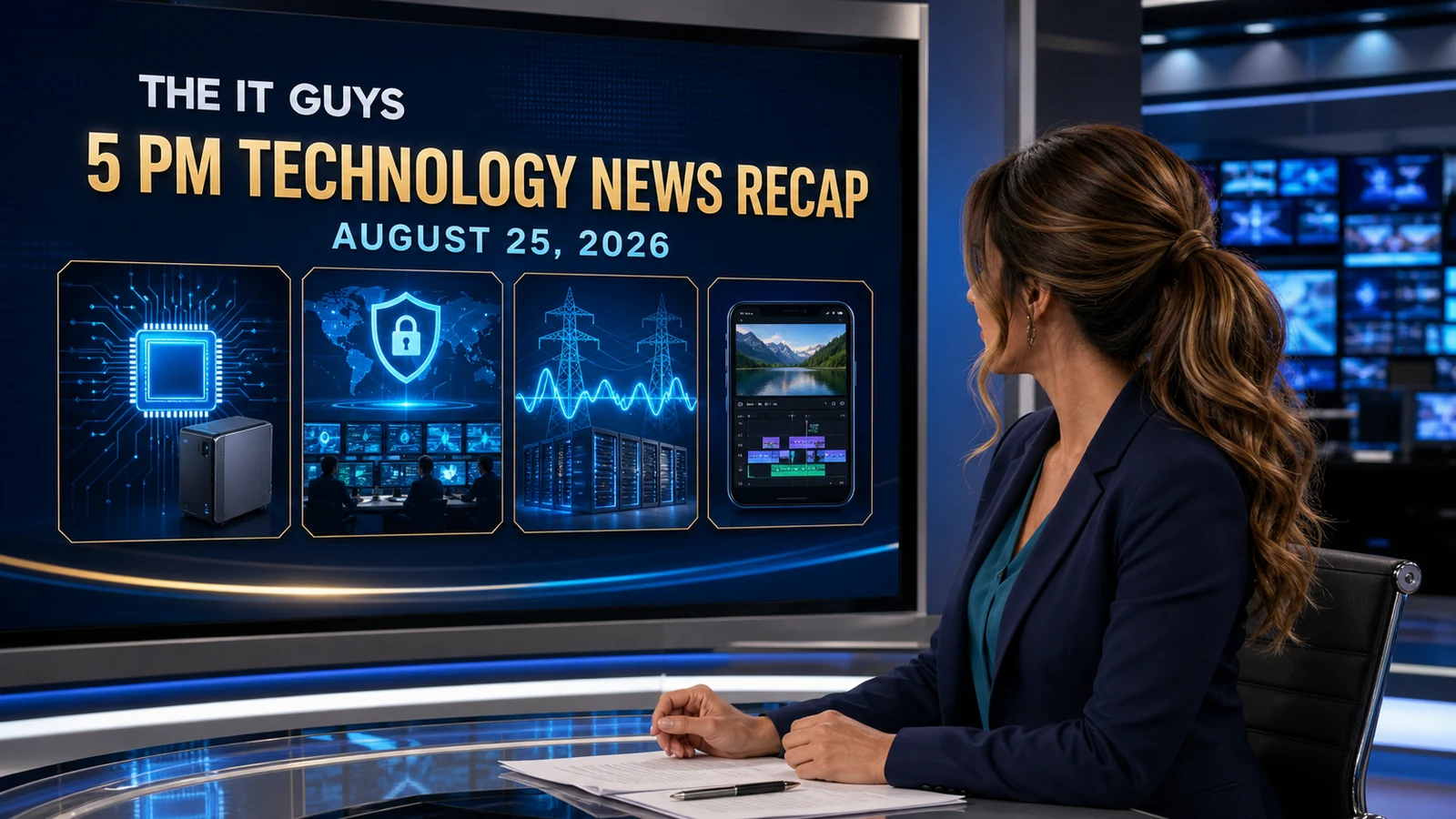
Tuesday’s technology news is about what happens when powerful systems meet practical limits: Apple pushed desktop silicon further, CISA showed why two security teams produced very different outcomes under the same kind of authorized pressure, investors backed software that shifts AI data-center power demand, and Instagram introduced an automatic rough-cut tool that its spokesperson says is not AI.
Reporting cutoff: August 25, 2026, 5:12 p.m. EDT (21:12 UTC). This edition prioritizes developments published or materially reported on August 25. Apple’s speed claims are vendor-run and await independent testing. CISA’s findings come from authorized simulations, not real intrusions. Emerald AI’s deployment and grid-potential claims are company-reported. Instagram’s rollout is initially described for iPhone, with Android timing unknown.
Listen to the broadcast-ready recap
This KittenTTS Bella narration was synthesized locally from the same checked facts as the article.
Tonight’s four-story rundown
1. Apple’s new desktop chips are official; the performance verdict is not
Apple introduced M6 for the Mac mini and M5 Ultra for the Mac Studio. The company describes M6 as its first 2-nanometre chip, with a 12-core CPU, 12-core GPU, dual 16-core Neural Engine, up to 32GB of unified memory, and up to 170GB/s of memory bandwidth.[1] M5 Ultra uses Apple’s first quad-die M-series architecture and scales to a 36-core CPU, 80-core GPU, 512GB of unified memory, and 1.2TB/s of bandwidth.[1]
The product details matter more than the superlatives. The M6 Mac mini starts at $899 and the M5 Pro model at $1,699—both $100 above the preceding starting prices reported by The Verge.[2] Mac Studio starts at $2,499 with M5 Max or $5,499 with M5 Ultra.[3] Preorders opened August 25, and the systems are scheduled to ship September 22; the 512GB-memory Mac Studio configuration is due later in October.[2][3]
Practical context: M6 should be evaluated as a shipping desktop platform, not just a process-node headline. Buyers should price the memory and storage they expect to need for the life of the machine. The 256GB base storage on the least-expensive Mac mini may be tight for creative libraries, virtual machines, development tools, or local models.[2]
2. CISA’s “two SOCs” lesson is about response discipline, not a flashy new exploit
CISA published findings from simultaneous authorized red-team assessments at two anonymized critical-infrastructure organizations: one providing government services and one in water and wastewater. Its teams achieved full domain compromise and reached sensitive business systems and cloud resources in both environments.[4] These were planned simulations conducted with permission—not evidence that either organization suffered a real hostile breach.[4]
The outcomes diverged. CISA says Organization A failed to detect or contain the activity. Organization B detected initial access and quarantined affected systems, then later detected activity against an operational-technology demilitarized-zone bastion host.[4] The difference was not simply whether alerts existed; it involved baselines, escalation, communication, cloud visibility, and whether the security operations center could convert signals into coordinated action.[5]
Practical context: businesses should test whether alerts reach a person who has authority, context, and a rehearsed procedure—not merely whether a tool produces a notification. Useful exercises include disabling a compromised account, tracing cloud-token use, preserving logs during isolation, escalating activity across IT and OT boundaries, and confirming after-hours ownership.
3. Emerald AI’s funding puts a price tag on the data-center power bottleneck
Emerald AI raised $150 million in a Series A round at a $1.05 billion valuation, bringing its total funding above $220 million. Reuters reported that Energize Capital and DCVC co-led the round.[6] The company develops software intended to reduce or shift AI data-center electricity use when power grids are stressed, rather than treating every workload as equally urgent at every moment.[6]
Emerald says it has completed five commercial demonstrations and reached multi-megawatt, full-data-center deployments.[7] It also projects that power-flexible computing could unlock more than 100 gigawatts of additional AI capacity on the existing U.S. grid.[7] That 100-gigawatt figure is a company projection—not an independently validated amount of capacity already available.[7]
Practical context: flexible computing can include delaying checkpoint work, moving jobs between sites or times, temporarily reducing non-urgent inference, and coordinating with utility signals. The hard part is proving that those changes preserve service levels, model-training integrity, contractual commitments, and predictable costs.
4. Instagram automates the rough cut—and explicitly says this one is not AI
Instagram is rolling out First Draft for Reels on iPhone. After a creator selects multiple clips, the feature trims pauses and assembles a starting edit that can be adjusted, reordered, or reversed before the creator moves on.[9] Instagram says it is intended for multi-clip montages, talking-head videos, and day-in-the-life material.[8]
The Verge reported that Instagram spokesperson Nicole Rechtszaid said First Draft does not use AI.[8] That is worth stating directly because automatic editing is often casually labeled “AI.” The checked sources do not expose enough technical detail to establish the underlying mechanism beyond Instagram’s attributed statement.
Practical context: creators should keep original files outside the app, check every automated cut, add accurate captions and alt text where supported, confirm music and footage rights, and export a review copy before publishing. Businesses should also decide who approves customer-facing posts when editing becomes faster.
What to do next
- Mac buyers: wait for independent sustained-performance and thermal testing, then price the memory and storage you will need for the full life of the machine.
- IT and security teams: run a tabletop or controlled detection exercise that follows one alert from first signal through escalation, containment, cloud review, and recovery.
- Infrastructure planners: ask data-center vendors how flexible-load claims are measured, what workloads can move, and which service-level guarantees survive a grid event.
- Creators and small businesses: keep source clips, review every automatic cut, add accurate captions, and preserve a human approval step before customer-facing publication.
- Everyone: distinguish a product announcement, a company measurement, an authorized simulation, an independent report, and a shipped result. They are different evidence layers.
Need help with security, backups, business technology, or a device decision? Schedule The IT Guys
More from The IT Guys today
Frequently asked questions
Are Apple’s new performance claims independently verified?
Not at this reporting cutoff. The architecture and products are official, but the comparative speed claims come from Apple’s selected preproduction systems, benchmarks, and workloads. Independent reviews should establish sustained performance, thermals, power use, and real application behavior.
Were the two CISA organizations really breached?
The advisory describes authorized red-team assessments conducted with permission. CISA’s teams achieved full domain compromise during the exercises; the publication is not evidence of a real hostile intrusion at those organizations.
Does Emerald AI already provide 100 gigawatts of capacity?
No. The company says power-flexible computing could unlock more than 100 gigawatts on the existing U.S. grid. That is a projection, not operating capacity independently verified today.
Does Instagram First Draft use AI?
According to Instagram spokesperson Nicole Rechtszaid, as reported by The Verge, First Draft does not use AI. It automatically trims and assembles clips into a reversible starting edit.
Why did this recap omit some same-day announcements?
The rundown favors materially distinct stories with accessible evidence and practical reader value. It avoided repeating today’s dedicated Intel coverage, repeating the prior recap’s legal-AI theme, and padding the article with older vulnerability or beta announcements.
Sources checked for this edition
- Apple — Apple introduces M6 and M5 Ultra for a big leap in performance and AI compute
- The Verge — Apple’s new Mac Mini has fresh M6 and M5 Pro chip offerings — and higher prices
- The Verge — Apple launches new Mac Studios with its “most powerful chip ever” — the M5 Ultra
- CISA — A Tale of Two SOCs: Insights From Two Red Team Assessments
- CISA — Advisory highlights red-team findings and incident-response lessons
- Reuters — Emerald AI valued at $1.05 billion after Series A funding round
- Emerald AI / Business Wire syndication — $150 million Series A announcement
- The Verge — Instagram’s “First Draft” trims your Reels clips for you
- Instagram Creators — First Draft announcement
Every accessible load-bearing page was reopened. CISA’s canonical pages returned HTTP 403 and Reuters returned HTTP 401 to automated retrieval, so official indexed CISA material and identifiable Reuters syndication were used to inspect the relevant text while retaining canonical links. Reporting ended at 5:12 p.m. EDT / 21:12 UTC.