

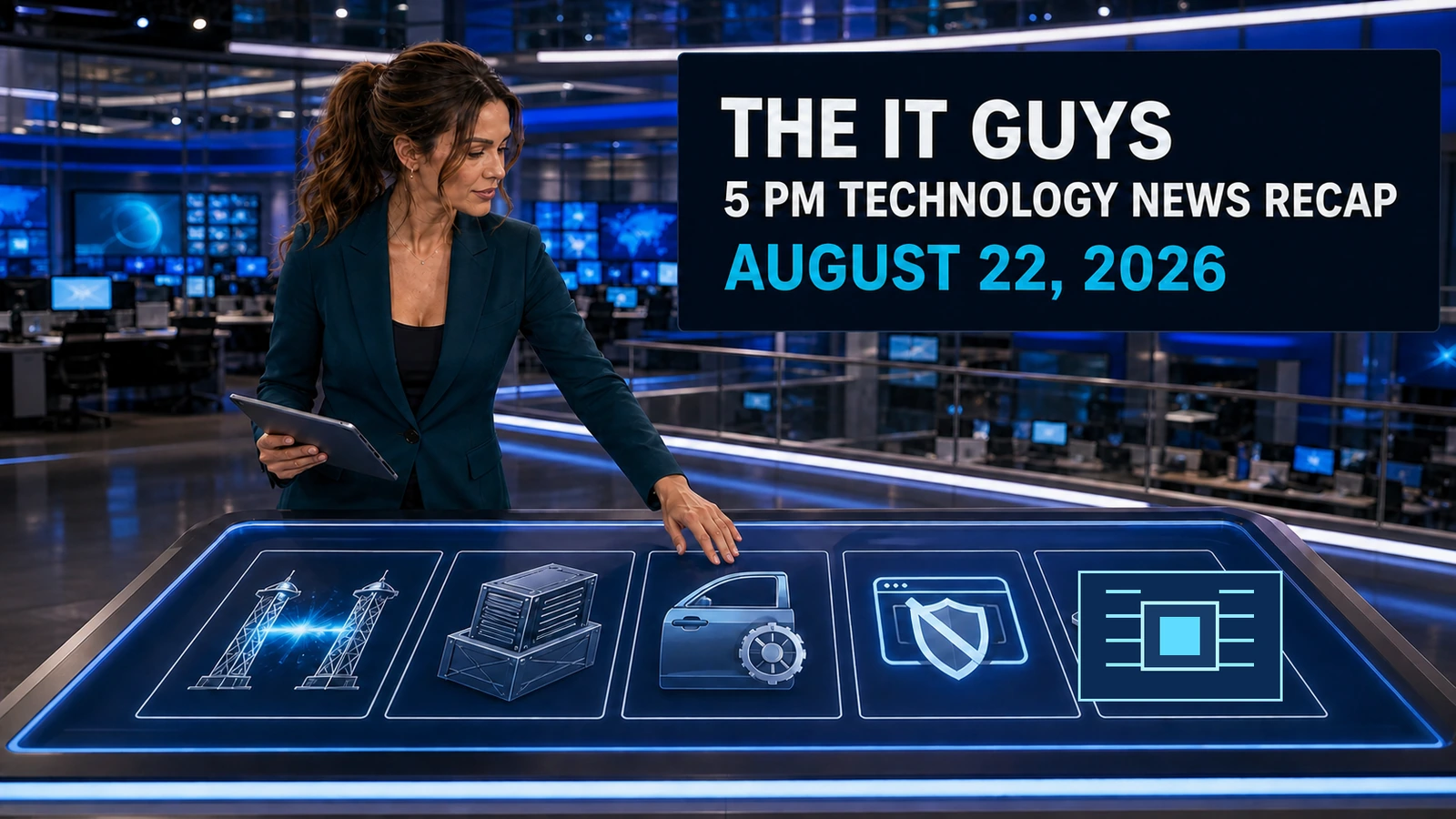
Today’s technology picture is less about one giant launch than five useful reality checks: a quantum link crossed open air, next-generation AI racks reached a major cloud operator, a huge vehicle recall put emergency door releases under scrutiny, an Irish public portal was taken offline as a precaution with no confirmed breach, and a tiny RISC-V chip gained a reproducible Linux build path.
Reporting cutoff: August 22, 2026, 5:18 p.m. EDT (21:18 UTC). This recap prioritizes developments published or materially verified for August 22, with clearly labeled late-August-21 source material where it carries today’s story. Company and institutional claims remain attributed; a delivery is not a deployment, a precaution is not a breach, and a successful software build is not a hardware boot.
Listen to the broadcast-ready recap
This narration is synthesized locally from the same checked facts as the article.
Tonight’s five-story rundown
1. Quantum information crossed a 13-mile open-air link
Brookhaven National Laboratory and Stony Brook University say researchers transmitted photons carrying quantum information through open air between Stony Brook’s “Quantum Watchtower” and Brookhaven’s “Quantum Lighthouse.” The demonstrated free-space path covered 13 miles and connected into a broader New York quantum-network effort that the institutions describe as spanning 161 miles and eight nodes.
The distinction between those two measurements matters: 13 miles describes this open-air segment; 161 miles describes the wider network. The achievement is an engineering demonstration, not a consumer service. The opened institutional material does not establish consumer availability, long-term uptime, weather tolerance, error rates, or a deployment schedule.
Why it matters: quantum networks are commonly discussed as fiber systems. A successful free-space segment shows another physical route that may help bridge places where continuous fiber is difficult or impractical. It also creates a real test bed for loss, alignment, reliability, weather, and repeatability.
Evidence: Brookhaven’s newsroom release, Stony Brook’s institutional report, and our detailed Morning Good News explainer.
2. Microsoft says its first production NVIDIA Vera Rubin systems arrived
Microsoft chief executive Satya Nadella posted that the first production Vera Rubin systems had arrived at Microsoft data centers. NVIDIA’s January 5 platform announcement said Vera Rubin was in full production. The accompanying receiving images support arrival; they do not prove installation, power-on, liquid-cooling integration, network fabric validation, software qualification, customer workloads, or general Azure availability.
Vera Rubin is NVIDIA’s successor platform to Blackwell. NVIDIA’s platform announcement describes a co-designed stack built around the Vera CPU, Rubin GPU, NVLink 6 switch, ConnectX-9 SuperNIC, BlueField-4 DPU, and Spectrum-6 Ethernet switch. Receiving production hardware at a major cloud provider is a meaningful supply-chain and infrastructure milestone—but the operational milestone comes later.
Practical context: enterprises should not plan migrations around a photograph of delivered racks. Wait for Microsoft to publish service regions, instance types, software support, pricing, quotas, and availability. Hardware arrival makes future capacity more credible without making that capacity purchasable today.
Evidence: Nadella’s delivery post, NVIDIA’s platform announcement, and our detailed arrival-versus-deployment analysis.
3. China’s record auto recall turns a hidden fallback into a mass-market safety lesson
China’s latest recall campaign includes millions of vehicles and focuses attention on whether people can identify and operate mechanical emergency door releases after electrical power is lost. The campaign reaches several automakers, with remedies ranging from warning labels and software changes to replacement release covers.
Specialist reporting from the regulator’s filings says the day’s combined recall plans cover more than seven million vehicles, but that broad total includes separate issues. Tesla’s reported door-release campaign covers 2,975,910 vehicles; a separate driver-attention-monitoring action covers 2,740,642 Model 3 and Model Y vehicles. Those counts should not be blended into one door-release number.
The everyday lesson travels beyond China: electronic latches may be convenient, but drivers and passengers should know where the mechanical release is before an emergency. In the United States, owners should use the official NHTSA recall lookup with their VIN rather than assuming a foreign campaign automatically applies to their vehicle.
Evidence: Reuters’ explainer, CnEVPost’s filing-based breakdown, and our detailed emergency-release guide.
4. Ireland restricted a legacy sports-grant portal after a cyber risk review—not a confirmed breach
Ireland’s Department of Culture, Communications and Sport restricted external access to a legacy portal called Oscar after a July 16 cyber risk assessment. Officials told the Irish Examiner there was no evidence of unauthorized access, no indication of compromise, and that the decision was not the result of a cyberattack or breach.
The assessment followed suspicious traffic aimed at a different National Archives public-facing site. That prompted a broader review of legacy systems. The Oscar portal is being moved to a new National Archives platform, while sports organizations can use an official email process for formal approvals and payment requests.
Why it matters: precautionary shutdowns are disruptive, but they are also what risk management can look like when a legacy system has not yet been breached. Organizations should have a verified fallback process before retiring or isolating an exposed service—and should communicate that workaround clearly enough to prevent phishing copycats.
Evidence: the official gov.ie workaround, the Irish Examiner report, and our detailed risk-review chronology.
5. Espressif’s ESP32-S31 Linux preview produced a flashable build—but no hardware boot proof yet
Embedded-systems publication CNX Software followed Espressif’s public Buildroot instructions and completed a Linux build for the ESP32-S31 RISC-V chip. Its captured output reported a 13,758,464-byte flashable image named s31_full_flash.bin, along with a device tree, OpenSBI firmware, U-Boot components, a kernel image, and root-filesystem formats.
That is useful independent evidence that the public source branches form a coherent build pipeline. It is not proof that the image boots on physical hardware: the tester did not have an ESP32-S31 board to flash. Wi-Fi, peripherals, reliability, performance, and production support therefore remain open questions. Espressif itself labels the material as a developer preview rather than a production release.
Practical context: developers can inspect and reproduce the build path today, but product teams should not treat the preview as a stable board-support contract. Pin exact commits, isolate experiments, and expect interfaces or dependencies to change.
Evidence: Espressif’s public BSP repository, CNX Software’s build report, and our detailed developer-preview analysis.
What to do next
- Families and home users: check your vehicle’s mechanical door-release instructions and verify any recall by VIN through the regulator serving your country.
- Small businesses: inventory legacy public portals, document a safe offline fallback, and rehearse how you will communicate a precautionary shutdown without creating phishing opportunities.
- Cloud and AI teams: separate hardware delivery announcements from purchasable service availability. Require region, SKU, quota, software, price, and support evidence before capacity planning.
- Developers: treat preview BSPs as experiments. Pin source versions, record toolchains, keep production credentials and data out of the lab, and do not infer hardware support from a successful cross-build.
- Curious readers: keep the optimism and the qualifiers together. Real progress is still progress even when it is not yet a product.
Need help checking a device, backup, network, or business system? Schedule The IT Guys
Frequently asked questions
Is the 13-mile quantum link a public quantum internet?
No. It is a research demonstration of a free-space segment between two institutions. The opened sources do not provide a consumer launch plan.
Can businesses order Microsoft Vera Rubin cloud instances now?
The delivery post does not establish that. Wait for official Azure service names, regions, pricing, quotas, and general-availability documentation.
Does China’s recall mean every electronic car door is unsafe?
No. The concern is model- and campaign-specific. The broader lesson is to know the mechanical fallback and verify recalls through an official VIN lookup.
Was Ireland’s Oscar portal hacked?
Officials said they found no evidence of unauthorized access or compromise. The reported action was precautionary after a cyber risk review.
Does the ESP32-S31 Linux image run on real hardware?
The specialist report verified the build, not a physical boot. Hardware behavior and several driver questions remain open.
Sources checked for this edition
- Brookhaven National Laboratory — Brookhaven and Stony Brook Researchers Demonstrate “Wireless” Capability for Quantum Network
- Stony Brook University — wireless capability for quantum network
- Satya Nadella — production Vera Rubin delivery post
- NVIDIA — Vera Rubin platform announcement
- Reuters — door-handle recall explainer
- CnEVPost — filing-based recall breakdown
- Irish Examiner — sports-funding system taken offline
- Government of Ireland — official formal-approval workaround
- Espressif — ESP Linux BSP repository
- CNX Software — ESP32-S31 Linux build report
Source pages were re-opened at the reporting cutoff. Stony Brook returned an automated-access block and Reuters returned an automated-access/authorization block to the verification client; those links remain included because their exact URLs and material claims were corroborated through the paired accessible sources and the already-published detailed The IT Guys coverage. No blocked response was counted as fresh body-text proof.