

The Night Shift: Overnight Tech News with Jennifer Hudsen • 11:30 PM edition • Cutoff August 21, 2026, 11:32:49 PM EDT / August 22, 2026, 03:32:49 UTC
China’s Record Auto Recall Puts Hidden Emergency Door Releases Under the Microscope
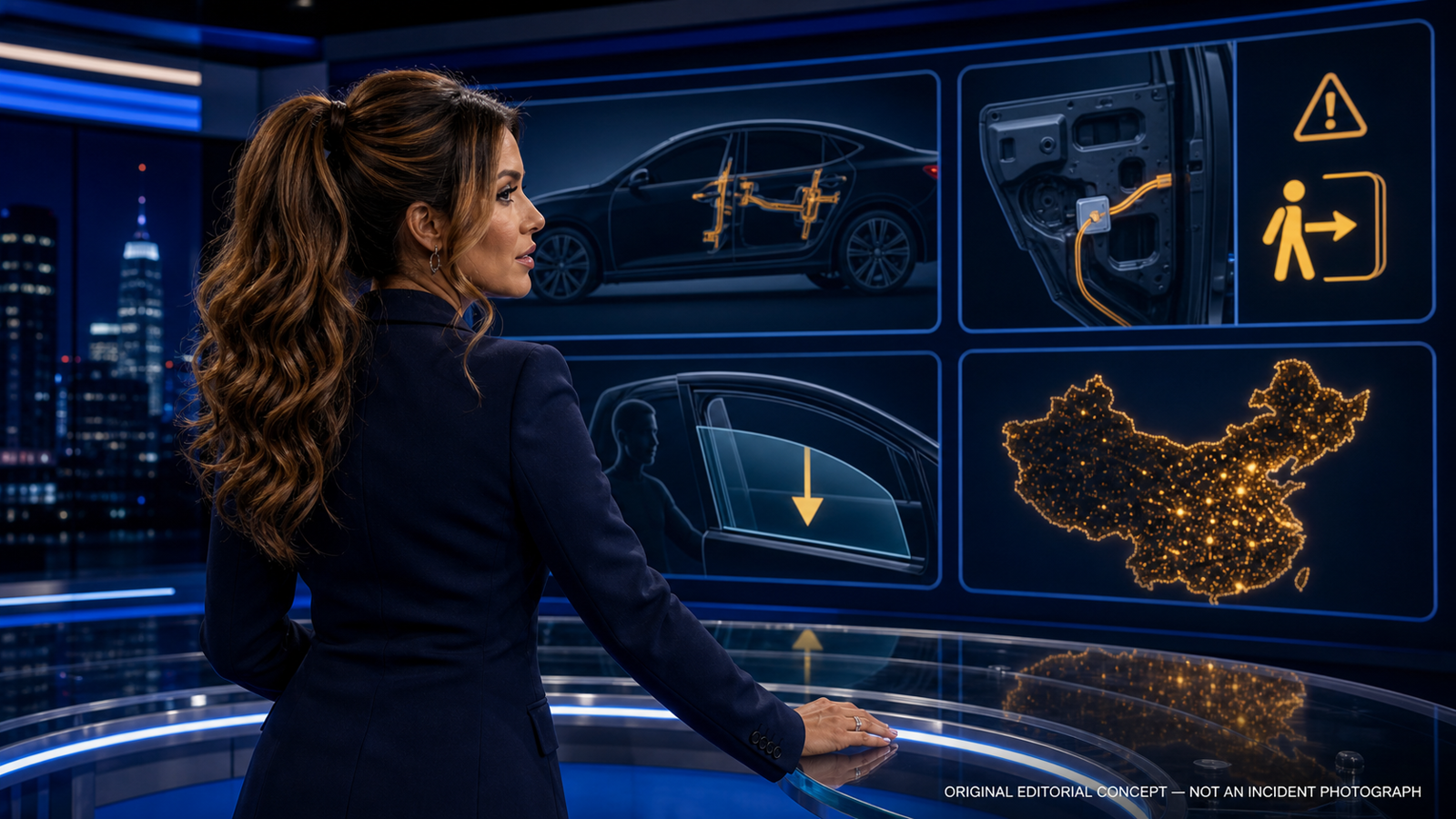
China’s latest vehicle-recall campaign has turned a design detail into a mass-market safety issue: can people quickly find and operate a mechanical door release after electrical power is lost? Tesla accounts for the largest share of the door-release action, but the campaign reaches several automakers. Remedies vary from labels and software changes to replacement release covers.
What happened
China’s State Administration for Market Regulation disclosed a large group of automaker recall filings on August 21. Reuters described it as China’s record auto recall and published a fresh explainer at 6:24:32 PM EDT, a little more than five hours before this edition’s cutoff. Because no stronger distinct subject survived the strict 9:11 PM-to-11:32 PM core window, this edition uses that clearly disclosed near-window development.
The common safety concern is not that every electric door handle will fail. It is that an emergency mechanical release may be too difficult to identify or operate when a severe crash disables a vehicle’s low-voltage electrical system. In that condition, an electronic button or powered latch may not work as expected. A mechanical fallback matters only if occupants and rescuers can recognize it and reach it quickly.
Shanghai-based EV specialist CnEVPost, reporting from the regulator’s filings, says the day’s recall plans cover more than seven million vehicles when all listed campaigns are combined. That broad total includes a separate Tesla driver-attention-monitoring recall, so it must not be confused with the narrower door-release problem. Tesla’s door-release campaign covers 2,975,910 vehicles; its separate driver-monitoring campaign covers 2,740,642 Model 3 and Model Y vehicles.
For the door-release action, Tesla’s reported remedy combines free warning labels with an over-the-air window-control update that adds a post-crash window-lowering strategy. Some other manufacturers will add labels, alter unlocking logic, or replace release covers. A label can improve discoverability, while software may improve a related escape path, but neither turns a mechanical release into an automatically self-executing rescue system.
Why it matters
Flush and electrically actuated door handles became a visual signature of modern electric vehicles. They can improve aerodynamics and create a clean exterior, but the safety chain is more complicated than the exterior handle alone. Inside the cabin, occupants may use an electronic button during normal operation and a separate mechanical control during a power failure. If the fallback is visually blended into trim, unfamiliar passengers may not know it exists.
The scale makes this more than a single-model service bulletin. Reuters’ reporting says the campaign is China’s largest, while CnEVPost identifies Tesla, Xiaomi, Leapmotor, Xpeng, Zeekr, Chery, Dongfeng, Arcfox and FAW among the affected manufacturers. The details and remedies differ by model, so owners should not assume that advice for one brand applies to another.
China has also adopted mandatory national standard GB 48001—2026. CnEVPost reports that the rule takes effect for new models on January 1, 2027 and requires mechanical release mechanisms, with a transition period for already-approved models through January 2029. The recall is therefore both a repair program and a preview of a broader design shift: emergency egress is becoming an explicit regulatory requirement rather than a feature buried in an owner’s manual.
The practical lesson travels beyond China. A vehicle sold in Florida may not be part of a Chinese recall, and specifications can differ by market. Yet the human-factors question is universal: during smoke, darkness, injury or power loss, can a passenger locate the fallback without a tutorial? Manufacturers, regulators and safety testers will likely face greater pressure to evaluate discoverability—not merely whether a mechanical cable exists somewhere behind the trim.
Who is affected
The announced recalls apply to specified vehicles in China, not automatically to every similarly named vehicle worldwide. Tesla’s door-release filing reportedly includes China-built Model 3 and Model Y vehicles plus smaller groups of imported Model 3, Model X and Model S vehicles. Other participating automakers list their own models, production ranges, start dates and remedies.
Owners outside China should not treat a headline as a recall notice for their VIN. Recall obligations are market-specific. The correct check is the manufacturer’s official recall tool or the vehicle-safety regulator for the country where the car is registered. In the United States, owners can use the National Highway Traffic Safety Administration VIN lookup and still follow any manufacturer instructions delivered through the vehicle or app.
Passengers are affected in a different way. They may ride in an unfamiliar car, taxi or rental without knowing where the emergency release is. Parents and caregivers should understand whether a rear-door child lock changes normal or emergency operation. First responders and roadside teams also benefit from model-specific rescue sheets rather than assumptions based on another brand’s layout.
What readers should do
- Check by VIN, not by viral headline. Use the official manufacturer or regulator lookup for the vehicle’s market. Do not pay a stranger who contacts you about a “recall fee”; legitimate safety-recall remedies are normally provided without charge.
- Find the mechanical releases while parked. Read the correct owner’s manual and locate the front and rear procedures before an emergency. Some vehicles use different mechanisms by seat or model year.
- Teach regular passengers without staging a dangerous test. Show the location and purpose of the fallback while the vehicle is stationary. Do not repeatedly operate an emergency release if the manual warns that it can damage trim or window seals.
- Install official recall software and physical remedies. An over-the-air update may address one part of a campaign, while labels or replacement pieces may require a service appointment. Verify completion in the official record.
- Keep rescue information accessible. Save the manufacturer’s digital rescue sheet or manual reference where it can be reached from a phone, but do not rely on a phone as the only source during an emergency.
- Report real problems through the proper channel. If a door does not operate as documented, stop improvising, preserve the facts, contact the manufacturer or qualified service provider, and report the safety issue to the applicable regulator.
Upside, cautions and unknowns
Upside: The campaign makes emergency egress more visible, requires free remedies for covered vehicles, and may accelerate clearer, more standardized mechanical releases. Labels and replacement covers are inexpensive compared with the potential value of faster recognition in an emergency.
Caution: “Record recall” does not mean seven million vehicles share one defect. The broad same-day total combines multiple campaigns, including Tesla’s separate driver-monitoring action. Remedies also differ. A software update cannot physically relabel a hidden release, and a label does not correct every possible latch or power problem.
Unknown: The opened sources do not establish how many incidents, injuries or deaths were attributed to each specific recalled configuration. They also do not show how quickly every owner will receive the physical portion of a remedy, whether other countries will order equivalent actions, or how consistently passengers will recognize the updated controls under real emergency conditions.
Evidence limit: The primary Chinese regulator notices were described by Reuters and directly summarized by CnEVPost, but this desk did not independently retrieve a stable English-language SAMR notice page by cutoff. Counts and remedies are therefore attributed to those opened reports rather than presented as a direct translation by The IT Guys.
| Campaign | Reported scope | Reported action | Do not infer |
|---|---|---|---|
| Tesla emergency mechanical door releases | 2,975,910 vehicles in China | Warning labels plus an OTA post-crash window-lowering strategy; applicability varies | That the separate driver-monitoring campaign is the same defect |
| Tesla driver-attention monitoring | 2,740,642 China-built Model 3 and Model Y vehicles | OTA addition of in-cabin camera monitoring alongside steering-wheel torque monitoring | That this campaign concerns emergency door releases |
| Other participating automakers | Model-specific groups across multiple brands | Labels, software logic changes or replacement release covers, depending on filing | That one brand’s remedy applies to every vehicle |
Frequently asked questions
Is every Tesla being recalled?
No. The opened reports concern specified vehicles and filings in China. Owners elsewhere must check their VIN in the official system for their registration market.
Does an over-the-air update fix a mechanical door release?
Not by itself. In Tesla’s reported door-release campaign, the OTA component adds a post-crash window-lowering strategy, while warning labels address release identification. The full remedy depends on the specific vehicle.
Why have a mechanical release if the normal button works?
Electronic controls depend on power and control systems. A mechanical path is intended as a fallback, particularly after a collision or electrical failure. Its usefulness depends on access, visibility and correct operation.
Should I try the emergency release now?
Read the owner’s manual first and follow its cautions. On some vehicles, using an emergency release when power is available can interfere with window movement or damage seals. Learn its location while parked; do not conduct an improvised stress test.
Are hidden exterior handles banned everywhere?
No. China’s new standard applies on its own schedule and market scope. Other jurisdictions may use different rules. The recall does not create a worldwide ban by itself.
Sources
- Reuters — “Explainer: What we know about the door handles that triggered China’s record auto recall” (published August 21, 2026, 22:24:32 UTC in Google News RSS; canonical page returned an automated-access restriction during this check).
- CnEVPost — “China’s biggest auto recall hits Tesla, Xiaomi, Leapmotor and others over door escape risk” (published August 21, 2026, 10:59:59 UTC; modified 14:19:19 UTC; article and WordPress record opened directly).
- Reuters — “Tesla’s popularized door handles drive China’s largest vehicle recall” (published August 22, 2026, 00:22:29 UTC in Google News RSS; canonical page returned an automated-access restriction during this check).
Reporting cutoff: August 21, 2026, 11:32:49 PM EDT (August 22, 2026, 03:32:49 UTC). Near-window fallback used: the selected Reuters explainer was published 5 hours, 8 minutes and 17 seconds before cutoff. This is one subject selected from the newest verified global technology developments and checked against The IT Guys’ daytime and prior Night Shift coverage.