

The Night Shift: Overnight Tech News with Jennifer Hudsen • 2:00 AM edition • Cutoff August 22, 2026, 2:13:36 AM EDT / 06:13:36 UTC
CNX Builds Espressif’s ESP32-S31 Linux Preview—Hardware Support Is Still an Open Question
A specialist’s in-window build test produced a complete, flashable Linux image for Espressif’s ESP32-S31 RISC-V chip, turning a newly public developer preview into something developers can inspect and reproduce. The test did not run the image on physical hardware, and Espressif explicitly says the preview is not for production.
What happened
Embedded-systems publication CNX Software published its hands-on build report at 12:26:56 AM EDT on August 22 (04:26:56 UTC), inside this edition’s strict window from the prior 11:30 PM desk cutoff. Writer Jean-Luc Aufranc followed Espressif’s public Buildroot instructions, updated to an ESP32-S31-capable version of esptool, configured the official external tree, and completed the build on a PC.
The result was a file named s31_full_flash.bin. CNX’s captured build output reports 13,758,464 bytes and says the image was ready to write at flash offset 0x0. The output directory also contained an ESP32-S31 device tree, OpenSBI firmware, U-Boot components, an execute-in-place kernel image and several root-filesystem formats. That is useful independent evidence that the published source branches form a coherent build pipeline—not merely a collection of placeholder repositories.
There is an important boundary: Aufranc did not own an ESP32-S31 board and therefore did not flash or boot the result. The report verifies a successful build and image package, not a successful hardware boot, stable networking or working peripheral drivers. CNX specifically leaves Wi-Fi support as an open question.
The provenance clock matters: the underlying Espressif repositories were created and populated earlier in the week, before this desk window. The genuinely new in-window development is the specialist’s completed build and publication of the resulting evidence. This article therefore does not pretend that every official commit landed after 11:30 PM.
Why it matters
The ESP32 family is better known for microcontroller firmware than a conventional Linux stack. Linux changes the development model: teams can bring familiar user-space tools, process isolation, filesystems and a broader software ecosystem to hardware that still sits much closer to embedded devices than to a desktop computer. The ESP32-S31’s memory-management unit and development boards with 16 MB of PSRAM make a minimal Linux configuration more plausible than it would be on earlier, tighter designs.
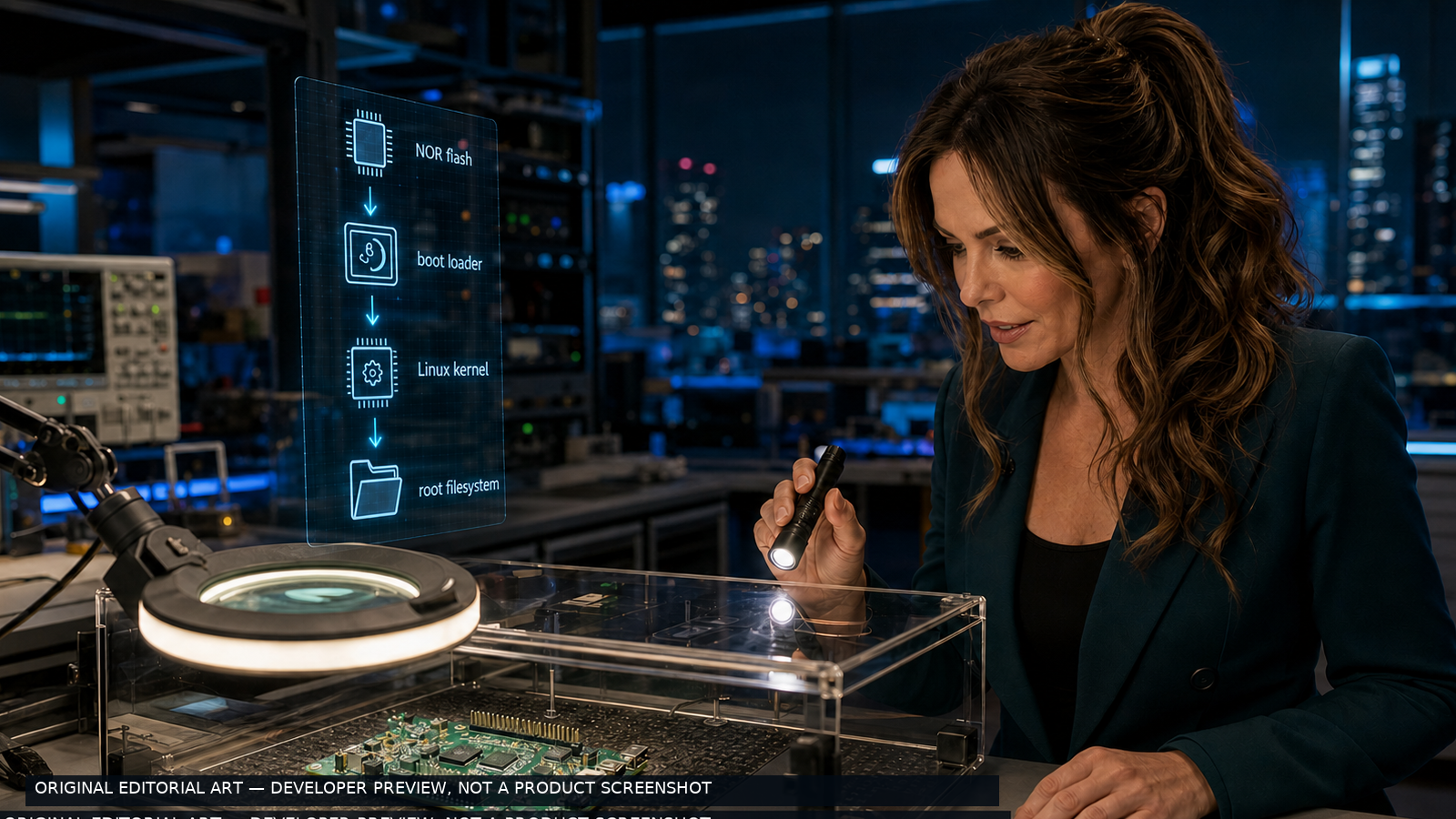
Espressif’s integration is also technically revealing. The official Buildroot tree pins a 32-bit RISC-V musl toolchain and named branches for OpenSBI 1.6, U-Boot 2024.07, Linux 6.18 and the BSP packaging tools. The packaging flow combines a U-Boot SPL, a U-Boot FIT image, a Linux device tree, an execute-in-place kernel and a cramfs root filesystem into one flashable binary. In plain English, the preview supplies a complete boot chain rather than asking developers to stitch together unrelated experiments.
The Linux fork’s commit history shows platform plumbing for the ESP32-S31, CLIC interrupt handling, UART support, an ESP32-S31 timer, execute-in-place kernel support and cache-maintenance work for PSRAM and executable flash mappings. Those commits establish design intent and source availability. They do not establish that every interface on a development board works under Linux.
For the broader RISC-V ecosystem, the preview is another sign that Linux-capable boundaries are moving downward. A compact connected device might eventually use a Linux control plane while retaining microcontroller-style hardware economics. That potential matters for gateways, experimental human-machine interfaces, smart-audio prototypes and lab devices—but only after drivers, power behavior, boot reliability, security maintenance and long-term branch policy mature.
Who is affected
The immediate audience is developers and hardware teams evaluating the ESP32-S31—not ordinary owners of existing ESP32 products. The preview targets only the ESP32-S31 and does not transform older ESP32 boards into supported Linux computers. A binary built for this target should never be treated as a generic firmware update.
Early adopters with an ESP32-S31 development board can use the public source to evaluate the boot chain, reproduce the build and file useful bug reports. Tool vendors, embedded-Linux consultants and board designers can inspect the branch structure and identify gaps. Product managers should treat the work as exploratory evidence, not as a production schedule.
Businesses already deploying ESP-IDF or another real-time firmware stack have no reason to switch merely because Linux now builds. Real-time behavior, boot time, memory use, power consumption, update safety and attack surface may all differ. A mature microcontroller application can be safer and simpler than a premature Linux migration.
What readers should do
- Start with the warning, not the demo. Espressif labels the branch a developer preview, says it is not recommended for production, and limits it to technical validation, experimentation and feedback.
- Use the exact official branches. The Buildroot documentation pins specific Espressif integration branches. Record commit hashes in your lab notes so a later breaking change does not silently alter a result.
- Build in an isolated development environment. The process downloads and compiles a substantial toolchain and operating-system stack. Review sources, preserve logs and avoid running an unfamiliar build as an elevated production user.
- Do not flash the wrong board. Confirm the chip, board, serial port and recovery procedure. Preserve factory firmware and configuration before writing experimental images.
- Separate “builds” from “works.” Test boot, console, storage, networking, each required peripheral, recovery, thermal behavior and repeated power cycles on hardware. Record failures instead of inferring support from a successful compiler run.
- Keep experiments off critical networks. Until driver behavior and update practices are understood, use a segmented lab network and non-sensitive test data.
- Retain a stable production path. Do not replace a supported ESP-IDF design or ship a customer device until Espressif publishes a production-ready branch and your own acceptance testing closes the gaps.
Inspect Espressif’s official preview repository
Upside, cautions and unknowns
Upside: Developers now have an official, reproducible path from Buildroot configuration to a single flash image. The public repositories expose the complete boot stack, and CNX’s successful build provides independent evidence that the documented pieces can resolve and compile together.
Caution: Espressif promises no scheduled update cadence, no API or ABI compatibility, only best-effort bug fixes and possible breaking changes without notice. The project is not recommended for production, long-term stability requirements or critical systems.
Unknown: The opened official documentation does not provide a complete supported-peripheral matrix. CNX did not test physical boot and explicitly questioned Wi-Fi status. Bluetooth, multi-core behavior, USB, display, storage, power management, networking throughput and long-duration stability remain unverified by this desk unless a specific driver or test says otherwise.
Evidence limit: A successful build proves that one source state produced a package on one developer’s system. It does not prove identical results after branches move, nor does it certify security, performance or hardware compatibility.
| Evidence | What it supports | What it does not support |
|---|---|---|
| CNX completed the documented Buildroot flow | The public components resolved and produced a full image in that test | That the image booted on a physical ESP32-S31 board |
| Espressif’s BSP packages SPL, U-Boot, device tree, XIP Linux and cramfs | A defined end-to-end NOR-flash boot layout exists | That all board peripherals have Linux drivers |
| Official Linux fork contains ESP32-S31 platform commits | UART, timer, interrupt, cache and XIP work is visible for review | Production support, stable ABI or upstream Linux acceptance |
| Developer-preview policy is explicit | Evaluation and feedback are intended uses | A product launch commitment or maintenance timetable |
Frequently asked questions
Did someone actually boot Linux on an ESP32-S31 in this report?
Not in the selected CNX test. The author completed the build but did not have the board to flash and boot it. Community projects report hardware progress, but they use separate branches and have their own limitations.
Is this an official Espressif project?
Yes. The BSP, Buildroot external tree, Linux fork, OpenSBI branch and U-Boot branch are hosted under Espressif’s official GitHub organization. “Official” does not mean production-ready; the repositories repeatedly label the work a developer preview.
Can I install it on any ESP32 board?
No. The published integration is explicitly limited to ESP32-S31. Other chips have different processors, memory maps, boot flows and peripherals.
Does Linux replace ESP-IDF?
Not automatically. ESP-IDF remains the established framework for many ESP32 applications. Linux may suit experiments that need a richer operating-system environment, while real-time or resource-constrained products may remain better served by firmware.
What is the clearest sign that the preview is immature?
Espressif’s own policy: irregular updates, possible breaking changes, no API or ABI compatibility guarantees, best-effort support and an explicit warning against production and critical systems.
Sources
- CNX Software — “Espressif Systems releases a Linux BSP developer preview for ESP32-S31 RISC-V microprocessor” (published August 22, 2026, 04:26:56 UTC; modified 04:31:32 UTC; direct article and RSS opened).
- Espressif — ESP32-S31 Linux BSP (official repository; developer-preview warning, packaging flow and maintenance policy opened directly).
- Espressif — ESP32-S31 Buildroot External Tree (official branch; pinned toolchain, component branches, build and deployment documentation opened directly).
- Espressif — Linux kernel fork, ESP32-S31 integration branch (official source and commit history opened through GitHub and its API).
- Espressif — ESP32-S31 Developer Platform (official product/developer context page opened directly).
Reporting cutoff: August 22, 2026, 2:13:36 AM EDT (06:13:36 UTC). Core window: the prior desk cutoff at August 21, 11:32:49 PM EDT (August 22, 03:32:49 UTC) through this run. The selected CNX build report was published at 12:26:56 AM EDT (04:26:56 UTC), inside the core window. This is one subject selected from the newest verified global technology developments and checked against The IT Guys’ daytime and prior Night Shift coverage.