

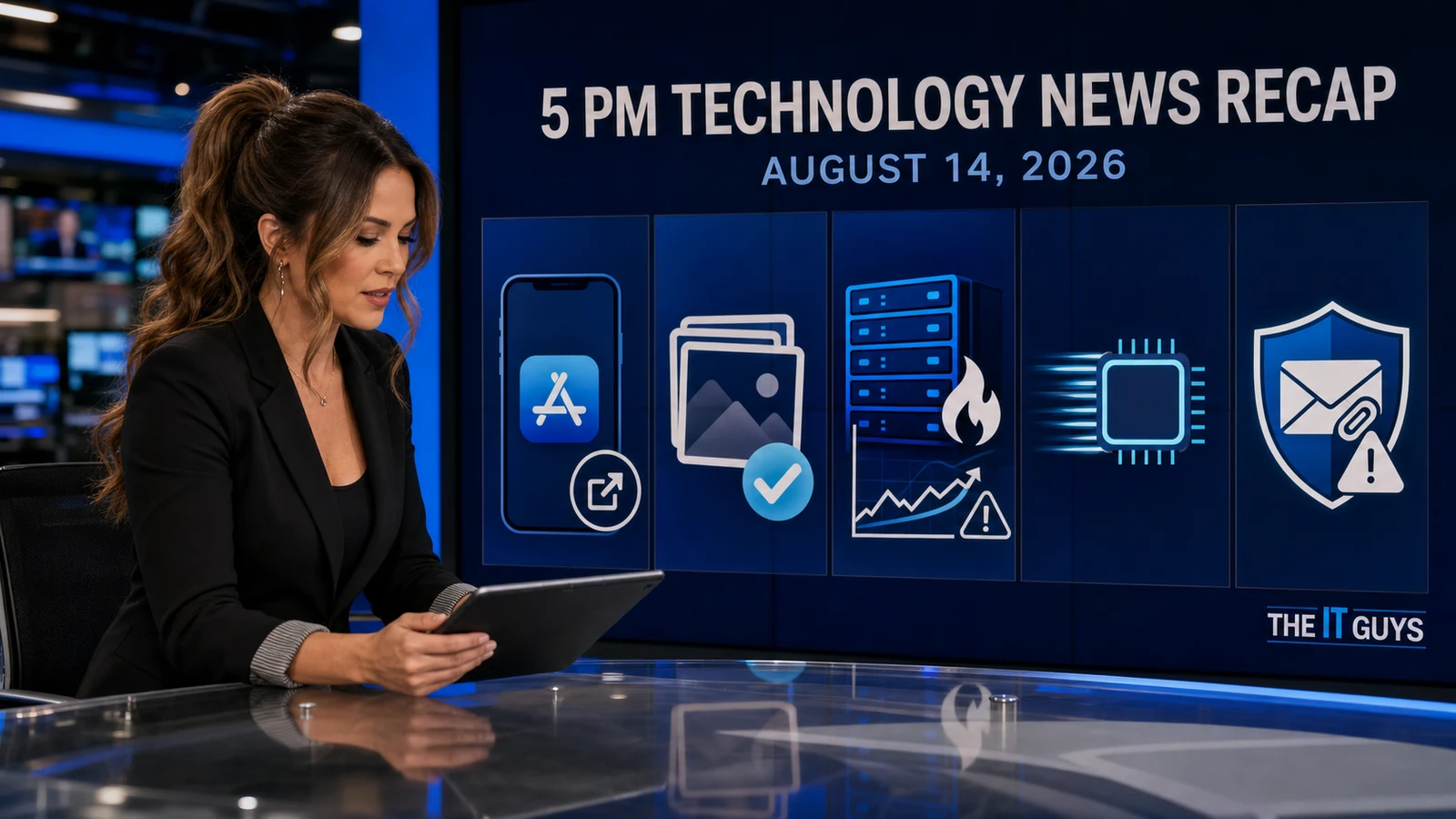
Tonight’s technology news is a reminder that the most important word in tech is often “trade-off.” Apple has proposed a new price for purchases that leave the App Store, Google is making visible AI watermarks optional while keeping quieter provenance signals, data-center builders face a possible energy-price squeeze, and a startup says software can unlock much more speed from familiar GPUs. We also have a practical Outlook security check and a consumer app built for people who can snooze through almost anything.
Listen to the 5 PM recap
This is a locally synthesized audio narration of Jennifer Hudsen’s August 14, 2026 technology-news briefing.
Apple proposed a 15% commission for standard apps using external purchase links, with lower rates for several programs.
Google will let creators hide the visible mark while retaining SynthID and C2PA signals.
A research forecast says AI data centers may be underestimating regional natural-gas price exposure.
Kog’s fast small-model demo is promising—but larger-model claims still need proof.
Tonight’s broadcast rundown
- Apple puts numbers on its proposed external-purchase commission structure.
- Google gives creators more control over visible AI labels without abandoning embedded provenance.
- AI data-center power plans meet an old-fashioned uncertainty: fuel prices.
- Kog argues that smarter, lower-level software can get more inference from standard data-center GPUs.
- A new reminder app uses persistence—not more organization—to help tasks survive the snooze button.
- Security desk: patch Outlook and keep treating unexpected Office attachments as hostile.
1. Apple proposes a 15% commission for standard external purchases
The fact: Apple submitted a court-ordered proposal describing commissions it wants to charge when an iOS app sends a customer to the web to complete a purchase. According to TechCrunch’s review of the filing, Apple proposed 15% for standard apps, 5% for developers in the Small Business Program, 10% for the Video Partner, News Partner, and Mini Apps programs, and 10% for subscription renewals.
This follows years of litigation with Epic Games over App Store rules. Apple had attempted to pause the lower-court proceeding while the U.S. Supreme Court considered another part of the dispute. The Supreme Court rejected that pause request, and the proposed fee structure was then filed. Apple argues that it should be compensated for the tools, technology, and services that support its platform.
The distinction that matters: these are proposed rates. They are not yet a final court-approved rule, and a developer should not rewrite pricing, checkout, or accounting systems as though the case is settled.
What businesses should do: model several outcomes instead of reacting to one headline. Include payment-processing cost, tax handling, fraud, refunds, customer support, conversion loss when a shopper leaves the app, and any Apple commission. Keep legal and product teams aligned on the difference between a proposal, a court order, and an implemented platform rule.
2. Google makes visible AI watermarks optional—but not provenance itself
The fact: Google says users will be able to turn off the visible watermark on AI-generated images, videos, and songs produced with Nano Banana, Omni, and Lyria. The setting is rolling out in Gemini and Google’s Flow video editor, with Search support planned. The visible mark changes, but Google says its invisible SynthID watermark and C2PA metadata remain.
Google is also open-sourcing Credentio, a C++ library intended to help developers validate C2PA Content Credentials locally in their own applications. That matters because provenance is more useful when it can travel through tools and be checked without sending every file to a remote service.
Why it matters: visible marks can interfere with a professional layout, a video frame, or an audio deliverable. Embedded provenance gives creators a cleaner output while retaining a machine-readable clue about origin. But “invisible” does not mean indestructible. Screenshots, transcoding, metadata stripping, heavy editing, or platform reprocessing can weaken or remove signals. A provenance check is one piece of evidence—not a truth machine.
Practical policy: if a business uses generative media in advertising, training, news, or customer communication, keep a human-readable disclosure when context could mislead. Preserve the original file, prompt or production notes, editor name, creation date, and usage rights. Do not outsource your disclosure policy to whatever marker happens to survive an upload.
3. AI data centers may be taking a larger natural-gas price risk than they realize
The fact: TechCrunch reports that energy research firm Noreva sees a scenario in which natural-gas prices climb above $10 per million BTUs at certain U.S. hubs. At the reporting checkpoint, cited prices were roughly $2 to $4.50, with the heavily traded Henry Hub just under $3. The argument is that data-center demand, slower supply growth, and expanding liquefied-natural-gas exports could tighten some regional markets.
The scale of planned projects is striking. The report points to Meta’s announced 7.5-gigawatt gas project in Louisiana and Amazon’s planned 7.6-gigawatt project in Texas, alongside gigawatt-scale plans involving Microsoft and Google. Those are plans; they should not be read as a statement that every gigawatt is built and operating today.
Fuel can represent about half the cost of electricity from a large gas power plant. A sustained doubling or tripling of fuel cost could therefore raise the economics of private power for AI facilities, pressure token prices, or encourage more operators to lean on public grids. The report also notes that gas futures were not forecasting a dramatic near-term move, so this is risk analysis—not a declaration that prices have already spiked.
What IT buyers should ask: where does your cloud or AI service run, how is price risk passed through, what happens during a power constraint, and can a workload move between regions or providers? A resilient architecture includes energy and location risk, not just servers and network links.
4. Kog says deeper software work can unlock much faster GPU inference
The fact: French startup Kog demonstrated about 3,000 per-request tokens per second with its roughly two-billion-parameter Laneformer 2B model on standard data-center GPUs. Kog’s pitch is that deep, hardware-specific software optimization can produce extremely fast single-request decoding on GPUs organizations already own, including the AMD MI300X and Nvidia H200 used in its work.
The company told TechCrunch it received 200 tangible business leads after an earlier preview. Its initial demand appears strongest around professional AI workflows such as software engineering, where waiting for a long result interrupts work. Kog has an 11-person team and says it may spend weeks or months optimizing for each new GPU.
The reality check: Kog’s demonstration used a purpose-built small model. That is not the same as accelerating a major frontier model by 30 times. The company says it aims to show a first major model at 10× speed in September. Until that result is independently benchmarked, it is a target—not an accomplished fact.
Benchmark correctly: compare the exact model and task you intend to run. Record latency to first token, end-to-end completion time, throughput under concurrency, answer quality, power, memory, engineering effort, and total cost. “Tokens per second” alone can hide a worse answer or an expensive integration.
5. Unforgetful tries to solve reminder failure with persistence
The fact: longtime indie developer Marco Arment released Unforgetful for iOS and Mac. It works with a user’s existing Apple Reminders database rather than building a separate task silo. Notifications repeat until a task is actually completed or deleted, snooze intervals change as postponement continues, and the app tries not to flood the user with multiple reminders at once. TechCrunch reports a price of $19.99 per year.
The app deliberately avoids a maze of tags, modes, and organizational systems. Users can continue creating reminders through Siri, turn off Apple’s standard Reminders notifications, and let Unforgetful provide the persistent alert layer. It also includes its own voice-entry control and widgets for the Lock Screen and Control Center.
Try before you trust: test with a few low-stakes tasks. Review notification permissions, shared-reminder behavior, data handling, battery impact, and what happens when the subscription ends. For medication, safety, compliance, or other critical deadlines, use a purpose-built system with escalation and a human backup—not a consumer reminder app alone.
6. Security desk: patch Outlook and distrust unexpected attachments
This is actionable background from Wednesday, not a new Friday disclosure. Microsoft’s August updates include CVE-2026-70329, a high-severity Outlook remote-code-execution vulnerability described as an integer-overflow flaw. The specialist report says exploitation requires user interaction—such as opening a malicious Office file—and that Microsoft had no evidence of active exploitation at disclosure and rated exploitation “unlikely.”
“Unlikely” does not mean “ignore.” Supported Microsoft 365 Apps, Office 2019 and LTSC editions, and Outlook 2016 configurations are among the affected products described. Click-to-Run installations normally receive fixes through Microsoft’s servicing channel, while older standalone deployments can require deliberate update work.
Do this tonight:
- Install the current Windows and Microsoft Office updates, then restart applications and the PC.
- Confirm update status on remote laptops, seldom-used machines, and older Office installations—not only the computer on your desk.
- Do not open an unexpected Office attachment because it appears to come from a familiar person. Verify through a separate channel.
- Use mail filtering, protected view, least privilege, and endpoint protection as layers; none substitutes for patching.
For the broader operating-system checklist, use The IT Guys’ August 2026 Windows Patch Tuesday guide.
What home users and small businesses should do this weekend
- iPhone app businesses: treat Apple’s rates as a proposal and model total checkout economics before changing anything.
- AI-media teams: document generated assets and keep a visible disclosure whenever omission could mislead a reasonable viewer.
- Cloud buyers: ask providers how region, electricity, and fuel costs can affect availability and pricing.
- AI engineers: require workload-matched benchmarks before buying a speed claim.
- Apple users: evaluate reminder tools with noncritical tasks before depending on them.
- Microsoft users: patch Office and Windows, verify the installed build, and keep attachment filtering turned on.
- Website owners: run our new 10-point website accessibility checklist; accessibility work improves real customer experience, not just compliance posture.
- Anyone hearing a loud fan: do not ignore heat while loading a PC with updates or AI workloads. Use our safe computer-overheating diagnosis guide.
Frequently asked questions
Is Apple already charging the proposed 15% rate?
No. The reported 15% structure is Apple’s proposal in an ongoing court process. Developers should wait for final legal and platform guidance while modeling possible outcomes.
Does removing Google’s visible watermark make AI media untraceable?
Not necessarily. Google says SynthID and C2PA metadata remain. However, embedded signals can be weakened or lost through some editing and reprocessing, so organizations should keep records and use clear disclosure where context matters.
Are natural-gas prices definitely going to triple?
No. That is a scenario from an energy research firm, not a certainty. The report itself notes that futures did not show a dramatic near-term increase. The practical lesson is to model regional fuel-price risk instead of assuming permanently cheap power.
Does Kog’s demo prove a large AI model will run 30× faster?
No. The reported 3,000-token-per-second demo used a specialized model of about two billion parameters. Kog’s larger-model targets still need workload-matched, independent proof.
Will Unforgetful move my reminders into its own database?
The product is designed to work with the existing Apple Reminders database. That reduces migration friction, but users should still review privacy, permissions, synchronization, and subscription terms before relying on it.
Is CVE-2026-70329 actively exploited?
The selected report says Microsoft had no evidence of active exploitation at disclosure and assessed exploitation as unlikely. It still warrants timely patching because it can reportedly allow code execution after user interaction with a malicious file.
What is the single most useful action tonight?
Update Windows and Office, restart, and verify the update history. New product features can wait; closing known security gaps should not.
Sources
- TechCrunch — Apple proposes a 15% external-purchase commission for standard apps
- TechCrunch — Google makes visible AI watermarks optional
- Google Developers Blog — Credentio C2PA validation library
- TechCrunch — Natural-gas price risk for hyperscale data centers
- TechCrunch — Kog’s GPU inference approach
- Hugging Face — Kog Laneformer 2B model artifact
- TechCrunch — Unforgetful for iOS and Mac
- Marco Arment — Unforgetful developer announcement
- Cyber Security News — Outlook CVE-2026-70329
- Microsoft Security Response Center — CVE-2026-70329
Need a practical technology check?
The IT Guys helps homes and small businesses in Port Saint Lucie, Jensen Beach, Fort Pierce, and Vero Beach with updates, security, networks, Microsoft 365, backups, and dependable troubleshooting.