

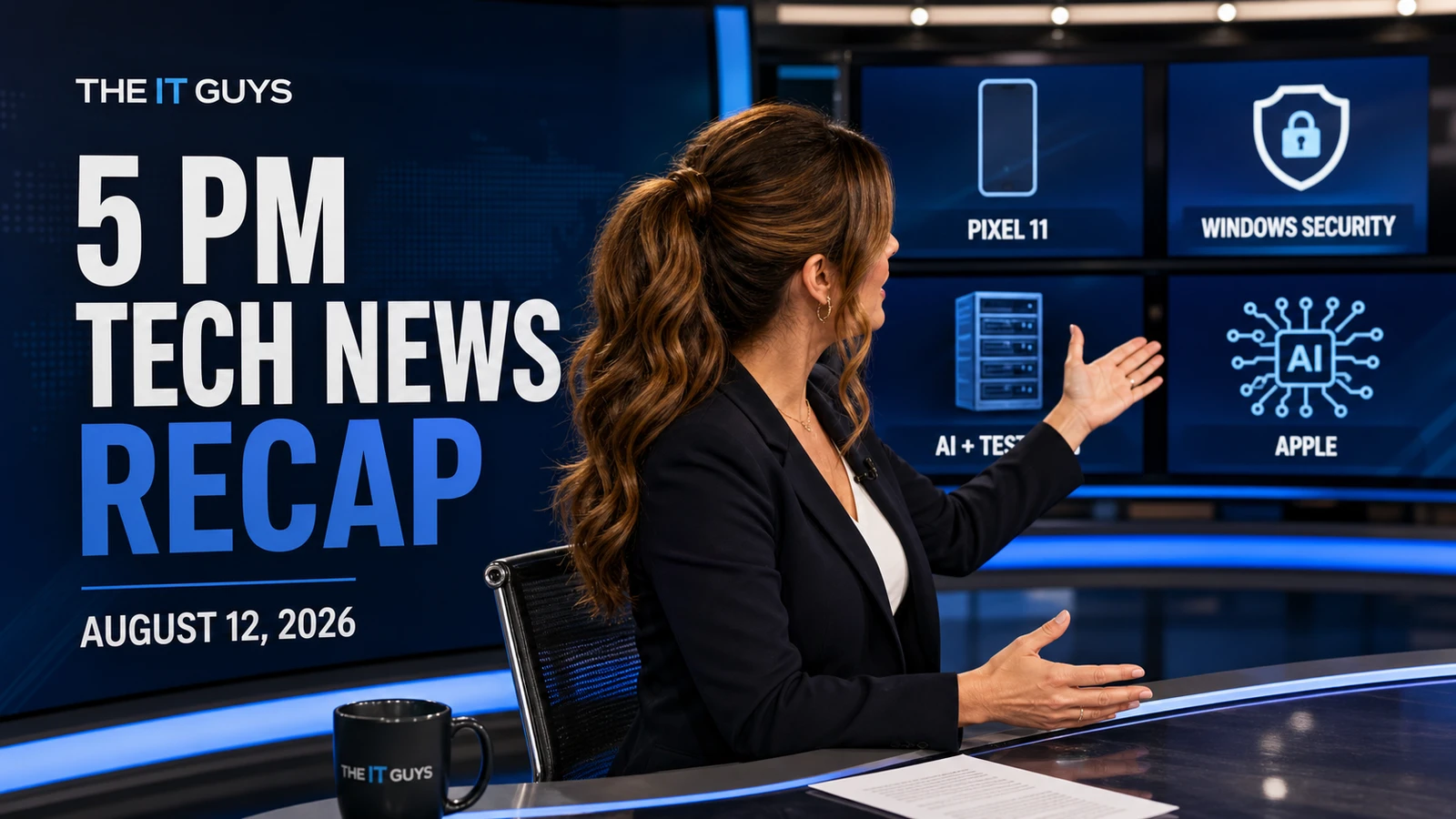
Tonight’s technology picture is split between shiny new hardware and an urgent security reality: Google introduced the Pixel 11 family and its first Pixel Tag, while Windows users face both a very large August security release and a newly disclosed flaw that reportedly does not yet have a patch. The business lesson underneath both stories is simple: new capability is useful only when testing, privacy and update discipline keep pace.
Listen to the 5 PM recap
This is a locally synthesized audio edition of Jennifer Hudsen’s broadcast script.
Tonight’s rundown
- Google’s hardware day: Pixel 11 phones start at $899, add Tensor G6 and expand camera and Gemini features; retail availability begins August 20.
- A new tracker: Pixel Tag is Google’s first item finder, but it will not reach shelves until November 11.
- Windows urgency: August Patch Tuesday addressed 421 CVEs, including an exploited privilege-escalation flaw. A separate Windows Defender-related bypass was publicly described today, reportedly without a patch at the reporting checkpoint.
- AI meets quality control: Blacksmith’s new funding round is another sign that faster AI-assisted coding is increasing demand for reliable testing—not eliminating it.
- Android productivity: Automattic’s Mesh relationship manager has arrived on Android, with useful multitasking features and a reason to review contact-data privacy before importing anything.
- Apple’s quieter lane: Apple announced two ad-free Arcade puzzle additions for September 3; no new Apple security release was visible on Apple’s official security-release page at our 5 PM checkpoint.
1. Pixel 11 is Google’s biggest consumer-tech story of the day
Google used its Made by Google 2026 event to introduce the Pixel 11, Pixel 11 Pro and Pixel 11 Pro XL, plus the Pixel 11 Pro Fold, Pixel Watch 5, updated earbuds and the company’s first Pixel Tag. The regular Pixel 11 lineup is available for preorder now, with Google listing starting prices of $899, $1,099 and $1,299. The three phones are due on store shelves August 20.
Google says its new Tensor G6 chip powers faster on-device Gemini features. The company also says the standard Pixel 11 gets a larger 48-megapixel main sensor with 56% greater light sensitivity, while its 5x telephoto system supports up to 30x Super Zoom. Those numbers are vendor claims, not independent review results, so buyers should wait for sustained battery, thermal, camera and repairability testing before treating the launch presentation as a verdict.
Good / caution
Good: a longer product stack gives Android shoppers more form factors, and on-device processing can reduce some cloud dependence. Caution: AI features, battery-life claims and zoom demonstrations deserve real-world testing. Do not trade in a working phone solely because the launch made last year’s model feel old.
Practical buying move: compare the total price after storage upgrades, protection plans and accessories. Confirm how long the device will receive operating-system and security updates, and decide whether the specific camera or accessibility feature solves a real need. If your current phone still receives updates and its battery is healthy, waiting for independent reviews is the low-risk option.
2. Pixel Tag joins the item-tracker market—with a November wait
Google’s first Pixel Tag works with Find Hub and is intended for keys, wallets and luggage. Google says Ultra-Wideband plus Bluetooth Channel Sounding can provide directional and distance cues, the tag can be shared with as many as 10 people, and the replaceable battery should last up to a year. The listed price is $29 for one or $99 for four, but the tags are not scheduled to reach shelves until November 11.
Trackers are convenient, but they are also location sensors. Before buying, check unwanted-tracker alerts across the phones your household uses, review who can see shared-item locations, and remove access when a trip, job or shared-key arrangement ends. Never hide a tracker on another person or in their property without lawful consent.
3. Windows has a patched emergency and a separate unpatched question
Microsoft’s August Patch Tuesday release addressed 421 CVEs, according to SecurityWeek’s review of the release. The list included CVE-2026-68820, a Windows kernel-mode driver issue that Microsoft said attackers had used to elevate privileges to SYSTEM. A second privilege issue, CVE-2026-62832, was publicly disclosed. This is the straightforward part of tonight’s advice: install the August cumulative update, restart, and verify that the update completed.
Today brought a separate complication. TechCrunch reports that a researcher published details of a Windows Defender-related bypass nicknamed “ShieldBreak,” describing a path to system-wide access and saying Microsoft had not released a patch as of the report. Public disclosure makes the issue a zero-day in the literal sense that the vendor had no patch available before details were published. It does not, by itself, prove widespread active exploitation.
Do not disable Microsoft Defender, install an unofficial “fix,” or run proof-of-concept code to see whether your PC is vulnerable. The safer interim posture is defense in depth: keep the August updates installed, use a standard user account for daily work, restrict local administrator access, leave cloud-delivered protection and tamper protection enabled, avoid untrusted downloads, and monitor Microsoft’s official guidance for a supported mitigation or patch.
For the step-by-step update check, use our August 2026 Windows Patch Tuesday guide. Small businesses should also review why Windows LAPS matters when local administrator passwords are reused.
Tonight’s Windows checklist
- Open Settings → Windows Update and install the August cumulative update.
- Restart—even if the PC says it can wait.
- Return to Windows Update and confirm there is no failed update.
- Keep Defender and tamper protection enabled.
- Back up irreplaceable files and verify that the backup can be opened.
- For managed PCs, document update status and watch Microsoft’s advisory channels for the newly disclosed issue.
4. AI writes faster; somebody still has to prove the software works
Software-testing company Blacksmith raised a $45 million Series B at a reported $550 million valuation, up from the $60 million valuation attached to its prior round. The company says it now serves more than 5,000 customers. Funding figures are business claims, but the underlying operational trend is credible: when teams generate more code with AI assistants, build pipelines and validation systems have more—not less—to examine.
For business owners, the useful takeaway is not the valuation. It is the release discipline. AI-generated code should enter the same controls as human-written code: peer review, automated tests, dependency and secret scanning, a staging environment, least-privilege deployment credentials, rollback instructions and a named human who approves production release. “The model wrote it” is not a warranty, a security review or an incident-response plan.
The good: better testing infrastructure can help teams catch regressions earlier. The bad: speed pressure can tempt teams to ship generated code before anyone has checked permissions, data handling or failure behavior. Faster typing does not shorten the time needed to understand risk.
5. Automattic’s Mesh reaches Android
Mesh, the personal relationship manager owned by WordPress.com parent Automattic, is now available on Android. TechCrunch reports that it can organize contacts, notes and follow-up reminders, and that the Android version supports split-screen, pop-up views, keyboard shortcuts, search and home-screen widgets.
The convenience question is easy; the privacy question deserves more time. A relationship manager can contain names, personal notes, job context and reminders that would be sensitive if synced to the wrong account or exposed on a lock screen. Before importing contacts, review the app’s permissions and synchronization model, confirm which account owns the data, test export and deletion, and avoid writing notes you would not want the subject to read.
6. Apple’s update is lighter tonight
Apple announced that Block Blast!+ and Art of Fauna: Cozy Puzzles+ will join Apple Arcade on September 3. Apple says the Arcade editions have no ads and no in-app purchases. The service is listed at $6.99 per month in the United States, with availability varying by device and region.
That is pleasant consumer news, not an urgent operating-system event. At our 5 PM research checkpoint, Apple’s official security-release page showed no new August 12 security release. Apple users should still leave automatic updates enabled and can review our recent Mac security update guidance if they have not installed the latest supported release.
What to do tonight
- Windows: install the August cumulative update, restart and verify success. Do not disable Defender because of the newly disclosed report.
- Businesses: inventory which PCs still grant everyday users local administrator rights. Remove unnecessary access and deploy unique managed local credentials.
- Phone shoppers: wait for independent Pixel 11 battery, camera, modem and thermal tests unless you have an immediate replacement need.
- Tracker buyers: evaluate unwanted-tracker alerts and sharing controls before November—not after tags are attached to family keys and luggage.
- AI development teams: require tests, review, staging and rollback for generated code.
- Everyone: verify backups. A backup you have never restored is still a theory.
Frequently asked questions
Does the August Windows update fix the newly disclosed ShieldBreak issue?
Not according to the reporting available at our 5 PM checkpoint. The August update fixes many vulnerabilities, including CVE-2026-68820, but TechCrunch described ShieldBreak as a separate issue for which Microsoft had not yet released a patch. Keep the supported updates installed and monitor Microsoft for new guidance.
Should I turn off Microsoft Defender until there is a fix?
No. Disabling your primary antivirus layer would create a broad, immediate reduction in protection. Avoid unofficial workarounds and untrusted downloads; keep Defender, tamper protection and Windows updates enabled.
Is the Pixel 11 available today?
Google opened preorders on August 12 and says the Pixel 11, Pixel 11 Pro and Pixel 11 Pro XL will be on shelves August 20. Availability, trade-in offers and carrier terms can differ.
Can I buy Pixel Tag with the phone?
Not at launch. Google says Pixel Tag is scheduled for November 11 at $29 each or $99 for four.
Did Apple release a security update today?
We did not find a new August 12 entry on Apple’s official security-release page by the 5 PM checkpoint. That can change after publication, so use Apple’s live page as the continuing authority and keep automatic updates enabled.
What if my PC fails to start after an update?
Do not immediately erase or reinstall it. Photograph the exact message, stop repeated forced restarts if the drive is making unusual sounds, and use our guide on what to do when Windows reports “No Boot Device Found”.
Sources
- Google: Made by Google 2026 announcement hub
- Google: Pixel 11, Pixel 11 Pro and Pixel 11 Pro XL
- Google: Pixel Tag specifications, pricing and availability
- TechCrunch: newly published Windows zero-day report
- SecurityWeek: August 2026 Patch Tuesday review
- TechCrunch: Blacksmith funding and software testing
- TechCrunch: Mesh arrives on Android
- Apple: September 3 Apple Arcade additions
- Apple: current security releases
Reporting checkpoint: August 12, 2026 at 5 PM Eastern. Developing security guidance, prices and availability can change. The IT Guys serves Port Saint Lucie, Jensen Beach, Fort Pierce and Vero Beach. If an update fails or you need a careful security check, contact The IT Guys.