
Apple has not announced an all-glass iPhone. But a growing collection of credible reports, display-industry claims, and Apple patent filings suggests that the company is exploring a dramatically more glass-forward iPhone for the product’s 20th anniversary in 2027. Here is what the evidence actually says—and where the internet is getting ahead of it.
The most defensible description is “mostly glass, curved, and nearly all-screen”—not a confirmed transparent phone carved from one solid block of glass. The expected 2027 launch date, the name “iPhone 20,” the final materials, and every feature discussed below remain unconfirmed until Apple announces them.
Why 2027 matters
The original iPhone went on sale on June 29, 2007, making 2027 its 20th-anniversary year. Apple used the tenth anniversary to introduce the iPhone X in 2017, eliminating the Home button and establishing the edge-to-edge design language that shaped later models. That history makes a commemorative redesign in 2027 plausible—but it does not guarantee a particular name or design.
Apple could call the device “iPhone 20,” “iPhone XX,” or something else entirely. Those names are media shorthand, not official branding. Apple also normally launches its premium phones in the fall, so a commemorative model could arrive months after the exact June anniversary.
What the strongest reporting says
The rumor gained real weight in May 2025 when Bloomberg’s Mark Gurman described Apple as planning a “mostly glass, curved iPhone” with no display cutouts for 2027. The Verge independently summarized that Bloomberg report and noted that The Information had separately reported a 2027 iPhone with its front-facing camera hidden beneath the screen.
A Korean supply-chain report added another piece: Apple was said to be studying “four-edge bending” display technology. Unlike older waterfall displays that primarily curved down the left and right sides, this approach would bend or visually flow around the top and bottom as well. MacRumors’ May 2025 coverage described discussions with Samsung Display and LG Display and emphasized the technical hurdles involved.
By July 2026, the picture had become more detailed but also more speculative. MacRumors’ latest design summary described shallow “micro-curves,” glass wrapping around the front and back, a very thin polished perimeter, and possible haptic controls instead of conventional mechanical buttons. A separate July 29 roundup collected additional claims about under-display Face ID, two screen sizes, new display construction, and other components. Those later details come from a mixture of reporting and individual leakers, so they should not all be treated equally.
“All glass” probably does not mean what it sounds like
A literal one-piece glass phone would create enormous problems for assembly, repair, antennas, heat dissipation, speakers, cameras, buttons, and drop resistance. Even Apple’s patent language generally describes multiple glass members joined together—not a magically hollow, seamless crystal.
The more realistic interpretation is a phone engineered to look and feel like a continuous slab of glass:
- Front and rear glass that curve gently into the perimeter.
- An extremely narrow or visually hidden structural frame.
- A display that reaches farther toward all four edges.
- Face ID and possibly the selfie camera moved beneath the display.
- Haptic touch zones replacing some mechanical buttons and their openings.
- Carefully controlled refraction and lighting that make seams appear to disappear.
It would still contain structural layers, adhesives, display encapsulation, antennas, camera assemblies, and internal supports. “Mostly glass” is therefore a better working description than “entirely glass.” It also does not mean the phone would be transparent enough to see its battery and circuit board.
Apple’s patents show the idea is real research—but not a product promise
Apple has pursued glass-enclosure concepts for years. The clearest example is U.S. Patent 11,175,769 B2, “Electronic device with glass enclosure”, granted to Apple on November 16, 2021. Its abstract describes a six-sided glass enclosure with a touchscreen display positioned adjacent to at least part of all six sides. Its drawings show information and controls extending around a phone-like device.
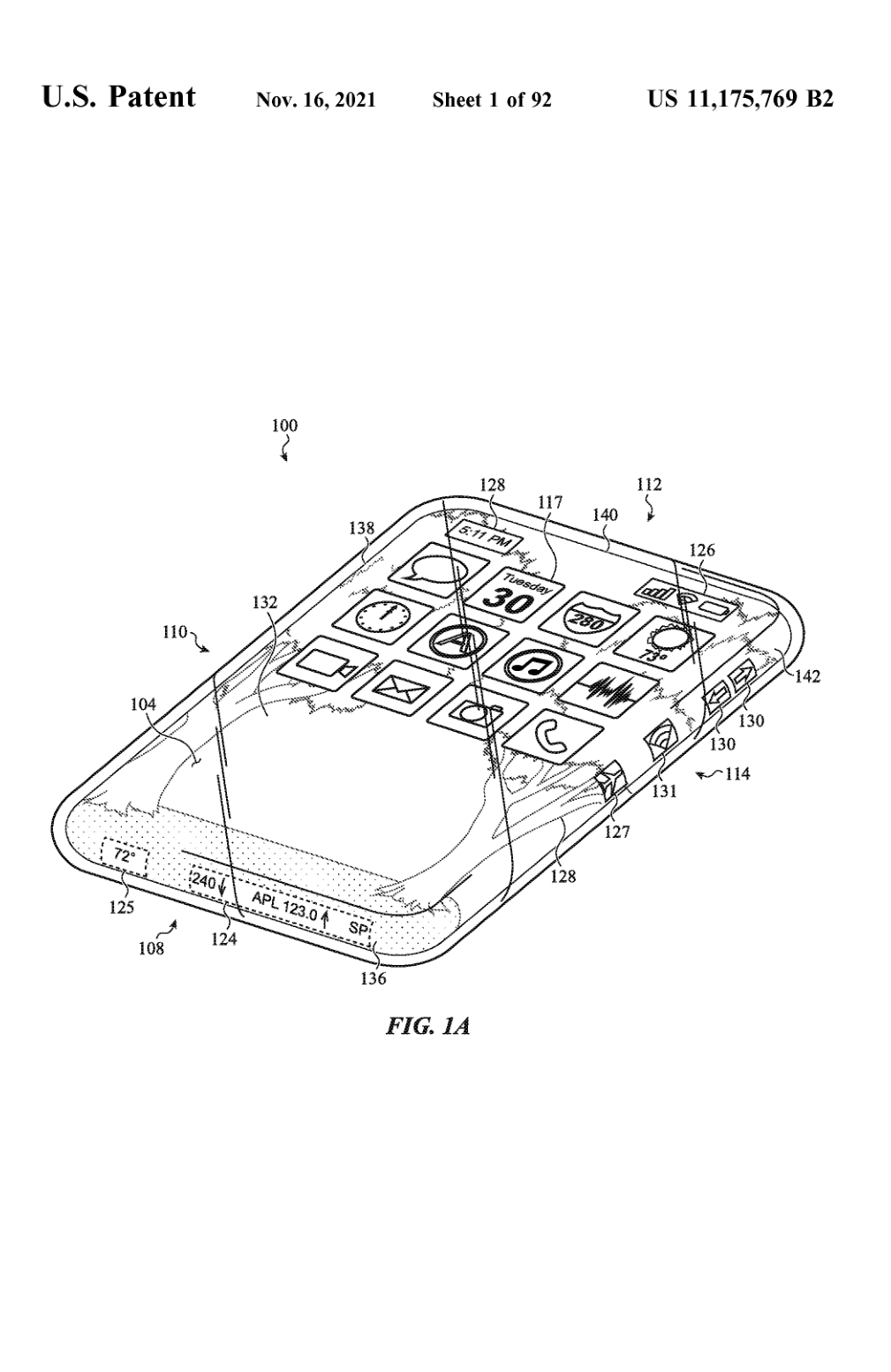
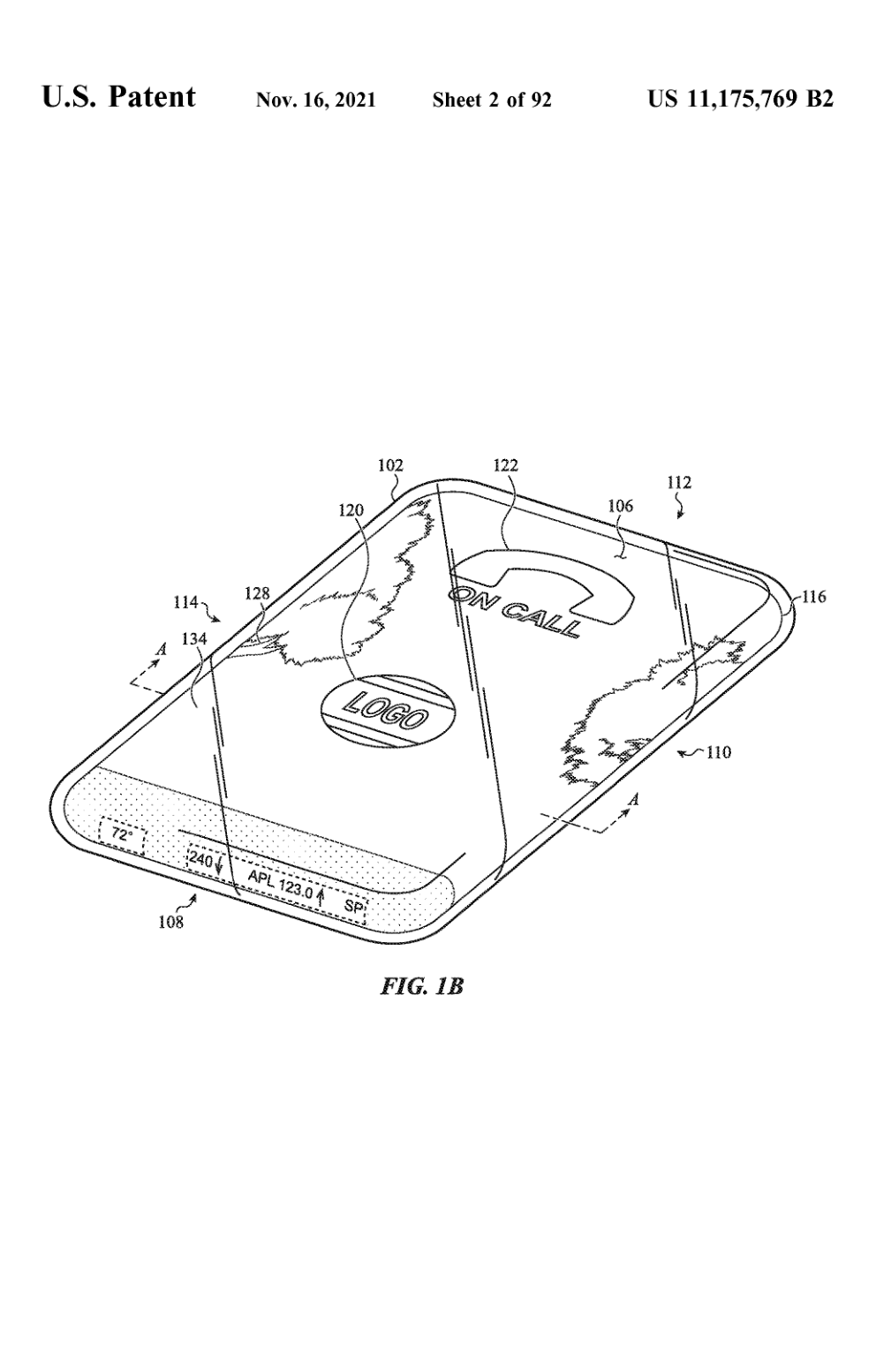
The patent family remains active. U.S. Patent Application 2025/0251816 A1, filed in March 2025 and published August 7, 2025, is a continuation of the same glass-enclosure work. It remains listed as pending. The filing describes two glass members, overlapping tapered edges, touch sensing, force sensing, haptics, and flexible displays that can present information through major and peripheral surfaces.
An even older Apple patent, U.S. Patent 8,824,140 B2, describes a glass enclosure formed from a hollow glass tube or bonded glass members and discusses water-resistant sealing. That long history proves Apple has repeatedly investigated advanced glass construction. It does not prove that any specific patent drawing is the 2027 iPhone.
What our concept assumes
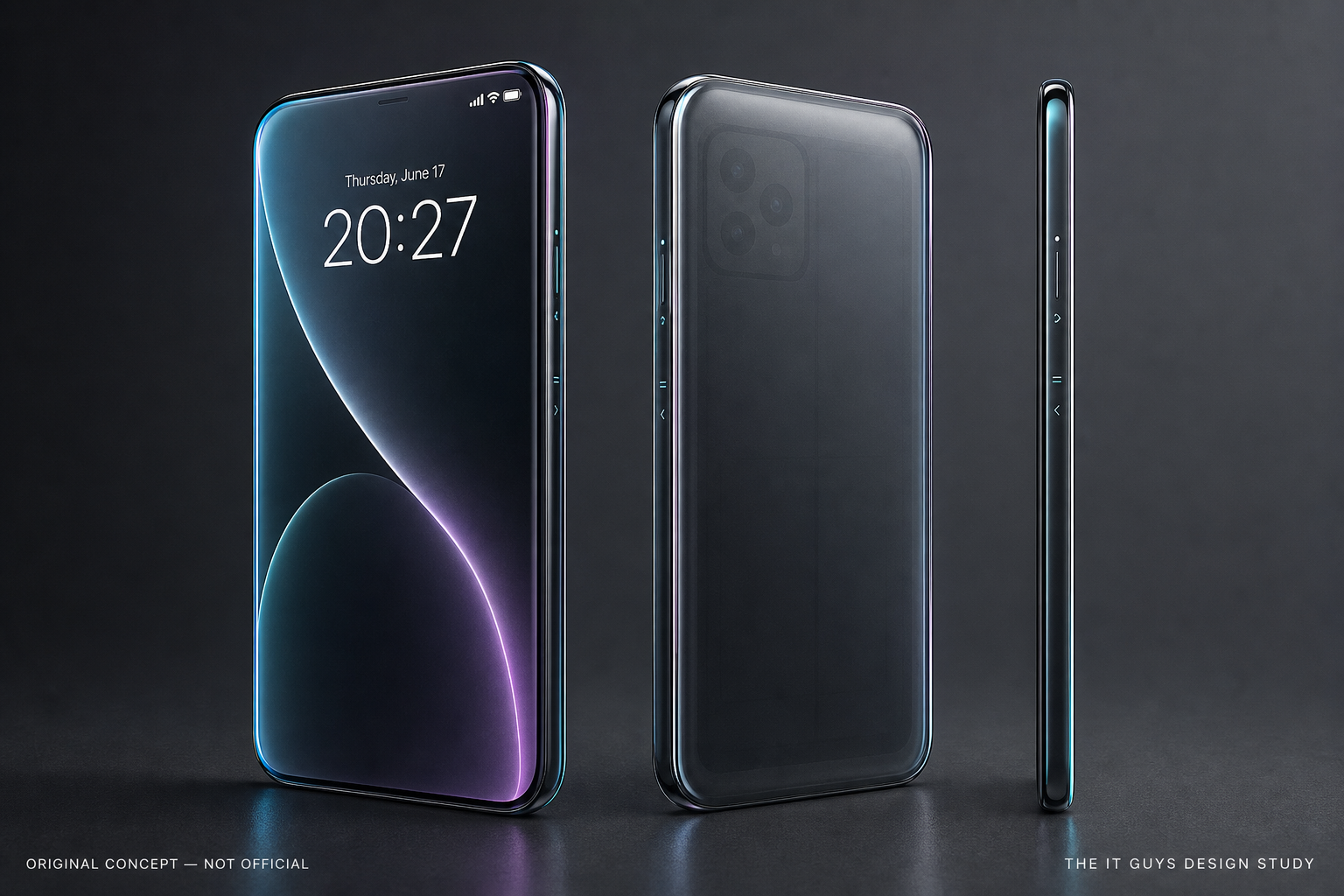
Our original hero and product render are deliberately conservative interpretations of the reporting—not predictions copied from another concept artist. We assumed:
- A conventional rectangular phone silhouette rather than a radically bent or transparent device.
- Very shallow curvature on all four display edges to limit distortion and accidental touches.
- A frosted, translucent-looking rear surface that hides the internal structure.
- No visible notch or Dynamic Island, while acknowledging that the under-display camera remains uncertain.
- A small camera area optically integrated beneath or into the rear glass rather than a large exposed metal island.
- Haptic control zones along the sides instead of moving mechanical buttons.
The final device could look significantly different. Apple may retain a small camera cutout, use a visible metal band, keep physical buttons, or delay the more ambitious version if durability and display yield are not ready.
The engineering problems Apple would have to solve
1. Drops, corners, and repair costs
Glass is strong under some loads but vulnerable to concentrated impacts—especially at corners. A screen that visually flows around every edge creates more exposed impact area. Apple would need tougher glass chemistry, protective internal structures, and clever control of glass thickness. Cases and screen protectors would also become harder to design without covering interactive edges.
2. Display distortion and brightness
Curved OLED panels can shift color and brightness when viewed at an angle. Text near the edge can appear distorted, and reflections can become distracting. The rumored shallow “micro-curve” approach makes more sense than an aggressive waterfall display because it can create the borderless visual effect while preserving a flatter usable area.
3. Accidental touches and accessibility
If every edge can detect input, iOS must distinguish intentional taps from the way a person naturally grips the phone. Palm rejection, gloves, wet fingers, cases, one-handed use, and accessibility controls all become more complicated. Haptic controls must also give consistent feedback when the battery is nearly empty or the device is restarting.
4. Cameras, Face ID, speakers, and antennas
Under-display cameras currently trade image quality for invisibility because light must pass through display layers. Face ID adds infrared emitters and sensors with their own optical requirements. Speakers need an acoustic path, while cellular, Wi-Fi, Bluetooth, NFC, and ultra-wideband antennas need carefully engineered radio-transparent regions. A seamless appearance does not eliminate those requirements; it merely hides them more elegantly.
5. Heat and manufacturing yield
A thin glass-forward enclosure must still dissipate heat from the processor, modem, charging system, cameras, and on-device AI workloads. Complex curved displays and bonded glass parts are also more difficult to manufacture without defects. Even if the design works in a laboratory, yield and repairability could determine whether Apple can sell it at iPhone scale.
How confident should we be?
| Claim | Our assessment | Why |
|---|---|---|
| Apple is planning a major 2027 anniversary redesign | Credible rumor | Reported by Bloomberg and echoed by other publications, but not announced by Apple. |
| The phone will use more curved glass and much smaller borders | Plausible | Consistent across reporting, display-industry discussion, and Apple’s patent work. |
| The display will visually wrap around all four edges | Plausible but technically difficult | Reported as four-edge bending; implementation details may change. |
| There will be no notch, hole, or Dynamic Island | Uncertain | Under-display Face ID and camera quality may not be ready together. |
| The complete body will be one solid piece of glass | Unlikely as stated | Patents describe multiple bonded members and hidden structural components. |
| The device will be called iPhone 20 | Speculative | Useful shorthand only; Apple has not announced the name. |
| Apple’s patent drawings reveal the final product | No | Patents protect possibilities and mechanisms, not finished product plans. |
Should you wait for it?
If your current phone works well and you enjoy first-generation designs, watching the 2027 model develop could be fun. But this rumor is not a good reason to struggle with an unreliable or unsupported phone for another year. Buy based on what you need now, not on a concept that may change, slip, cost considerably more, or launch in limited quantities.
Anyone who depends on an iPhone for business should also consider repair time, case availability, and first-generation durability—not just appearance. Before a major iOS upgrade or phone migration, review our iPhone and small-business preparation guide. For current Apple developments, see our July 30 technology news recap.
Frequently asked questions
Has Apple officially announced an all-glass iPhone?
No. Apple’s Newsroom contains no announcement for a 2027 all-glass iPhone. Current information comes from reporting, supply-chain claims, analyst comments, and patent documents.
Is the concept phone in these images real?
No. The color images are original editorial concepts created by The IT Guys to visualize the reported ideas. They are clearly labeled and are not Apple designs, leaked prototypes, or production CAD renders. The black-and-white images are genuine published patent figures, but they are not proof of the final 2027 design.
Would an all-glass iPhone be transparent?
Probably not. “All glass” describes the enclosure’s material and visual continuity, not a see-through body. Apple would likely use coatings, tinting, printed layers, and internal shielding to hide components.
When could it be released?
The strongest rumor points to fall 2027, the iPhone’s 20th-anniversary year. Apple has not confirmed a date.
Will it be more fragile?
That cannot be known until a real product is tested. More exposed curved glass could increase risk, while stronger glass chemistry and internal reinforcement could offset it. Marketing claims should never replace independent drop and repair testing.
The bottom line
There is a credible story underneath the hype: Apple appears to be exploring a major glass-forward, nearly borderless iPhone for 2027, and its patent portfolio shows sustained engineering work on six-sided glass enclosures and wraparound interaction. The leap from “credible direction” to “confirmed all-glass iPhone,” however, is still too large.
Our expectation is a premium anniversary model that appears more like one continuous piece of glass—using shallow curves, hidden sensors, a reduced frame, and haptic controls—rather than a transparent crystal phone. Until Apple speaks, every rendering, including ours, should be treated as a design study.
Sources and further reading
- Bloomberg: Apple’s 2027 product plans (paywall or automated-access restrictions may apply)
- The Verge: “mostly glass, curved iPhone” reporting summary
- MacRumors: four-edge display and technical challenges
- MacRumors: July 2026 design summary
- MacRumors: July 2026 rumored-feature roundup
- Google Patents/USPTO: U.S. Patent 11,175,769 B2
- Google Patents/USPTO: U.S. Patent Application 2025/0251816 A1
- Google Patents/USPTO: U.S. Patent 8,824,140 B2
- Apple Newsroom: Liquid Glass software design (context, not proof of the hardware rumor)
- Apple Newsroom: expanded Corning cover-glass manufacturing (context, not proof of an all-glass iPhone)
Research current as of July 30, 2026. Rumor assessments can change as new reporting or official information appears.