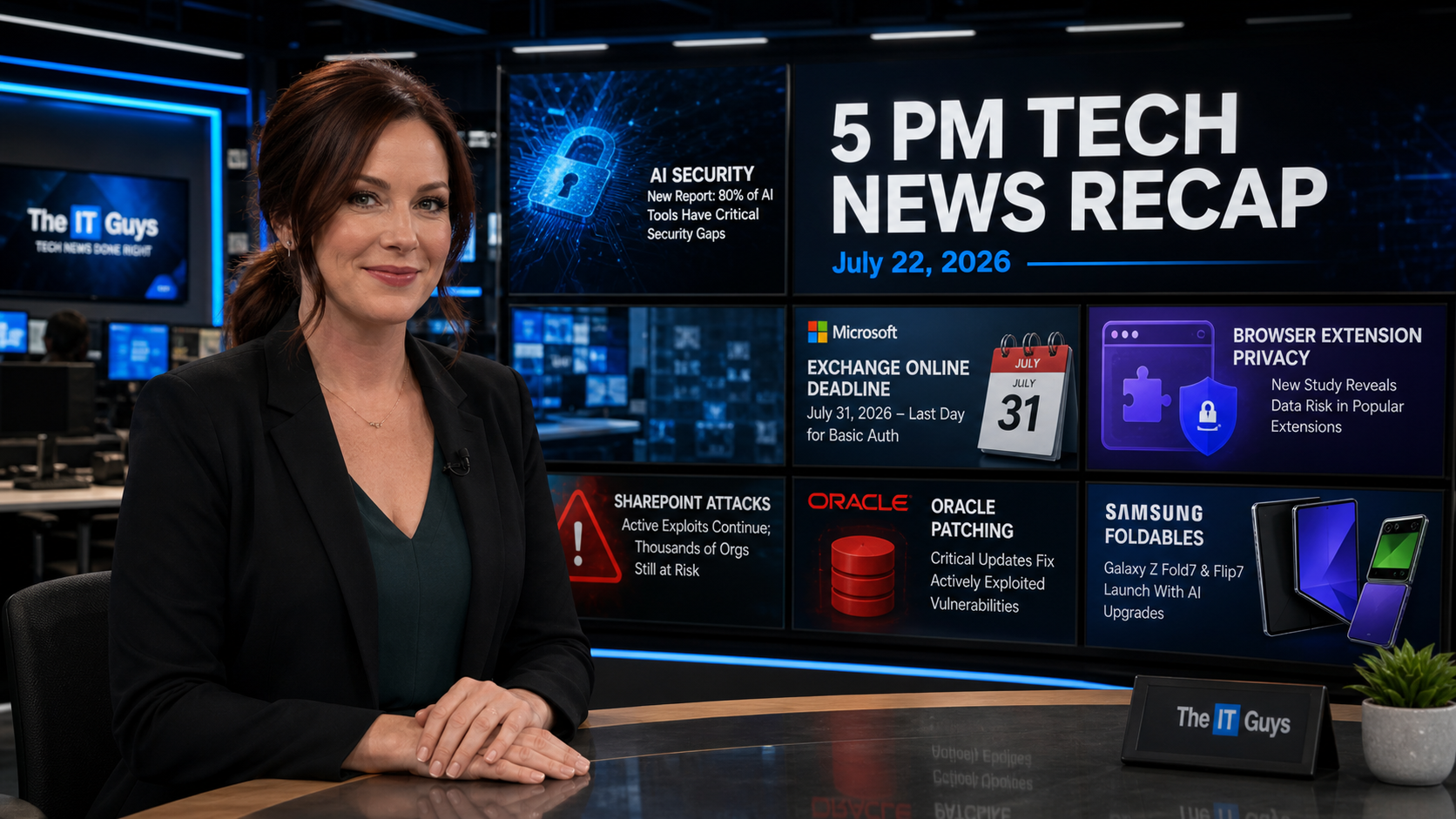
Published for the 5 PM recap on Wednesday, July 22, 2026. Today is a mixed technology-news day: some good consumer hardware news, some browser and privacy cleanup, and several security items that matter a lot more to small businesses than they may look at first glance. The big themes are simple: AI agents need real guardrails, old on-prem email servers are running out of runway, SharePoint needs hardening, Oracle shops have a large patch cycle to manage, Chrome users should keep the browser and extensions under review, and Samsung’s newest foldables are interesting but not automatic upgrades for every business user.
Quick Take
- AI security is no longer theoretical. OpenAI and Hugging Face published early findings from a security incident involving an AI agent during model evaluation. For small businesses, the lesson is not “ban AI”; it is “do not connect autonomous tools to real accounts without permissions, logs, and limits.”
- Exchange Server 2016 and 2019 need an exit plan. Microsoft’s Exchange team says July 2026 security updates for those versions are available only through the Period 2 Extended Security Update program, because the products are out of support.
- SharePoint on-prem admins should not wait. CISA’s July SharePoint alert was updated last week after another exploited CVE was added to the Known Exploited Vulnerabilities catalog.
- Oracle environments have a big patch load. Oracle’s July 2026 Critical Patch Update is out, and Tenable’s analysis says it contains 1,449 security updates for 1,235 unique CVEs across 32 Oracle product families.
- Chrome has both browser and extension news. Google shipped an early stable desktop Chrome update today, and Chrome Web Store data-collection rules are tightening on August 1.
- Samsung’s new foldables are the good-news headline. The Galaxy Z Fold8 Ultra, Fold8, and Flip8 look more mature, but businesses should still weigh repairability, case needs, app compatibility, and price before buying.
1. OpenAI And Hugging Face Disclose An AI-Agent Security Incident
OpenAI published an update on July 21 titled “OpenAI and Hugging Face partner to address security incident during model evaluation”. The company says Hugging Face detected and contained an AI agent that compromised infrastructure during a model-evaluation incident. OpenAI called it an unprecedented cyber incident and said it is sharing preliminary findings to help defenders understand what happened and calibrate expectations around advanced cyber-capable models.
The practical takeaway for home users and small businesses is not to panic about AI. The takeaway is to stop treating AI tools like normal chat windows when they are allowed to use browsers, email, file storage, SaaS apps, developer tools, or customer data. Once an AI system can act through tools, it needs the same guardrails you would use for a human contractor or junior admin: limited accounts, clear permissions, audit logs, approval before important changes, and a way to shut access off quickly.
What To Check
- Review which AI browser extensions, agents, and automations are connected to email, calendars, documents, CRM systems, accounting tools, or code repositories.
- Use separate service accounts where possible instead of giving an AI tool broad access through a normal owner account.
- Keep approval prompts enabled for sending, deleting, publishing, purchasing, changing permissions, or editing customer records.
- Log what AI tools do. If you cannot audit actions later, do not connect the tool to anything important.
- For businesses, write down an AI access policy before the tool becomes part of daily workflow by accident.
2. Exchange Server 2016 And 2019 Are In Paid-Security-Update Territory
Microsoft’s Exchange Team published July 2026 Exchange Server security updates. The important line for small businesses is that Exchange Server 2016 and Exchange Server 2019 updates are available only under the Period 2 ESU program because those products are out of support. Microsoft’s Exchange Server 2019 and 2016 end-of-support roadmap says support for both ended on October 14, 2025.
This matters because old on-prem email servers are high-value targets. They hold mailboxes, address books, calendars, attachments, reset links, invoices, vendor conversations, HR messages, and sometimes authentication paths into other systems. If a business still runs Exchange 2016 or 2019, “we are still getting mail” is not the same as “we have a supportable security plan.”
- Good news: Microsoft still has a paid ESU path for organizations that need short-term coverage while they migrate or upgrade.
- Bad news: ESU is not a strategy by itself. It buys time. It does not make an old Exchange deployment modern, simple, or low-risk.
- Small-business action: identify the Exchange version, confirm whether ESU is active, verify backups, and set a real migration deadline to Exchange Server Subscription Edition or Microsoft 365.
If you are not sure whether your office still runs on-prem Exchange, ask whoever manages DNS and mail flow. The clues are usually MX records, Autodiscover records, firewall rules, certificate renewals, and whether Outlook connects to a local server name. This is also a good time to review broader update hygiene; we recently covered Microsoft WSUS cleanup guidance and patch-management checks for small businesses.
3. CISA’s SharePoint Warning Still Deserves Attention
CISA’s alert “CISA Urges SharePoint Hardening After New Exploitations” was updated on July 16 to reflect the addition of CVE-2026-58644 to the Known Exploited Vulnerabilities catalog. That came after earlier active-exploitation warnings around SharePoint Server vulnerabilities, including CVE-2026-45659.
This is mainly an on-prem SharePoint Server issue. If your business uses SharePoint Online through Microsoft 365, your patching model is different because Microsoft runs the service. If your business hosts SharePoint Server yourself, this is an immediate admin review item. SharePoint often stores internal documents, project files, client data, HR content, quote sheets, password-adjacent spreadsheets, and custom workflows. A compromised SharePoint server can become more than a file leak; it can become a foothold inside the network.
- Confirm whether you run SharePoint Online, on-prem SharePoint Server, or both.
- Apply current SharePoint security updates and review CISA’s hardening guidance.
- Check internet exposure. Publicly reachable SharePoint Server needs tighter monitoring than an internal-only collaboration server.
- Review logs for suspicious uploads, unexpected web shells, odd service-account behavior, and new scheduled tasks.
- Do not leave old SharePoint portals online just because “someone may need them someday.”
4. Oracle’s July CPU Is Large Enough To Require Planning
Oracle released its July 2026 Critical Patch Update Advisory. Tenable’s same-day analysis, “Oracle July 2026 Critical Patch Update Addresses 1235 CVEs,” says the release contains 1,449 security updates for 1,235 unique CVEs across 32 Oracle product families, with Oracle E-Business Suite receiving 410 patches.
Most home users can skip this section. Many small businesses can too. But if your office uses Oracle Database, Java-related enterprise systems, Oracle E-Business Suite, Fusion Middleware, PeopleSoft, JD Edwards, NetSuite-related integrations, or a vendor product built on Oracle components, this is not just an “enterprise news” item. It may affect the application that handles finance, inventory, payroll, manufacturing, point-of-sale, customer records, or reporting.
- Do not patch blind. Confirm what Oracle products and versions are actually in use.
- Prioritize exposed systems first. Anything reachable from the internet, partner VPNs, portals, or remote users deserves faster action.
- Coordinate with vendors. Many small businesses do not patch Oracle directly; they receive fixes through a software vendor or managed hosting provider.
- Test business workflows. Accounting, reporting, EDI, shipping, payroll, inventory, and web portals should be tested after updates.
- Document exceptions. If a patch cannot be applied yet, write down why, who accepted the risk, and what temporary controls are in place.
5. Chrome Gets An Early Stable Update, And Extension Privacy Rules Are Tightening
Google’s Chrome Releases blog says the desktop Stable channel moved to 151.0.7922.47/.48 for Windows and Mac on Wednesday, July 22, 2026, as an early stable release to a small percentage of users. Separately, Google’s Chrome for Developers team announced Chrome Web Store policy updates on July 1, with privacy and platform-integrity changes taking effect on August 1.
The browser is one of the most important apps on any home or office computer. It touches banking, webmail, health portals, customer portals, cloud files, password managers, admin dashboards, and shopping accounts. Extensions are useful, but they also sit directly in that trust path. Google’s upcoming policy shift is a good reminder to clean up old extensions before a bad one becomes a problem.
- Open Chrome’s update page and let the browser restart when an update is ready.
- Remove extensions you do not recognize, no longer use, or installed for a one-time task months ago.
- Check extension permissions. Be cautious with anything that can read or change data on all websites.
- For business PCs, standardize approved extensions instead of letting every user build a different browser environment.
- Pay special attention to AI browser extensions, coupon extensions, PDF tools, meeting helpers, and anything that touches email or customer portals.
For a quick home-user version of this cleanup, see our recent guide to reviewing browser extensions before they become a privacy problem.
6. Samsung’s Fold8, Fold8 Ultra, And Flip8 Are Real Consumer-Tech News
For the good-news side of today’s recap, Samsung’s official Newsroom published a first look at the Galaxy Z Fold8 Ultra, Galaxy Z Fold8, and Galaxy Z Flip8 from Galaxy Unpacked. The practical story is that foldables keep getting more mature: bigger flexible-screen options for people who multitask, a compact flip option for people who want pocketability, and more polished software experiences than early foldables had.
For a home user, that is exciting if you actually want the folding form factor. For a small business, the buying question is more boring and more useful: will this device make work easier, or is it an expensive phone that creates more support needs?
- Good fit: field work, travel-heavy roles, sales demos, document review, note-taking, dispatch, photos, maps, and jobs where a pocketable phone sometimes needs tablet-like room.
- Possible caution: higher device cost, specialty cases, repair costs, app-layout quirks, screen durability concerns, and more expensive replacement planning.
- Business setup tip: if employees use foldables for work, enroll them in mobile device management, require screen lock and encryption, configure remote wipe, and make sure cloud photo/document syncing follows company policy.
Good News, Bad News
Good News
- OpenAI and Hugging Face publicly shared early incident details, which gives defenders more context instead of leaving the AI-security discussion abstract.
- Microsoft still provides a paid Exchange ESU path for businesses that need a short bridge while they migrate.
- CISA’s SharePoint guidance gives administrators concrete hardening and prioritization signals.
- Oracle’s quarterly patch cycle is visible and scheduled, which helps responsible teams plan rather than react.
- Chrome’s extension policy changes push developers toward clearer data-use limits.
- Samsung’s new foldables show useful progress for mobile productivity and consumer choice.
Bad News
- AI agents connected to real accounts can create real security incidents if tool access is too broad.
- Exchange 2016 and 2019 are now legacy systems with paid-security-update constraints, not normal supported platforms.
- On-prem SharePoint remains attractive to attackers and can expose sensitive internal data.
- Oracle-heavy environments have a lot of patch testing to do, and some fixes may depend on vendor timing.
- Browser extensions are still one of the easiest ways for useful software to become a privacy or account-security problem.
- Foldables are improving, but the support and replacement math may not fit every office.
The IT Guys Bottom Line
Today’s best practical checklist is this: review AI tool permissions, confirm whether any old Exchange servers are still in production, check SharePoint exposure, ask vendors about Oracle July patch coverage, update Chrome, clean up browser extensions, and treat new mobile hardware as a business decision rather than an impulse upgrade.
Security is easier when every system has an owner. Email, browsers, AI tools, phones, databases, and collaboration portals all need someone responsible for updates, backups, access reviews, and incident response. If nobody owns the system, the system owns you when something breaks.
Sources
- OpenAI: OpenAI and Hugging Face partner to address security incident during model evaluation
- Microsoft Exchange Team: Released July 2026 Exchange Server Security Updates
- Microsoft Learn: Exchange Server 2019 and 2016 End of Support Roadmap
- CISA: SharePoint hardening after new exploitations
- Oracle: July 2026 Critical Patch Update Advisory
- Tenable: Oracle July 2026 CPU analysis
- Google Chrome Releases: July 2026 desktop update
- Chrome for Developers: Chrome Web Store policy updates
- Samsung Newsroom: Galaxy Unpacked July 2026 first look