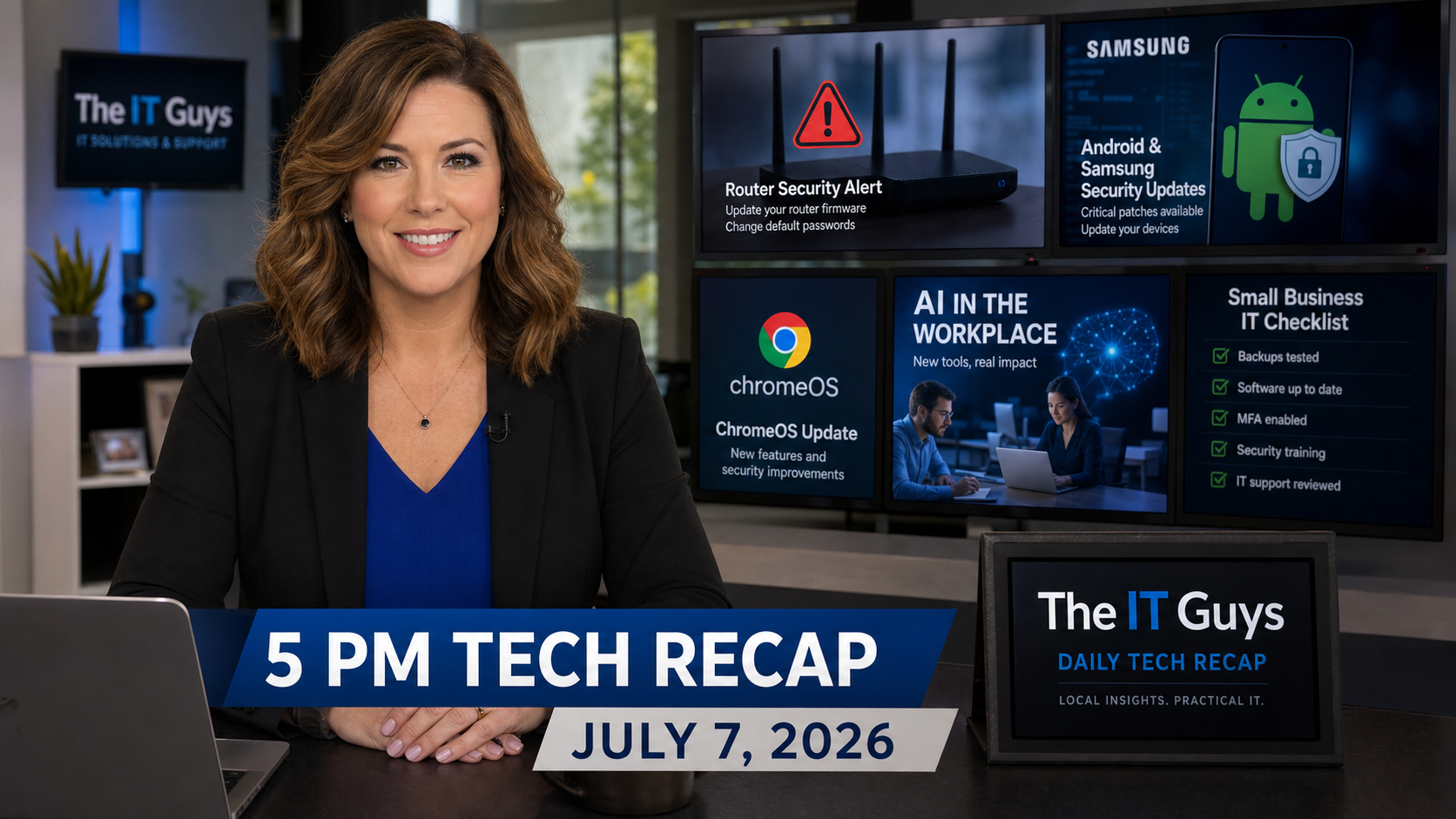
Daily technology news recap for Tuesday, July 7, 2026. Today’s practical tech news is mostly about trust: whether you can trust the router at the edge of your network, the remote-support tool your IT team uses, the code host that stores your projects, and the AI systems now being wired into developer and security workflows. There is some good news in the mix. Android, Samsung, ChromeOS, BeyondTrust, Google, and Linux maintainers all have fixes or better tooling moving forward. The bad news is that several of the issues are exactly the kind small businesses tend to overlook because they live in “infrastructure” rather than on someone’s desktop.
This recap is written for home users, freelancers, and small offices around Central Florida that want the plain-English version: what happened, who should care, what to check today, and what to put on the maintenance list before it becomes an emergency.
Quick Take
- Router risk: CERT/CC disclosed an unpatched hidden authentication backdoor in multiple Tenda router firmware builds. If you use Tenda equipment, check the model and firmware, disable remote management, and consider replacement if no patch appears.
- Remote access risk: BeyondTrust published fixes for critical Remote Support and Privileged Remote Access flaws. Cloud customers were patched, but self-hosted appliances need verification.
- Developer risk: Security researchers warned that attackers are actively exploiting a Gitea Docker image authentication-bypass flaw. Internet-facing code repositories should be patched and checked for exposed secrets.
- Linux and cloud risk: A newly disclosed Linux KVM bug, Januscape, can let a guest VM affect the host in certain virtualization environments. This matters most to hosting providers, labs, and businesses running their own virtualization stacks.
- Update news: Android’s July bulletin, Samsung’s July maintenance release, and a ChromeOS stable update are out or rolling. For most households, the best action is still boring but effective: install updates, restart, and verify the patch level.
- AI good news with caveats: Google expanded managed-agent capabilities for developers, while the UK’s NCSC described a national AI “Cyber Shield.” These tools can help defenders, but they also raise the bar for logging, permissions, and approval controls.
1. Tenda Router Firmware Backdoor Is The Home And Small Office Headline
The most customer-facing security story today is the CERT/CC advisory for CVE-2026-11405, an undocumented authentication backdoor in several Tenda firmware versions. CERT/CC says the issue can grant administrative access to the router’s web management interface regardless of the normal administrator account credentials. BleepingComputer’s July 7 report adds the practical concern: the vendor could not be reached, and there is no confirmed firmware fix at the time of the advisory.
Why this matters: the router is not just a Wi-Fi box. It decides DNS, firewall rules, port forwarding, guest network separation, and how traffic leaves the building. If someone can administer it, they may be able to redirect browsing, weaken firewall settings, expose internal devices, or use the router as a foothold for the rest of the network.
- Home users: log into the router, record the exact model and firmware version, disable remote web management, and make sure the admin password is unique. If the router is on the affected list and there is no patch, replacement is the cleanest fix.
- Small businesses: treat an affected perimeter router as a failed security control, especially if you handle client data, payment systems, remote access, cameras, or compliance-sensitive records.
- IT takeaway: router inventory matters. A lot of security work fails because nobody knows the exact model, firmware, WAN exposure, and support status of the box at the edge.
Related local reading: if you often work away from the office, our quick tip on using a phone hotspot for sensitive work is a useful companion to this router story.
2. BeyondTrust Remote Support Patches Need Self-Hosted Follow-Through
BeyondTrust’s security advisory list now includes BT26-03, covering CVE-2026-40138, CVE-2026-40139, CVE-2026-40140, and CVE-2026-40141 in Remote Support and Privileged Remote Access. BleepingComputer reported today that the two most severe issues can allow authentication bypass under specific configurations, while BeyondTrust says cloud customers were patched and self-hosted customers should apply the relevant rollup or upgrade.
This is not a reason to panic if your remote-support vendor is managed well. It is a reason to ask a precise question: “Are our remote access appliances cloud-hosted and already patched, or self-hosted and awaiting maintenance?” Remote access software is powerful by design. When it has an authentication problem, the blast radius can be much larger than a normal desktop app bug.
- Check today: product, hosting model, current version, update status, exposed hostname, MFA policy, and logs for unexpected sessions.
- Good news: patches exist and cloud deployments were handled centrally.
- Bad news: self-hosted appliances often sit outside normal workstation patch routines, so they can remain exposed unless someone owns them.
3. Gitea Docker Authentication Bypass Is Being Probed In The Wild
SecurityWeek reported July 7 that attackers are exploiting CVE-2026-20896, a critical Gitea issue tied to Docker images and reverse-proxy authentication. The practical version: under vulnerable settings, an attacker who can directly reach the container’s HTTP port may be able to impersonate a known user through a single header. SecurityWeek cites researcher warnings that exploitation started 13 days after disclosure and that about 6,200 Gitea instances were visible on the internet, though not all are necessarily vulnerable.
For most home users, this is not relevant. For small software shops, web agencies, MSPs, and anyone hosting Git repositories, it is very relevant. Code repositories often contain private code, deployment keys, old credentials, CI/CD configuration, and client project history. If a code host is exposed, assume the cleanup is bigger than “change the password.”
- Update Gitea Docker images to 1.26.3 / 1.26.4 or later guidance from the project.
- Do not expose the container port directly when reverse-proxy authentication is used.
- Rotate deploy keys, API tokens, and secrets if there is any sign the instance was reachable and vulnerable.
- Review recent repository writes, new users, webhook changes, and CI/CD configuration edits.
For everyday file safety, this pairs with the basic habit we covered in showing file extensions before opening attachments: small visibility improvements prevent expensive mistakes.
4. Linux KVM Januscape Is Serious For Virtualization Hosts
SecurityWeek also covered Januscape, CVE-2026-53359, a Linux Kernel-based Virtual Machine flaw in shadow MMU handling. The issue was reportedly patched in the Linux mainline on June 19 and disclosed publicly today. The risk is highest for multi-tenant virtualization environments, public-cloud-style setups, hosting providers, labs, and businesses that let untrusted users run VMs.
If you only use a normal Windows or Mac laptop, this is not a direct “click update right now” story. If your business runs Proxmox, KVM, RHEL virtualization, nested virtualization, development sandboxes, or local private cloud infrastructure, it belongs on the server patch board. The important question is whether your distribution has shipped the kernel fix and whether your hosts have actually rebooted into it.
5. Android, Samsung, Qualcomm, And ChromeOS Updates Are Moving
Google published the Android Security Bulletin for July 2026 on July 6. Samsung’s mobile security page shows a July 2026 maintenance release that includes Google patches and Samsung-specific fixes, including multiple critical Google CVEs listed for the July package. Qualcomm also published a July 2026 security bulletin, which matters because many Android phones rely on Qualcomm components. Google’s Chrome Releases blog also notes a ChromeOS / ChromeOS Flex stable update to OS version 16667.61.0 for most ChromeOS devices.
For customers, the main lesson is not to memorize CVE numbers. It is to verify patch levels. Android updates arrive through Google, Samsung, Motorola, OnePlus, carriers, and device makers at different speeds. A phone can be “working fine” and still be months behind on security. Chromebooks are better about automatic updates, but they still need a restart to finish many updates.
- Android: Settings > Security & privacy > System & updates, then check Android security update and Google Play system update.
- Samsung: Settings > Software update, then check “Security software version” if you need proof for a work device.
- ChromeOS: Settings > About ChromeOS > Check for updates, then restart when prompted.
- Small offices: keep a simple device update inventory for phones, tablets, Chromebooks, routers, NAS boxes, and remote access tools, not only PCs.
6. CISA Added Fresh Known-Exploited Vulnerabilities
CISA’s Known Exploited Vulnerabilities feed added several items dated July 7, including JoomShaper SP Page Builder, Langflow, Joomlack Page Builder, and Adobe ColdFusion entries. This does not mean every reader runs those products, but it is a useful signal: attackers are still moving fast against web apps, plugins, AI workflow tools, and exposed admin surfaces. If your business has a website, custom app, old portal, ColdFusion service, Joomla plugin, or AI workflow tool on the internet, it should be in a patch inventory rather than treated as “set and forget.”
Source: CISA Known Exploited Vulnerabilities Catalog.
7. AI Security Is Moving From Theory To Operations
Two AI stories today are worth putting next to each other. Google announced expanded Managed Agents in the Gemini API, including background execution, remote MCP server integration, custom function calling, and credential refresh for longer-running agent workflows. Meanwhile, The Record reported on the UK NCSC’s plan for an AI-driven Cyber Shield that would use agentic systems to discover and help fix weaknesses across government and critical infrastructure.
The good news is obvious: defenders need help. AI systems that can triage logs, test configurations, and keep long-running work organized could reduce response times. The caution is just as important: when software agents can run tools, talk to remote systems, refresh credentials, and make changes, they need the same controls you would require for a junior admin. That means least privilege, logs, approval gates for risky actions, sandboxing, secret handling, and a clear owner.
- For home users: be careful with “AI browser” and “AI assistant” extensions that ask for broad access to your accounts.
- For small businesses: do not connect AI tools directly to email, files, code, ticketing, or accounting systems without deciding what they can read, what they can write, and who reviews actions.
- For developers: treat MCP servers, tool descriptions, and agent permissions as part of the security boundary, not just convenience plumbing.
What I Would Check Before Tomorrow Morning
- Check whether any Tenda router is in use at home, in the office, or at a client site. Record model and firmware version.
- Disable remote management on routers unless there is a documented business reason and compensating protection.
- Confirm BeyondTrust Remote Support / PRA patch status if your organization uses it, especially for self-hosted deployments.
- Patch Gitea Docker deployments and make sure container ports are not directly exposed.
- Schedule Linux virtualization host kernel updates and reboots where KVM is used.
- Install Android, Samsung, Qualcomm-vendor, and ChromeOS updates as they become available, then restart.
- Review CISA KEV additions against your website, plugins, portals, and web-facing business tools.
- For AI agents, document where they have credentials, what tools they can call, and what actions require approval.
Bottom Line
Today’s recap is not about one flashy consumer feature. It is about the unglamorous parts of technology that decide whether everything else stays safe: routers, remote access appliances, code repositories, virtualization hosts, mobile updates, browser updates, and AI tool permissions. The practical win is to make a short inventory and close the obvious gaps. If you know what you own, what version it runs, whether it faces the internet, and who is responsible for updates, you are already ahead of many small offices.
Source note: This recap was checked on Tuesday, July 7, 2026 around 5:00 PM Eastern. Security advisories can change quickly, especially when vendors publish fixes after disclosure, so follow the linked vendor and agency pages for final remediation instructions.