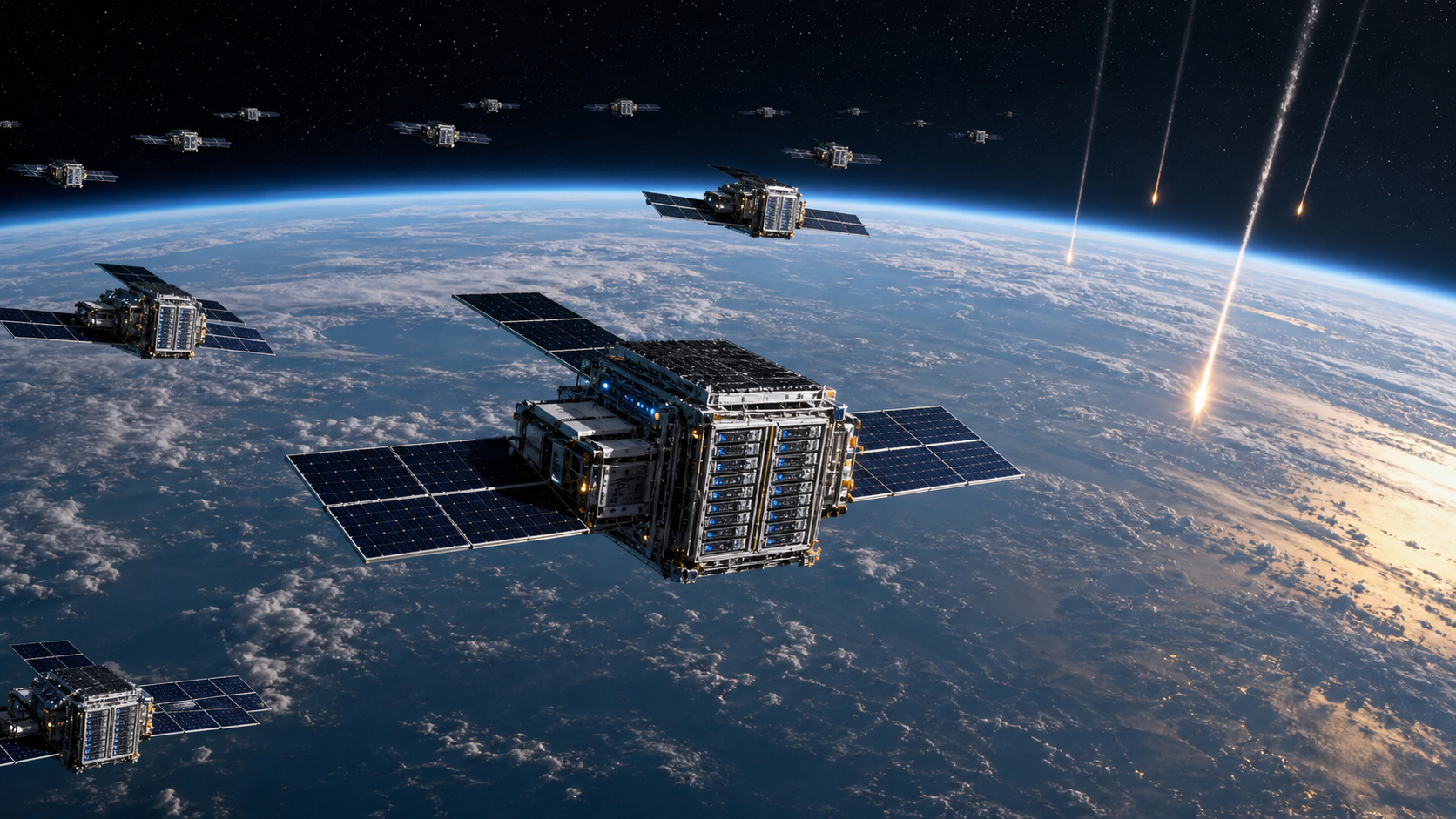
SpaceX has asked the Federal Communications Commission for permission to build something far bigger than ordinary satellite internet: an orbital data-center system with up to one million satellites. The application is real. The environmental fight around it is real. The most dramatic social-media version of the story, though, needs careful framing: the concern is not that Earth will literally catch fire tomorrow, but that massive numbers of satellites and launches could inject metals, soot, aluminum oxides, debris risk, and light pollution into parts of the atmosphere and night sky that regulators have not studied at that scale.
The FCC accepted SpaceX’s application for filing on February 4, 2026, under ICFS File No. SAT-LOA-20260108-00016. The public notice says SpaceX is seeking authority for a new non-geostationary satellite system of up to one million satellites operating as the “SpaceX Orbital Data Center system” at altitudes ranging from 500 km to 2,000 km. SpaceX describes the project in unusually sweeping terms, including a reference to becoming a Kardashev II-level civilization that can harness the Sun’s power.
On the other side, Earthjustice, Public Employees for Environmental Responsibility, DarkSky International, Environment America, and other petitioners are asking the FCC to pause space data-center licensing until a serious environmental review is done. Their petition argues that multiple pending orbital data-center proposals, taken together, seek to place well over a million data-center satellites in low Earth orbit over the next decade, and that the FCC should evaluate the cumulative impact before issuing licenses one project at a time.
In This Article
- What SpaceX actually filed with the FCC
- Why anyone would put data centers in orbit
- The environmental concerns: atmosphere, ozone, debris, and night sky
- What the science already shows
- What is not proven yet
- Why this matters to ordinary customers and small businesses
- Sources and further reading
What SpaceX Actually Filed
The most important primary source is the FCC public notice titled “Space Bureau Accepts For Filing SpaceX’s Application For Orbital Data Centers”. It states that Space Exploration Holdings, LLC, a SpaceX entity, applied for a new NGSO system of up to one million satellites. The system would use optical inter-satellite links, telemetry, tracking, and command operations, and SpaceX requested several FCC waivers tied to NGSO processing, milestones, surety bonds, and Schedule S filing details.
That matters because “up to one million” is not just a rumor. It is in the FCC notice. The project is also not just Starlink broadband under a different name. The filing describes a separate orbital data-center system that could link with SpaceX’s existing first- and second-generation Starlink systems and route traffic through a high-capacity laser mesh.
The application should still be understood as a regulatory request, not a completed deployment. A filing can be accepted for review without being granted. Comments, petitions, oppositions, replies, technical questions, policy questions, and public-interest review can all come before a final authorization.
Why Put Data Centers In Space?
The idea behind orbital data centers is that AI infrastructure is hungry for power, cooling, land, and grid capacity. On Earth, AI data centers can strain utility planning, water resources, local permitting, transmission capacity, and community politics. In orbit, advocates argue that satellites could use abundant solar power and radiate heat into space instead of drawing from terrestrial grids and cooling systems.
That is the sales pitch. It sounds elegant until the engineering and environmental bill arrives. Compute hardware is heavy. Radiators and solar arrays are large. Satellites fail, age, maneuver, collide, and eventually reenter. Launches produce emissions. A constellation measured in hundreds of thousands or a million objects changes the scale of every risk: orbital traffic, conjunction management, launch cadence, replacement cadence, brightness, radio interference, atmospheric deposition, and end-of-life disposal.
There is also a practical latency and workload question. Some AI work can tolerate delays. Other interactive workloads cannot. If an orbital data center has to send results back to users on Earth, the network design, ground-station capacity, laser links, routing, weather resilience, cybersecurity, and reliability all matter. This is not simply “put GPUs in space and the problem is solved.”
The Environmental Concerns
The Earthjustice petition asks the FCC to prepare a Programmatic Environmental Impact Statement, or PEIS, before licensing orbital data-center projects. The core argument is cumulative impact: if SpaceX, Blue Origin, Starcloud, Cowboy Space, and future applicants all pursue space-based compute constellations, the environmental result cannot be understood by looking at one application in isolation.
1. Satellite Reentry Pollution
When satellites reenter, they do not simply disappear. Much of the material vaporizes and can form particles or chemical compounds high in the atmosphere. Scientists are especially interested in aluminum and aluminum oxide because satellites use aluminum-rich structures and because aluminum oxide particles can persist and interact with atmospheric chemistry.
The concern is scale. A single satellite burning up is one event. Thousands of satellites retiring over many years is a different problem. A million-satellite orbital data-center system, if it ever became real and required constant replacement, would move the discussion into a category regulators have never had to manage before.
2. Ozone And Stratospheric Chemistry
NOAA scientists reported in 2023 that about 10% of stratospheric sulfuric acid particles larger than 120 nanometers contained aluminum and other elements associated with spacecraft reentry. NOAA also warned that planned growth in low Earth orbit satellites could push that fraction much higher over the next few decades. That does not mean the ozone layer is already collapsing because of satellites, but it does mean spacecraft metals are measurable in a sensitive atmospheric layer.
A 2024 study in Geophysical Research Letters modeled aluminum oxide production from satellite demise and estimated that a typical 250 kg satellite could generate around 30 kg of aluminum oxide nanoparticles. The study also estimated that satellite reentries in 2022 caused roughly 17 metric tons of aluminum oxides and that future megaconstellations could raise that number sharply. These are modeling results, not a final global damage assessment, but they explain why scientists want more study before constellations get dramatically larger.
3. Rocket Launch Emissions
Every satellite must get to orbit. A mega-constellation of orbital data centers would require a huge launch and replacement pipeline. Launch emissions can include black carbon, nitrogen oxides, carbon monoxide, water vapor, alumina from solid motors, and other compounds depending on vehicle and propellant. The exact impact depends on launch vehicle, altitude, frequency, and atmospheric chemistry, but high-altitude emissions deserve extra scrutiny because they occur in layers where pollution can behave differently than at ground level.
4. Orbital Debris And Collision Risk
Low Earth orbit is already crowded. Satellite operators can maneuver around predicted conjunctions, but more satellites mean more objects to track, more avoidance maneuvers, more failure modes, and more chances for fragments if a collision happens. Even small debris can be dangerous at orbital speeds. A data-center constellation also raises questions about size, mass, power, radiator area, and how well failures can be safely deorbited.
5. Light Pollution And Astronomy
DarkSky International and astronomy groups are worried that huge numbers of satellites could permanently change the night sky. Bright satellites can leave streaks in telescope images, interfere with surveys, and reduce the quality of natural dark skies. This matters for professional observatories, backyard astronomy, cultural sky traditions, wildlife behavior, and simple human enjoyment of the night sky.
What The Science Already Shows
There are three useful layers of evidence:
- Measured spacecraft metals: The 2023 PNAS/NOAA work found spacecraft-origin metals in stratospheric aerosols. This is direct measurement, not speculation.
- Modeled aluminum oxide production: The 2024 AGU study modeled how satellite aluminum can oxidize during reentry and how long resulting particles may persist.
- Regulatory review concerns: The GAO warned in 2022 that the FCC had not sufficiently documented whether its broad categorical exclusion from environmental review should apply to large satellite constellations.
Taken together, those points do not prove every worst-case claim. They do prove that the issue is legitimate enough for detailed review. The best question is not “Is space technology bad?” It is “What scale of space infrastructure can we operate without damaging the atmosphere, astronomy, orbital safety, and the public interest?”
What Is Not Proven Yet
It is important not to overstate the story. Several things remain uncertain:
- SpaceX has not launched one million data-center satellites. This is an application under review, not a completed constellation.
- The exact satellite design is not fully public in everyday-customer terms. Mass, materials, brightness controls, replacement rate, radiator design, failure behavior, and end-of-life assumptions all affect impact.
- The phrase “fire pit” is dramatic shorthand. Reentries create heat and plasma, but the scientific concern is atmospheric chemistry and pollutant deposition, not Earth turning into a literal fireball.
- Orbital data centers may face serious economics and engineering limits. Heat rejection, launch cost, repairability, chip radiation hardening, networking, and replacement cadence are hard problems.
- Environmental impacts need better quantification. That is exactly why the petitioners want a comprehensive environmental review before the FCC approves projects at this scale.
Good Points And Bad Points
The Potential Good
- AI infrastructure is a real bottleneck. Power, cooling, land, and grid connection delays are serious constraints for terrestrial data centers.
- Space-based solar power is attractive on paper. Satellites can receive sunlight without weather interruptions depending on orbit and design.
- Optical inter-satellite links keep improving. Laser mesh networks could make space infrastructure more capable than older satellite systems.
- Regulatory scrutiny is happening before deployment. The filing, petitions, and public record give regulators a chance to ask hard questions early.
The Serious Bad
- The proposed scale is enormous. One million satellites would be orders of magnitude beyond today’s active satellite population.
- Reentry pollution is no longer hypothetical. Spacecraft-origin metals have already been measured in stratospheric aerosols.
- Current environmental review rules may be outdated. GAO already told the FCC to reexamine how it applies environmental exclusions to large constellations.
- The night sky is a shared resource. Astronomy, wildlife, dark-sky tourism, culture, and human experience all take the hit if satellite brightness is not controlled.
- Cumulative impact is the hard part. A single company may claim mitigation, but multiple giant constellations can create combined effects no one applicant owns alone.
Why This Matters To Customers And Small Businesses
At first glance, orbital data centers may sound distant from daily IT work in Port Saint Lucie, Jensen Beach, Fort Pierce, or Vero Beach. They are not. AI infrastructure decisions affect cloud pricing, power demand, hardware supply chains, cybersecurity, satellite internet, emergency communications, environmental policy, and the future cost of online services.
If space-based compute becomes a serious industry, businesses will eventually hear promises about faster AI, cheaper cloud services, resilient off-world infrastructure, and lower water usage. Those claims need the same skepticism we use for any technology project: where is the data, what is the failure mode, who pays for cleanup, what happens at end of life, and what happens if the provider changes pricing or shuts down a service?
For homeowners and small businesses, the near-term action is not to buy or avoid anything today. The practical action is to understand the trend. AI demand is pushing technology companies toward extreme infrastructure ideas. Some will be useful. Some will be hype. Some may create new risks faster than rules can catch up.
What To Watch Next
- FCC action on SAT-LOA-20260108-00016: whether the agency asks for more environmental detail, grants waivers, pauses review, or moves toward approval.
- Responses to the Earthjustice petition: whether the FCC agrees a PEIS is needed or continues treating satellite licensing through existing review categories.
- Technical details from SpaceX and other applicants: satellite mass, materials, brightness mitigation, reentry design, replacement rate, launch cadence, and failure handling.
- Independent atmospheric research: especially work measuring or modeling aluminum oxide, metals, ozone effects, and high-altitude launch emissions.
- Astronomy and dark-sky comments: because visibility and radio interference can become operational limits even if the compute technology works.
FAQ
Is SpaceX definitely launching one million data-center satellites?
No. The FCC accepted an application for filing. That starts a regulatory review and public-comment process. It does not mean the full system is approved, funded, manufactured, launched, or operating.
Could satellites really damage the atmosphere?
Scientists have measured spacecraft-related metals in stratospheric aerosol particles, and modeling studies suggest satellite reentry can produce aluminum oxide particles. The exact long-term climate and ozone impacts at mega-constellation scale need more research, which is the core reason environmental groups are pushing for review.
Why not just build data centers on Earth?
Terrestrial data centers have their own problems: power demand, grid delays, cooling, land use, water use, noise, and local permitting fights. Moving compute to space may avoid some terrestrial constraints but introduces new launch, orbital, reentry, light-pollution, repair, and regulatory problems.
Is this only about SpaceX?
No. SpaceX’s one-million-satellite filing is the biggest headline, but the environmental petition also points to other orbital data-center proposals and future similar projects. The concern is the combined effect of a new industry, not only one company.
Sources And Further Reading
- FCC public notice: SpaceX application for orbital data centers, DA 26-113
- Earthjustice petition asking the FCC for environmental review of space data-center proposals
- Space.com: space-based data centers and criticism over missing environmental review
- The Guardian: experts warn about environmental risks from space data centers
- The Register: orbital data-center gold rush and FCC environmental review petition
- Data Center Dynamics: coalition asks FCC to halt orbital data-center applications pending review
- GAO: FCC should reexamine environmental review process for large satellite constellations
- NOAA: scientists link exotic metal particles in the stratosphere to spacecraft reentry
- PNAS: Metals from spacecraft reentry in stratospheric aerosol particles
- Geophysical Research Letters: Potential ozone depletion from satellite demise during atmospheric reentry
- AGU press release on satellite megaconstellations and ozone concerns
Bottom Line
The strongest version of this story is not “SpaceX is about to set the atmosphere on fire.” The stronger and more accurate version is this: SpaceX has filed for a million-satellite orbital data-center system, other companies are pursuing related ideas, and environmental groups are warning that regulators are not prepared to evaluate the cumulative atmospheric, orbital, and night-sky effects at that scale.
That is a serious enough issue to deserve real review before the sky becomes the next data-center construction zone. The technology may be impressive, but impressive infrastructure still needs accountability, lifecycle planning, and honest environmental math.