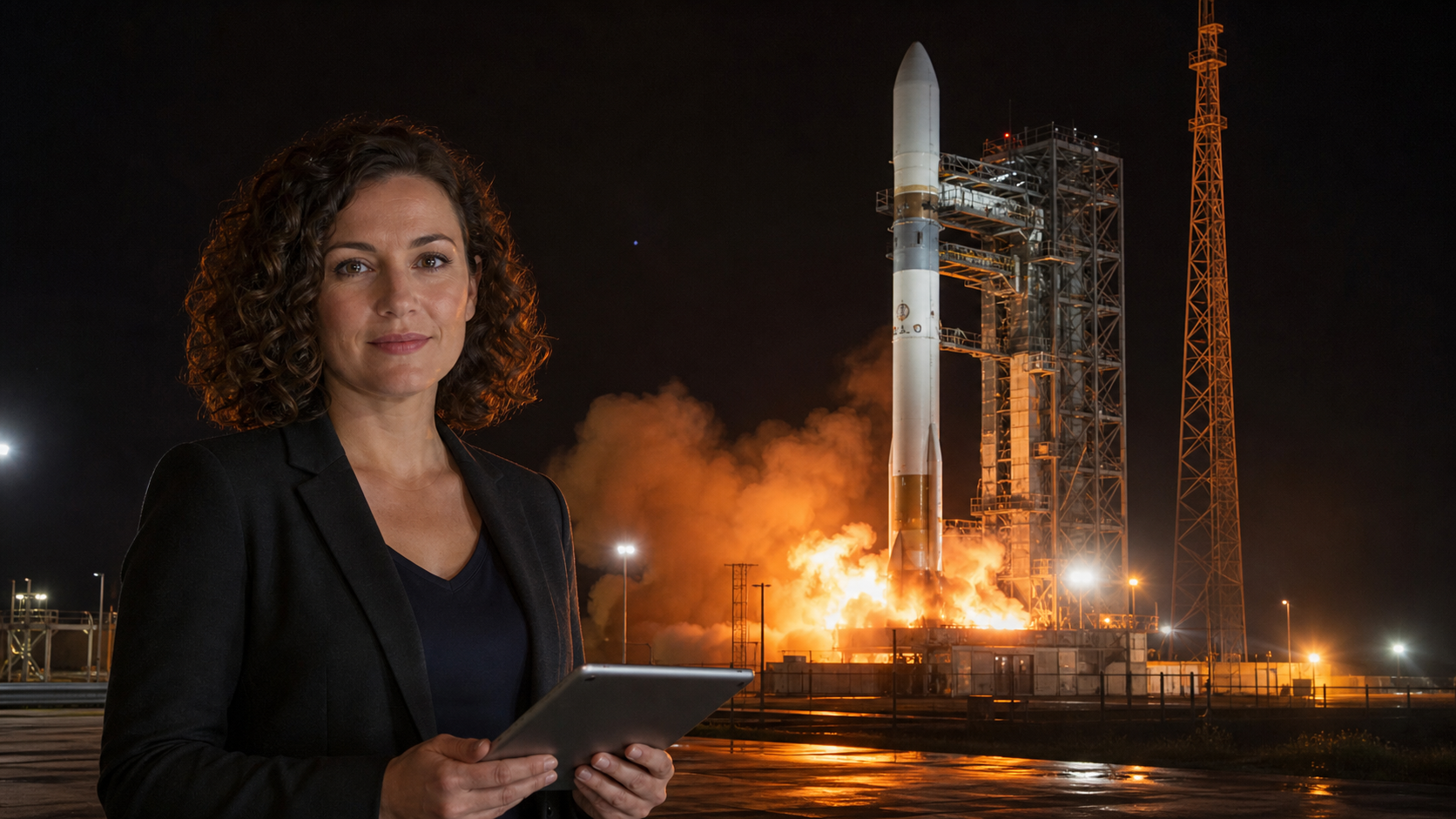
Updated May 29, 2026: Blue Origin’s New Glenn rocket was destroyed Thursday night during a hot-fire ground test at Cape Canaveral Space Force Station in Florida. The test was being run ahead of a planned mission to launch Amazon Leo broadband satellites. The important customer-facing facts right now are simple: this was not a crewed launch, officials reported no injuries, Blue Origin has not announced a root cause, and the incident may delay near-term New Glenn missions.
For The IT Guys readers, this is worth watching for two reasons. First, Amazon Leo is part of the growing satellite internet market that could eventually matter for rural homes, mobile businesses, backup internet, and locations where cable or fiber are unreliable. Second, the incident is a useful reminder that complex technology systems need testing, telemetry, backup plans, and honest post-incident analysis before they can be trusted at scale.
What Happened Thursday Night?
Multiple reports say Blue Origin was conducting a static-fire, also called a hot-fire, test of its New Glenn rocket around 9:00 p.m. Eastern on Thursday, May 28, 2026. During this kind of test, the rocket remains held down on the launch pad while its engines are fired so engineers can verify fuel systems, engine behavior, ground equipment, software timing, and countdown procedures before an actual launch attempt.
Instead of completing the test normally, the rocket suffered what Blue Origin called an “anomaly.” Video from launch observers showed a fireball and heavy smoke at the pad. AP reported that nearby homes felt shaking and that the sky briefly turned orange. CBS News reported that the vehicle was destroyed and that post-incident video showed multiple fires and major pad damage. Reuters described the incident as a major setback for Blue Origin’s effort to grow New Glenn into a serious heavy-lift launch competitor.
The Quick Facts
- Company involved: Blue Origin, the space company founded by Jeff Bezos.
- Rocket: New Glenn, Blue Origin’s heavy-lift orbital rocket.
- Location: Cape Canaveral Space Force Station in Florida.
- Type of event: Hot-fire/static-fire ground test, not an in-flight launch failure.
- Planned mission: A future launch carrying Amazon Leo low-Earth-orbit broadband satellites.
- Injuries: Reports from Blue Origin and local/range officials said personnel were accounted for and safe.
- Cause: Not yet known publicly as of Friday morning, May 29.
- Customer impact today: No direct home or small-business service outage, but the schedule for Amazon Leo launches on New Glenn could be affected.
What Jeff Bezos Said Friday Morning
Jeff Bezos posted that personnel were safe and that it was too early to know the root cause. He also said Blue Origin would rebuild and return to flying. His message was essentially: the team is safe, the investigation is beginning, and the company intends to continue.
The most telling short line from Bezos was: “Very rough day.” That is a fair description. This was not a small test stand hiccup. It was a full-pad failure involving a major rocket Blue Origin needs for commercial satellite launches, national security work, and NASA-related lunar plans.
Was This Really “Amazon’s Rocket”?
Not exactly. The rocket belongs to Blue Origin, not Amazon. The Amazon connection is the payload Blue Origin was preparing to launch. Reports from ABC News, Forbes, Reuters, and CBS News say the planned mission was expected to carry 48 Amazon Leo satellites into low Earth orbit.
Amazon Leo is the new name for Amazon’s satellite broadband constellation, formerly known as Project Kuiper. It is intended to compete in the same broad market as SpaceX Starlink: internet service delivered from a large network of low-Earth-orbit satellites. That makes the New Glenn launch schedule important to Amazon because more satellites in orbit usually means more coverage, more capacity, and faster progress toward commercial service.
The key caution: Reuters and CBS News reported that the Amazon Leo satellites were not on board during the hot-fire test. That matters because the explosion appears to have destroyed the rocket and damaged launch infrastructure, but the satellite payload itself was reportedly not lost in the blast.
Why This Matters Beyond Space Fans
For regular customers and small businesses, satellite internet is becoming part of the backup-connectivity conversation. It is not always the first choice when fiber, cable, or strong 5G fixed wireless are available, but it can be valuable in places where wired internet is weak or where a business needs a backup path for point-of-sale systems, cloud phones, security cameras, or remote work.
Amazon Leo is not yet something most local customers can buy and install like a normal router. But launches like the one Blue Origin was preparing for are how those networks grow from concept to practical service. A launch delay does not mean Amazon Leo is canceled, but it may slow the pace of getting more satellites into orbit through this specific Blue Origin vehicle.
What A Hot-Fire Test Is Supposed To Prove
A hot-fire test is one of the most demanding checks before launch. The rocket is fueled, the countdown gets close to real launch conditions, and the engines fire while the vehicle stays attached to the pad. Engineers use the data to confirm that the rocket, pad systems, computers, plumbing, valves, sensors, and abort logic behave correctly.
That is why this kind of test is both valuable and risky. If something is wrong in the fuel system, engine startup sequence, ground support hardware, pressure behavior, or software timing, the test may reveal it before a real mission. The painful part is that a serious failure can damage the rocket and the pad, which can take months to inspect, repair, certify, and return to service.
Good News And Bad News
Good News
- No reported injuries: Blue Origin, local authorities, and range officials reported that personnel were accounted for and safe.
- It happened during a test: The failure occurred on the ground before a launch attempt, not during a crewed mission or an orbital flight with people aboard.
- The payload was reportedly not on board: Reuters and CBS News reported that the Amazon Leo satellites were not integrated on the rocket at the time.
- The investigation starts with data: A test like this generates telemetry, video, sensor data, and timeline records that engineers can use to identify what failed.
Bad News
- The rocket appears to be a total loss: Reports say the New Glenn vehicle was destroyed.
- The launch pad may be badly damaged: New Glenn depends on specialized ground infrastructure, and pad repairs can become the long pole in the schedule.
- Amazon Leo timing could slip: If Blue Origin cannot use this pad quickly, the satellite launch plan may need to be rescheduled or adjusted.
- NASA and other customers will watch closely: NASA Administrator Jared Isaacman said the agency would assess near-term mission impacts.
What We Do Not Know Yet
There are several things no responsible article should claim yet. Blue Origin has not publicly identified the exact root cause. It has not announced a return-to-flight date. It has not given a detailed repair estimate for the launch pad. Amazon has not publicly laid out any revised schedule for this specific Leo mission as of this writing.
That means any article claiming a final cause today is moving faster than the evidence. The likely next steps are debris safety, pad safing, telemetry review, hardware inspection, range review, customer schedule review, and, if needed, regulatory involvement before New Glenn flies again.
Small Business Takeaway: Test Like It Matters
Most businesses do not launch rockets, but the operational lesson is very familiar. The best time to find a failure is during a controlled test, not during a live customer event. That applies to rockets, backups, firewalls, phone systems, cloud migrations, security cameras, and point-of-sale equipment.
If your business depends on technology, do the boring checks before the stressful day:
- Test backups by restoring a real file, not just checking for a green status light.
- Test internet failover before your main provider goes down.
- Test UPS battery runtime before hurricane season.
- Test MFA recovery codes before a phone is lost or replaced.
- Test software updates on one machine before pushing them everywhere.
- Document what failed, what worked, and who needs to be called next time.
The lesson is not that failures are acceptable. The lesson is that serious systems need serious testing, and serious testing needs a plan for what happens when something goes wrong.
What To Watch Next
- Blue Origin’s investigation updates: Look for an official explanation of the root cause and any corrective actions.
- Launch pad repair timeline: Pad damage may determine how quickly New Glenn can fly again.
- Amazon Leo schedule changes: Amazon may need to adjust launch timing or use other providers depending on New Glenn availability.
- NASA statements: NASA will watch the issue because New Glenn and Blue Origin hardware are tied to broader lunar program plans.
- FAA or range review: A major pad incident can require formal review before another launch attempt.
FAQ
Did anyone get hurt in the Blue Origin rocket explosion?
Reports from Blue Origin, local authorities, and range officials said personnel were accounted for and safe, with no injuries or fatalities reported.
Was this a launch failure?
No. It was a ground test, often called a hot-fire or static-fire test. The engines were being tested while the rocket remained on the pad.
Were Amazon satellites destroyed?
Reuters and CBS News reported that the Amazon Leo satellites were not on board during the test.
What did Jeff Bezos say?
Bezos said personnel were safe, that the root cause was not yet known, and that Blue Origin would rebuild and return to flying.
Does this affect home internet customers today?
No direct customer outage has been reported. The possible impact is on future satellite broadband rollout timing, especially if New Glenn launch schedules slip.
Related Reading
- Meet Jennifer: The AI Assistant Helping The IT Guys Share Better Tech News, Guides, and Customer Information – related guidance from The IT Guys archive
- Carnival Data Breach May Affect 800,000 Texans: What To Do Now – related guidance from The IT Guys archive
- iOS Changes Coming In June 2026: What iPhone Users and Small Businesses Should Understand – related guidance from The IT Guys archive
Sources
- Associated Press: Blue Origin rocket explodes during a test at the launch pad
- ABC News: Blue Origin rocket explodes during test at Cape Canaveral
- Reuters: Blue Origin rocket explodes on launchpad
- CBS News: Blue Origin New Glenn rocket explodes on launch pad in Florida
- Forbes: Bezos and Musk comment on Blue Origin rocket explosion
- TechCrunch: New Glenn rocket explodes during testing in Florida
- Blue Origin statement on X
- Jeff Bezos statement on X
- NASA Administrator Jared Isaacman statement on X