

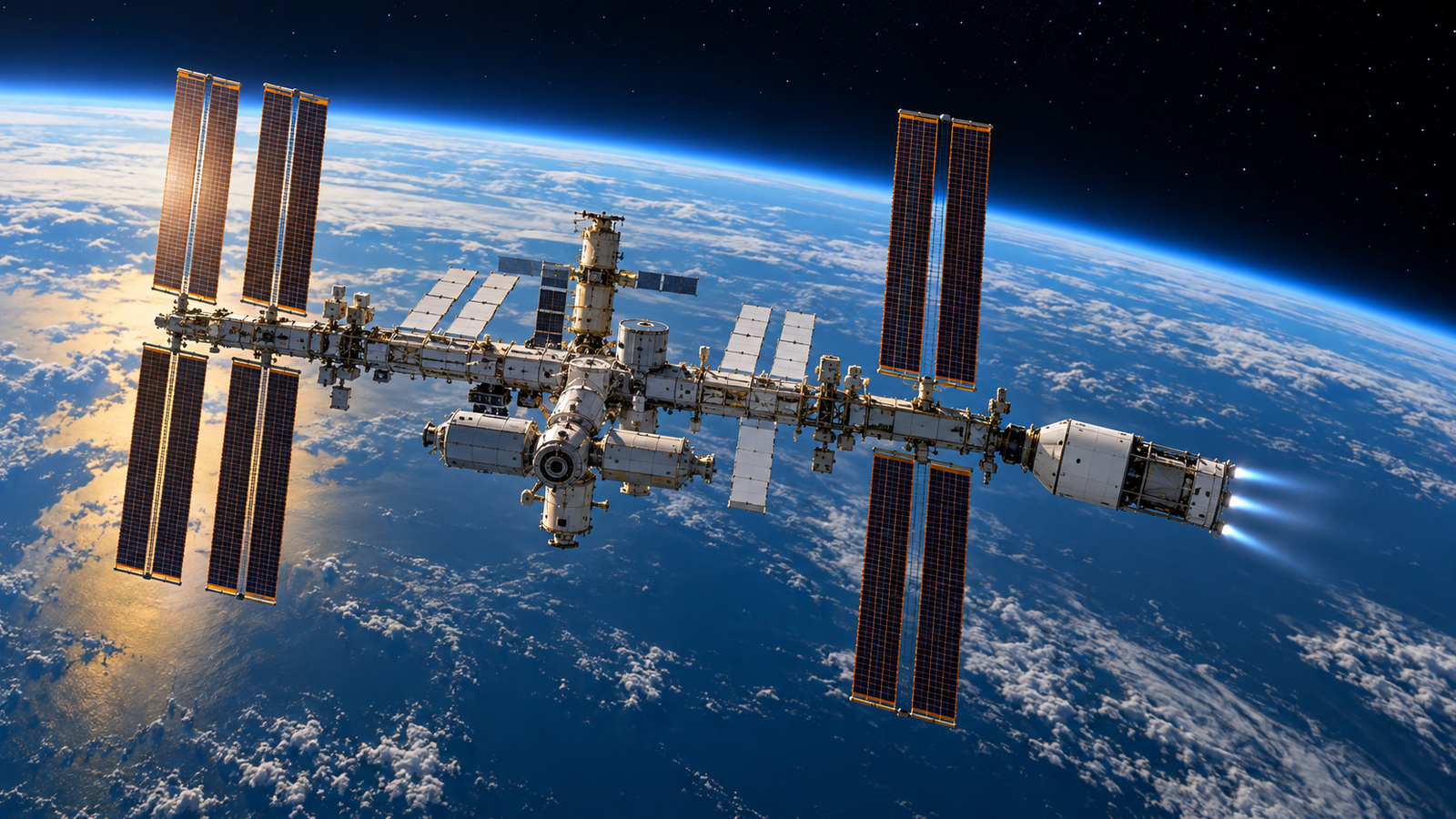
How SpaceX’s $843 Million ISS Deorbit Vehicle Is Supposed to Work
NASA selected SpaceX on June 26, 2024—not in 2026—to develop and deliver the U.S. Deorbit Vehicle that will guide the International Space Station through a controlled reentry.1 The latest public planning described by the U.S. Government Accountability Office puts a retire-or-extend decision in 2027, vehicle completion in 2028, launch and docking in mid-2029, and final reentry at the end of 2030 or early 2031.2
CURRENT EXPLAINER • Reporting cutoff: October 27, 2026, 9:51 a.m. EDT / 13:51 UTC
The bottom line
The contract’s $843 million figure is a maximum potential value for developing and delivering the vehicle—not the total cost of the deorbit mission.1 NASA says the launch service will be bought separately, and NASA will own and operate the vehicle after SpaceX finishes development.1
Verified facts
What happened
GAO’s June 17, 2026 report says NASA’s transition plan was still in flux as of May. Under the March 2026 timeline, NASA expects to assess in 2027 whether to launch the deorbit vehicle in 2029 and proceed toward retirement, or extend ISS operations.2 GAO says NASA estimates SpaceX will complete the vehicle in 2028.2
That decision is linked to more than spacecraft hardware. NASA and its partners need time to arrange funding, crew and cargo flights, spares and international support if operations continue; GAO also says NASA had not yet documented all the factors it will use to make the retirement decision.2 NASA agreed with GAO’s recommendation to document the process and gave June 30, 2027 as its estimated completion date.2
Why it matters
The deorbit vehicle is the last major control system planned for the world’s largest crewed orbital structure. Its job is to narrow the final debris footprint while NASA also manages station aging, partner commitments and the possibility that a replacement commercial station will not be ready on the current schedule.24
The vehicle: Dragon in front, a much stronger trunk behind it
Public descriptions identify a Dragon-based spacecraft with docking and rendezvous capability and a propulsion-equipped trunk.2 NASA’s procurement vignette calls it a Dragon spacecraft with an “enhanced trunk section.”5
At NASA’s July 2024 briefing, SpaceX said the design would carry about 35,000 pounds—roughly 16,000 kilograms—of propellant, use 46 Draco thrusters in total, and place 30 of those engines in the extended trunk for the orbit-lowering maneuvers.7 Those detailed counts came from SpaceX’s briefing description and remain design figures rather than proof of a completed flight vehicle.
How NASA plans to bring the station down
| Phase | What is planned |
|---|---|
| 1. Begin lowering | GAO says natural atmospheric drag and reentry maneuvers by the Russian segment are expected to begin lowering the station in early to mid-2028.2 |
| 2. Launch and dock | NASA’s current planning has the U.S. Deorbit Vehicle launch and attach to the ISS in mid-2029.2 |
| 3. Align the ground track | Operators will use natural decay and controlled maneuvers to lower altitude and line up the final track and debris footprint over an uninhabited ocean region.34 |
| 4. Crew leaves | NASA says the large final burn happens only after all crew have safely returned to Earth.3 |
| 5. Final reentry burn | At the end of 2030 or early 2031, the vehicle is planned to push the station into the atmosphere and direct the debris footprint into a remote part of the ocean.2 |
The station will not descend intact. NASA expects solar arrays and radiators to separate first, followed by breakup of modules and the truss, then fragmentation of those structures.3 Most hardware is expected to burn up or vaporize, but NASA says some dense or heat-resistant components are expected to survive and splash down inside the targeted ocean region.3
Why NASA rejected the apparent alternatives
- Uncontrolled reentry: The ISS is too large. NASA says a random reentry would produce large surviving debris across a broad footprint and would not meet the government’s public-risk standard.4
- Take it apart and bring it home: The station was assembled with 27 shuttle flights and 161 spacewalks. Reversing that work would require extensive spacewalks and a shuttle-like cargo capability that does not exist.4
- Reuse or deorbit modules one by one: Major modules are not self-sufficient spacecraft, use decades-old interfaces, lack convenient docking ports for disposal craft, and would require multiple new vehicles, launches and controlled reentries.4
- Boost the ISS to a graveyard orbit: NASA estimates 120–140 meters per second of velocity change for a roughly 100-year orbit and 760 meters per second for more than 10,000 years, compared with about 57 meters per second for controlled deorbit.3 Higher orbits also increase debris-strike exposure, while the required propulsion, tankers and long-duration support do not exist today.4
- Hand it to a commercial operator: NASA says industry produced no feasible proposal to keep using the major hardware; age, complexity, distributed ownership and missing intellectual-property rights make a takeover harder than deploying new hardware.4
Crew, partners and the backup problem
The ISS is an interdependent partnership. Canada, Europe, Japan, NASA and Roscosmos control the hardware they contributed, and all five agencies share responsibility for the station’s deorbit.1 GAO says the international partners had confirmed support through the planned 2030 retirement, while NASA was still working with Roscosmos to solidify the level of Russian operational support through retirement and deorbit.2
NASA OIG reported that continuing safe operations requires reliable crew and cargo transportation, functioning systems and enough time to prepare the station.6 GAO’s 2026 review says at least three crew members are needed for spacewalks, maintenance and processing, and a regular cadence of four to five cargo flights a year is needed to maintain operations and prepare for controlled deorbit.2 A prolonged uncrewed period would increase the risk that lost functionality leads to an uncontrolled reentry.2
Environmental and public-safety limits
NASA’s objective is risk reduction, not zero physical impact. Its procurement summary describes a targeted debris footprint of 6,000 kilometers or less in an uninhabited region of the South Pacific Ocean and projects small environmental effects, with toxic liquids or materials expected to burn during reentry.5 NASA’s transition FAQ is more explicit about uncertainty: fragments of various sizes will form, some are likely to survive, and the remote ocean target is chosen to protect people and property.3
The reviewed NASA sources describe a remote, unpopulated ocean area; this article does not label the target “Point Nemo” because the current official plan cited here does not require that name.
What this means for readers
The $843 million headline does not mean SpaceX received that amount in 2026, and it does not price the launch or the full mission. The most important current milestone is NASA’s planned 2027 retire-or-extend decision, followed by the vehicle’s estimated 2028 completion and a possible 2029 launch.12
Verified videos
Official NASA media teleconference
YouTube’s oEmbed record identifies NASA Provides Background on Space Station Deorbit Planning (July 17, 2024) as an upload from NASA Video; the measured duration is 5,045 seconds (1:24:05).8 A chronological review shows a static NASA media-teleconference title card throughout, so this is useful as the full official audio briefing rather than as a visual animation.
Watch directly on YouTube. The player does not contact YouTube/Google until you activate it; activation loads the privacy-enhanced youtube-nocookie.com player.
Independent visual explainer
YouTube’s oEmbed record identifies A Closer Look At SpaceX’s New ISS Deorbit Vehicle as an upload from TheSpaceBucket; the measured duration is 485 seconds (8:05).9 A chronological contact-sheet review found relevant ISS, Dragon, docking and reentry imagery without unrelated advertising in the sampled frames. This is an independent explainer, not an official NASA or SpaceX production.
Watch directly on YouTube. The player does not contact YouTube/Google until you activate it; activation loads the privacy-enhanced youtube-nocookie.com player.
What remains unknown
The 2030 retirement date is still a plan, not an irreversible command. GAO says NASA expects a 2027 readiness decision, and an extension remains possible if the station, partners, funding and transportation can support it.2
Commercial replacements may not be ready. GAO says NASA had not assessed the likely duration of a gap in continuous U.S. presence in low Earth orbit and called the commercial-station schedule ambitious.2
The launch cost is not in the $843 million figure. NASA will procure launch separately, so the final government cost of preparing, launching, operating and executing the mission will be higher than the development contract alone.1
The final footprint will depend on conditions near reentry. NASA describes active targeting and attitude control, but atmosphere, station condition and vehicle performance remain mission variables rather than guarantees.
Sources
- NASA Selects International Space Station US Deorbit Vehicle — NASA, June 26, 2024.
- Low-Earth Orbit: NASA Faces Impending Decisions for Replacing International Space Station with Commercial Stations — U.S. GAO, June 17, 2026.
- FAQs: The International Space Station Transition Plan — NASA, updated July 18, 2024.
- International Space Station Deorbit Analysis Summary — NASA, 2024.
- United States Deorbit Vehicle procurement vignette — NASA Office of Procurement, 2025.
- NASA’s Management of Risks to Sustaining ISS Operations through 2030 — NASA OIG, September 26, 2024.
- Enhanced Dragon spacecraft to deorbit the ISS at the end of its life — SpaceNews, July 18, 2024.
- NASA Provides Background on Space Station Deorbit Planning (July 17, 2024) — NASA Video on YouTube.
- A Closer Look At SpaceX’s New ISS Deorbit Vehicle — TheSpaceBucket on YouTube, July 17, 2024.
Update and correction note: This explainer reflects the official and independent sources checked through October 27, 2026, 9:51 a.m. EDT. It will be updated if NASA changes the retire-or-extend decision schedule, vehicle design, launch plan, partner commitments or controlled-reentry timeline.