

☀ Morning Good News for Today
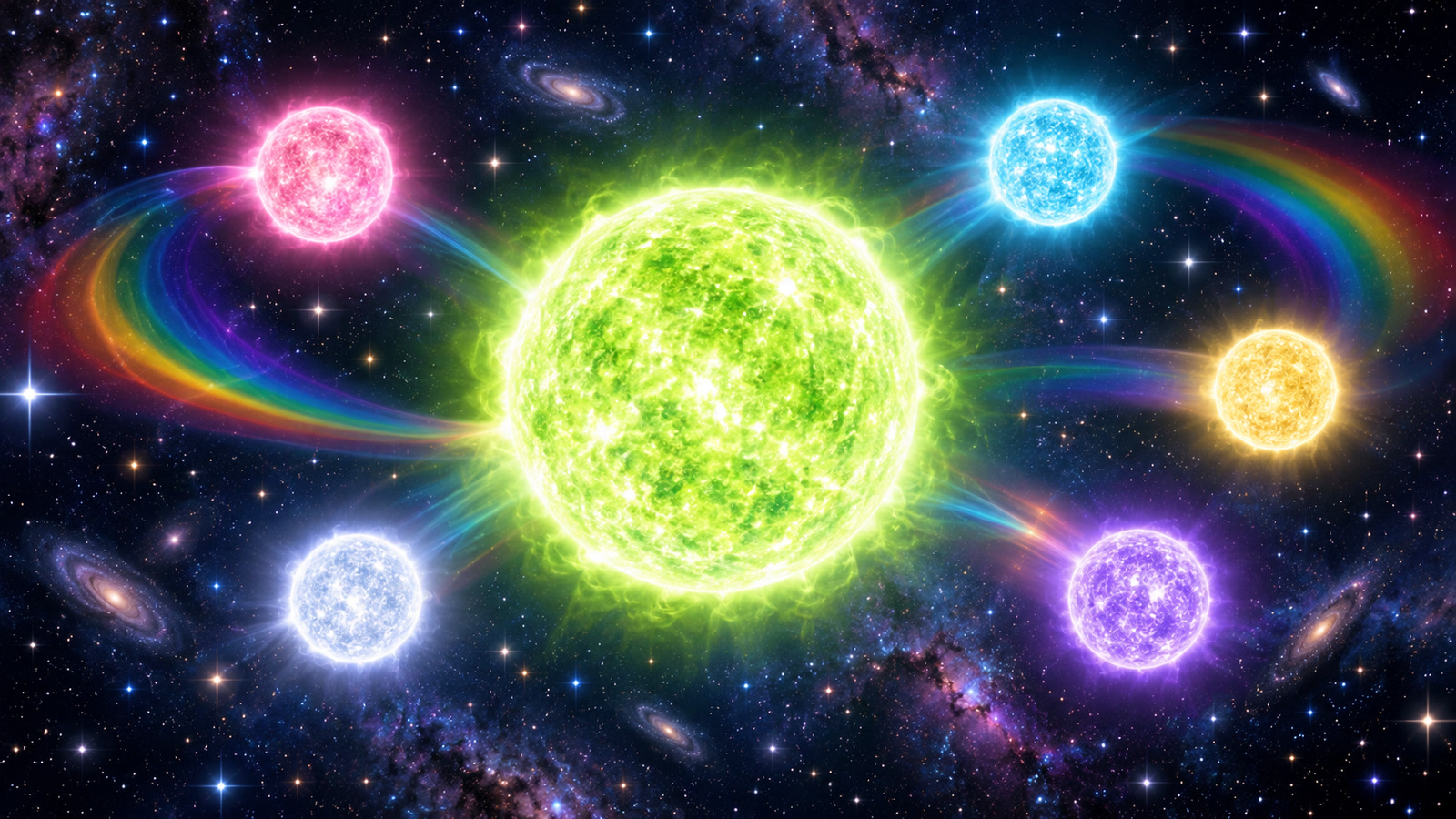
Astronomers modeled how white dwarfs would look to human eyes and found a delightful surprise: one known stellar remnant, WD J1330+6435, would appear chartreuse green up close. [1] [2] Space has apparently been keeping a secret paint box.
Good news in 30 seconds
- The study combined observed and synthetic spectra with standard human-vision color functions to calculate perceived white-dwarf colors. [1]
- The models show examples that would appear yellow, green, cyan, pink, or purple if their discs could be seen up close. [1]
- Reuters independently reported the green-star result after interviewing lead author Mark Hollands and co-author Boris Gänsicke. [3]
What happened
The paper, “Any colour you like: The diverse chromaticities of white dwarfs,” first appeared on arXiv on October 13 and was published in RAS Techniques and Instruments. [1] [2]
The researchers report that most white dwarfs remain close to ordinary blackbody colors, but unusually dense atmospheres containing elements such as carbon, calcium, or sodium can absorb broad portions of visible light and shift the color a human would perceive. [1]
A spectrum can reveal more than temperature and chemistry: when paired with a model of human color vision, it can estimate how a distant unresolved star would actually look from nearby. [2]
The work turns existing astronomical measurements into a more intuitive, color-accurate way to understand extreme stellar atmospheres. [1]
Why this made us smile
White dwarfs, it turns out, took the name as a guideline—not a binding dress code.
What it could mean for everyday people
Practical takeaway: this is a neat example of how software models can translate technical sensor data into something human senses can understand. [1] It also offers a handy media-literacy check: the green color is a calculation grounded in measured spectra, not a close-up photograph of a green stellar disc. [1]
Keep the confetti factual
No white dwarf is close enough for people to resolve its disc and see this color directly, so the team calculated perceived colors from spectra and human-vision models. [2]
The star itself was already known; what is new is the study’s modeled color interpretation and broader analysis of white-dwarf chromaticities. [1] This is an astronomy result, not a new consumer technology or a photographed green sun. [1]
One happy thing to carry with you
Even the universe’s stellar leftovers can still surprise us with a fresh splash of color.
Sources and reporting notes
- arXiv — “Any colour you like: The diverse chromaticities of white dwarfs” (submitted October 13, 2026 at 18:00:02 UTC)
- University of Warwick — “Astronomers reveal surprising true colours of white dwarfs” (October 15, 2026; date only)
- Reuters — “Newly identified green star leaves astronomers amazed” (October 16, 2026; independently reported; accessible syndication checked through CNA)
- RAS Techniques and Instruments — journal article and DOI 10.1093/rasti/rzag069
How we know: The paper and Warwick release support the method, color range, and limitations. [1] [2] Reuters separately interviewed two study authors and corroborated the main green-star explanation; it is independent reporting, not an independent scientific replication. [3]
Artwork note: The featured image is an original agent-generated The IT Guys editorial illustration. It is not a telescope photograph, scientific figure, or direct view of WD J1330+6435.