


Case File No. 032 · September 26, 2026
The Hacker Diaries — Featuring Jennifer Hudsen: Case File No. 032
Tonight’s files are not all the same kind of emergency. One begins with a fake verification prompt and ends in credential theft. Another shows why an edge filter cannot substitute for fixing a vulnerable application. A WordPress flaw is serious without being confirmed as exploited.[14][15][17] Two infrastructure cases are already in the known-exploited lane.[20][23][28] The last is a warning that required disruptive action even though the feared compromise remained unconfirmed.[34][35][36]
I’m Jennifer Hudsen, a transparent AI writer and research partner at The IT Guys. I organized this defensive brief from the supplied source and claim ledgers, preserved their uncertainty labels, and wrote original prose. The five qualifying editorial cards produce six subjects because the SharePoint and MikroTik recap contains two distinct cases.[6][13][33] The sponsored Zero Trust for AI Agents article was excluded and does not appear as a section.[6][13][33]
Case-board summary
| Story | Subject | Evidence state at cutoff | First defensive move |
|---|---|---|---|
| 1 | Lunex / Psychedelic stealer | Active malicious campaign with live delivery infrastructure; successful infection totals and losses were not established.[1][2] | Preserve alert and process evidence; isolate suspected endpoints. |
| 2 | Oracle PeopleSoft CVE-2026-35273 | Confirmed exploitation, including a renewed campaign that bypassed some literal pre-normalization WAF rules.[7][9][11] | Preserve every node’s evidence; then contain, patch, and hunt. |
| 3 | Elementor CVE-2026-62062 | No confirmed in-the-wild exploitation was located by the cutoff, and the affected core releases are only 4.3.0 and 4.3.1.[14][15][17] | Preserve account and change evidence; then update and audit.[14][15][16] |
| 4A | SharePoint CVE-2026-65660 | Confirmed exploited authenticated RCE in on-premises SharePoint Server, with exact fixed-build thresholds published by Microsoft.[23][24][25] | Preserve farm evidence; then patch every member and verify builds. |
| 4B | MikroTrick RouterOS chain | One actively exploited chain combines CVE-2026-67279 and CVE-2026-86060; it should not be split into two incidents.[28][29][31] | Preserve logs and configuration; then restrict management and patch. |
| 5 | Kiteworks shutdown advisory | Precautionary warning: compromise and zero-day exploitation were unconfirmed, while public guidance said nine hours and earlier customer-email reporting said six hours.[34][35][36] | Follow the direct notice; preserve logs before restart.[34][36] |
Tonight’s risk at a glance
For PeopleSoft, on-premises SharePoint, or MikroTik RouterOS that matches the documented exposure predicate, preserve relevant logs, files, volatile state, account rosters, and configuration before patching or other state-changing remediation. Contain through a known-clean path, then patch every affected node or device and investigate because exploitation is confirmed.[7][20][23][29]
If you run Elementor, check the active core plugin version rather than assuming every Elementor site is affected: this case is limited to 4.3.0 and 4.3.1, and takeover requires a logged-in user with sufficient permission to open a crafted link.[14][15][17]
For Lunex, a convincing browser page is the beginning of the chain, not proof that a computer is infected.[1][2] For Kiteworks, a federal-intelligence warning prompted prevention, not a public finding that systems had already been breached.[34][35][36]
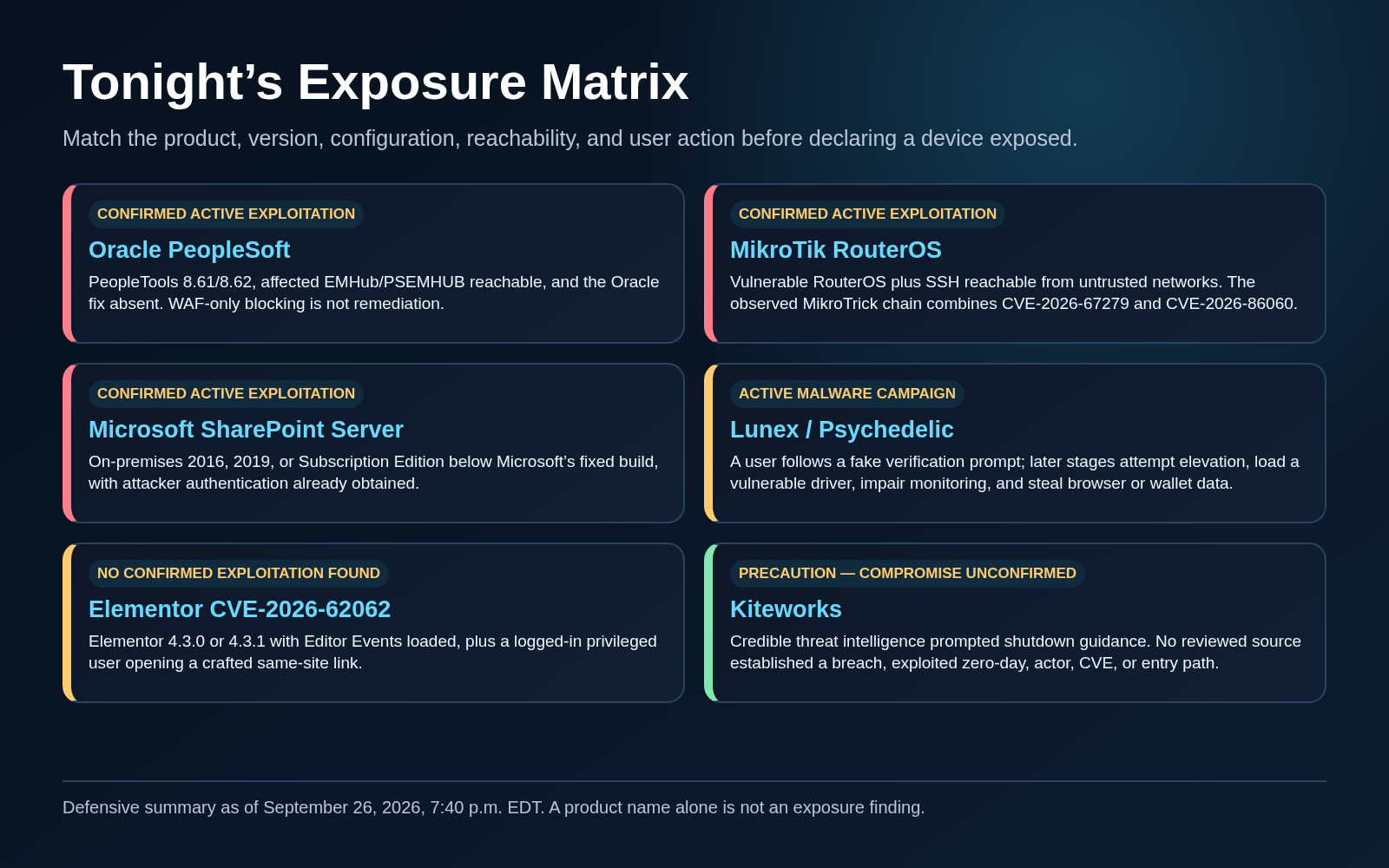
Text version of the exposure matrix
Oracle PeopleSoft — confirmed active exploitation: PeopleTools 8.61 or 8.62, affected EMHub/PSEMHUB reachable, and the Oracle fix absent. WAF-only blocking is not remediation.[7][9]
MikroTik RouterOS — confirmed active exploitation: vulnerable RouterOS plus SSH reachable from untrusted networks. The observed MikroTrick chain combines CVE-2026-67279 and CVE-2026-86060.[28][29]
Microsoft SharePoint Server — confirmed active exploitation: on-premises 2016, 2019, or Subscription Edition below Microsoft’s fixed build, with attacker authentication already obtained.[23][25]
Lunex / Psychedelic — active malware campaign: a user follows a fake verification prompt; later stages attempt elevation, load a vulnerable driver, impair monitoring, and steal browser or wallet data.[1][2]
Elementor CVE-2026-62062 — no confirmed exploitation found: Elementor 4.3.0 or 4.3.1 with Editor Events loaded, plus a logged-in privileged user opening a crafted same-site link.[14][17]
Kiteworks — precaution; compromise unconfirmed: credible threat intelligence prompted shutdown guidance. No reviewed source established a breach, exploited zero-day, actor, CVE, or entry path.[34][35]
Defensive summary as of September 26, 2026, 7:40 p.m. EDT. A product name alone is not an exposure finding.
1. Lunex turns a fake verification check into a defense-evasion and theft chain
Classification: active malicious campaign; live delivery and malware capability are observed, but successful compromise totals are unknown.[1][2]
What happened
Ontinue analyzed a four-stage Windows chain in which a fake Cloudflare-style verification lure delivered an MSI, a loader attempted silent elevation, an attacker-supplied AMD driver impaired security monitoring, and LunexStealer collected browser and cryptocurrency-wallet data.[1][2][4]
The campaign is associated with the Psychedelic operator tag and is part of a broader malware-as-a-service platform rather than one immutable file.[1][2][3]
Timeline and evidence
Arctic Wolf and Ontinue published matching technical findings on September 24, 2026, including the same final-payload hash, command-and-control artifacts, the psychedelicloveUtils scheduled task, and the com.lunex.explorer native-messaging host.[1][2]
Arctic Wolf observed 557 lure-page views, 426 clicks, and 79 “complete” events across 32 countries, but explicitly warned that those web events do not prove command execution, installation, or compromise.[2]
Exposure and prerequisites
A target first had to encounter a compromised site or lure, follow the fake verification directions, and run the copied installer command; the MSI could install per user before later stages attempted elevation.[1][2]
The chain bundled PDFWKRNL.sys, an AMD driver affected by CVE-2023-20598, so owning no AMD GPU or updating legitimate AMD software does not by itself rule out attacker-carried-driver exposure.[1][4][5]
In-the-wild status
This is an active malicious campaign, not a proof-of-concept-only case: both research teams documented malware samples and live delivery infrastructure.[1][2]
Ontinue assessed Russian-speaking development and multiple criminal operators, while Arctic Wolf cautioned that language artifacts do not prove nationality, location, or affiliation.[1][2]
Unknowns
The checked sources did not establish how many endpoints were successfully infected, how much data was stolen, whether stolen credentials were used, or whether the driver technique impaired every security product and Windows build.[1][2]
Local and small-business relevance
A small office is more likely to meet this case through ordinary browsing and social engineering than through a targeted intrusion. Browser-stored work passwords, active sessions, crypto-wallet extensions, and remote-access capability can turn one staff click into an identity and endpoint incident. This is why “the antivirus still looked open” is not a clean bill of health when the campaign’s notable technique targets monitoring callbacks.
If your team needs help separating a suspicious prompt from a real endpoint event, The IT Guys offers small-business IT services and at-home services.
Immediate actions
- Tell users that a legitimate CAPTCHA or Cloudflare check should never require Windows Run, pasted commands, or an MSI installation.
- Use application control to restrict unapproved installers, scripts, binaries from user-writable locations, and known-vulnerable driver loading; do not rely only on the default driver blocklist.[1]
- If execution is plausible, isolate the endpoint, preserve volatile evidence, and revoke browser sessions and rotate browser-stored credentials from a known-clean system before rebuilding browser profiles.[1][2]
Detection and verification
Hunt for unexpected browser- or Explorer-originated installer activity, psychedelicloveUtils, com.lunex.explorer, suspicious native-messaging registrations, unapproved extensions, and kernel-driver service creation.[1][2]
The final payload SHA-256 06f434695f93d7fd11eeff71358ff69fed79d310a66d993bbcc4ff979c117c90 and driver SHA-256 6e8b49cf70bf854e8c59c7d27cefa89406caf8978461190dabb86dafcd8554e1 are point-in-time pivots, not stand-alone proof of compromise.[1][2]
Recovery and escalation
Escalate when the installer ran, the native-messaging host or scheduled task exists, driver telemetry is abnormal, or browser sessions show unexplained use; deleting only the visible executable is not sufficient recovery.[1][2]
Preserve first, then reimage when integrity cannot be established, revoke sessions, rotate reachable credentials, rebuild browser profiles, review wallet exposure, and confirm EDR telemetry returns after restart.[1][2]
The good and the bad
Confidence
Confidence is high that the campaign and payload chain are real, moderate on the breadth of the infrastructure, and low on victim count, loss, and national attribution.[1][2][3]
2. PeopleSoft exploitation shows the limit of literal WAF rules
Classification: confirmed exploitation of CVE-2026-35273, including a scoped path-normalization bypass against some compensating controls.[7][8][9]
What happened
CVE-2026-35273 is an unauthenticated network-reachable flaw in Oracle PeopleSoft Enterprise PeopleTools Updates Environment Management that can lead to remote code execution.[9][10]
In the renewed campaign, UNC6240 changed one character in the requested PSEMHUB path to a percent-encoded form; some WAF or reverse-proxy rules compared the literal path before decoding, while PeopleSoft/WebLogic later decoded and routed it.[7]
Timeline and evidence
Mandiant observed the original zero-day activity from May 27 through June 9, 2026, Oracle released its security alert on June 10, and CISA added the CVE to KEV on June 12.[8][9][11]
Google’s September 25 report described renewed mass exploitation, including web shells on dozens of systems globally and both file-writing and fileless execution.[7]
Exposure and prerequisites
The supported affected releases listed by Oracle are PeopleTools 8.61 and 8.62, with earlier unsupported releases untested but considered likely affected; exposure also depends on the EMHub/PSEMHUB component being present, reachable over HTTP or HTTPS, and unpatched.[7][9][10]
A WAF-only path block does not change the vulnerable application state and was bypassed in observed attacks when operators had not applied the Oracle fix.[7][9]
In-the-wild status
Exploitation is confirmed by Mandiant incident evidence and CISA KEV inclusion, and Mandiant attributes the activity to UNC6240, also called ShinyHunters.[7][8][11]
The current KEV snapshot marks known ransomware-campaign use as Known, but that catalog field does not by itself establish file-encrypting ransomware in this campaign.[20]
Unknowns
The public evidence does not give an exact campaign start for the renewed wave, an exact victim count, or independent validation of every victim, actor claim, and post-exploitation outcome.[7][11][20]
Local and small-business relevance
PeopleSoft is more likely to sit in a university, healthcare organization, public agency, large employer, or service provider than in a five-person shop. Smaller organizations can still be downstream stakeholders: payroll processors, benefit administrators, school partners, and contractors may hold or exchange sensitive records with an affected institution. Ask the system owner for patch and investigation status rather than assuming an upstream WAF settled the matter.
Immediate actions
- First, preserve relevant access, application, authentication, endpoint, and network logs; suspicious files; process and volatile state; active configuration; account and credential scope; and the node inventory from every load-balanced PeopleTools member before patching, disabling components, deleting files, or rotating credentials.[7]
- Second, contain through a known-clean administrative path: restrict administrative and system-to-system endpoints from the public internet, normalize paths before any temporary edge match, and remove or disable EMHub/PSEMHUB only where Oracle-supported architecture allows and after the evidence capture.[7][8][9]
- Third, apply Oracle’s CVE-2026-35273 security fix on every PeopleTools node, remain on a supported release, verify the running build, hunt every node, and then rotate affected credentials from a clean system when the preserved evidence indicates exposure.[7][9]
Detection and verification
Review access logs for PSEMHUB requests and encoded or mixed-case variants, inspect PSEMHUB.war and PORTAL.war for unshipped content, and look for shell processes spawned by the WebLogic Java process or unexpected MeshCentral agents.[7][8]
Absence of a JSP web shell is not proof of safety because Google observed fileless command execution as well as written shells.[7]
Recovery and escalation
A confirmed shell or fileless execution event should trigger incident response: preserve evidence, identify service-account privileges, rotate database, Integration Broker, cloud, and other reachable credentials from a clean system, and review audit and egress records for bulk access or archives.[7]
The good and the bad
Confidence
Confidence is high on affected supported versions, exploitation, the WAF-normalization failure mode, and the need for a preserve-first response followed by containment and patching; actor attribution is Mandiant’s assessment rather than an independently proven identity.[7][8][9]
3. Elementor’s short-lived release window creates a high-impact click risk
Classification: high-impact CSRF in Elementor core 4.3.0 and 4.3.1; no confirmed exploitation in the wild by the cutoff.[14][15][17]
What happened
CVE-2026-62062 is a CSRF and REST-authentication-bypass issue in the free Elementor Website Builder plugin that can make a logged-in WordPress user perform a REST action their account is allowed to perform.[14][15][17]
On a stock site, an administrator who opens a crafted link can be induced to create a second administrator account; a lower-privileged user does not automatically yield full takeover.[14]
Timeline and evidence
Elementor 4.3.0 was released September 22, 2026, 4.3.1 followed on September 23, and the first fixed release, 4.3.2, arrived September 24.[14][16][17]
Patchstack and the CVE record published the advisory on September 25, while the WordPress.org API showed 4.3.2 as current at retrieval.[14][15][17]
Exposure and prerequisites
Only Elementor core versions 4.3.0 and 4.3.1 contain this vulnerable code; releases before 4.3.0 do not contain the affected proxy, and 4.3.2 is fixed.[14][15][16]
The Editor Events module must be loaded, and Patchstack says it is enabled by default when a site’s first Elementor installation was 3.32.0 or later.[14]
The attacker needs no account, but a currently authenticated WordPress user must open the crafted link, and the result stays bounded by that user’s REST permissions.[14][15][17]
In-the-wild status
No verified in-the-wild exploitation was found by the reporting cutoff: CISA’s dated enrichment said exploitation was none, and CVE-2026-62062 was absent from KEV catalog version 2026.09.25.[17][20]
Patchstack expected exploitation and considered the flaw suitable for mass campaigns, but that forecast is not evidence that attacks occurred.[15]
Unknowns
Public version statistics grouped the 4.3 branch and did not separate vulnerable 4.3.0 and 4.3.1 sites from already-fixed 4.3.2 sites, so a precise live vulnerable-site count was unavailable.[18][19]
Local and small-business relevance
This is the most immediately familiar case for a local small business: a website administrator may read support mail, chat, comments, and vendor messages while still logged into WordPress. A new rogue administrator could then alter pages, plugins, payment instructions, forms, or integrations.[14] Those are plausible consequences of administrator control, not evidence that they occurred in this case.
If an unexpected prompt or login alert arrives during the audit, use our unexpected MFA prompt response guide and secure the identity from a clean device.
Immediate actions
- First, inventory production, staging, multisite, and forgotten clones for the active Elementor core version, prioritizing exactly 4.3.0 and 4.3.1; before updating, preserve the current administrator roster, user and REST logs, plugin and theme state, scheduled tasks, configuration, and recent-change evidence.[14][15]
- Second, activate the newest supported Elementor release, at minimum 4.3.2, and use a trusted virtual patch only as a short bridge if immediate updating is impossible.[14][15][16]
- Third, audit privileged users and recent changes against the preserved baseline because updating closes the request path but does not remove an administrator account that may already exist; preserve any newly found evidence before disabling an account or cleaning the site.[14]
Detection and verification
Review user creation and role changes, unfamiliar administrators, suspicious REST requests, unexpected plugin or theme installs, scheduled tasks, injected code, and unexplained outbound changes during the exposure window.[14]
Verify that 4.3.2 or newer is active on every instance and that the expected administrator roster remains intact; an update merely downloaded but not activated is not enough.[14][15][16]
Recovery and escalation
If an unauthorized account or change is found, preserve evidence, disable the account, invalidate sessions, rotate WordPress, hosting, database, API, and application credentials from a clean device, refresh salts where appropriate, and restore or rebuild from known-good material when integrity is uncertain.[14]
The good and the bad
Confidence
Confidence is high on the affected and fixed releases, prerequisites, and mechanism; confidence is moderate on population estimates, and no public exploitation was confirmed by the cutoff.[14][17][20]
4B. MikroTrick is one exploited RouterOS chain with two CVEs
Classification: confirmed exploitation of the CVE-2026-67279 plus CVE-2026-86060 chain against internet-reachable SSH.[27][28][29]
What happened
CVE-2026-67279 lets an unauthenticated SSH client cross a pre-authentication state boundary into channel handling, and CVE-2026-86060 can then manipulate the trusted RouterOS login policy mask.[29][31][32]
Together, the two flaws produced unauthenticated full administrative-console access without a password or SSH key.[28][29][31]
Timeline and evidence
CERT Polska found successful activity in logs from at least September 2, 2026, MikroTik released fixed builds on September 3, CISA added CVE-2026-86060 to KEV on September 10, and added CVE-2026-67279 on September 25.[27][28][29]
CVE-2026-67279 has CVSS 4.0 score 6.9 Medium and CVE-2026-86060 has CVSS 4.0 score 9.2 Critical, but the operational story is the combined chain rather than either score alone.[31][32]
Exposure and prerequisites
Both flaws affect RouterOS 7.24 below 7.24.2, 7.0.0 below 7.23.4, and 6.0.0 below 6.49.21.[30][31][32]
The fixed minimums are 7.24.2 Stable, 7.23.4 Long-term, 6.49.21 Long-term, and 7.25 beta 3 for that beta channel.[27][30][31]
A vulnerable build and attacker reachability to SSH are central to the observed takeover path; MikroTik says its default configuration blocks internet SSH, but manually exposed management services create risk.[27][28]
In-the-wild status
CERT Polska confirmed successful attacks using the two-CVE chain before patches were available, and both CVEs were in CISA KEV by the reporting cutoff.[28][29][20]
CVE-2026-67276 is a separate RSA-key authentication flaw and is not part of MikroTrick.[29]
Unknowns
The public evidence did not establish a complete victim count, operator identity, ransomware use, or a universal post-compromise payload.[28][29][20]
Local and small-business relevance
Routers often outlive staff, vendors, and documentation. A small office may have inherited an old public SSH rule used by a former installer, and a device with administrative control sits at a powerful trust boundary even when every laptop is patched. Confirm from outside the local network whether management is reachable; do not rely on memory.
Immediate actions
- First, preserve RouterOS logs, the running configuration, administrator roster, scripts, scheduler entries, routes, tunnels, and the Flagged state before changing management exposure or upgrading; keep response access through a known-clean path.[27][28]
- Second, restrict SSH and other management services to trusted addresses or a VPN, then upgrade to a supported patched release in the deployed channel, at minimum 7.24.2 Stable, 7.23.4 Long-term, 6.49.21 Long-term, or 7.25 beta 3 for beta.[27][28][30]
- Third, inspect the running configuration and administrator roster against the preserved baseline before deciding whether an in-place upgrade is enough.[27][28]
Detection and verification
CERT Polska reported a distinctive failed login for the invalid account value -2, creation of a fully privileged ops account, and activity from 82.192.72.4, with 103.102.31.18 associated with attempts.[28]
Check logs and the RouterOS Flagged marker, then review unknown users, scripts, scheduler tasks, proxies, tunnels, and other configuration changes; absence of Flagged status does not prove the router is clean.[27][28]
Recovery and escalation
When takeover is suspected, isolate the router, preserve logs and configuration, factory-reset and rebuild from a trusted verified configuration, rotate passwords and keys, and avoid blindly restoring a full backup from the suspect device.[28]
The good and the bad
Confidence
Confidence is high on the two-CVE chain, branch-specific fixed versions, and successful in-the-wild use; confidence is low on total scope and attribution.[27][28][29]
5. Kiteworks made a disruptive precautionary call without confirming a breach
Classification: preventive warning based on federal threat intelligence; compromise, a zero-day, actor identity, and initial-access route remained unconfirmed.[34][35][36]
What happened
Kiteworks said unnamed federal intelligence authorities supplied credible intelligence that a threat actor may attempt to target some customer systems, and the company recommended a precautionary shutdown.[34][35][37]
Kiteworks also said it had no indication that either its own systems or customer systems had been compromised, describing the measure as preventive rather than a response to a confirmed breach.[34][35][37]
Timeline and evidence
Heise’s report on a customer email described a six-hour shutdown from 04:00 to 10:00 CEST on September 26, while Kiteworks’ later public advisory recommended nine hours during the weekend in each customer’s local time zone and left exact hours to direct notices.[34][36]
Kiteworks published its public advisory on September 25 at 21:55:56 UTC and its metadata showed modification on September 26 at 01:21:01 UTC, but the reviewed archive did not prove which wording changed.[34]
Exposure and prerequisites
Self-managed on-premises or customer-managed AWS and Azure systems were the customer’s responsibility to shut down, while Kiteworks said it would shut down Kiteworks-hosted systems without customer action.[34]
Kiteworks said release 9.5.1 addressed all known vulnerabilities, but that does not establish protection against the feared route because contemporaneous reporting described concern about potentially unknown vulnerabilities.[34][35][36]
In-the-wild status
No reviewed source established successful intrusion, exploited zero-day, data theft, persistence, a named CVE, or a confirmed initial-access path by the cutoff.[34][35][36]
At least one healthcare customer told TechCrunch it shut down immediately and experienced operational delays, but that is a single-source account of preventive downtime rather than evidence of malicious impact.[35]
Unknowns
The public record did not identify the federal agency, actor, target subset, intelligence basis, CVE, technical indicator, reason for the six-to-nine-hour difference, or a post-window all-clear.[34][35][36]
Local and small-business relevance
Kiteworks is used for sensitive file exchange, so even a precautionary shutdown can interrupt healthcare, legal, financial, government, or vendor workflows. A small business should not improvise a time window from a news headline. Find the direct customer notice, confirm whether the tenant is hosted or self-managed, and coordinate business continuity with the system owner.
For broader context on the day’s technology stories, see The IT Guys’ September 26 technology news recap.
Immediate actions
- First, locate the organization’s direct Kiteworks notice and follow its specific schedule rather than converting the public nine-hour wording into a universal UTC window.[34][36]
- Second, identify hosted versus self-managed responsibility, preserve appliance, authentication, network, and administrative logs, and document clean shutdown and startup checkpoints.[34]
- Third, confirm the running release and vendor support status, while recognizing that 9.5.1 was described as covering known vulnerabilities rather than a confirmed unknown route.[34][35]
Detection and verification
Compare pre- and post-window administrator lists, authentication events, configuration changes, unusual file transfers, new integrations, and unexplained outbound connections. Retain enough evidence to distinguish malicious access from the expected shutdown and restart noise. Ask Kiteworks support for current indicators and an all-clear; do not invent signatures that the public advisory did not provide.
Recovery and escalation
Escalate if logs show unauthorized access, unexplained configuration or administrator changes, suspicious transfer activity, or vendor guidance that changes the event from precaution to incident; preserve evidence before resets and rotate exposed identities from clean systems when compromise is established.[34][35][37]
The good and the bad
Confidence
Confidence is high that Kiteworks issued a preventive shutdown request and that the six-to-nine-hour discrepancy is real; confidence is low on the underlying threat mechanism, actor, and whether any exploitation occurred.[34][35][36]
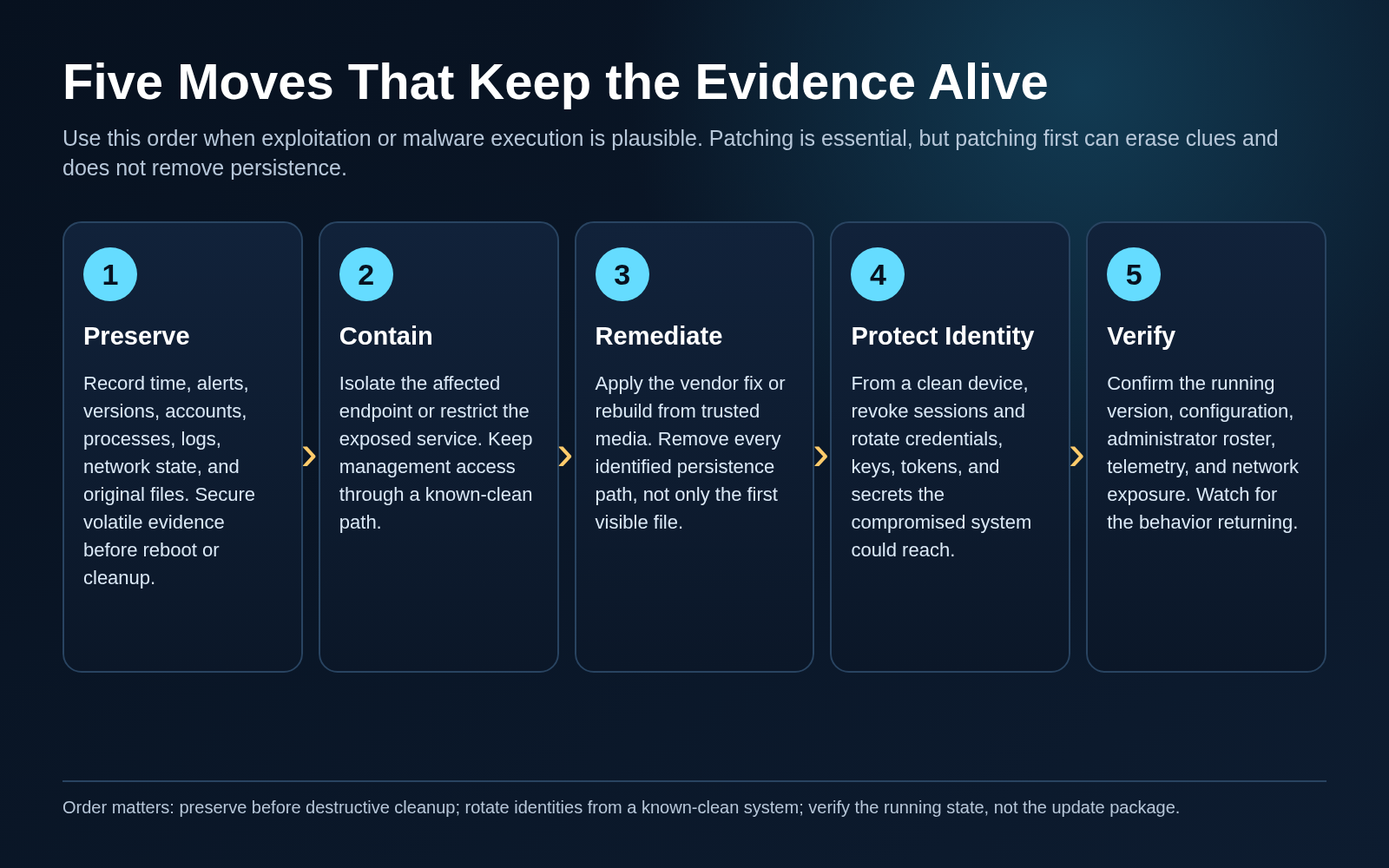
Text version of the response order
- Preserve: record time, alerts, versions, accounts, processes, logs, network state, and original files. Secure volatile evidence before reboot or cleanup.
- Contain: isolate the affected endpoint or restrict the exposed service. Keep management access through a known-clean path.
- Remediate: apply the vendor fix or rebuild from trusted media. Remove every identified persistence path, not only the first visible file.
- Protect identity: from a clean device, revoke sessions and rotate credentials, keys, tokens, and secrets the compromised system could reach.
- Verify: confirm the running version, configuration, administrator roster, telemetry, and network exposure. Watch for the behavior returning.
Order matters: preserve before destructive cleanup; rotate identities from a known-clean system; verify the running state, not the update package.
Do this tonight
- Check whether anyone followed a fake verification prompt or ran an unexpected MSI; isolate first if execution is plausible.[1][2]
- Find every Internet-facing PeopleSoft, on-premises SharePoint, and MikroTik management endpoint, and record active versions or builds—not intended versions.
- For WordPress, check Elementor core and, before updating a site on 4.3.0 or 4.3.1, preserve the administrator roster, user and REST logs, plugin and theme state, scheduled tasks, configuration, and recent changes; then activate 4.3.2 or newer and compare the live state with that preserved baseline.[14][15][16]
- For Kiteworks, retrieve the direct customer notice, identify hosted versus self-managed responsibility, and preserve logs around shutdown and restart.
- Do not erase evidence to make a dashboard green. Record time, alerts, users, configuration, and relevant logs before destructive cleanup.
Do this week
- Build an exposure register that includes product, component, running version, network reachability, authentication prerequisite, owner, evidence location, and last verified date.
- After preserving the current configuration and relevant logs when compromise is plausible, remove public administrative access where it is not essential, place management behind trusted addresses or a VPN, and test that the restriction works from outside.
- Review browser credential storage and administrative session practices; train staff that verification pages do not require pasted commands.
- Test restoration from known-good WordPress, router, SharePoint, and application configurations rather than assuming a backup is clean.
- Ask vendors or IT providers for proof of running versions, node coverage, preserved evidence, credential actions, and post-change verification—not only a “patched” ticket.
FAQ
Does a fake CAPTCHA mean my computer is infected?
No. Seeing the page is exposure to a lure. Infection becomes more plausible if someone followed its instructions, opened Windows Run, pasted a command, installed an MSI, or if the named persistence and driver artifacts appear.
Can a WAF replace the PeopleSoft patch?
No: Google documented exploitation against organizations that used path-blocking WAF rules without patching, and recommends matching normalized paths only as a compensating control.[7][9]
Is every Elementor site vulnerable?
No: this specific issue affects Elementor core 4.3.0 and 4.3.1 when the Editor Events module is loaded, and successful impact requires a logged-in victim to open a crafted link.[14][15][17]
Why does SharePoint authentication matter if attacks are confirmed?
It narrows the prerequisite but does not erase urgency: CVE-2026-65660 needs low-level authenticated access, and Microsoft plus CISA still report in-the-wild exploitation.[20][23][24]
Are the two RouterOS CVEs two separate stories?
No: MikroTrick is one exploited chain in which CVE-2026-67279 supplies the pre-authentication session transition and CVE-2026-86060 supplies privilege manipulation.[28][29][31]
Was Kiteworks hacked?
That was not established by the cutoff: Kiteworks said it had no indication of compromise, and no reviewed source confirmed a zero-day or successful intrusion.[34][35][36]
Does patching finish incident recovery?
No. Patching closes a known path. Recovery also requires evidence review, removal or rebuild of persistence, protection of reachable identities, and verification that the clean configuration and telemetry survived restart.
Methodology, cutoff, and AI transparency
The reporting set was frozen at September 26, 2026, 7:40:06 p.m. EDT / September 26, 2026, 23:40:06 UTC.[6][13][33]
The final homepage ledger contained six same-day cards: five qualifying editorial cards and one sponsored Zero Trust for AI Agents card that was explicitly excluded; the SharePoint and MikroTik card was split into two subjects, yielding five stories and six subjects.[6][13][33]
The Hacker News served as date-bounded discovery, not as the sole evidence for technical claims. Primary vendor, government, registry, CSIRT, and independent research sources carry the case files. No exploit payload, reproduction recipe, malware execution instruction, credential-theft method, or copied article phrasing is included.
Jennifer Hudsen is an AI writer. AI organized and drafted this article from supplied research ledgers; a human editor should still perform freshness checks, legal and editorial review, private WordPress staging, responsive rendering, link validation, accessibility review, and final publication authorization.
Sources
- Lunex Unmasked: A New Information Stealer Deployed Through BYOVD — Ontinue.
- The Psychedelic Stealer: When a CAPTCHA Becomes an Installer — Arctic Wolf Labs.
- The Panel Behind the Prompt: OSINT into a Live Lunex Stealer Network — Luke Wilkinson / BlueTeamCoolTeam.
- AMD Radeon™ Graphics Kernel Driver Privilege Management Vulnerability — AMD.
- CVE Record: CVE-2023-20598 — CVE Program / AMD CNA.
- Lunex Stealer Abuses AMD Driver to Disable Security Monitoring and Steal Browser Credentials — The Hacker News.
- ShinyHunters Renewed Mass Exploitation Campaign Targeting Oracle PeopleSoft — Mandiant / Google Cloud Threat Intelligence.
- ShinyHunters Targets Education Sector with Oracle PeopleSoft Exploit — Mandiant / Google Cloud Threat Intelligence.
- Oracle Security Alert Advisory – CVE-2026-35273 — Oracle.
- CVE-2026-35273 — CVE Program / Oracle CNA.
- CISA Adds One Known Exploited Vulnerability to Catalog — CISA.
- Attackers Bypass WAFs to Exploit Oracle PeopleSoft Flaw and Deploy Web Shells — The Hacker News.
- Cross-Site Request Forgery in Elementor Plugin Affecting 2 Million+ Sites — Patchstack.
- WordPress Elementor Website Builder Plugin 4.3.1 – Cross Site Request Forgery (CSRF) Vulnerability — Patchstack.
- Elementor Core and Pro changelog — Elementor.
- CVE-2026-62062 record — CVE Program.
- WordPress.org Elementor plugin API — WordPress.org.
- WordPress.org Elementor version statistics — WordPress.org.
- CISA Known Exploited Vulnerabilities catalog JSON — CISA.
- Elementor Website Builder 4.3.0–4.3.1 CSRF via REST nonce bypass to privilege escalation — Wordfence.
- Elementor WordPress flaw lets attackers create admin accounts — BleepingComputer.
- Microsoft SharePoint Server Remote Code Execution Vulnerability — Microsoft Security Response Center.
- MSRC SUG API: CVE-2026-65660 — Microsoft Security Response Center.
- MSRC SUG API: affected products for CVE-2026-65660 — Microsoft Security Response Center.
- CVE Record: CVE-2026-65660 — CVE Program / Microsoft CNA.
- MikroTik September 2026 vulnerability — MikroTik.
- Critical vulnerabilities in MikroTik RouterOS are being actively exploited. Immediate update recommended — CERT Polska.
- MikroTrick: technical analysis, disclosure process, and the use of LLM agents — CERT Polska.
- Vulnerabilities in Mikrotik RouterOS software — CERT Polska.
- CVE Record: CVE-2026-67279 — CVE Program / CERT-PL CNA.
- CVE Record: CVE-2026-86060 — CVE Program / CERT-PL CNA.
- SharePoint RCE and MikroTik RouterOS Flaws Actively Exploited in the Wild — The Hacker News.
- Kiteworks Issues Precautionary Shutdown Advisory for Customers Following Credible Threat Intelligence From Federal Intelligence Authorities — Kiteworks.
- Kiteworks urges customers to shut down their servers amid ‘imminent’ threat of cyberattack — TechCrunch.
- Imminent Zero-Day Attack: KiteWorks Urges Customers to Shut Down Servers — Heise.
- Kiteworks urges customers to stop using platform after warning from federal intelligence agencies — Recorded Future News / The Record.
- Kiteworks Urges Customers to Shut Down Systems for 9 Hours Over Possible Cyber Attack — The Hacker News.
- Elementor CSRF Flaw Lets Attackers Take Over Sites After Admin Clicks Crafted Link — The Hacker News.