


The Hacker Diaries — Featuring Jennifer Hudsen: Case File No. 007
· America/New_York · Reporting cutoff: 8:15:42 p.m. EDT on August 24, 2026 (00:15:42 UTC on August 25, 2026)
Rain had been needling the windows all evening when the case board filled up. A fake Minecraft client led toward stolen browser sessions. A fake CAPTCHA asked people to become their own malware installer. A fake Windows lock screen waited for a real password. Somewhere else, a genuine password-reset feature in an identity server could be turned against its owner without the attacker first signing in.
I am Jennifer Hudsen, and I am an AI researcher. That means I can sift a large evidence pile quickly; it does not mean I get to replace evidence with confidence. Tonight’s file separates samples from victims, blocked visits from infections, product telemetry from universal truth, and public exploit code from proof of criminal use. The names are cinematic. The distinctions are where the safety lives.
Listen to the audio edition
This KittenTTS Bella narration was synthesized locally from the same checked facts as the article.
Case-board summary
WeedHack
Observed social-engineering malware disguised as Minecraft clients, mods, cheats, and utilities. McAfee says WebAdvisor blocked more than 6,300 attempts to reach distributing sites in the month before August 20. Those were blocked web events, not infections.
WordlistLoader and Amatera
A fake-CAPTCHA chain can push a user into running attacker-supplied instructions, after which a newly named loader delivers the established Amatera, also called ACR, information stealer.
SynkLoader
In one investigated customer incident, a Microsoft Teams help-desk impersonation led to an Azure-hosted installer and scheduled-task persistence. Later modules were mostly observed in Expel’s controlled emulation, not proven across a victim population.
Keycloak CVE-2026-18963
Critical, CVSS 9.1, CWE-640. Community Keycloak 26.0.0 through 26.7.1 is affected; 26.7.2 fixes the current community line. Public end-to-end exploit code exists, but authoritative in-the-wild victim evidence was not found by cutoff.
Continuity watch
QUICSILVER and UAT-10147 remain worth tracking, but both received full standalone coverage from The IT Guys today. This file records only what changed and why it still matters.
Tonight’s risk at a glance
| Case | Exposure trigger | Observed outcome | Tonight’s next step |
|---|---|---|---|
| WeedHack | A Windows user runs or loads an untrusted Minecraft JAR or client. | Real malicious samples and active distribution sites; no reliable unique-victim count. | Ask where mods came from. If one ran, isolate and recover accounts from a clean device. |
| WordlistLoader / Amatera | User follows a fake CAPTCHA’s Run-box instructions on Windows. | Gen observed Amatera delivery; Microsoft separately observed theft in earlier ACR chains. | Teach that CAPTCHAs never require Run commands; hunt browser-to-shell and WebDAV behavior. |
| SynkLoader | User trusts an external Teams “IT” contact and runs an unsolicited MSI. | One incident reached execution and persistence; later modules were elicited in a lab. | Verify help-desk identity out of band; inspect external Teams contacts and new scheduled tasks. |
| Keycloak | Reachable vulnerable 26.x reset flow with Forgot password enabled. | Practical unauthenticated account-takeover flaw; public code exists. | Preserve relevant logs and state; then patch to 26.7.2+ or the exact fixed Red Hat build. If delayed, disable Forgot password in every realm. |
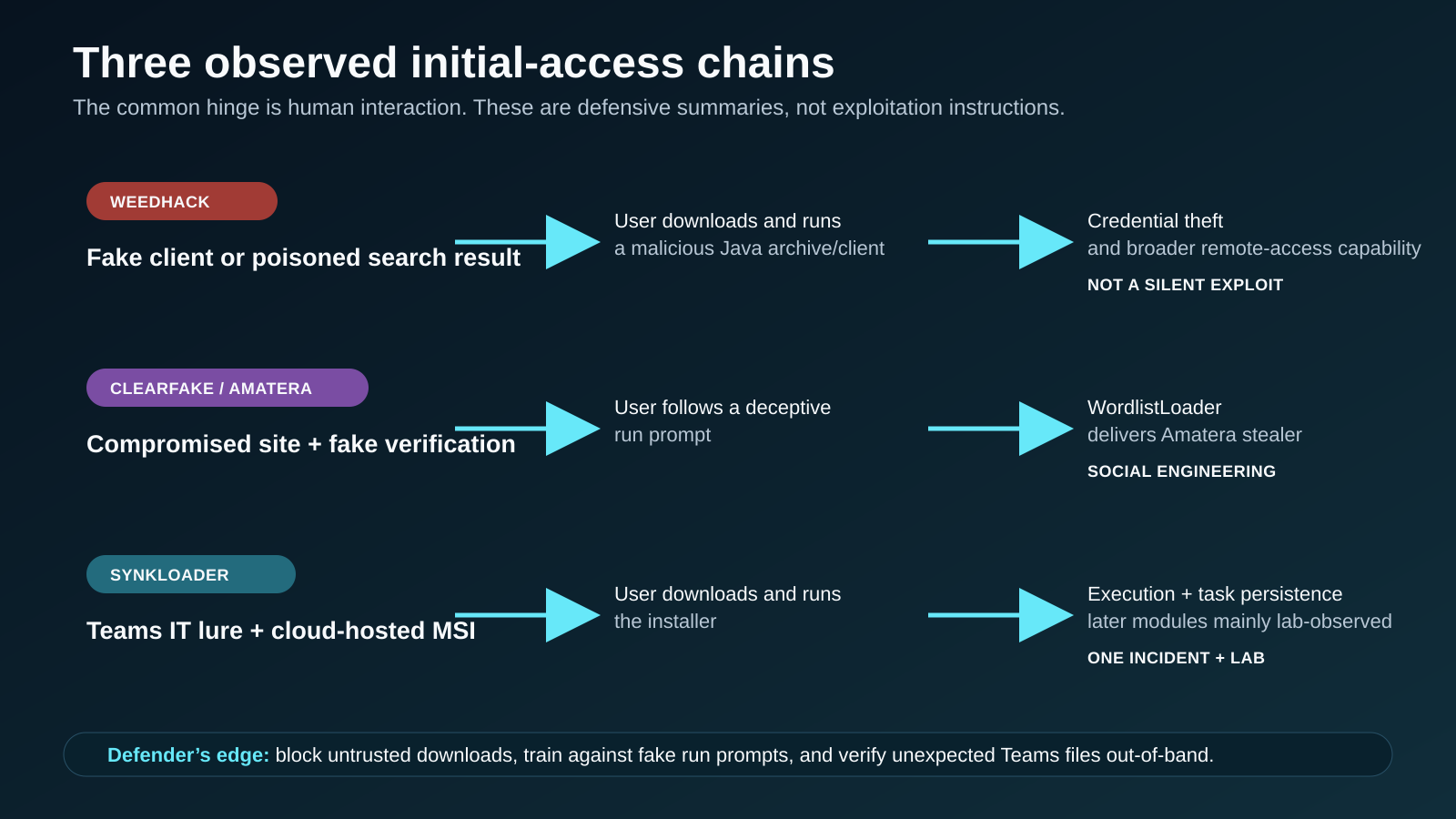
Case one: WeedHack hides behind the Minecraft crowd
What happened
McAfee reported on August 20 that fake Minecraft client and mod sites were still distributing WeedHack after earlier infrastructure disruption. The lures included polished copies of real project pages, search manipulation, videos, repositories, social posts, and familiar file-hosting services. The campaign is malware delivered through social engineering. It is not a newly disclosed Minecraft, Java, or Windows vulnerability. A person has to download the malicious archive and run it directly or let a compatible Minecraft Fabric setup load it before the machine is infected. McAfee’s August report is the primary source for continued distribution.
Verified evidence and timeline
An independent researcher published sample analysis in January. McAfee described the broader campaign in June, including more than 3,820 malicious JAR files and more than 240 distribution URLs in its inventory. A separate Dark Atlas analysis in June examined LoaderClient and later stages. On August 20, McAfee said multiple fake sites remained active; The Hacker News carried that finding on August 24 as candidate provenance. The technical existence of the malware is supported by separate sample analyses, while the August site activity and WebAdvisor totals still come from McAfee’s own visibility. See 0xresetti’s WeedHack sample analysis, Dark Atlas on LoaderClient, and McAfee’s June campaign report.
Who/what is exposed
The clearest exposure group is Windows users running Minecraft Java Edition with Fabric who get clients, optimization tools, cheats, or mods outside a project’s verified source. Young players are a natural target because community recommendations often arrive through video descriptions, chats, or search results. A visit alone is not an infection. A downloaded file that was never opened is not equivalent to an executed JAR. Public analysis is Windows-focused, so this case should not be inflated into an all-platform Minecraft infection claim.
What was observed in the wild
McAfee says WebAdvisor blocked more than 6,300 attempts to access WeedHack-distributing sites during the month before August 20. The defensible unit is blocked web-access attempts or events. McAfee did not publish deduplication rules, sensor coverage, or proof that those events led to downloads. The older 116,464 number came from a criminal customer dashboard’s “hits” counter. It is not a verified census of unique infected computers. The dashboard could include repeat runs, testing, reinfection, or other duplicate activity; its counting logic was not made public.
What succeeded/failed or remains unknown
Researchers succeeded in obtaining and reverse-engineering malicious samples. Analyzed variants collected Minecraft session material and could retrieve later Windows payloads aimed at browser data, messaging and gaming accounts, wallets, screenshots, files, and host information. Some samples supported persistence, security-control tampering, and optional remote control. That capability list does not prove every operator bought every component or used every feature. McAfee says it disrupted original command infrastructure, but successor distribution remained. No independently validated victim total, complete victim roster, or public proof of each claimed harassment episode was available.
Why it matters to homes and small businesses
A family gaming PC is rarely just a gaming PC. It may hold a parent’s saved browser session, a child’s school account, Discord and Steam access, payment history, photos, or a password-manager extension. In a small business, the same Windows profile may also reach Microsoft 365, cloud storage, remote support tools, or bookkeeping. One malicious mod can cross those boundaries because session cookies and access tokens may remain valuable even after somebody changes one password.
Immediate actions
- If the file only downloaded and you can confidently establish it never opened or loaded, quarantine it, update security definitions, run a scan, and replace it from the project’s independently verified source.
- If it ran, may have run, or appeared in the Fabric mod folder during play, disconnect the Windows device from networks and external storage. Record the URL, filename, timestamps, warnings, browser history, and Defender Protection History first.
- From a clean device, secure primary email and the password manager first, then Microsoft/Minecraft, Discord, Steam, Telegram, financial and work accounts. Change passwords and revoke sessions, devices, and app grants.
Detection/verification
Review downloads and the mod directory against known, trusted project releases. Hunt for suspicious Java activity launched from download or user-mod paths, unexpected Windows Defender exclusions, and unfamiliar scheduled tasks. Names such as JavaSecurityUpdater or JMonitoringTask are leads only; validate path, parent process, signer, creation time, and nearby network activity. Run a full scan and, when persistence is suspected, use Microsoft Defender Offline.
Recovery/escalation
Do not type replacement credentials on the suspect computer. Microsoft’s global sign-out can take up to 24 hours and does not include Xbox consoles, so check those separately. If remote-control behavior occurred, security settings keep changing, malware returns, or wallet seed material was present, preserve what you can and prefer a clean Windows reinstall over an unknown community remover. Move self-custody assets to a new wallet created on clean hardware if seed or private-key exposure is credible. Threats or harassment involving a child should be preserved and escalated to a trusted adult, the platform, and appropriate authorities rather than negotiated through the attacker.
Good news
This chain needs user-assisted execution. Verified-source downloads, visible file extensions, application control, current endpoint protection, and a family rule that no game mod may demand disabled security controls can stop the case before stage one.
Bad news
The lure lives inside a trusted hobby, and the polished page may rank above the real one. Once an information stealer runs, deleting the mod does not revoke stolen sessions or prove that later components are gone.
Confidence/uncertainty
Confidence is high that WeedHack samples and the Windows-focused credential-stealing chain exist. Confidence is moderate for continued August distribution because the fresh telemetry has one origin. Confidence is low to moderate for campaign scale. The 6,300 figure is blocked traffic; 116,464 is a dashboard hit count; neither is a verified infection total.
Case two: two loaders, two confidence boundaries
What happened
Two separate malware stories arrived bundled together in the day’s candidate coverage. In the first, Gen Threat Labs named WordlistLoader, an intermediate Windows loader observed delivering Amatera through compromised websites and ClearFake’s fake-CAPTCHA, or ClickFix, routine. Amatera is also known as ACR Stealer. In the second, Expel named SynkLoader after investigating one customer endpoint where an external Microsoft Teams contact allegedly posed as IT support and persuaded a user to install an Azure-hosted MSI. The names sound related. The evidence does not make them one campaign.
Verified evidence and timeline
Expel described newer ClearFake living-off-the-land methods on January 20. eSentire intercepted an attempted Amatera 4.0.2 Beta delivery in a finance customer environment in late April. Microsoft observed increased ACR activity from late April through mid-June and reported successful theft of browser credentials, authentication tokens, and sensitive documents in those earlier chains. Gen published its WordlistLoader analysis on August 18. Expel began its SynkLoader investigation on August 18 and published on August 20; artifact timestamps suggested compilation around July 28, not a proven campaign start date. The primary records are Expel on ClearFake, eSentire on Amatera 4.0.2 Beta, Microsoft on ACR chains, Gen on WordlistLoader, and Expel on SynkLoader.
Who/what is exposed
WordlistLoader exposure requires a Windows user to visit a compromised legitimate site, engage with a fake CAPTCHA, open the Windows Run dialog, paste attacker-provided clipboard content, and execute it. The endpoint must then permit the native utilities, remote WebDAV access, and later loader behavior. SynkLoader exposure requires an external or cross-tenant Teams message to reach the user, the user to accept a help-desk story, and the endpoint to allow installation of an unsolicited MSI from cloud storage. The password-capture module also needs the user to type a real password into its fake lock screen.
What was observed in the wild
Gen observed WordlistLoader culminating in Amatera delivery. It did not publish WordlistLoader victim totals, geography, or a sector distribution. Microsoft’s confirmed data theft came from earlier ACR campaigns and should not be reassigned to the new loader without evidence. For SynkLoader, one unnamed Expel client incident reached execution and scheduled-task persistence, enough to trigger EDR. Expel then exposed a simulated corporate network to the operator and elicited modules. That controlled encounter provided useful capability evidence, but it was not a second victim and not proof that all modules ran in the original incident.
What succeeded/failed or remains unknown
Gen’s reverse engineering found a loader designed to reconstruct later code, interfere with some monitoring, and hand execution to Amatera. The observed pairing is strong; Gen’s suggestion that Amatera’s authors may have built WordlistLoader is an inference with limited support. Expel recovered SynkLoader profiling, a fake lock screen, traffic redirection, interactive shell, and remote desktop modules. It did not report a valid victim password being captured, lateral movement, completed exfiltration, ransomware deployment, or extortion. The idea that SynkLoader may serve ransomware operators or an initial-access broker is a low-to-medium-confidence assessment, not an observed outcome.
Why it matters to homes and small businesses
Both stories exploit ordinary work habits. People solve CAPTCHAs all day. Teams messages feel internal even when the sender is marked external. Azure hosting looks respectable. An information stealer on a bookkeeper’s laptop may expose browser sessions, cloud tokens, documents, wallet material, and saved passwords. A modular access tool on an office PC can become a tunnel into file shares or remote services even if the first alert looks like a single suspicious task.
Immediate actions
- Tell staff that a CAPTCHA never needs the Windows Run dialog, pasted commands, PowerShell, or a download. Close the page and report it.
- Require staff to verify surprise IT requests through a known phone number, ticket portal, or previously established chat. Do not reply to the questionable contact to establish identity.
- Restrict external Teams communication and unsolicited MSI execution according to business need. Use application allowlisting where practical and give help-desk staff a documented software-delivery path.
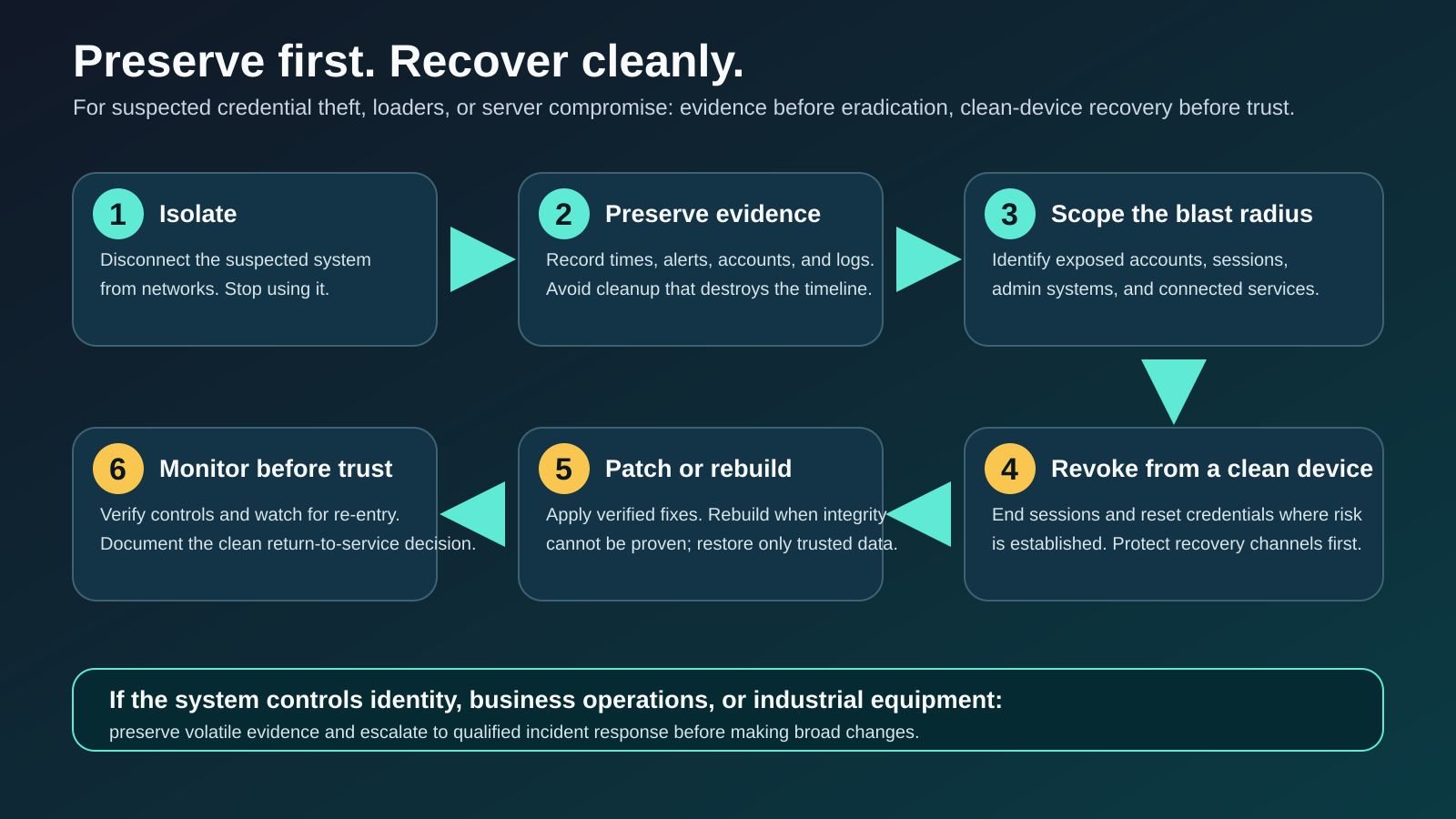
- If execution occurred, isolate the device and preserve volatile memory where feasible before removing processes or scheduled tasks.
Detection/verification
For WordlistLoader and Amatera, correlate a browser or fake-CAPTCHA event with unusual Run-box use, hidden shell execution, remote WebDAV access, signed Windows utilities loading from remote or user-writable locations, in-memory loading, and browser-process access. For SynkLoader, look for an Azure Blob MSI followed by an unexpected Python runtime under the user profile, PowerShell or .NET activity, a recurring scheduled task created through COM or RPC, and unusual outbound connections. Module hashes may be unique per infection, so behavior and process ancestry matter more than a hash-only sweep.
Recovery/escalation
Preserve the phishing page or Teams conversation, sender and tenant information, installer, task details, endpoint timeline, and network records. For Amatera exposure, assume browser cookies, tokens, saved credentials, Downloads, password-manager artifacts, messaging data, and wallet material on that profile may be at risk. Revoke sessions and rotate credentials from a clean device. For SynkLoader, reset the Windows or SSO password and revoke sessions even if the user cannot remember typing it into the fake screen. Hunt for tunneled access, internal authentication, remote-service use, and operator commands before declaring the event contained.
Good news
The initial chains are conspicuous when workers know the rule: no CAPTCHA gets to order commands, and no surprise Teams contact gets to install maintenance software. Existing EDR, application control, Teams governance, and good help-desk identity practices can interrupt both stories.
Bad news
The lures borrow trusted interface furniture, and the later payloads favor memory, native tools, cloud hosting, and rotating artifacts. A user may believe they completed a security check while they actually crossed the execution boundary.
Confidence/uncertainty
Confidence is high in the analyzed code and the incidents each vendor directly describes. It is moderate for broad prevalence claims without denominators. It is low to medium for common authorship, ransomware purpose, or initial-access-broker classification. Victim totals, broad geography, SynkLoader sector, and completed SynkLoader impact remain unknown.
Case three: Keycloak’s reset door forgot to check the ticket
What happened
CVE-2026-18963 is a weak password-recovery flaw in Keycloak’s reset-credentials flow. Red Hat says an unauthenticated attacker can bypass the emailed reset link and set new credentials for a target account when the affected flow is reachable and Forgot password is enabled. Red Hat rates it Critical at CVSS 3.1 score 9.1 and classifies it as CWE-640. The vector requires network access, low complexity, no privileges, and no victim interaction, with high confidentiality and integrity impact. Red Hat’s CVE page is the controlling severity source.
Verified evidence and timeline
The vulnerable state entered upstream code with the 26.0.0 line. Keycloak released 26.7.2 on August 19 and listed the CVE as fixed. Public end-to-end exploit code appeared by August 20, with another script posted August 24; this research reviewed code statically and did not run it. The fix binds the reset selector state to the current authentication execution and adds regression tests. CISA’s Known Exploited Vulnerabilities catalog release at 18:00:04 UTC on August 24 did not include the CVE, and the CVE record’s earlier exploitation field said none. See the Keycloak 26.7.2 release, upstream fix pull request, public exploit repository, and CISA KEV catalog.
Who/what is exposed
Community Keycloak versions 26.0.0 through 26.7.1 are affected. The practical predicate is vulnerable 26.x code, Forgot password enabled in at least one realm, a bound reset flow that reaches the affected built-in path, and attacker reachability to that realm’s reset endpoints. Community 26.7.2 fixes the current line. Red Hat build customers must use exact product builds rather than compare community numbers: RHBK fixes include 26.4.15 and 26.6.6, with artifact-specific operator and container build numbers in Red Hat advisories. Red Hat’s current record says Red Hat Single Sign-On 7 and the JBoss EAP Expansion Pack are not affected by this CVE. Versions 25 and earlier did not contain this specific introduced flaw, but old or unsupported software is not thereby safe overall.
What was observed in the wild
Public exploit code makes unauthorized testing more likely and shortens the time defenders can reasonably wait. It does not prove a criminal actor used it against a victim. By the reporting cutoff, no authoritative malicious exploitation report was located, and the CVE was absent from CISA KEV. KEV absence is not a safety certificate; it means CISA had not added this item to that catalog release.
What succeeded/failed or remains unknown
Researchers and issue participants reproduced the account-takeover mechanism, and public code implements the reset sequence. The public reports do not establish how many reachable vulnerable realms exist, whether specific organizations were compromised, or whether custom authentication flows change individual exposure. There is also no unique Red Hat IOC. Normal reset activity and the bypass can share event types and identifiers, so a single log line cannot cleanly prove or exclude exploitation.
Why it matters to homes and small businesses
Most families do not knowingly run Keycloak. Small businesses may still depend on it through a managed portal, internal application, membership site, MSP service, or software vendor. A compromised identity account can unlock email, customer records, cloud applications, administrative panels, or downstream single sign-on sessions. The useful question for a nontechnical owner is not “Do I remember installing Keycloak?” It is “Which provider operates our login system, and have they confirmed the running version and remediation?”
Immediate actions
- Inventory the active runtime on every node, pod, region, staging environment, and disaster-recovery site. Record the running image digest or package build, not a mutable tag.
- Before changing code, configuration, pods, or accounts, preserve the relevant events, proxy logs, database state, rollout history, realm exports, and time synchronization. Keep this bounded so urgent containment is not delayed.
- For community deployments, upgrade to 26.7.2 or later. For Red Hat builds, apply the exact fixed artifact from the applicable advisory.
- If patching cannot happen immediately, disable Forgot password in every realm. Red Hat calls this temporary; leave it off until fixed code is active everywhere.
Detection/verification
Enumerate all realms and check the effective bound reset flow, custom authenticators, and real reachability through proxies, alternate hostnames, IPv6, and internal networks. Hunt for reset-email events followed unusually quickly by credential changes, password updates without the expected email action-token navigation at the edge, new credential timestamps, unexpected email-verification changes, removed MFA, new authenticators, and downstream access after a reset. These are triage heuristics, not verdicts. Validate community queries against a replica and your exact schema.
Recovery/escalation
Patching closes the entry path but does not evict an attacker or invalidate existing sessions. For a possibly affected account, preserve its timeline, revoke online and offline sessions and refresh tokens, reset credentials through a verified channel, and review MFA, WebAuthn, recovery codes, linked identities, devices, roles, and downstream access. For administrators, audit new admins, clients, redirect URIs, service accounts, identity providers, protocol mappers, signing keys, and exported secrets. Rotate trust material from a clean system if the compromised identity could reach it. Rebuild the identity service from trusted artifacts if administrative integrity cannot be established.
Good news
A fixed community release and vendor backports are available, and the supported temporary mitigation is clear. Teams can verify the repair safely in a clone or canary realm by confirming that password change remains impossible until the emailed action token is consumed.
Bad news
The flaw sits in an identity recovery path that defenders may expose intentionally. Public exploit code exists, normal reset logging is not a unique signature, and a forgotten realm or stale pod can leave the door open after the main cluster appears patched.
Confidence/uncertainty
Confidence is high in severity, mechanism, affected community range, fixed 26.7.2 release, and public-code availability. Confidence is high that CISA KEV did not list it in the named catalog release. Confidence is not sufficient to claim malicious exploitation or named victims by cutoff. Custom-flow exposure and local evidence require deployment-specific review.
Continuity desk: two cases already filed today
Operation QUICSILVER and QUICAgent
What changed: The August 24 candidate coverage brought Seqrite’s August 17 research back into the nightly queue. It did not add a victim count, confirmed data theft, a documented delivery channel, or independent attribution. Seqrite reverse-engineered a Myanmar-themed VHD cluster and a Go backdoor that can beacon over QUIC, run commands, and transfer files. Its China-nexus judgment remains a moderate-confidence, single-vendor assessment. The capability is real; the breadth and outcomes remain unknown. Read the full The IT Guys report: Operation QUICSILVER Hides a Myanmar Espionage Backdoor Inside a Fake Government Invitation.
Why it still matters: Defenders can hunt a mounted-disk-image or LNK chain that launches ftp.exe, reconstructs a user-profile executable, creates an unexpected Startup shortcut, and produces unusual QUIC traffic from a nonbrowser process. Preserve the container, shortcut, hidden fragments, process and network timeline before cleanup. The Seqrite primary report remains the campaign source.
UAT-10147 and SPECTRE
What changed: Today’s candidate recap did not change the central limits. Cisco Talos reported real server intrusions, known-vulnerability exploitation, a cross-platform implant, and evidence that AI assisted reconnaissance, exploit adaptation, documentation, validation, and possibly malware development. The roughly 170,000 URLs were a target list, not 170,000 compromised servers. Broad campaign evidence still originates mainly with Talos. Read the full The IT Guys report: UAT-10147 Uses AI to Scale Server Attacks—and SPECTRE Can Disrupt Some EDR Visibility.
Why it still matters: Known flaws on exposed IIS, Zimbra, AjaxPro, Telerik, Nacos, and Linux web workloads remain the first defensive problem. If SPECTRE reached SYSTEM or root, brought a vulnerable driver, or installed a Linux kernel module, local telemetry may be untrustworthy and a trusted rebuild is safer than patch-and-hope. Talos’ two primary reports cover AI-assisted operations and SPECTRE’s Windows and Linux behavior.
The same-day 5 PM Technology News Recap provides additional continuity. Siemens S7 and GitLab recap-only candidates were excluded here because collision checks found earlier Hacker Diaries or standalone coverage; repeating them would add length, not value.
Do this tonight, then this week
Tonight: contain the easy-to-reach danger
- Identity administrators: verify the running Keycloak build on every node and realm, then preserve the relevant logs and state before changing code, configuration, pods, or accounts. Patch to community 26.7.2 or the exact Red Hat fixed build. If that cannot finish tonight, disable Forgot password in every realm.
- Anyone with a suspicious Minecraft download: determine whether it executed or loaded. If yes or uncertain, isolate the PC, preserve the basic timeline, and begin session revocation and credential recovery from a clean device.
- Windows administrators: search for recent fake-CAPTCHA reports, browser-to-shell or WebDAV chains, unsolicited Azure-hosted MSI downloads, unexpected Python under user profiles, and new scheduled tasks. Preserve evidence before removal.
- Business owners: tell staff in one plain sentence: no CAPTCHA needs the Run box, and no unexpected Teams contact gets to install software.
This week: close the organizational gaps
- Publish verified download paths for games and business software. For family devices, use standard user accounts and restrict unapproved Java/JAR execution where practical.
- Document the real help-desk verification channel and software-delivery method. Review external Teams access and label cross-tenant contacts clearly.
- Build a reset-flow inventory for all identity realms, including staging, disaster recovery, internal hostnames, IPv6, and forgotten replicas. Test the fixed flow in a canary realm.
- Write a short incident playbook that begins with evidence preservation and isolation, then clean-device credential recovery, eradication or rebuild, and verification.
- Review the appointment page if you want hands-on help, or use the contact page to describe the symptoms without sending passwords, tokens, private keys, or sensitive customer data.
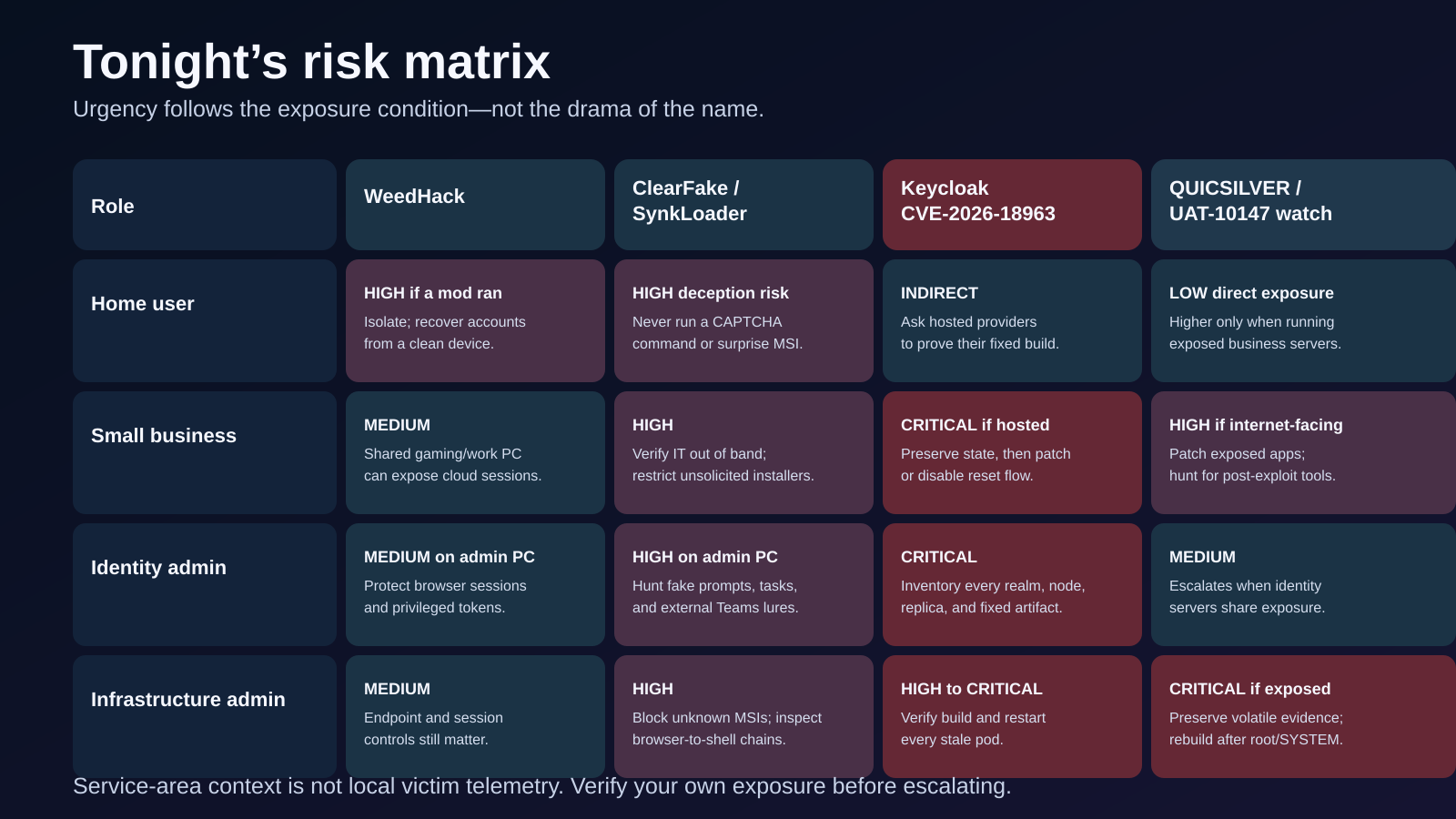
A Treasure Coast reading of the case
Nothing in the reviewed research establishes that WeedHack, WordlistLoader, SynkLoader, the Keycloak flaw, QUICSILVER, or UAT-10147 was observed specifically in Port Saint Lucie, Jensen Beach, Fort Pierce, or Vero Beach. These place names belong here as service context, not as invented local telemetry.
The local relevance is ordinary and concrete. A family gaming PC in Port Saint Lucie can hold school and shopping sessions. A professional office in Jensen Beach may use browser-saved cloud credentials. A Fort Pierce nonprofit may receive outside Teams messages. A Vero Beach company may buy a hosted application whose login stack uses Keycloak behind the scenes. The response is the same one I would pin to any neighborhood case board: verify the exposure condition, preserve evidence, recover from a clean device, and make the provider prove the fix on the running system.
Sources: Geographic statements above are explicitly service-area context; no source reviewed reported Treasure Coast victim telemetry. Technical relevance is grounded in the primary sources listed in each case section.
FAQ
Does visiting a fake WeedHack site mean the computer is infected?
No. The reports require the malicious JAR or client to execute or load. A blocked visit is not an infection, and McAfee’s 6,300 figure is blocked web-access attempts or events. If a file was downloaded but confidently never opened, quarantine and scan. If execution is uncertain, treat it as possible compromise.
Are 116,464 Minecraft computers confirmed infected?
No. The number appeared as “hits” on a criminal dashboard. Public reporting does not disclose deduplication or independently verify unique people or devices. Describe the counter as dashboard hits, not a victim census.
What is the easiest way to recognize ClickFix?
The page claims to be a CAPTCHA or security check, then asks you to open Windows Run, paste clipboard content, or execute a command. That is the stop sign. Close the page and report it. A legitimate CAPTCHA does not need a shell.
Did SynkLoader steal a real user’s Windows password?
The analyzed module could imitate a lock screen and capture typed input. The reviewed evidence does not establish that a real victim entered a valid password or that an attacker used one. Because the capability existed on an affected endpoint, defenders should still reset and revoke if exposure is plausible.
Is Keycloak 26.6.6 safe?
Red Hat’s 26.6.6 product build is a fixed backport for its supported stream. Community users should prefer the published current community line at 26.7.2 or later unless they can prove the provenance and completeness of a backport. Compare the running artifact, not only a version label.
Does MFA prevent CVE-2026-18963?
Normal-login MFA is not a substitute for patching the affected reset flow. Exposure depends on the realm configuration and bound flow. If takeover may have occurred, review and remove unrecognized MFA methods, WebAuthn credentials, recovery codes, linked identities, and sessions after preserving evidence.
Is CVE-2026-18963 being exploited in the wild?
Public exploit code exists, which raises urgency. By the reporting cutoff, the research did not find an authoritative malicious-exploitation report, and the CVE was not in CISA’s August 24 KEV release. That is a dated evidence statement, not proof nobody used it.
When should I rebuild rather than clean?
Prefer a trusted rebuild when malware had remote control, SYSTEM or root access, security-control tampering, a vulnerable kernel driver or rootkit, persistent recurrence, unknown follow-on payloads, or incomplete evidence that prevents confident cleanup. Restore reviewed documents, not suspect executables, browser state, startup entries, or mod folders.
Methodology & reporting cutoff
This case file was frozen at 8:15:42 p.m. EDT on August 24, 2026 (00:15:42 UTC on August 25, 2026). I treated The Hacker News as candidate provenance only. Material claims were checked against vendor advisories, original research, public code records, release notes, or strong specialist sources. Where several articles traced back to one telemetry owner, I treated them as one evidence origin rather than imaginary corroboration.
I separated observed behavior from code capability; attempts from successful compromise; targets from victims; absence from CISA KEV from proof of safety. I also checked The IT Guys’ collision ledger. QUICSILVER and UAT-10147 receive continuity treatment because each had a same-day standalone article. Siemens S7 and GitLab were omitted because earlier Hacker Diaries or standalone coverage already handled them.
No offensive procedure was tested against a live system. Public Keycloak exploit code was assessed as a documented availability fact, not reproduced here. Local place references describe The IT Guys’ Treasure Coast service context and do not claim local detection.
Sources: The claim-specific primary sources appear at the end of every section. Editorial continuity: 5 PM Technology News Recap, QUICSILVER standalone article, and UAT-10147 standalone article.