

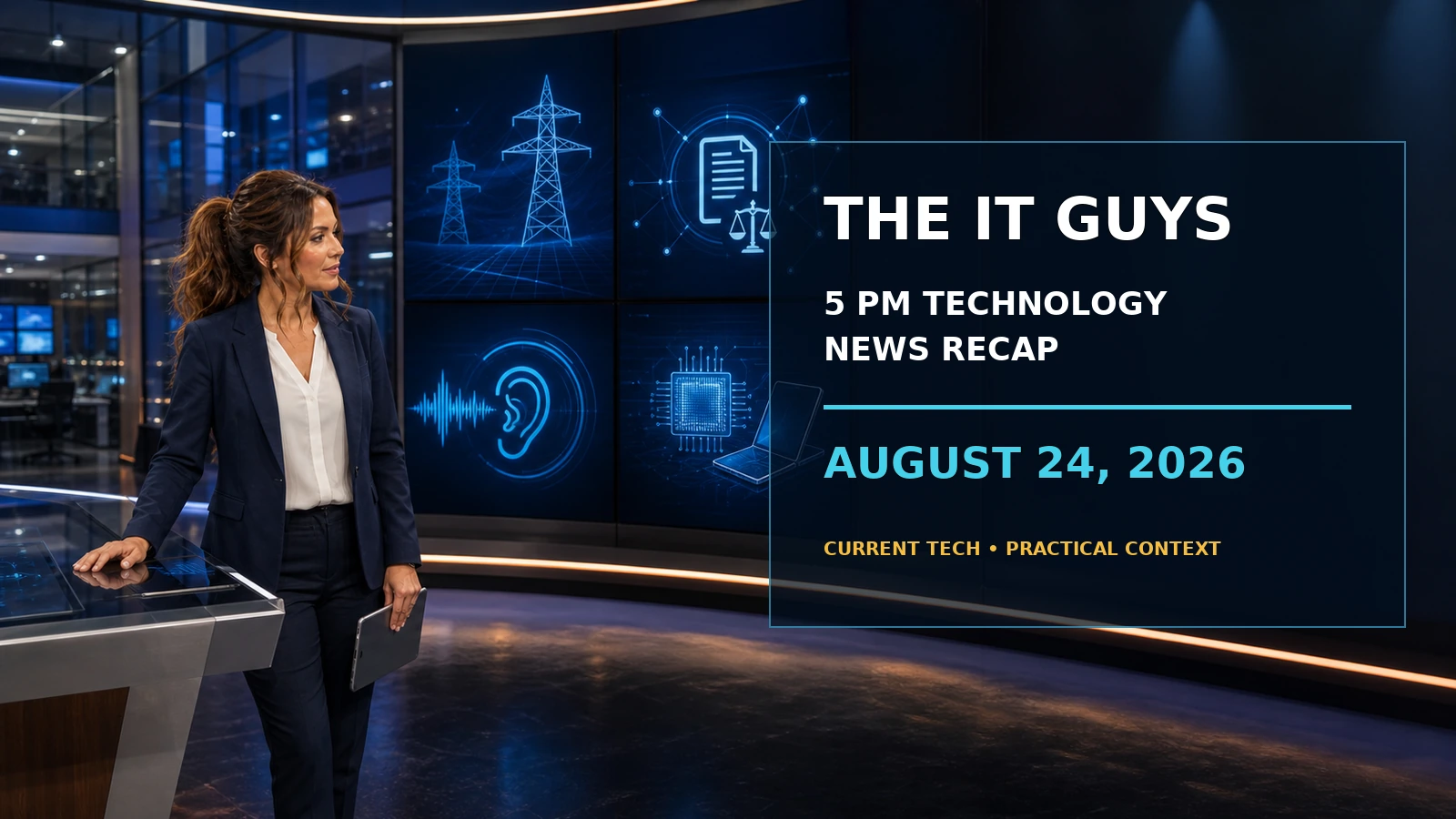
Monday’s technology news connects four very different systems: a small UK power generator became the center of a national cyber briefing, Thomson Reuters launched a legal-focused language model, Phonak pushed AI hearing aids toward mainstream connected audio, and Xiaomi unveiled another in-house smartphone chip while key manufacturing details remained source-reported.
Reporting cutoff: August 24, 2026, 5:06 p.m. EDT (21:06 UTC). This edition prioritizes developments published or materially reported on August 24. The UK incident is confirmed, but the Iran attribution is not official. Thomson Reuters and Sonova performance figures remain company-reported. Reuters’ TSMC, 3-nanometre, foldable-phone, and shipment details for Xiaomi came from unnamed sources and were not confirmed by Xiaomi or TSMC.
Listen to the broadcast-ready recap
This KittenTTS Bella narration was synthesized locally from the same checked facts as the article.
Tonight’s four-story rundown
1. A small UK generator went offline—and the unanswered cyber questions are the point
Reuters reported that the British government briefed energy-company leaders and issued protective guidance after reports that hackers forced a small electricity generator offline in July. Energy Minister Michael Shanks confirmed that a cyber incident affected a generator and that the government and National Cyber Security Centre responded. He also said nobody lost power and the wider electricity grid was not threatened.
Those confirmed facts are narrower than the most dramatic version of the story. The government did not publicly identify the facility, location, attack vector, affected control layer, or responsible actor. Reports attributed the activity to Iran-linked hackers and described a four-day shutdown, but Shanks did not confirm either the actor or the precise timeline. That distinction matters: an official response to a real cyber incident is solid evidence; a nation-state attribution requires a separate evidentiary chain.
The operational lesson is larger than the generator. Modern energy systems rely on many distributed assets, contractors, remote-management channels, engineering workstations, and business networks. One small facility may not threaten national continuity, yet the same access path or weak control pattern can exist elsewhere. SecurityWeek’s coverage emphasized that collective resilience depends on systems that may look insignificant one at a time.
Practical context: energy operators and other organizations running operational technology should inventory remote access, separate business and control networks, require phishing-resistant multi-factor authentication for privileged access, centralize logs, test manual operating procedures, and rehearse how to isolate one site without losing visibility. Smaller vendors and generators should be included in exercises rather than treated as outside the real perimeter.
Evidence: Reuters — UK briefs energy chiefs after Iran-linked cyber attack reports and SecurityWeek — Iran-Linked Hackers Shut Down UK Power Plant for Four Days.
2. Thomson Reuters is betting that professional data can matter more than model size
Thomson Reuters launched “Thomson,” its first proprietary large language model developed in-house. Instead of training a foundation model from nothing, the company says it began with an open-weight model and specialized it with professional content, tools, training methods, and workflows associated with services such as Westlaw, Practical Law, Checkpoint, and Reuters.
The company says it invested $40 million in talent and compute over two years. SiliconANGLE reports that economies in the project reduced the final training run to about $450,000. Those figures do not mean that any company can build an equivalent legal model for that amount: the content estate, licensing, expert reviewers, product integration, data engineering, evaluation, and earlier development work are part of the real cost.
The first deployment is Tabular Analysis in CoCounsel Legal, a document-review workflow where structured comparisons and citations can be checked. CoCounsel remains multi-model; Thomson will be used where the company believes it has an advantage, while other models can serve other tasks. Thomson Reuters also plans a smaller open-weight release on Hugging Face for academic and noncommercial evaluation.
The announcement reflects a broader business-tech shift. Organizations with unique, high-quality data may not need to beat general-purpose models at everything. They may instead build or adapt a smaller model for a bounded task, connect it to trusted sources, and measure cost per useful reviewed result. That can improve governance and reduce inference cost—but it does not eliminate hallucinations, outdated law, jurisdiction mistakes, or the need for professional accountability.
Practical context: businesses evaluating vertical AI should ask what data trained the model, whether customer data is reused, how citations are validated, which jurisdiction and cutoff apply, what happens when the model is uncertain, and whether a human can reconstruct the answer from source material. “Specialized” is a design choice, not an accuracy guarantee.
Evidence: Thomson Reuters — Thomson Reuters Leverages its World-Class Data Assets to Launch Its Own Frontier Model and SiliconANGLE — Thomson Reuters launches proprietary AI model for legal work.
3. Phonak EON pushes hearing aids closer to the connected-audio mainstream
Sonova introduced the Phonak EON portfolio: EON Sphere, EON R, and CROS EON R. The company describes EON Sphere as its third generation of real-time AI hearing technology, while CROS EON R serves people with unilateral hearing loss by routing sound from the unaided side.
The central hardware claim is efficiency. Sonova says its new HYPERSONIC chip uses 37% less power than the previous Sphere generation, which supports a device that is 25% smaller and 20% lighter, with up to 38 hours of battery life. The company also cites improvements in speech understanding, listening effort, and wind-noise management. Those numbers come from Sonova and Phonak studies; they are not independent launch-day tests and should not be treated as guaranteed results for every wearer or environment.
Connectivity may be just as important as the AI label. The platform supports Bluetooth, two active connections, Phonak’s Roger microphones, and Auracast. Auracast allows compatible venues to broadcast audio directly to many receivers, potentially making announcements, tours, performances, and public spaces easier to hear without borrowing a separate receiver. The benefit depends on compatible broadcasts actually being available where people go.
US hearing-care professionals could order the devices beginning August 24, with Germany, France, the United Kingdom, Australia, and other markets planned for September. Sonova did not publish pricing. Real access will depend on professional fitting, local reimbursement, insurance, and the individual’s hearing needs—not the specification sheet alone.
Practical context: anyone considering new hearing technology should compare speech performance in their own difficult environments, battery life with their real streaming habits, phone and television compatibility, warranty, follow-up fitting, repair logistics, and total cost. A clinic demonstration in quiet conditions is not enough.
Evidence: Sonova — Sonova strengthens innovation leadership with Phonak EON portfolio and third-generation proprietary real-time AI and TNW — Phonak’s new EON hearing aids run two AI systems on a chip built to sip power. For a deeper breakdown, see The IT Guys’ Phonak EON explainer.
4. Xiaomi’s Xring O3 is official; the manufacturing and foldable-phone story is not
Xiaomi unveiled Xring O3, the next version of its in-house handset processor after Xring O1. A system-on-chip combines central processing, graphics, imaging, AI acceleration, and other functions that shape a phone’s performance and features. Owning more of that design can give a device maker tighter product integration and more leverage with outside suppliers.
Reuters reported, citing two people familiar with the matter, that TSMC will manufacture Xring O3 using a 3-nanometre process. One source said the chip is expected to power a future flagship folding phone with targeted shipments of 200,000 to 300,000 units. Xiaomi and TSMC did not confirm the manufacturer, process technology, or shipment target in response to Reuters.
That creates a clean fact boundary. The chip announcement is confirmed. The specific foundry relationship, process node, product placement, and volume target are source-reported plans. A target is not a shipment result, and using an in-house processor does not mean Xiaomi has replaced Qualcomm or MediaTek across its lineup.
Xiaomi has said it plans to invest at least 50 billion yuan—about $7 billion—over a decade in chip development. The strategy follows Apple, Samsung, and Huawei in trying to control more of the silicon roadmap. The possible upside is better integration and supply-chain bargaining power. The risk is substantial: leading-edge chips require expensive design, software support, manufacturing capacity, yield management, modem strategy, and long-term updates.
Practical context: consumers should wait for the actual phone, regional modem compatibility, sustained-performance tests, battery measurements, camera results, thermal behavior, and update policy. A process-node headline alone does not tell you whether a finished device is faster, cooler, longer-lasting, or better supported.
Evidence: Reuters — Xiaomi launches new Xring chip, partners with TSMC for production, sources say. Read The IT Guys’ detailed Xring O3 fact-and-source breakdown.
What to do next
- Infrastructure operators: inventory every remote path into operational systems, include small sites and contractors in exercises, and verify that isolation does not destroy logging or recovery access.
- Businesses testing professional AI: demand source traceability, data-use terms, jurisdiction and date boundaries, uncertainty handling, and human-review procedures before trusting output.
- Hearing-aid buyers: test devices in your real difficult environments, confirm phone and venue compatibility, and compare the complete fitted cost—not only the launch specifications.
- Phone buyers: treat Xring O3 as an engineering milestone, not a purchase verdict. Wait for shipping hardware, modem support, thermals, battery testing, and update commitments.
- Everyone: separate what was announced, what a company measured, what anonymous sources reported, and what independent testing has actually shown. Those are four different evidence layers.
More from The IT Guys today
- Operation QUICSILVER Hides a Myanmar Espionage Backdoor Inside a Fake Government Invitation
- Socket Links 737 Chrome “VPN” Extensions to One Proxy Operation—Here Are 25 IDs to Check
- UAT-10147 Uses AI to Scale Server Attacks—and SPECTRE Can Disrupt Some EDR Visibility
- Browse The IT Guys Technology News archive
Frequently asked questions
Did Iran officially claim or receive official blame for the UK generator incident?
No official attribution was established in the sources checked for this edition. The incident and government response are confirmed; the Iran linkage remains attributed reporting.
Does Thomson replace every other model in CoCounsel?
No. Thomson Reuters says CoCounsel remains multi-model. Thomson’s first deployment is Tabular Analysis, with other models available for other tasks or administrator choice.
Are Phonak’s EON performance numbers independently proven?
Not by the launch-day evidence reviewed here. The efficiency, size, weight, battery, speech, effort, and wind-noise figures are Sonova or Phonak claims based on company studies. Individual outcomes depend on hearing profile, fitting, environment, and use.
Has TSMC confirmed it will manufacture Xring O3?
Not in the Reuters report checked for this edition. Reuters cited unnamed sources; Xiaomi and TSMC did not confirm the manufacturer, process node, or shipment plans.
Why are there no Apple or Windows lead stories tonight?
The official channels checked before the cutoff did not expose a comparably strong new production release. Routine beta items and older pages with later edits were not used to pad the recap.
Sources checked for this edition
- Reuters — UK briefs energy chiefs after Iran-linked cyber attack reports
- SecurityWeek — Iran-Linked Hackers Shut Down UK Power Plant for Four Days
- Thomson Reuters — Thomson Reuters Leverages its World-Class Data Assets to Launch Its Own Frontier Model
- SiliconANGLE — Thomson Reuters launches proprietary AI model for legal work
- Sonova — Sonova strengthens innovation leadership with Phonak EON portfolio and third-generation proprietary real-time AI
- TNW — Phonak’s new EON hearing aids run two AI systems on a chip built to sip power
- Reuters — Xiaomi launches new Xring chip, partners with TSMC for production, sources say
Every accessible load-bearing page was reopened for this edition. Reuters’ canonical pages returned an automated access block, so accessible attributed syndication and corroborating coverage were used to inspect the relevant text while retaining the canonical Reuters links. Reporting ended at 5:06 p.m. EDT / 21:06 UTC.