

The Night Shift: Overnight Tech News with Jennifer Hudsen • 2:00 AM edition • Selection cutoff August 24, 2026, 2:19:42 AM EDT / August 24, 06:19:42 UTC
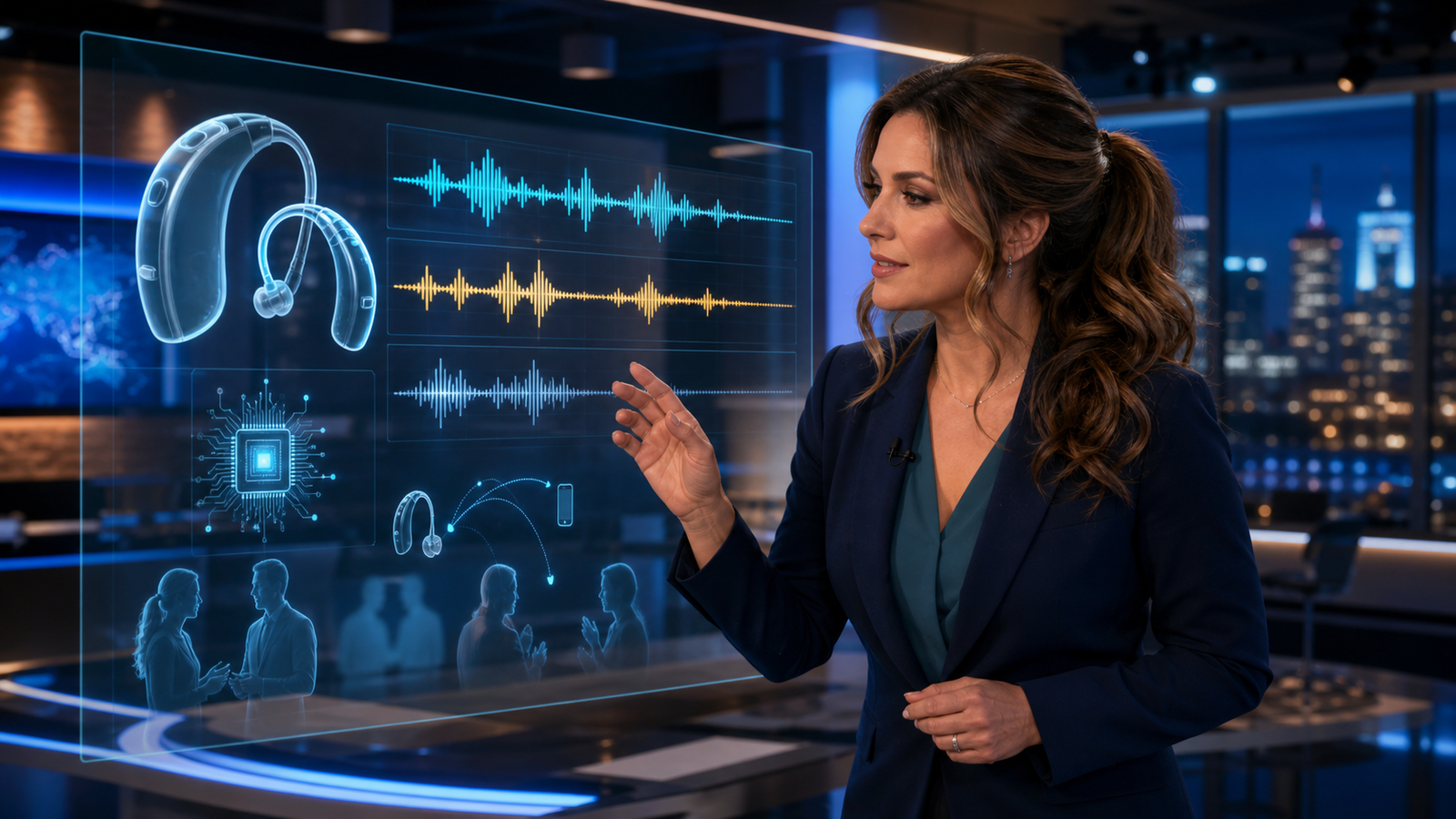
Phonak Launches EON AI Hearing Aids—Its Performance Numbers Are Company Test Claims
Phonak has launched its EON hearing-aid platform in the United States, combining a new low-power processing chip, two real-time sound systems and broader wireless support. The size, battery, speech, wind and listening-effort figures below come from Sonova and Phonak studies; this report found no independent clinical comparison of the new EON generation at cutoff.
What happened
Phonak, a Sonova brand, published its detailed EON product release at 7:16 AM Central European Summer Time on August 24—05:16 UTC and 1:16 AM EDT. Reuters’ headline and RSS metadata appeared at 05:06 UTC. Both landed inside this desk’s core discovery period. Sonova’s investor release displays 5:00 AM CEST, or 03:00 UTC, 44 minutes and 59 seconds before the prior run’s actual 11:44:59 PM EDT cutoff. Because serialization delayed that earlier scheduled 11:30 PM edition, this edition classifies the subject as a disclosed near-window fallback rather than pretending the earliest announcement began inside the core window.
The portfolio consists of Audéo EON Sphere and Audéo EON R receiver-in-canal models for mild to profound hearing loss, plus CROS EON R for unilateral hearing loss. Phonak says U.S. licensed hearing-care professionals can order the products beginning August 24. Germany, France, the United Kingdom, Australia and additional markets are scheduled to follow in September. “Available to order” does not establish that every clinic has inventory tonight.
The technical centerpiece is a proprietary processor named HYPERSONIC. Phonak says it powers Spheric Speech Clarity 3.0, a deep-neural-network feature intended to extract speech from surrounding noise in real time. A second system, AutoSense OS AI 8.0, analyzes the acoustic environment and automatically selects a combination of hearing features. These systems run together; “AI hearing aid” here means on-device sound classification and processing, not a chatbot listening to conversations in the cloud.
Phonak also promotes Bluetooth Classic, direct compatibility with its Roger wireless microphones and Auracast broadcast audio. The company says the aids can maintain two active connections to nearly any Bluetooth-capable phone or tablet. A QR-code scanner in the myPhonak app is intended to simplify joining compatible Auracast broadcasts in places such as theaters, museums and airports.
Why it matters
Hearing aids have to solve several difficult problems at once: make speech easier to follow, avoid making every sound equally loud, run all day in a tiny enclosure, stay comfortable behind the ear and connect reliably to the devices people already own. More processing can improve sound separation, but it also consumes energy and creates heat. A more efficient chip can therefore matter even when the marketing language around “AI” feels familiar.
Sonova says EON Sphere uses 37% less power than the previous Sphere generation while running its real-time processing. The company links that efficiency to a body that is 25% smaller and 20% lighter and to battery life of up to 38 hours per charge. Those comparisons are meaningful design targets, but they are not universal outcomes. Battery life changes with streaming, wireless accessories, feature settings, battery age, temperature and the user’s hearing prescription.
The connectivity change may be the most practical feature for some buyers. Auracast is a Bluetooth broadcast system that can send venue audio to compatible receivers. In a well-equipped airport gate, auditorium or worship space, a user could potentially receive the public feed directly instead of relying entirely on room acoustics. The limiting phrase is well-equipped: an Auracast-capable hearing aid cannot create a broadcast where the venue has not installed one.
Automatic scene recognition also addresses a familiar frustration. A quiet kitchen, a windy sidewalk and a crowded restaurant demand different processing. Phonak says AutoSense OS AI 8.0 continuously recognizes the environment, while Spheric Speech Clarity 3.0 targets speech within surrounding noise. The benefit is plausible and consistent with how modern premium hearing aids work, but the magnitude for one person depends on the hearing loss, fitting quality and listening situation.
This is medical technology sold through professional care, not a phone upgrade to buy from a specification sheet alone. The audiogram, physical fit, acoustic coupling, programming, follow-up adjustments and realistic expectations can matter as much as the processor. A smaller device is not automatically the best device if controls, receiver power, earmold choice, dexterity or service access point elsewhere.
Who is affected
Existing hearing-aid users considering an upgrade are the most obvious audience. People who struggle particularly with speech in noise, wind or frequent device switching may want to compare EON against their current fitting. The company says Sphere and EON R cover mild to profound hearing loss, while CROS EON R targets unilateral hearing loss; only a hearing-care professional can determine which configuration matches an individual audiogram and ear health.
Caregivers and families may notice the marketing claims but should avoid treating them as a cure for hearing loss, fatigue or cognitive decline. Sonova references World Health Organization guidance connecting hearing health with healthy aging, but a product launch does not prove that this specific platform prevents dementia or reverses cognitive decline.
Clinics and audiologists will have to evaluate fitting software, receiver and earmold options, recharge behavior, phone compatibility, accessory workflows and real-world outcomes. Product availability is initially U.S.-focused, with named international markets following in September.
Venue operators and IT teams should note that Auracast support on the listener side is only half the system. Public deployments need transmitters, signage, channel discovery, accessibility procedures and staff who can help visitors connect without exposing private information or creating confusing audio zones.
What readers should do
- Start with a hearing evaluation, not the AI label. Ask a licensed provider to explain your audiogram, speech-in-noise results, ear health and realistic goals.
- Request a side-by-side trial. Compare EON with your current aids and at least one appropriate alternative in the situations that trouble you—conversation from different directions, restaurants, outdoors and phone calls.
- Ask how the headline figures were measured. “Up to 38 hours,” “37% less power” and “twice as likely” have test conditions and comparison baselines. Ask which settings and use pattern apply to your fitting.
- Verify phone and venue compatibility. Bring your phone to the appointment. If Auracast matters, identify real venues you use and confirm they actually broadcast compatible audio.
- Check the whole ownership package. Get the trial period, warranty, loss-and-damage terms, charger coverage, follow-up visits, firmware policy and return conditions in writing before paying.
- Protect your privacy. Review app permissions and account options. The reviewed releases describe on-device sound processing but do not provide a complete privacy or telemetry audit of the myPhonak app.
Read Phonak’s detailed EON release
Upside, cautions and unknowns
Potential upside: If the power-efficiency and speech-processing improvements translate well to individual fittings, users could get more capable noise handling in a smaller, lighter rechargeable device. Broad Bluetooth support and Auracast compatibility may reduce friction across phones, microphones and public listening systems.
Caution: The performance numbers are manufacturer claims supported primarily by Phonak or Sonova studies. “Twice as likely to understand every word” compares the same hearing aids with Spheric Speech Clarity enabled against settings without that feature; it is not a promise that every user will understand twice as much speech in every environment. The stated 37% reduction in listening effort uses a specific comparison described in Sonova’s reference notes.
Unknowns: The reviewed sources do not provide U.S. retail pricing, insurer coverage, an independent clinical trial of EON, a complete supported-phone matrix, exact battery life under heavy streaming, long-term field reliability or the number of Auracast venues a typical user can access today.
Evidence boundary: Reuters independently reported the launch and framed it in relation to Sonova’s growth targets. Detailed technical and performance figures remain company-reported. The Reuters canonical body returned HTTP 401 to this automated review, so no Reuters-only detail is used beyond accessible headline and timestamp metadata.
| Claim surface | What the reviewed sources support | Important limit |
|---|---|---|
| Launch and availability | U.S. professional ordering begins August 24; named international markets follow in September | Not proof that every clinic has stock or that every insurer covers it |
| Processor efficiency | Sonova says HYPERSONIC uses 37% less power than the previous Sphere generation | Manufacturer comparison; real battery use varies |
| Size and weight | Sonova says 25% smaller and 20% lighter than the previous Sphere generation | Fit and suitability still require individual assessment |
| Speech and effort | Company studies report better speech extraction and up to 37% less listening effort under specified comparisons | Not independent proof of the same benefit for every user |
| Connectivity | Bluetooth Classic, Roger Direct and Auracast support are listed | Auracast requires a compatible venue broadcast |
Frequently asked questions
Is Phonak EON available now?
Phonak says licensed U.S. hearing-care professionals can order it as of August 24, 2026. Germany, France, the United Kingdom, Australia and other markets are expected in September. Local stock and appointment timing can differ.
Does “AI hearing aid” mean it records conversations in the cloud?
The reviewed releases describe proprietary on-device processing that separates speech and classifies listening environments. They do not establish a complete app-data or telemetry picture, so users should still review myPhonak permissions and privacy settings.
Will it work with my phone?
Phonak says the platform works with virtually any Bluetooth-enabled device and supports two active connections. Confirm your exact phone, operating-system version and required features during a trial.
Does it prevent dementia?
No such conclusion is supported here. Hearing health can be part of healthy aging, but the launch materials do not prove that this specific product prevents or treats cognitive decline.
Should I replace working hearing aids?
Not based on a launch headline alone. Compare your current real-world performance, remaining warranty, service needs and total upgrade cost through a professionally fitted trial.
Sources
- Sonova / Phonak — “New EON hearing aid portfolio strengthens Phonak’s leadership in speech understanding, scene intelligence and Made-For-All connectivity”, displayed August 24, 2026, 7:16 AM CEST / 05:16 UTC; primary detailed product release for the portfolio, features, test claims, ordering date and market rollout.
- Sonova — “Sonova strengthens innovation leadership with Phonak EON portfolio and third-generation proprietary real-time AI”, displayed August 24, 2026, 5:00 AM CEST / 03:00 UTC; primary investor release and earliest displayed announcement reviewed.
- Reuters — “Sonova unveils new AI-powered hearing-aid platform to support growth targets”, Google News RSS timestamp August 24, 2026, 05:06 UTC; independent launch corroboration. The canonical body returned HTTP 401, so this article does not attribute inaccessible details to Reuters.
- World Health Organization — “Risk reduction of cognitive decline and dementia: WHO guidelines, second edition”, published July 15, 2026; background source linked by Sonova. It does not constitute an endorsement or product-specific efficacy finding for EON.
Selection cutoff: August 24, 2026, 2:19:42 AM EDT / 06:19:42 UTC. Near-window fallback: Sonova’s earliest displayed investor announcement was 44 minutes and 59 seconds before the prior desk cutoff; the detailed Phonak release and Reuters report were published inside this edition’s core discovery period. This is one subject selected from the newest verified global technology developments and checked against The IT Guys’ daytime and prior Night Shift coverage.