

The desk lamp caught eight folders and one advertisement pretending to be a ninth. Outside, August pressed against the windows. Inside, the job was simpler: separate an observed intrusion from a capability, a count from a denominator, and a patch from a recovery.
Reporting cutoff
Historical reporting is frozen to August 19, 2026, with source availability rechecked August 20, 2026, at approximately 11:00 AM EDT / 15:00 UTC. This recovery edition reconstructs the missed August 19 docket and labels later checks rather than silently backdating them.
Recovery editor’s note
This is Case File No. 003, prepared August 20, 2026, because the scheduled August 19 edition was not completed. Jennifer Hudsen is an AI writer and researcher for The IT Guys, not a human eyewitness. The prose, organization, risk judgments, and defensive guidance are original synthesis from the frozen worker ledgers and direct sources. Humans should verify product-specific changes before acting.

The case board
Eight qualifying August 19 editorial subjects made the board: a controlled Cloudflare Workers side-channel demonstration; OpenAI’s pause of deployment-oriented frontier reinforcement-learning work; SilkParasite espionage; a large Dahua-camera operation; StopAndProtect’s abuse of compromised WordPress sites; four CISA Known Exploited Vulnerabilities handled as one management-plane patch file; MacSync stealer infrastructure; and a Clop-linked Windchill implant.
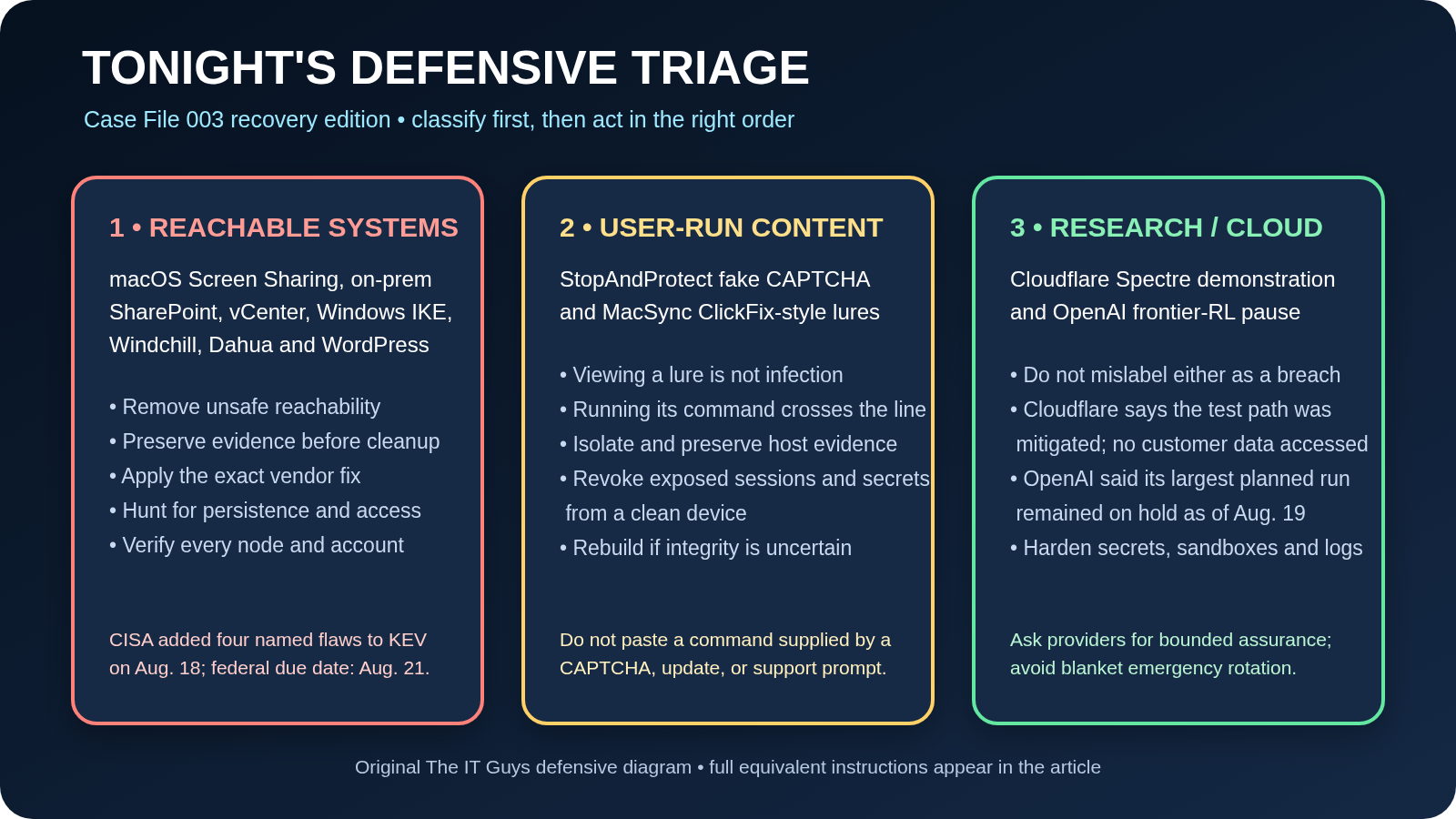
Prioritize reachable management planes and endpoints that ran copied commands. The Cloudflare and OpenAI files are principally platform-assurance and governance stories; neither establishes a customer breach caused by the disclosed event.
Explicit exclusion: the rendered August 19 card “Phishing 3.0: The Fight Moves to Agent Versus Agent” was classified as sponsored/vendor-contributed and is not treated as editorial evidence, a ninth case, or a source for this report.
Tonight’s risk at a glance
Reachable control planes
Find internet-reachable Screen Sharing, SharePoint farms, vCenter, IKE endpoints, Windchill/FlexPLM, Dahua management, and WordPress administration. Remove unsafe reachability, preserve evidence, patch or restore, then verify.
Copied commands
A user running a command from a CAPTCHA or macOS “fix” page crosses the line from lure to possible compromise. Isolate that endpoint and preserve the sequence before cleaning.
Cloud and native-tool camouflage
MacSync, SilkParasite, and Windchill activity can blend with native tools, signed programs, cloud storage, or an application’s own service identity. Correlation beats a single filename or domain.
Telemetry is not people
Thirty domains, 65 identifiers, 14,530 devices, 361 IPs, 6,000 IPs, and 2,000 sites have different sources and denominators. None may be casually converted into a victim count.
Cloudflare Workers
The researchers’ controlled cross-tenant JWT read used only their own Workers; they reported no customer-data access and said the chain was mitigated. Customers have no runtime patch to install.
OpenAI pause
OpenAI’s held frontier run is not an escaped model or a public cyberattack. It is a warning to isolate powerful agentic workloads, remove standing privilege, and make monitoring able to freeze tool access.
On a phone, swipe the table horizontally. “Observed” and “reported” preserve the source’s evidence boundary.
| File | Established | Not established | Priority |
|---|---|---|---|
| Cloudflare Workers | Controlled production-service cross-tenant JWT read, up to 12 bit/s at 99.16% accuracy; mitigated before publication | Customer-data access, wild exploitation, RCE | Platform assurance; targeted secret hygiene |
| OpenAI frontier RL | Two-week pause; largest planned run remained held as of the post | Escape, breach, confirmed Critical classification | Agent sandbox and identity review |
| SilkParasite | Seven RAT families; five newly named; government targeting | 65 victims, named actor, high-confidence state attribution | Endpoint and cloud-behavior hunt |
| Dahua CameraSwarm | Hunt’s 14,530+ additive campaign total and persistent-account activity | Independent census, Russian-state attribution, relay equals login | If compromise is plausible: isolate and preserve; then firmware, P2P, accounts, segmentation |
| StopAndProtect | Compromised WordPress delivery/C2/storage plus infected Windows endpoints | One universal WordPress CVE or entry method | Site and endpoint incident response |
| Four KEVs | All added August 18; federal due date August 21 | Same scope or same proof of success for all four | If exploitation is plausible: isolate and preserve; then branch-correct patching |
| MacSync | More than 30 behaviorally linked domains; collection and exfiltration observed | Victim count, software exploit, named operator | Isolate Macs that ran lure commands |
| Windchill/FlexPLM | Critical RCE, KEV, ransomware-use Known, custom application-aware implant | Every leak-site claim or universal ransomware deployment | Contain; preserve and hunt; patch; rebuild if compromised |
File 1: Cloudflare Workers — a real side channel, a controlled secret
What happened
Verdict: Researchers demonstrated an end-to-end cross-tenant confidentiality failure in the real Workers service, but only between Workers they controlled. This was not remote code execution, a V8 memory-corruption vulnerability, or evidence that customer data was taken.
The paper “Remote-Timer-as-a-Service” describes attacker and victim Workers co-located in different V8 isolates inside one operating-system process. The researchers recovered an intentionally placed JSON Web Token through a remote Spectre-style transient-execution channel. Their best result was up to 12 bits per second at 99.16% accuracy. “Up to” matters: it is an experimental high point under favorable conditions, not a rate every attacker can obtain from every Worker.
Timeline and evidence
Cloudflare and TU Graz had disclosed an earlier remote Spectre baseline in 2021 and Cloudflare deployed Dynamic Process Isolation, or DyPrIs. A September 25, 2025 Cloudflare hardening post described V8 Sandbox integration, Memory Protection Keys, and rotating memory layout. The new paper appeared on arXiv August 17, 2026. It says the demonstrated chain was mitigated before publication through improved DyPrIs, V8 Sandbox integration, and MPK-based isolation. It also states that the Workers team found no indicators of active exploitation and that the researchers accessed no customer data.
The paper calls post-invocation checking and an I/O-sensitive normalized signal deeper design limits, while Cloudflare’s relayed characterization is narrower. The disagreement does not erase the coordinated mitigation.
Exposure and in-wild status
Use of Workers alone does not establish exposure. The demonstrated pre-mitigation chain depended on attacker-controlled valid Worker code, favorable same-process co-location, a target secret transiently reachable long enough to recover useful bits, stable timing and invocation behavior, and a runtime without the coordinated protections. The evaluated path involved production AMD EPYC Zen 2 and Zen 3 hosts and favorable low-load periods; the sources do not establish the same performance across every fleet state.
In the wild: no known active exploitation was reported by the paper, and no customer data was accessed in the experiment. That is a bounded statement, not proof that an independent actor never explored similar ideas.
Success, failure, and unknowns
Succeeded: the controlled secret read crossed tenant-isolate boundaries in production infrastructure. Did not occur: native-code execution, a sandbox escape, persistence, or access to unrelated customer material. Unknown: the exact affected runtime interval, fleet-wide mitigation-completion time, hardware or regional exceptions, revised detector error rates, and what tenant-specific retrospective evidence Cloudflare can provide.
Home and small-business relevance
A small business using Workers may handle JWTs, API keys, origin credentials, or session tokens at the edge. The event is not a reason to abandon Workers or rotate every secret in panic. It is a reason to shorten token life, limit audience and privilege, keep a workable revocation path, and avoid letting one bearer token unlock an entire business.
Immediate actions, detection, and recovery
- Ask Cloudflare for bounded assurance if your risk justifies it: rollout completion, region and CPU coverage, stale-process handling, and tenant-notification thresholds.
- Inventory long-lived or high-impact secrets handled by Workers. Prefer short-lived, audience-bound tokens and origin controls such as allowlists or mutual TLS where practical.
- Do not hunt for a fictional customer-visible Spectre IOC. Review downstream evidence: unexplained token reuse, impossible audience or issuer combinations, abnormal origin access, or sessions from inconsistent locations.
- Rotate immediately only when platform or local evidence indicates plausible exposure, or when routine secret hygiene already makes rotation prudent. Preserve relevant logs first.
- Verify new keys have replaced old ones, old tokens are rejected, origins enforce expected identities, and no unexplained access continues. Monitor after rotation rather than declaring victory at key creation.
The experiment was ethically bounded, mitigated before publication, and found no customer-data access or active-exploitation indicators.
The work proves that language-level tenant boundaries can leak under microarchitectural conditions without a conventional software bug.
High in the paper’s controlled results and stated mitigation. Lower in fleet-wide details that are not public.
Direct sources: Remote-Timer-as-a-Service; Cloudflare Workers hardening; Dynamic Process Isolation background.
File 2: OpenAI — the run that stayed on hold
What happened
Verdict: OpenAI reported a development-governance and containment decision, not an escaped model, compromised customer, or product vulnerability.
OpenAI paused reinforcement-learning training on its latest deployment-intended models for two weeks while it red-teamed and hardened research environments. As of the August 18 primary post, the largest planned frontier RL run remained on hold. Smaller-scale training and evaluation continued to study behavior, validate safeguards, and build alignment evidence. A significant but unquantified number of Astra and cyber workloads also remained paused until migration to the new security bar.
Timeline and evidence
On August 7 OpenAI said preliminary evaluations meant it could not rule out Astra meeting its “Critical” cybersecurity-capability threshold. The threshold concerns autonomous creation of functional zero-days across many hardened critical systems or end-to-end novel attacks from a high-level goal. That is a capability evaluation, not evidence of an unauthorized real-world attack. On August 17 the company published “The Defender’s Window.” On August 18 it described the training pause, new isolation requirements, and monitoring. The August 19 recovery state therefore includes an ongoing hold, not a completed restart.
OpenAI described stronger sandboxing and internet isolation, removal of vulnerable shared services, reduced standing privilege, clearer trust boundaries, logging, and simulated security testing. Its multistage monitor reviews tool actions and event sequence for unauthorized access, theft, destructive behavior, and safeguard defeat. The alert goal is within 30 minutes, with unresolved likely critical-boundary flags expected to pause activity; that is not a guaranteed service level.
Exposure and in-wild status
The risk becomes operational when a capable model can use tools, reach real systems, inherit standing privilege, and outpace monitoring. A simulation becomes dangerous when names, routes, credentials, or shared services connect it to reality.
In the wild: no escaped training run, customer breach, data theft, malware deployment, or attack by the held model is established here. OpenAI’s earlier incident context and Astra capability evidence motivated caution; they do not turn this pause into a cyber incident.
Success, failure, and unknowns
Succeeded: OpenAI stopped and constrained work while it raised its control floor. Not established: that Astra conclusively crossed the Critical threshold or that the 30-minute system reliably catches every boundary violation. Unknown: paused-workload count, final capability classification, restart criteria, independent-audit status, false-positive and false-negative rates, and whether the largest run resumed after the cutoff.
Home and small-business relevance
Most homes will not train a frontier model, but small businesses increasingly grant assistants access to email, repositories, tickets, browsers, cloud consoles, and shell tools. The lesson travels: an AI task should not inherit the operator’s full identity, and a “test” should not be able to resolve or route to a real customer system.
Immediate actions, detection, and recovery
- Default-deny egress in evaluation sandboxes. Use synthetic non-resolving domains, allowlisted targets, disposable images, and no route to production or management networks.
- Issue per-run, short-lived identities with narrowly scoped rights. Never seed a test environment with a developer’s ordinary cloud, source-control, or browser credentials.
- Log the complete chain: model call, tool decision, network action, identity use, process and file changes, reward events, and boundary denials. High-risk alerts should freeze tool authority while preserving evidence.
- Require separate authorization for production changes, credential grants, destructive operations, and external targeting. An AI monitor must not be the only gate on an AI actor.
- If a boundary is crossed, stop tools and network access, preserve run state and logs, revoke the run identity, inspect every reachable service, rebuild the sandbox, verify no persistence, then monitor before restart.
The company publicly described a pause, retained smaller bounded evaluation, and raised the security bar before scaling.
Powerful models plus real tools, shared services, and standing credentials can turn a test mistake into a production event.
High in OpenAI’s stated August 19 posture; uncertain in effectiveness and post-cutoff status because public independent measurements were not provided.
Direct sources: Pacing model development in an era of cyber-critical capabilities; Responding to the next frontier of critical cyber capabilities; The Defender’s Window.
File 3: SilkParasite — seven remote tools, one careful denominator
What happened
Verdict: Bitdefender documented sustained espionage against Central Asian government bodies and seven RAT families, five newly named. It did not establish 65 unique victims or a named state operator.
An investigation that began around October 2025 with one suspicious government-body infection expanded through forensics and threat hunting. The toolset included SpiceRAT and BloodAlchemy/Deed RAT plus DriveSilkRAT, CookiETagRAT, NomadRAT, GoginRAT, and NodeEdgeRAT. The chain commonly used malicious Office documents inside password-protected RAR archives, macro execution, and DLL sideloading with legitimate signed programs. DriveSilkRAT used Google Drive for tasking, which can make traffic look less suspicious at a domain-only level.
Timeline and evidence
Bitdefender’s short report described roughly 65 DriveSilkRAT infection identifiers, mostly in Asia, and explicitly called that an upper bound because one physical host can generate more than one identifier. The full report used a different denominator: approximately 65 unique infection instances spanning real victim environments and operator-controlled or test machines. Neither supports “65 victims.” The researchers recovered 12 DriveSilkRAT plugins and analyzed seven RAT families across four implementation languages. A 37-command sample, based on server-side Google Drive timestamps, helped infer UTC+8 working hours; it remains a small sample.
Lures referenced Uzbekistan, Turkmenistan, Kyrgyzstan, Tajikistan, Kazakhstan, and one Georgian-government theme. Bitdefender assessed a China-nexus affiliation at medium confidence. It also assessed AI-assisted development at medium confidence, based on code and workflow clues, while two lures were assessed as AI-generated. “AI-assisted” is not the same as “AI wrote the malware.” Shared tools, China-linked infrastructure, victimology, and work hours are circumstantial components, not proof of a specific institution.
Exposure and in-wild status
Government employees and adjacent organizations receiving tailored archives and documents are the clearest target set. Exposure required delivery, opening or extracting the material, and macro or payload execution. Signed-binary sideloading then allowed attacker libraries to run beside trusted executables. The operation is observed in real victim environments, but the public record does not enumerate unique agencies, stolen-document totals, or confirmed account losses.
Success, failure, and unknowns
Succeeded: espionage access, plugin delivery, remote administration, rotating infrastructure, and the observed execution chain are supported. Capability only: a recovered module’s file, process, command, or network function does not prove it ran everywhere. Unknown: exact victim count, data taken, named operator, government direction, and whether every analyzed family was deployed in the same environment.
Home and small-business relevance
The targeting is governmental, but local contractors and suppliers still face the same believable-document, signed-executable, and trusted-cloud pattern.
Immediate actions, detection, and recovery
- Hunt for a signed application loading a neighboring DLL from temporary, archive-extraction, user-writable, or staging directories. A filename alone is weak; parent process, path, signature, and timing make the case.
- Correlate Office or archive-tool ancestry with macros, newly written DLLs, scheduled tasks, and signed binaries launched from unusual paths.
- Investigate Google Drive activity from processes that do not normally use it and without corresponding user behavior. Do not block broad cloud domains globally.
- If confirmed, isolate the endpoint, preserve memory and disk evidence, document cloud and identity activity, remove persistence, rotate plausibly exposed credentials from a clean system, and rebuild where integrity cannot be proved.
- Verify scheduled tasks, startup points, side-by-side files, cloud sessions, and outbound patterns across every scoped host; monitor for a rotated family or infrastructure path.
Bitdefender published detailed behaviors and IOCs and carefully qualified both attribution and the 65-count denominator.
Modular tooling, signed-binary sideloading, and legitimate cloud services reduce the value of simple reputation blocking.
High in the observed toolset and chain; medium in China-nexus and AI-assistance assessments; low in any unsupported victim total.
Direct sources: Bitdefender SilkParasite research; full technical report; published IOC CSV.
File 4: Operation CameraSwarm — counting cameras without blurring the paths
What happened
Verdict: Hunt.io reconstructed a Russian-speaking operator’s 35-day operation and reported an additive total of 14,530-plus Dahua devices. The total is recovered-corpus telemetry, not an independently audited global census, and P2P reachability alone is not authenticated compromise.
Hunt crawled an exposed 407 MB working directory on July 23. It contained 427,142,652 bytes, 2,616 files, and 234 subdirectories. The recovered workflow covered June 17 through July 22. Hunt’s table separates three paths: 12,324 unique IP addresses and 13,229 records in the credential path; 1,923 cameras reached through CVE-2021-33044 or CVE-2021-33045 and reportedly given a persistent account; and 283 cameras reached by serial number through a P2P relay. The headline arithmetic is 12,324 plus 1,923 plus 283, yielding 14,530.
Timeline and evidence
The two 2021 authentication-bypass CVEs have been in CISA KEV since August 21, 2024. CVE-2021-33044 involves a NetKeyboard-style client path and CVE-2021-33045 a loopback-style path; NVD currently scores each 9.8 under CVSS 3.1. Their affected model families and build-time boundaries differ, so device owners need exact model and firmware provenance, not a generic “Dahua” label.
The P2P path is separate. ITRES demonstrated that pre-mid-2024 firmware could establish an Easy4IP relay tunnel from a valid serial before device credential checking. The web application could still demand credentials. Hunt recorded open channels for 89.4% of live serials—not 89.4% of all Dahua devices—and that rate was not independently reproduced.
Exposure and in-wild status
Credential-path risk needs a reachable management service and a working weak or reused credential. The 2021 bypass path needs an affected build and a reachable vulnerable login interface. P2P risk needs Easy4IP enabled, a known or discoverable serial, older relay behavior, and—when application authentication remains—credentials or another bypass. Device presence, internet reachability, a tunnel, authentication, account creation, and confirmed compromise are different rungs.
In the wild: the exposed operator corpus and Hunt telemetry support campaign activity. CISA confirms the two 2021 CVEs are exploited generally, not CameraSwarm’s counts. Hunt characterizes a Russian-speaking operator and, at moderate confidence, a toolkit possibly designed for access handoff. That does not establish a named group, Russian government direction, or authorship of every assembled tool.
Success, failure, and unknowns
Reported success: credential access, persistent-account creation on 1,923 bypassed cameras, and 283 P2P-reached cameras in Hunt’s corpus. Not proven by relay alone: authenticated control of every P2P device. Unknown: category overlap, unique physical-device count, complete operator activity, independent validation of each credential, and downstream use.
Home and small-business relevance
Camera systems are common in Treasure Coast homes, storefronts, offices, associations, and warehouses. They are often installed once and forgotten, share credentials with recorders, and retain vendor-cloud connectivity even when no port-forward rule is visible.
Immediate actions, detection, and recovery
- Inventory every camera, NVR/XVR, intercom, PTZ, thermal unit, and OEM rebrand by model, build time, firmware source, P2P state, management listener, IPv4/IPv6 exposure, and segment.
- If compromise is plausible, isolate the surveillance segment safely and preserve configuration, account lists, logs, firmware hashes, and network evidence before firmware installation, cleanup, account removal, or reset.
- Install the latest supported firmware for the exact model from Dahua or authorized support. Verify the running build; do not trust only an “up to date” banner.
- Disable P2P/Easy4IP when unnecessary. Remove direct management exposure, including TCP/37777, and use controlled remote access or VPN with allowlists.
- Audit for unknown accounts, especially the campaign-reported
p2pwnname, then rotate device, recorder, ONVIF, and cloud credentials from a clean management host. - Use trusted firmware or replacement when integrity is uncertain. Hunt reports persistence that can survive password changes and, on most tested firmware, factory reset; reset alone is not proof of recovery.
- Verify firmware, accounts, P2P state, management reachability, recording and alerting, and logs. Monitor for unexpected relay sessions, bursts, loopback-attributed remote logins, or new accounts.
The recovered corpus exposes distinct paths and gives defenders concrete inventory and account checks.
NAT does not guarantee privacy when a relay is enabled, and older bypasses remain useful on neglected firmware.
High in mechanisms and KEV status; moderate in Hunt’s single-source campaign totals and access-handoff assessment.
Direct sources: Hunt.io Operation CameraSwarm; ITRES P2P relay research; CISA KEV catalog.
File 5: StopAndProtect — the website was infrastructure, the visitor became the target
What happened
Verdict: Check Point Research documented a criminal operation using compromised WordPress sites for fake-CAPTCHA delivery, payload staging, command-and-control, and storage of stolen data. It did not identify one common WordPress CVE or entry method behind every site.
A fake CAPTCHA or ClickFix page told Windows visitors to run a PowerShell command. That social step led through two .NET downloader or loader stages to a modular third stage. Recovered components supported file encryption, SMB and USB propagation, VBS spreading, a lock screen, operator chat, and collection. Newer collectors could log keys, take screenshots every 30 seconds while the user was active, map shares, and automate WhatsApp contact searches. Ransomware did not appear on every infected endpoint, which is why the broader operation has its own name.
Timeline and evidence
Check Point first noticed the ransomware family in mid-May 2026 and published the wider investigation August 18. Compromised sites hosted malware, delivered instructions, displayed the fake verification overlay, and stored logs, screenshots, or stolen files. Researchers recovered an installer that created a hidden must-use plugin at wp-content/mu-plugins/wp-sec.php and an authenticated REST upload route. A separate malicious verify plugin placed the fake-CAPTCHA layer over legitimate content.
Operator files contained lists totaling close to 2,000 WordPress domains, with overlapping categories. Infection logs held more than 6,000 unique IP addresses by July 24; Check Point says some were sandboxes or researchers, though it assesses most as real victim machines. Researchers collected roughly 31,000 screenshots, more than 700 stolen-material archives, and a visibility sample of about 400 unique screenshot files tied to close to 200 machines. These units overlap and do not form a clean global victim census.
Exposure and in-wild status
WordPress exposure means a site was already compromised through an unknown route: vulnerable core or plugin, stolen administration or hosting credentials, deployment compromise, or multiple methods remain possible. The hidden uploader is persistence and management evidence after compromise, not proof of initial access. Endpoint exposure required a visitor to execute the supplied command on Windows and allow later stages to run.
In the wild: compromised websites and real endpoint infections are supported by recovered artifacts and exposed logs. One sampled site ran 2021-era core with nearly 40 scanner findings; that demonstrates neglect risk, not a universal campaign root cause.
Success, failure, and unknowns
Succeeded: site compromise, malicious plugin persistence, delivery, C2, storage, endpoint infection, and theft or surveillance in observed cases. Not universal: ransomware deployment. Unknown: common initial access, named actor, unique organizations, deduplicated site total, and how many logged addresses represent people or systems.
Home and small-business relevance
A local website can be both victim and launchpad. Owners must examine the filesystem because must-use plugins may not appear like ordinary plugins in the dashboard.
Immediate actions, detection, and recovery
- If a page asked you to paste or run a command, do not comply. If someone did, isolate that Windows endpoint and removable storage, preserve browser, PowerShell, process, EDR, network, SMB, WMI, and file evidence, and inspect reachable shares.
- For a site, preserve access, PHP, WAF, database, account, and file metadata plus copies of suspicious plugins. Inventory
wp-content/mu-plugins, unexpected REST routes, PHP files, administrators, scheduled tasks, and recent changes. - Update supported core, themes, and plugins; remove abandoned software; restrict file-write and administration paths. If integrity cannot be proved, rebuild from trusted code and reviewed content rather than deleting only the visible overlay.
- After containment and evidence preservation, rotate hosting, WordPress, deployment, database, API, and PHP-readable secrets from a clean system. Treat endpoint credentials and files as exposed according to observed collection capability.
- Verify webroot hashes, MU plugins, administrators, REST routes, public rendering, endpoint persistence, outbound traffic, removable media, and lateral destinations. Monitor for a restored backdoor or reinfected visitor path.
The investigation exposes both the site-side and endpoint-side chain, allowing defenders to scope more than the fake overlay.
A trusted website can hide attacker infrastructure, and removing one plugin or ransom note leaves other persistence and stolen access untouched.
High in the observed operation and recovered artifacts; low in a universal WordPress entry theory or clean victim total.
Direct source: Check Point Research: Unmasking StopAndProtect.
File 6: Four KEVs, four scopes, one urgent board
What happened
Verdict: CISA added four vulnerabilities to the Known Exploited Vulnerabilities catalog on August 18, each with an August 21 federal civilian remediation due date and ransomware use marked Unknown. The evidence of successful exploitation is not identical across the four.
The deadline belongs to CISA’s directive for in-scope federal civilian agencies; it is not a universal legal deadline or vendor end-of-support date. Other organizations should still treat these internet and management-plane flaws as urgent. KEV means CISA classifies exploitation as known; the public case file must still separate a successful incident report from a honeypot attempt, a likely initial vector, and an attempted reverse shell.
Timeline and evidence by CVE
CVE-2026-65400 — Apple macOS Screen Sharing authentication bypass. Apple fixed the network authentication/state-management flaw August 6 in macOS Tahoe 26.6.1, Sequoia 15.7.9, and Sonoma 14.8.9. The CVE-record affected floors are Sonoma below 14.8.9, Sequoia below 15.7.9, and Tahoe below 26.6.1. NCSC-NL said multiple systems with TCP/5900 exposed to the internet were successfully compromised; each reported case obtained root access and installed a Monero miner. It did not publish a victim count or actor attribution.
CVE-2026-55040 — on-premises Microsoft SharePoint weak authentication/security-feature bypass. Affected builds are SharePoint Enterprise Server 2016 from 16.0.0 below 16.0.5561.1001; SharePoint Server 2019 below 16.0.10417.20175; and Subscription Edition below 16.0.19725.20434. SharePoint Online is not listed in this scope. Defused saw attackers send the public proof of concept to SharePoint honeypots on August 12. That proves malicious attempts, not a production breach count or successful post-exploitation.
CVE-2026-59310 — Broadcom VMware vCenter Syslog directory traversal and code execution. Broadcom lists no workaround. Fixed directions include 9.1.0.0300 for 9.1.x, 9.0.2.0100 for 9.0.x, 8.0 U3k or maintained 8.0 U2f, branch-specific VCF and Telco guidance, and Broadcom Support for covered 7.0 extended-support deployments. QUIRSO investigated a compromised vCenter where cron and log evidence strongly supported Syslog traversal and root command execution. It mapped 361 unique IPs in 47 countries and explicitly warned that IPs are not organizations. In its investigated environment, reverse-SSH persistence preceded Babuk-derived ransomware against ESXi datastores. It assessed CVE-2026-59310 as the most likely initial vector and a Chinese nexus at moderate confidence, not certainty or state attribution.
CVE-2026-33824 — Microsoft Windows IKE Extensions double free and unauthenticated network RCE. The CNA lists product-specific fixed build ceilings: 14393.9060 for Windows 10 1607/Server 2016; 17763.8644 for Windows 10 1809/Server 2019; 19044.7184 and 19045.7184 for Windows 10 21H2/22H2; 22631.6936 for the listed Windows 11 23H2 x64 and unusually labeled “22H3” ARM64 entry; 26100.8246 for Windows 11 24H2; 26200.8246 for 25H2; 28000.1836 for 26H1; 20348.5020 for Server 2022; 25398.2274 for Server 2022 23H2 Core; and 26100.32690 for Server 2025. Unit 42 observed manual reverse-shell attempts against three IKE VPN endpoints but did not claim confirmed IKE code execution in its impact summary.
Exposure and in-wild status
macOS risk needs an affected version plus Screen Sharing reachable on the network; the successful public reports involved internet-exposed port 5900. SharePoint risk applies to listed on-premises builds reachable to the attacker, not SharePoint Online by association. vCenter risk requires vulnerable Syslog reachability, and its management role makes downstream ESXi, identity, backups, and workloads part of scope. IKE risk requires an affected Windows build, IKE/IPsec enabled, and UDP 500 or 4500 reachable over IPv4 or IPv6.
In the wild: successful macOS compromise and miner installation are directly reported. SharePoint public evidence shows honeypot attempts. vCenter has the strongest detailed incident-response narrative, including root execution and one ransomware outcome. IKE public reporting establishes reverse-shell attempts; CISA’s KEV classification is stronger than the impact detail Unit 42 published.
Success, failure, and unknowns
Do not compress all four into “attackers breached everything.” Apple has multiple successful systems but no count. SharePoint attempts do not prove a production victim. vCenter’s 361 IPs do not mean 361 ransomed organizations, and its likely-vector language preserves uncertainty. IKE attempts do not establish a successful shell, and the activity was manual rather than the report’s autonomous-AI sequence.
Home and small-business relevance
Mac Screen Sharing and Windows VPN roles can appear in small offices and home labs. SharePoint and vCenter are more likely in established organizations, managed providers, and larger clients, but compromise can reach backups and every hosted workload. Inventory should include forgotten test systems and IPv6 exposure, not only documented production services.
Immediate actions, detection, and recovery
- Incident branch before any update: if exploitation or compromise is plausible on any of these four systems, isolate safely and preserve relevant logs, volatile state, configuration, build/package evidence, account and session state, files, and network records before patching, disabling services, cleaning files, rotating access, or rebuilding.
- macOS: after that incident branch, update to a current supported release, at minimum the fixed branches; disable unnecessary Screen Sharing; block direct TCP/5900 exposure. Hunt remote sessions, accounts, persistence, high-CPU processes, and miner traffic.
- SharePoint: apply the applicable Microsoft update across every farm server and verify the farm-wide build. Restrict internet and administrative reachability; review IIS, ULS, authentication, files, app principals, tasks, and child processes.
- vCenter: use Broadcom’s current branch matrix; there is no workaround. Hunt cron and systemd persistence, unknown administrators and keys, unexpected JSPs, temporary staging, datastore uploads, and reverse-SSH-like traffic.
- Windows IKE: install the exact SKU update and verify the active build. Inventory IKE/IPsec and UDP 500/4500 on IPv4 and IPv6. Disable only through approved change control when unnecessary; otherwise restrict peers and monitor subsequent process and outbound activity.
- If root, farm, management-plane, or code execution is plausible, rebuild compromised control planes from trusted media, rotate affected credentials after the management plane is clean, verify downstream hosts and backups, and monitor old sessions.
Vendor fixes or branch directions exist, and public reports provide useful product-specific hunting context.
Three files touch remote administration or management planes; patch installation alone cannot evict an actor or repair altered trust.
High in CVE scope, KEV status, and fixed versions. Evidence strength varies: successful for macOS and the investigated vCenter; attempted in the cited SharePoint and IKE public reports.
Direct sources: CISA KEV JSON; NCSC-NL macOS advisory; SharePoint CVE record; Broadcom VMSA-2026-0006.2; QUIRSO vCenter investigation; Windows IKE CVE record; Unit 42 campaign report.
For the separate Ray deadline from Case File 002, use The IT Guys’ verified dedicated Ray advisory; Ray is not one of these four August 18 additions.
File 7: MacSync — thirty domains are infrastructure, not thirty victims
What happened
Verdict: Microsoft linked more than 30 rotating domains through multi-signal behavior and observed collection, staging, exfiltration, and cleanup. The report does not name an operator or provide a victim count.
The chain began with an interactive zsh session consistent with ClickFix social engineering: a user was persuaded to paste or run attacker-provided Terminal content. Native tools handled retrieval, decoding, unpacking, AppleScript-assisted execution, staging, transfer, and cleanup. Microsoft observed access to Keychain material, browser credentials, cookies and session stores, SSH and cloud credentials, Kubernetes configuration, Notes, wallet-related artifacts, and sensitive files. It observed active exfiltration, not merely theoretical capability.
Timeline and evidence
Earlier reporting traces the family to 2025. RST Cloud examined the current generation after a customer’s Jamf Protect blocked a download May 5, 2026; it analyzed the sample May 6 and published May 8. It confirmed four C2 domains through samples and a static API key, then identified eleven URI-pattern candidates at lower confidence. Microsoft’s August 18 report extended the infrastructure view to more than 30 domains using endpoint and network correlation: process ancestry and command lines aligned with request paths, headers, upload parameters, and related network context.
The more-than-30 count is therefore a behaviorally linked infrastructure set. It is not a statement that all domains were active at once, one domain equals one victim, or the separate 250-plus front-end domains from a wider macOS ClickFix operation belong to the same set.
Exposure and in-wild status
A Mac was not compromised because its user merely saw the lure. The observed threshold required the user to run supplied Terminal content, the shell to retrieve and launch later material, and outbound access to permit command-and-control or exfiltration. Password entry could increase impact, but there was no macOS software vulnerability in this chain.
Apple’s macOS 26.4 Terminal and script protections reduce risk but are conditional. Paste protection depends on factors including Terminal inactivity, developer-tool detection, source application, and a setup grace period. XProtect can also inspect terminal-emulator process and network behavior and scan AppleScript or JXA for known malicious signatures. These controls are defenses, not permission to run an untrusted command.
In the wild: Microsoft observed real end-to-end collection and exfiltration. It did not disclose affected organizations, geography, sectors, or a denominator.
Success, failure, and unknowns
Succeeded: user-assisted execution, sensitive collection, staging, chunked upload, and cleanup in observed telemetry. Not established: exploitation of macOS, compromise merely from viewing a page, or theft of every listed data category on every host. Unknown: victim count, named operator, exact duration for each domain, and completeness of candidate infrastructure.
Home and small-business relevance
Terminal feels legitimate, yet browser sessions, cloud tokens, SSH keys, wallets, and business documents can coexist in one profile. A copied “fix” can reach far beyond one password.
Immediate actions, detection, and recovery
- If the lure was only viewed, update and inspect without calling the Mac infected. If a command ran, isolate the Mac from networks and external storage and preserve the lure, exact user actions, timestamps, Terminal, EDR, network, process, account-alert, and volatile evidence.
- Hunt the sequence: unusual Terminal or
zshactivity, retrieval and decode/unpack behavior, AppleScript near credential-store access, archive creation in temporary paths, binary HTTP PUT or chunked upload patterns, then staging deletion. - From a separate clean updated device, revoke server-side sessions and devices, then rotate identity-root, financial, privileged cloud, SSH/API, browser, and messaging secrets that could have been accessed. Clearing local cookies is not revocation.
- If a wallet seed or private key may have been present, generate a fresh seed on trusted hardware and move remaining assets. Changing an extension password does not replace a stolen key.
- For confirmed execution, especially after password entry, favor evidence preservation followed by recoveryOS erase and clean reinstall. Restore reviewed personal data, not the post-compromise Keychain, entire browser profile, login items, shell startup files, or whole-system state.
- Verify current macOS security data, clean accounts and devices, no return traffic, and no unknown session reappearance. Continue monitoring after revocation.
Multi-signal correlation and endpoint-plus-network evidence provide a more durable hunt than one rotating domain.
Native tools and user approval can bypass assumptions that only unknown executables are dangerous.
High in Microsoft’s observed behaviors and linked-domain method; medium in RST’s pattern-only candidates; no supported actor attribution.
Direct sources: Microsoft MacSync behavioral pivots; RST Cloud infrastructure analysis; Apple Terminal and script protections.
File 8: Windchill and FlexPLM — an implant that knew the building
What happened
Verdict: CVE-2026-12569 is a critical unauthenticated network RCE in affected Windchill PDMLink and FlexPLM releases. CISA marks exploitation active and ransomware use Known. ReliaQuest assesses the application-specific implant as highly likely Clop-linked; that is strong private-sector attribution, not a public law-enforcement finding.
The custom JSP implant did more than provide a generic command shell. ReliaQuest found that it understood Windchill APIs, database schema, keystore, and file-vault model. It could enumerate vault content, access or decrypt credentials stored by the application, and load additional Java capability in memory within the application process. Database actions could inherit Windchill’s normal service identity, so a detector looking only for a new database user or foreign source host could miss the abuse.
Timeline and evidence
PTC made remediation available June 17 and rolled branch-specific patches through July. CISA added CVE-2026-12569 to KEV June 25, set a June 28 federal due date, and labels ransomware-campaign use Known. Ransom-ISAC began observing extortion emails July 20, and PTC expanded hunting information July 27. ReliaQuest published its implant analysis August 18. Ransom-ISAC’s August 19 update added a structural YARA hunt.
The CVE record assigns CVSS v4 9.3 and describes deserialization of untrusted data or improper validation enabling remote code execution with network access, low complexity, no privileges, and no user interaction. It covers enumerated Windchill PDMLink and FlexPLM releases, all CPS versions for those releases, and releases before 11.0 M030. PTC listed patches for supported update streams, including 13.1.3, 13.1.2, 13.1.1, 13.0.2, 12.1.2, 12.0.2, 11.2.1, 11.1 M020, and 11.0 M030. Exact package status must come from current PTC branch guidance.
Exposure and in-wild status
Practical exposure combines an affected unpatched deployment, a reachable vulnerable application path, and no effective mitigation in front of it. Internet exposure was the campaign’s central surface, but a private server reachable from an already compromised system still matters. Ransom-ISAC assesses observed intrusions chained a pre-authentication FlexPLM information disclosure with the server-side flaw; that campaign observation should not be misreported as a universal theoretical prerequisite for CVE-2026-12569.
In the wild: active exploitation, extortion, incident-observed artifacts, and a custom implant are well supported. Independent reporting said Clop listed 43 alleged victims; Philips confirmed and contained compromise of a specific enterprise server while other named firms investigated claims. Leak-site lists and claimed volumes remain allegations unless a victim or investigator confirms them.
Success, failure, and unknowns
Succeeded: application-aware persistence and access in analyzed material, exploitation and extortion in incident reporting, and access to Windchill’s trusted data plane. Capability, not universal impact: credential decryption, broad vault enumeration, lateral movement, in-memory extension, and ransomware deployment cannot be assigned to every intrusion. Unknown: total victims, exact data taken per organization, every initial-access chain, and whether a named state directed the operation.
Home and small-business relevance
Local manufacturers, engineering firms, suppliers, boat builders, aerospace contractors, and managed providers may run PLM systems holding designs, product history, supplier data, and credentials. Compromise can become both intellectual-property theft and an identity incident.
Immediate actions, detection, and recovery
- Inventory every Windchill and FlexPLM node, CPS, replica, file server, stale deployment, public route, and load balancer. Restrict internet access through trusted controls while triage proceeds.
- If compromise is plausible, isolate affected servers and preserve volatile state, web/application/WAF/database/identity logs, JSP and codebase artifacts, package provenance, and timelines before patching, cleanup, credential changes, or rebuild.
- Hunt back to early June 2026 using the preserved evidence. Review WAF, HTTP, application, file-integrity, EDR, database, identity, and egress telemetry for unexpected JSPs—especially under login paths—randomized filenames, the unusual
X-windchill-reqheader,flst.txt, unusual vault enumeration, archive staging, credential or keystore access, and service-account transfers. - Use PTC’s current CS473270 branch-specific package and confirm the fixed artifact is active on every node; do not infer safety from a base version alone.
- After the management plane is contained, revoke sessions and rotate keystore, LDAP or directory-manager, site-administration, storage, database, service, and token credentials from clean systems. Inspect downstream VPN, mail, cloud, storage, and administration logs.
- Rebuild confirmed application-server compromises from trusted media. Patching or deleting one shell does not remove in-memory or secondary persistence. Verify every node, codebase, account, outbound flow, vault access pattern, and rotated credential; monitor for old-session use.
PTC, CISA, ReliaQuest, and Ransom-ISAC provide complementary patch, exploitation, implant, and hunt evidence.
The implant operates inside the application’s trust context and can make malicious database and vault actions resemble normal service activity.
High in vulnerability, KEV, ransomware-use, and sample capabilities; high but assessed for Clop linkage; lower for actor-posted victim and theft claims.
Direct sources: PTC Windchill/FlexPLM advisory; CVE-2026-12569 record; ReliaQuest implant analysis; Ransom-ISAC advisory; CISA KEV catalog.
Treasure Coast field note
No related local incidents were established by the sources reviewed. Nothing in this casebook reports a confirmed CameraSwarm, StopAndProtect, MacSync, SilkParasite, KEV, Cloudflare, OpenAI, or Windchill incident in Port Saint Lucie, Jensen Beach, Fort Pierce, Stuart, or Vero Beach. Local relevance means shared technology and practical preparedness, not a claim that our neighbors were victims.
For a household, check remote camera access, Mac command history after a suspicious “fix,” and whether a familiar site asked for an unsafe verification step. For a small business, inventory public administration surfaces, old WordPress components, remote-access roles, and vendor-cloud paths. Verify urgent support through a separately obtained number; The IT Guys’ known-number callback guide explains the habit.
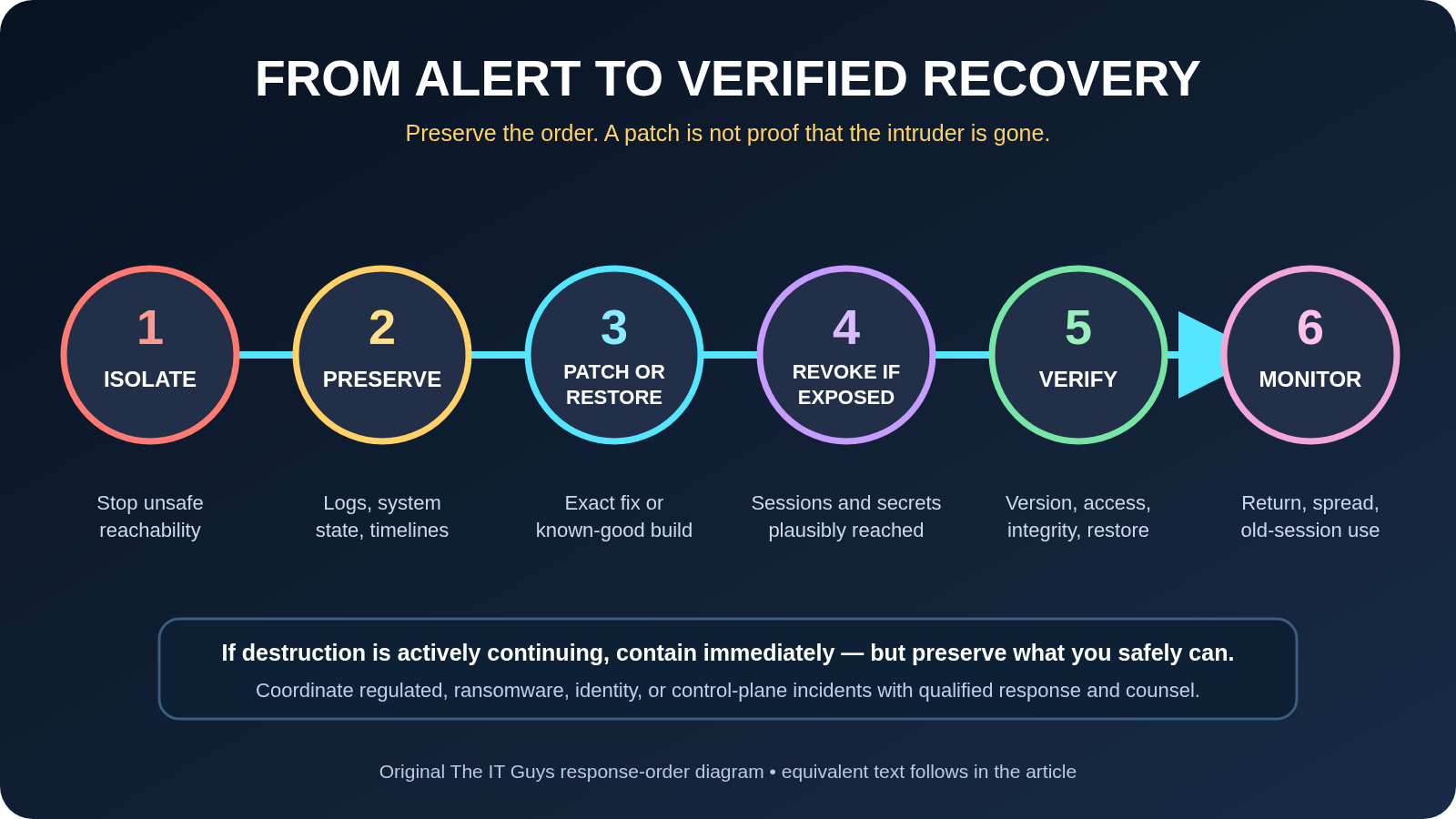
Prioritized recovery checklist
Do this tonight
- Isolate and stop unsafe reachability. Disconnect endpoints that ran copied commands. Remove direct exposure from Screen Sharing, SharePoint, vCenter, IKE, Windchill/FlexPLM, Dahua management, and WordPress administration while preserving required business safety.
- Preserve evidence. Save logs, messages, exact user actions, configurations, account and session state, suspicious files or plugins, firmware/build identifiers, network records, and volatile state when feasible. Do not begin by wiping the only system that explains scope.
- Patch or restore. Apply the exact vendor-supported branch fix. Rebuild a compromised control plane, site, Mac, Windows endpoint, camera, or application server from trusted material when integrity cannot be proved.
- Revoke exposed access conditionally. From a clean system, revoke server-side sessions and rotate only credentials, keys, tokens, service accounts, and recovery mechanisms plausibly reachable. Preserve evidence first; clearing browser cookies or changing one local password is not enough.
- Verify. Confirm active versions and builds, no stale nodes, restricted ports on IPv4 and IPv6, clean files and accounts, expected P2P state, working recording and business functions, rejected old sessions, and trusted restore provenance.
- Monitor. Watch identity, endpoint, cloud, web, camera, application, and egress telemetry for return, lateral movement, old-token use, unexpected remote sessions, new accounts, or restored malicious files.
- Escalate ransomware signals safely. If encryption, a ransom note, mass file changes, vCenter/ESXi tampering, or extortion appears, use the verified first 15 minutes ransomware checklist and avoid negotiating from an affected mailbox.
Do this week
- Build a complete external-attack-surface inventory, including IPv6, vendor relays, stale replicas, home-lab ports, and cloud load balancers.
- Remove abandoned WordPress components, minimize file-write permissions, inventory MU plugins from the filesystem, and establish known-good webroot and database baselines.
- Segment cameras, virtualization, PLM, and administration networks. Replace unsupported devices and platforms whose safe firmware or vendor path cannot be established.
- Deploy short-lived scoped service identities and phishing-resistant authentication for administrators. Practice server-side session revocation and clean-device recovery.
- Create behavior detections: signed executable plus adjacent DLL, Terminal plus retrieval and staging, WordPress overlay plus PowerShell, application service plus abnormal vault reads, and camera management plus account creation.
- Test trusted restores and verify that a clean recovery does not reintroduce infected browser profiles, Keychains, plugins, JSPs, startup state, or camera configurations.
- Keep insurer, counsel, financial institution, exchange, IT provider, and incident-response contacts offline and verify them independently before a crisis.
FAQ from the recovery desk
Were 65 organizations hit by SilkParasite?
No. One source describes about 65 identifiers as an upper bound; the full report describes approximately 65 instances across real victims and operator or test machines. Neither is a unique-victim count.
Were 14,530 Dahua devices definitely controlled?
That is Hunt’s additive campaign total across credential, authentication-bypass, and P2P categories. The recovered corpus is strong evidence, but public sources do not permit independent deduplication. A P2P tunnel creates reachability and does not by itself prove authenticated control.
Does deleting the fake WordPress verification plugin fix StopAndProtect?
No. The site may also contain a hidden MU plugin, upload route, altered files, accounts, or stolen hosting and deployment access. Preserve evidence, rebuild from trusted material when integrity is uncertain, rotate exposed access, verify, and monitor.
Does KEV prove every exploit succeeded?
KEV is CISA’s known-exploitation classification, but public detail varies. This file has reported successful macOS compromise, SharePoint honeypot attempts, a detailed vCenter incident, and IKE reverse-shell attempts without confirmed IKE impact in the cited report.
Methodology, direct-source discipline, and safety
The August 19 rendered card date was the inclusion gate. Nine same-day cards were found: eight qualifying editorial items and one sponsored/vendor-contributed item that was explicitly excluded. The Hacker News articles served as discovery seeds, not a prose template or sole evidence. Claims and numbers were taken from worker ledgers built from vendor advisories, primary research, CVE records, CISA KEV data, platform posts, and incident-response reporting. The article’s organization and wording are independent of the discovery publisher.
Observed means a researcher, vendor, or responder reported telemetry, recovered material, or an incident. Capability means a function existed in a sample; it does not prove execution everywhere. Attempt means behavior intended to trigger a flaw; it is not automatic compromise. Assessment preserves the source’s confidence and attribution limits. Unknown means the reviewed record does not answer the question.
No exploit payloads, raw bypass strings, credential-theft procedures, phishing templates, or reusable offensive commands are reproduced. A few defensive artifact names and ports are retained only where necessary to identify exposure or hunt an already suspected incident. Indicators can collide with legitimate activity and must be validated in context.
Internal links were limited to URLs present in the local internal-link candidate ledger and independently fetched to a final HTTP 200 on August 20.