

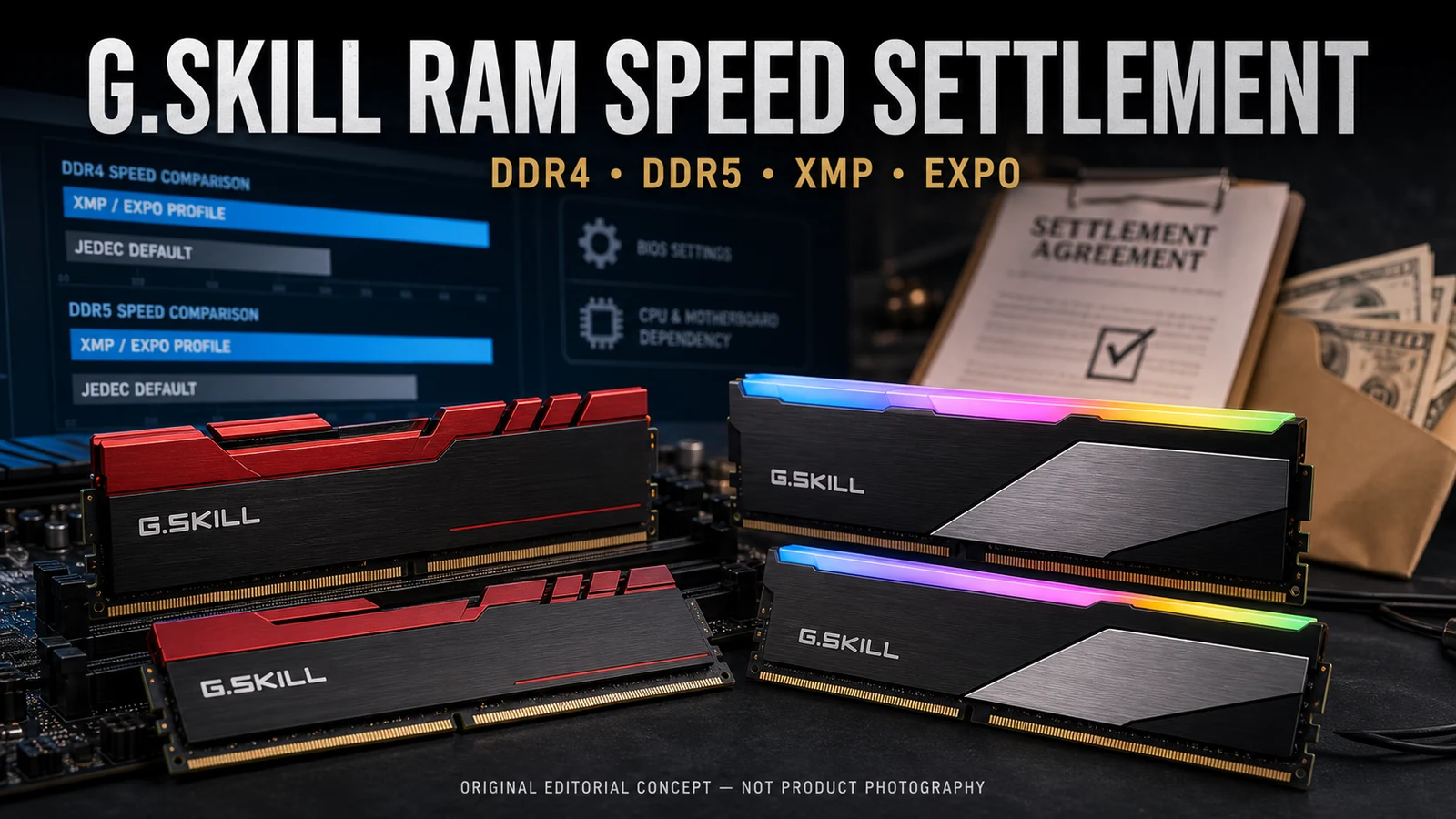
G.Skill has begun paying claims from a $2.4 million class-action settlement over allegations that certain desktop DDR4 and DDR5 products were marketed at speeds buyers could not reach “out of the box.” The individual payments being reported are much smaller—roughly $20 to $25—because the $2.4 million is a gross settlement fund that also covers administration, legal fees and costs, representative awards, taxes, and every approved claim.
What the lawsuit alleged—and what it did not decide
The case is Hurd et al. v. G.Skill International et al., No. 2:22-cv-00685-SSS-MAR, in the U.S. District Court for the Central District of California. Plaintiffs Tristan Hurd and Ken DiMicco alleged that G.Skill and related defendants deceptively advertised and labeled the rated speeds of certain non-laptop DDR4 and DDR5 memory products. The theory was that reasonable buyers could understand the number on the box as an out-of-box operating speed, even though reaching that profile could require overclocking or BIOS changes.
G.Skill denied all wrongdoing, denied violating any law, and maintained that its memory was appropriately labeled, advertised, and performed as represented. The parties settled to avoid further cost, delay, and litigation risk. The agreement says it cannot be treated as an admission of misrepresentation, negligence, fault, or liability.
Allegation
Rated speeds above the default standards were not disclosed clearly enough as requiring user action, overclocking, and compatible system components.
Defense position
G.Skill maintained its products were accurately labeled and performed as represented. No trial verdict decided the underlying dispute.
Who was included in the settlement?
The court-authorized notice defined the class as U.S. residents who bought covered desktop memory between January 31, 2018 and January 7, 2026:
| Memory type | Covered rated speed | Form factor | Purchase location/time |
|---|---|---|---|
| DDR4 | Over 2,133 MHz | Desktop; non-SODIMM | United States, Jan. 31, 2018–Jan. 7, 2026 |
| DDR5 | Over 4,800 MHz | Desktop; non-SODIMM | United States, Jan. 31, 2018–Jan. 7, 2026 |
Laptop/SODIMM memory was excluded. “Rated speed” covered effective speed, transfer rate, frequency, and other terminology used to describe advertised or specified memory performance.
Why individual payments are around $20–$25
The agreement created a $2.4 million non-reversionary fund, meaning unused settlement money generally does not return to G.Skill unless the settlement terminates. But that gross number is not a $2.4 million pile divided only among buyers.
Administration
The settlement agreement capped administration—including notice, claims processing, fraud controls, payment distribution, escrow, and related work—at $295,000.
Attorneys’ fees and costs
Class counsel agreed to limit its fee petition to one-third of the fund, plus reasonable expenses. The court could award less.
Representative awards
The two named plaintiffs could each seek up to $5,000, subject to court approval.
Approved buyer claims
The remaining net fund is distributed pro rata based on qualifying products. More valid claims and products mean a smaller per-product amount.
Tom’s Hardware and TechSpot report examples of $19.68 and $24.60 reaching claimants. Those figures come from media reports and shared payment screenshots—not a final public administrator accounting reviewed here.
The technical heart of the dispute: default speed versus profile speed
JEDEC/default startup behavior
A system generally starts memory at conservative, broadly compatible settings stored on the module. The exact default depends on the DIMM, CPU, board, firmware, and platform.
XMP or EXPO profile
An optional performance profile asks the BIOS to apply higher frequency, different timings, and often different voltage. That is memory overclocking, even when activation is a simple menu choice.
AMD’s own EXPO page calls EXPO “Extended Profiles for Overclocking” and describes it as user-friendly DDR5 memory overclocking. Intel XMP serves a similar profile role on supported systems. The RAM kit can carry the profile, but the rest of the computer still has to run it reliably.
Why a DDR5-6000 kit may start below 6000
The motherboard trains the memory
During boot, firmware discovers the modules and chooses conservative startup parameters that prioritize compatibility.
The user enables a profile
XMP or EXPO may need to be selected manually in BIOS/UEFI. A prebuilt PC vendor may leave it disabled, hide the option, or use its own tested profile.
The CPU memory controller matters
Memory stability depends partly on the processor’s integrated memory controller. Two processors of the same model can have different margins.
The motherboard and BIOS matter
Board topology, firmware quality, supported module list, slot choice, and BIOS version can affect whether the rated profile trains and remains stable.
Module population matters
Four DIMMs or high-capacity configurations can put more electrical load on the memory controller than a two-module kit.
Stability still has to be proven
A successful boot is not the same as stable operation. Memory errors can look like application crashes, corrupted archives, installation failures, blue screens, or silent data damage.
What labeling changes did G.Skill agree to pursue?
For covered products manufactured after the implementation date, the agreement calls for commercially reasonable efforts across packaging, G.Skill’s website, and specifications sent to resellers. The exact notice language is: “Requires overclocking/BIOS adjustments. Maximum speed and performance depend on system components, including motherboard and CPU.”
“Up to” rated speeds
Covered rated speeds are to be presented as “up to” figures instead of appearing as an unconditional operating state.
Overclocking disclosure
The warning states that reaching the figure requires overclocking or BIOS adjustments.
System dependency
The disclosure says maximum speed and performance depend on components including the motherboard and CPU.
Old inventory can remain
The agreement does not require a recall or relabeling of products already manufactured or sitting in reseller channels, so older packaging may persist.
Can you still file a claim?
No. The court-authorized deadline was April 7, 2026, and that claims deadline is closed. Current distribution reports concern people who submitted valid claims before April 7. A website or social post offering to “help” you file now should be treated skeptically, especially if it asks for a fee, password, banking login, remote access, or an unexpected verification code.
What RAM owners should check today
Confirm the actual operating rate
Use BIOS/UEFI, a reputable hardware-information tool, or Windows Task Manager as a starting point. Remember that some utilities display the real clock while marketing uses double data rate.
Read the profile—not just the box
Identify whether the kit carries XMP, EXPO, or both; check the profile voltage, frequency, and timings.
Check board and CPU support
Review the motherboard memory-support list, firmware notes, processor memory specification, slot population guidance, and vendor compatibility data.
Do not force an unstable profile
If the system crashes or reports memory errors, return to known-safe settings. Do not keep raising voltage blindly or trust important data to an untested configuration.
How to verify your RAM safely
Start by recording the exact kit model, motherboard model, CPU, BIOS version, module count, and installed slots. Do not change anything yet. Read the current memory frequency and timings in BIOS and compare them with a reputable hardware-information utility inside the operating system. Some tools show the physical clock instead of the effective double-data-rate figure, so a DDR reading near 1,600 MHz can represent an effective DDR4-3200 transfer rate rather than a failure.
- Check the current baseline. Save screenshots of the BIOS memory page and operating-system reading. If the machine is stable, that baseline is valuable rollback evidence.
- Read the motherboard manual. Confirm the preferred slots, maximum supported population, profile support, and whether a BIOS update addresses memory compatibility.
- Confirm the profile identity. A kit may include Intel XMP, AMD EXPO, or both. Select only the profile intended for the platform and kit rather than entering somebody else’s voltages and timings.
- Change one thing. Enable the profile, save, and allow the board to train. Repeated power cycles during training are not automatically a defect, but an endless loop or failed boot requires returning to safe settings.
- Test before trusting. Run a reputable memory test and the applications that matter. Watch for corrected hardware errors, crashes, decompression failures, game exits, and file corruption—not merely whether Windows starts.
- Document the accepted state. Save the final frequency, timings, voltage, BIOS version, and test result. If the system is unreliable, use a lower supported speed rather than forcing the printed maximum.
What shoppers should demand from a RAM listing
A useful product page should separate default compatibility data from optional profile performance. Look for the DDR generation, capacity and module count; base SPD/JEDEC behavior; XMP or EXPO profile frequency, timings, and voltage; supported platform; warranty cautions; and a clear statement that the CPU and motherboard affect the result. “DDR5-6000” by itself does not tell you whether that is the startup behavior, an EXPO profile, an XMP profile, or a validated limit on your exact system.
Also check whether the kit was tested as one matched package. Combining separate kits—even with the same model number—can complicate memory training. Four-module configurations may need lower speeds than two-module configurations. Motherboard qualified-vendor lists are helpful evidence, but absence from a list is not automatic incompatibility, and inclusion is not a universal guarantee across every BIOS and CPU sample.
The best retailer pages will eventually make this distinction obvious before checkout. Until then, treat the largest number in a RAM title as a profile target whose prerequisites and limits must be verified, not as an unconditional promise that every computer will boot at that rate. Keep the original packaging, invoice, exact kit SKU, BIOS screenshots, and stability-test results; together they make future warranty, support, resale, and troubleshooting conversations far more precise.
Frequently asked questions
Did G.Skill admit misleading customers?
No. G.Skill denied wrongdoing, and the settlement is not an admission or trial verdict.
Was DDR5 really included?
Yes. The filed agreement and notice cover non-laptop G.Skill DDR5 rated above 4,800 MHz, along with covered DDR4 above 2,133 MHz.
Why is the payment not hundreds of dollars?
The $2.4 million gross fund also covers administration, legal fees/costs, representative awards, and every valid claim. Buyer payments were pro rata per qualifying product.
Can I submit a claim now?
No. The deadline was April 7, 2026.
Does enabling XMP or EXPO guarantee the box speed?
No. The profile requests settings, but stability and achievable speed depend on the modules, CPU memory controller, motherboard, BIOS, module count, and other conditions.
Is XMP or EXPO overclocking?
Yes. AMD explicitly describes EXPO as memory overclocking; XMP is likewise an optional higher-performance memory profile.
Were laptops included?
No. The settlement class covered desktop, non-SODIMM memory.
Will new packaging appear immediately?
Not necessarily. The agreement permits sell-through of existing inventory and does not require recall or relabeling of previously manufactured products.
Sources and court documents
- Official G.Skill DRAM settlement website
- Filed class-action settlement agreement
- Court’s preliminary approval order
- Court-authorized long-form notice
- Tom’s Hardware: current payment distribution report
- TechSpot: current payout and settlement summary
- ClassAction.org: settlement overview and document links
- AMD: EXPO memory-overclocking technology
Visit the official settlement website
Reporting cutoff: August 20, 2026. This article is general technology reporting, not legal advice or a promise of payment. G.Skill, Intel, AMD, XMP, EXPO, DDR4, and DDR5 names belong to their respective owners. The IT Guys is not affiliated with the parties, court, administrator, or cited publications.