

SUPPLY-CHAIN REPORT • UPDATED AUGUST 20, 2026
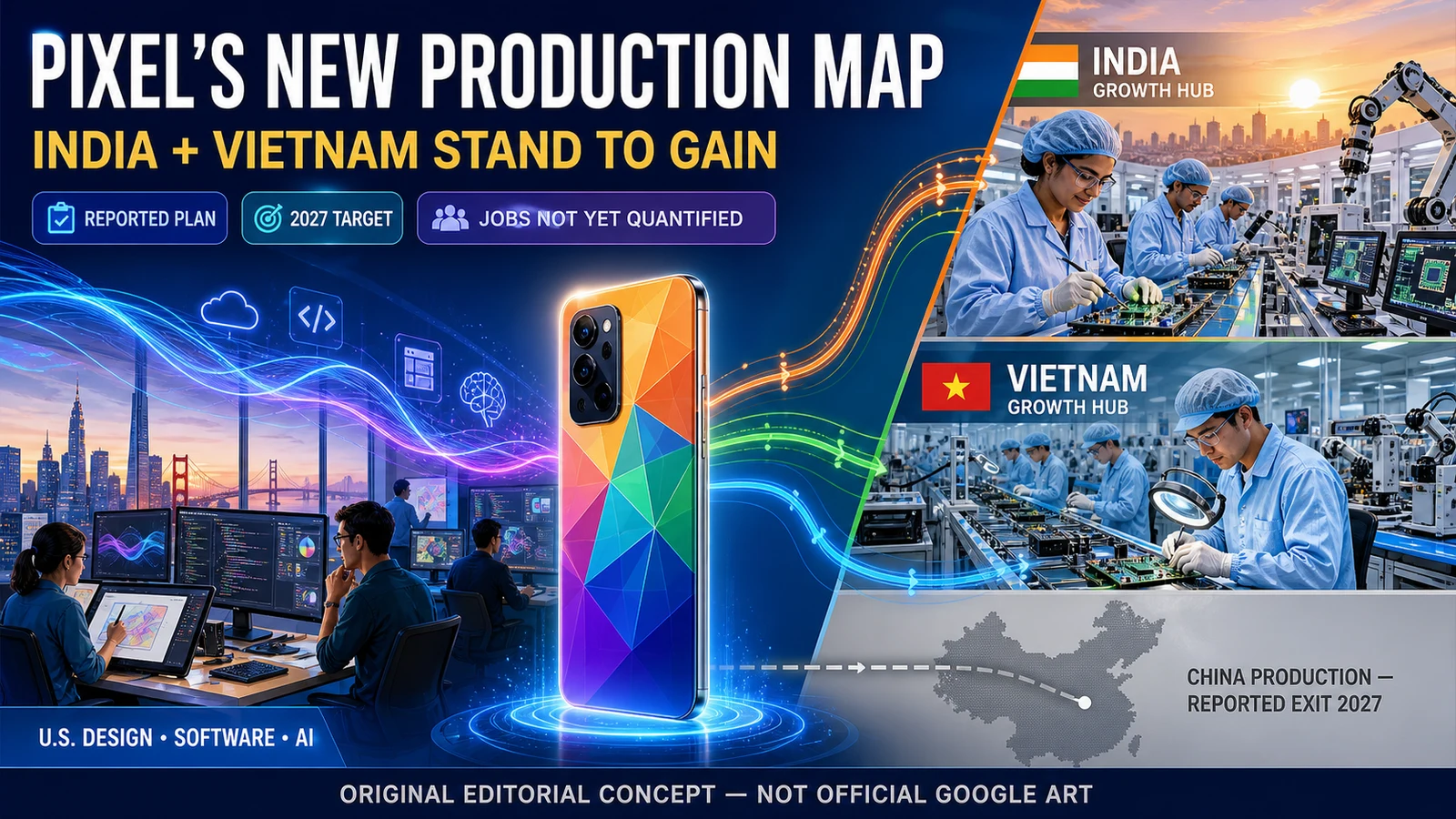
A widely shared version of this story says Google is moving Pixel production from China to the United States. The uplifting part is real—but the destination is wrong. Nikkei Asia reports that Google has told suppliers it plans to produce all Pixel smartphones, watches and wireless earbuds outside China beginning in 2027. The two named growth hubs are Vietnam and India, not America. [1]
What Nikkei’s report actually says
Nikkei’s August 18 exclusive says Google communicated the plan to suppliers amid continuing Washington–Beijing tensions. The report covers the complete Pixel hardware portfolio—not only phones—and says production should take place outside China starting next year. Its subheadline names Vietnam and India as the beneficiaries while Google aims to increase smartphone shipments. [1]
The Next Web’s accessible summary says Google has not commented publicly. It also reports that Vietnam developed and produced the Pixel 11 generation, giving Google confidence that a non-China line could handle high-end phones before simpler products followed. [2]
China
Important historical manufacturing base. Nikkei reports a planned Pixel-product exit in 2027.
Vietnam
Reported high-end phone development and production hub, with established tooling and testing capability.
India
Existing Pixel assembly base positioned for deeper manufacturing and export activity.
Why this can still be genuinely uplifting
Vietnam proved it could build the hard product
Moving a premium phone line requires far more than adding workers to a conveyor. Suppliers need precision tooling, test equipment, process engineering, quality systems and reliable component logistics. Reported Pixel 11 work suggests Vietnam cleared an important capability hurdle.
India can move beyond final assembly
DIGITIMES reported in 2024 that trial Pixel production in India had begun through Foxconn and Dixon. More volume can support a deeper ecosystem of tooling, testing, components, logistics and export operations—although Google has not publicly disclosed the final allocation. [4]
American innovation still matters
Google is a U.S. company, and Pixel’s value is not created only where screws, displays and boards meet. Product strategy, Android, AI features, software engineering, security work, industrial design, cloud services and customer operations remain important parts of the product. That is real American contribution—but it is not the same as a new U.S. assembly plant.
Diversification can improve resilience
Spreading production across capable regions may reduce single-country concentration and give Google more options during trade, logistics or geopolitical disruption. It can also create new dependencies and transition risks, so diversification is resilience work—not a guarantee against shortages or price changes.
How many jobs could this create?
The honest answer is that no reliable Pixel-specific number has been published. None of the reviewed reports identifies new headcount, factory-by-factory hiring, contractor totals or a direct-versus-indirect employment model. A responsible article cannot turn a 13-million-phone shipment target into a job estimate because automation, line reuse, supplier overlap, utilization and product complexity all change the labor requirement.
What we can identify are the categories of work that typically grow when a region earns more electronics production:
Production and quality
Assembly technicians, line leaders, quality inspectors, failure-analysis staff, test operators and maintenance teams.
Engineering and tooling
Manufacturing engineers, automation specialists, fixture/tooling designers, process engineers and reliability teams.
Supply-chain services
Component procurement, warehousing, customs, export compliance, logistics, packaging and supplier-quality management.
Those are plausible employment channels—not a promise that every category will expand or that any particular number of jobs will be created. We will update this article if Google, Foxconn, Dixon, another named partner or a government filing publishes an attributable figure.
The reported growth target—and why it matters
Secondary reporting describes Google targeting roughly 13 million Pixel phone shipments in 2026, up from about 12 million in 2025. [2] That scale remains far below the largest smartphone vendors, but it is large enough to test whether Google can manage high-end product launches across a broader supplier network.
A shipment target is not a sales result. Demand, component availability, yields, pricing and competition can all change the outcome. The meaningful signal is Google’s reported willingness to pair growth ambitions with a deeper manufacturing reorganization.
What this means for U.S. Pixel buyers
For buyers, the practical advice is simple: judge future Pixel devices by independent reviews, support policy, repair options, update lifespan, reliability and total price. The factory map is strategically interesting, but it does not by itself determine whether a phone is right for you.
What would need to happen before “Made in America” became true?
| Required evidence | What we have today | Status |
|---|---|---|
| Named U.S. assembly location | No reviewed source names one | Not established |
| Google or manufacturing-partner announcement | Google has not publicly confirmed the reported full plan | Not established |
| Production scope and opening date | India and Vietnam are named in reporting | Not U.S.-specific |
| Direct/indirect job methodology | No Pixel-specific estimate published | Unknown |
What “moving production” does—and does not—mean
A modern phone is not made in one place. Final assembly brings together displays, camera modules, memory, processors, batteries, circuit boards, enclosures, antennas and many smaller parts supplied through a global network. A company can move final-device production while continuing to buy upstream components, materials or subassemblies from China and other countries. That is why the report’s wording matters: it concerns production of Pixel-branded phones, watches and earbuds outside China, not proof that every supplier tier will leave China.
Production also includes more than the assembly line visible in factory photographs. New or expanded lines require equipment installation, process qualification, sample builds, yield improvement, quality audits, software loading, radio and camera calibration, packaging validation and export documentation. Vietnam’s reported Pixel 11 role is important because a flagship phone forces this entire system to perform together. India’s existing Pixel base gives it a different advantage: production partners, trained teams and export pathways that can potentially absorb more volume.
A years-long transition—not an overnight factory move
Earlier diversification
Reports of Google shifting Pixel work toward Vietnam date back several years. This means the 2027 target should be understood as the possible completion of an existing diversification strategy, not a surprise decision to box up one Chinese plant and reopen it elsewhere.
India builds a second pillar
India’s role has expanded as global device makers seek local manufacturing and exports. Existing Foxconn and Dixon/Padget activity gives the reported plan a foundation, though Google has not disclosed which future Pixel models or volumes each partner would receive.
Vietnam tackles premium complexity
The reported Pixel 11 development and production work indicates that Vietnam is not being positioned only for lower-cost accessories. High-end phones demand tighter tolerances, advanced testing and rapid coordination with engineering teams.
2027 remains a target
Supplier plans can change. Product demand, yields, geopolitics, component shortages, costs and partner readiness may alter the timing or leave some upstream Chinese content in the chain even if finished Pixel production exits.
Why a credible jobs estimate needs more evidence
Employment impact depends on facts that have not been published: which existing lines will be reused, how many shifts will operate, how much automation each factory uses, whether suppliers add new capacity, which products go to which country, and whether growth replaces other work or represents genuinely new volume. A line transferred into spare capacity may add fewer jobs than a new facility; a new supplier cluster can add more indirect work than assembly alone.
A defensible future estimate would separate at least four categories:
- Direct jobs: people employed by the factories making Pixel devices.
- Supplier jobs: employees producing components, fixtures, packaging and manufacturing services.
- Logistics and professional services: warehousing, transportation, customs, testing, compliance and engineering support.
- Induced employment: local economic activity supported when those workers spend their income.
It would also state the time horizon and identify whether the number is gross jobs, net new jobs, temporary construction positions or sustained operating employment. Until Google, its partners or government filings provide those inputs, “many jobs” is an optimistic possibility—not a verified count.
What could make the transition succeed
Consistent quality
New lines must reach acceptable yields without compromising cameras, radios, displays, batteries or durability. Early quality problems can erase the savings of diversification.
Supplier depth
India and Vietnam gain more long-term value when component makers, tooling specialists and repair ecosystems develop near final assembly rather than importing nearly everything.
Workforce development
Training in precision electronics, automation, quality systems and process engineering can turn one product contract into durable industrial capability.
Responsible labor standards
Growth should be measured not only by output but also by wages, worker safety, working hours, grievance systems and transparent supplier oversight.
Environmental controls
Electronics growth requires responsible energy, water, chemicals, waste and recycling practices. Moving geography does not automatically reduce environmental impact.
Stable trade pathways
Factories need predictable component imports and finished-device exports. Customs delays or sudden policy changes can undermine even a technically excellent production line.
What the United States could realistically gain
This specific report does not create an American assembly story, but supply-chain diversification can still matter to U.S. customers and workers. Google’s American product, Android, AI, security, cloud, design and business teams coordinate much of the value that makes a Pixel more than assembled components. Successful hardware growth can support those existing functions and create demand for software, services, support and retail work—but the reviewed sources do not quantify incremental U.S. employment caused by this move.
If policymakers want more phone manufacturing inside the United States, the requirements would go well beyond a corporate headquarters. Competitive domestic assembly would need a dense supplier base, specialized equipment, trained manufacturing engineers and technicians, predictable trade rules, sufficient demand, and economics that can compete with mature Asian electronics clusters. A future U.S. announcement should therefore be judged by named facilities, investment, production scope, timelines and transparent job methodology—not a patriotic headline alone.
What to watch before 2027
- A direct Google statement confirming or narrowing Nikkei’s report.
- Named India and Vietnam manufacturing partners and model allocations.
- Capital-investment, land, equipment or regulatory filings tied to new capacity.
- Partner hiring announcements with locations, job types and sustained headcount.
- Whether watches and earbuds follow phones on the reported timetable.
- Independent teardown and country-of-origin evidence from shipping products.
- Any effect on launch availability, quality, repairability, pricing or export markets.
Those milestones will tell us whether the reported plan becomes a completed supply-chain transformation or changes along the way. The IT Guys will update the story when attributable evidence arrives.
Frequently asked questions
Is Google moving all Pixel production to the United States?
No. The reviewed reporting names India and Vietnam as the manufacturing growth hubs.
Is Google definitely leaving China in 2027?
Nikkei says Google told suppliers that this is the plan. Google has not publicly confirmed the complete move, so it remains a well-sourced report rather than a finished transition.
Which products are included?
The report covers Pixel smartphones, smartwatches and wireless earbuds.
How many jobs will be created?
No defensible Pixel-specific number has been published. Any precise figure today would be speculation.
Does this mean Pixel prices will fall?
Not necessarily. Assembly location is only one part of costs, alongside components, tariffs, logistics, yields, software, marketing and distribution.
Is China no longer part of Google’s supply chain?
The report concerns production of Pixel-branded finished hardware. It does not prove that every component, material, supplier or upstream process will leave China.
Sources
- Nikkei Asia: Exclusive supplier report
- The Next Web: accessible report summary
- TechRepublic: India and Vietnam manufacturing summary
- DIGITIMES: India trial production through Foxconn and Dixon
Read the original Nikkei report
Reporting cutoff: August 20, 2026, 6:55 p.m. EDT. This article will be corrected if Google or a named manufacturing partner publishes materially different information.