


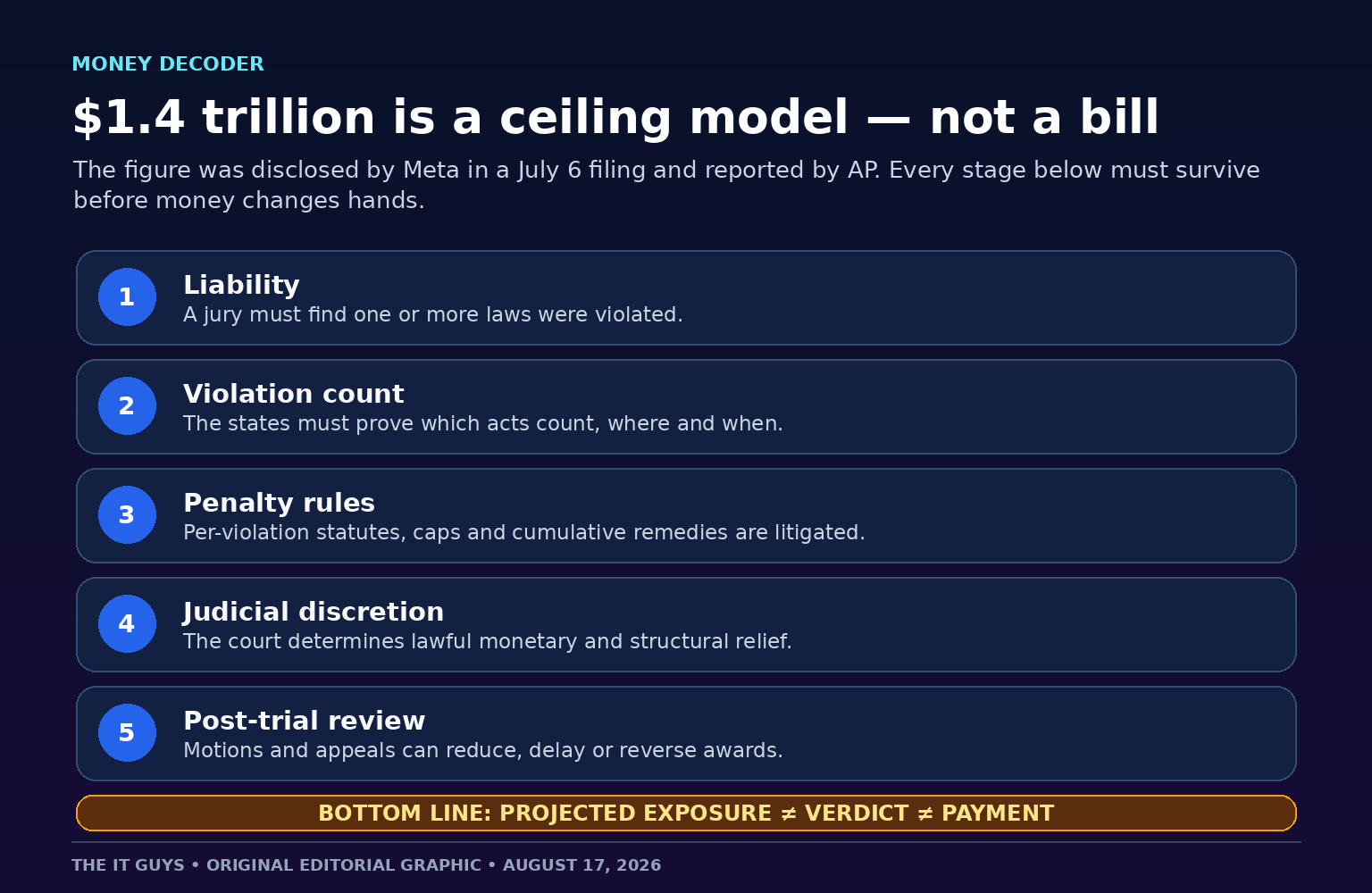
A federal jury trial beginning in Oakland could expose Meta to sweeping penalties and force changes to Facebook and Instagram. The number dominating headlines is $1.4 trillion. It is real as a reported litigation projection—but it is not a verdict, not a settlement and not a check anyone has ordered Meta to write.
The short answer: could Meta really owe $1.4 trillion?
In theory, a sufficiently large number of statutory violations multiplied by per-violation penalties can produce an extraordinary ceiling. According to The Associated Press, Meta disclosed the $1.4 trillion figure in a July 6 federal court filing. Meta called a sanction of that scale unprecedented in consumer-protection enforcement and argued that the states’ model was disconnected from any properly established violation.
That does not mean the states have already won $1.4 trillion, formally billed Meta for that amount or proved the assumptions needed to reach it. The jury must first decide liability. The parties may then fight about what constitutes one violation, which users and time periods count, whether different penalties can accumulate, what remedies each state’s law allows, how statutes of limitation apply and whether the resulting amount is constitutionally permissible. The judge retains substantial authority over remedies, followed by post-trial motions and appeals.
AP quoted legal experts who considered an amount close to $1.4 trillion unlikely even if the states prevail. That is the sober way to read the headline: the number demonstrates the theoretical scale of per-violation exposure; it does not predict the final judgment.
What is the exact case beginning now?
The trial is part of the federal litigation captioned State of California et al. v. Meta Platforms, Inc. et al., filed as case 4:23-cv-05448 and coordinated within In re Social Media Adolescent Addiction/Personal Injury Products Liability Litigation, MDL 4:22-md-03047-YGR, in the U.S. District Court for the Northern District of California.
Chief U.S. District Judge Yvonne Gonzalez Rogers is presiding. The first trial places four state attorneys general before a jury:
- California
- Colorado
- Kentucky
- New Jersey
The California Attorney General’s August 17 briefing says opening statements begin August 18, 2026, in Oakland. AP reports that another 25 states in the federal matter are expected to receive later trials, while eight states pursued separate cases in their own courts.
The Oakland defendants are Meta corporate entities and Instagram. The platforms at issue are Facebook and Instagram. Google and YouTube are not listed as defendants in this four-state trial.
Why there are two stories—and why YouTube still belongs in this article
The national news cycle compresses thousands of lawsuits into one phrase: “the social-media addiction cases.” That is understandable, but legally dangerous. The Oakland state-enforcement case and the Los Angeles KGM case ask different questions.
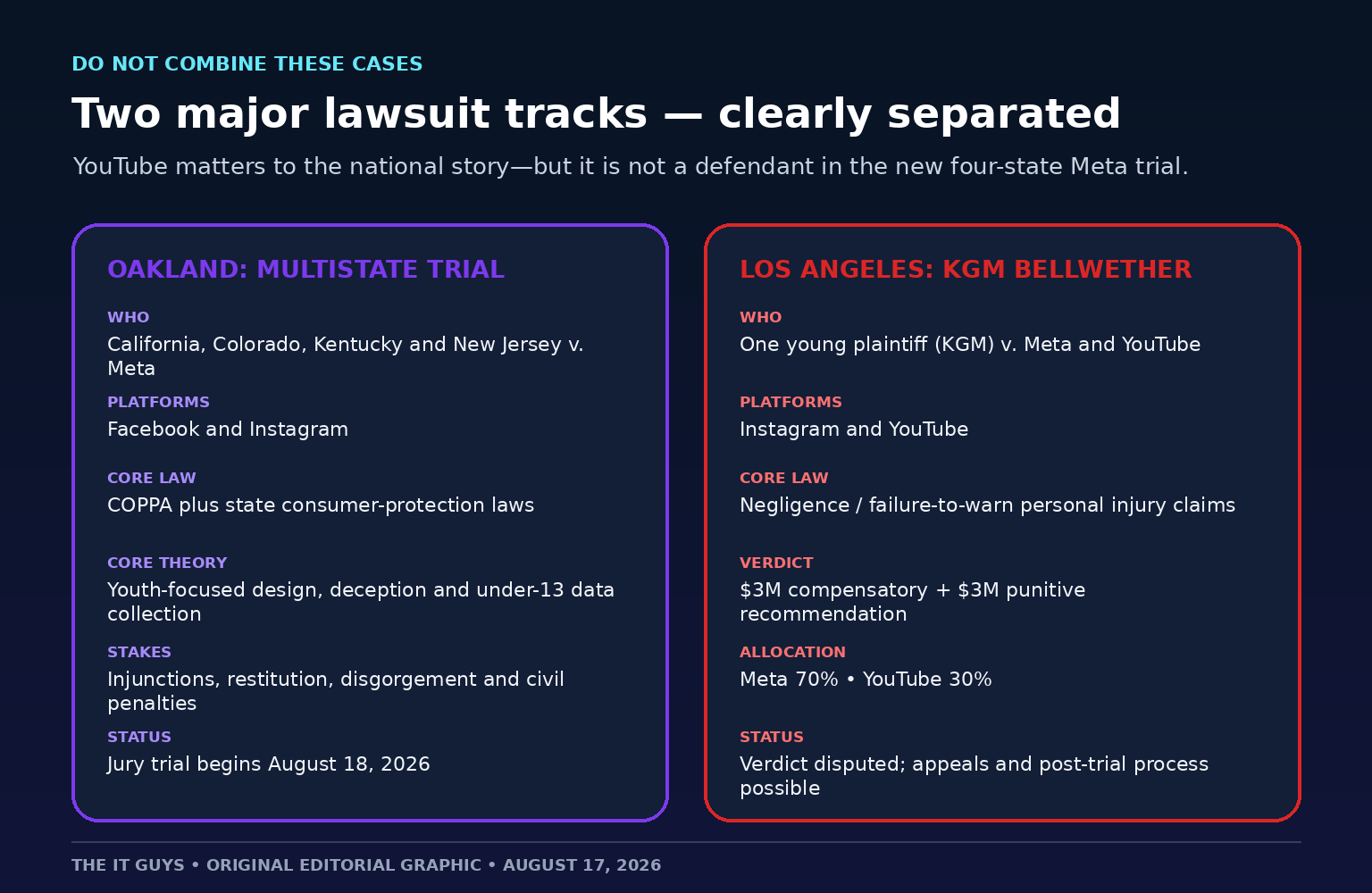
| Question | Oakland multistate trial | Los Angeles KGM bellwether |
|---|---|---|
| Who sued? | State attorneys general | One young plaintiff |
| Who is defending? | Meta entities, including Instagram | Meta and Google-owned YouTube at verdict; TikTok and Snap settled before trial |
| Main legal theory | COPPA and state consumer-protection laws | Negligent design/operation and failure to warn |
| Primary focus | Youth design, alleged deception and under-13 data collection | Whether platform design was a substantial factor in one plaintiff’s harm |
| Result so far | Trial begins August 18 | $3 million compensatory award plus $3 million punitive recommendation; post-trial review possible |
The federal complaint: design claims, deception claims and privacy claims
The states’ 233-page federal complaint, filed October 24, 2023, is not limited to data privacy. It combines three broad theories.
1. Product-design allegations
Allegation
The attorneys general allege that Meta developed and deployed features that exploit psychological vulnerabilities and encourage prolonged or compulsive use by young people. The complaint identifies engagement-ranked feeds, infinite scroll, autoplay, push notifications, public like counts, appearance-altering filters, ephemeral content and support for multiple accounts.
The states say these are not isolated interface choices. Their theory is that the features work together as an engagement system: recommendations supply personalized material; endless presentation removes stopping cues; notifications summon users back; public metrics intensify social comparison; temporary posts create fear of missing out; and multiple accounts can deepen participation.
Those are allegations the states must prove. It would be inaccurate to report every identified feature as already adjudicated illegal.
2. Alleged public deception
Allegation
The states allege that Meta knew more about youth risks than it disclosed and made misleading statements about platform safety, compulsive use, under-13 access and the prevalence of harmful experiences. The June court order says the attorneys general offered more than 100 purportedly deceptive statements, although the judge criticized both sides for failing to identify every statement with sufficient precision during summary-judgment briefing.
The complaint and court record cite internal research and presentations. But internal concern is not automatically equivalent to a legally actionable public misrepresentation. The jury must evaluate particular statements, context, falsity, knowledge and materiality under the laws that survive for trial.
3. The COPPA privacy theory
Allegation
The Children’s Online Privacy Protection Act protects children under 13. In simplified terms, the FTC’s COPPA Rule requires covered online services to provide notice and obtain verifiable parental consent before collecting personal information from children.
The states allege that Meta possessed actual knowledge of under-13 users on Instagram and Facebook, collected personal information from them and relied on nominal age restrictions rather than obtaining parental consent. They also argue that the services were directed to children within COPPA’s framework.
Meta disputes those gateways. It argues that Facebook and Instagram are not directed to children and that it did not possess the type of actual knowledge the statute requires. That distinction matters: merely knowing that some children may evade an age gate is not necessarily identical to the legal “actual knowledge” standard for particular users and collections.
What the judge has already ruled—and what she has not
The court’s June 29, 2026 summary-judgment order is the best antidote to oversimplified headlines. Judge Gonzalez Rogers denied Meta’s request to end the attorneys general’s deception, unfairness, disgorgement and COPPA theories before trial. She also denied significant portions of the states’ cross-motion.
Court ruling
- Material factual disputes exist regarding whether Meta must comply with COPPA under the states’ theories.
- The parties stipulated that Facebook and Instagram are websites or online services for COPPA purposes.
- The court said there was no factual dispute that Meta had not followed COPPA notice and parental-consent procedures—consistent with Meta’s position that COPPA did not apply to these users and services.
- The court found triable disputes over whether Meta had actual knowledge of under-13 users and whether the platforms were directed to children.
- The court found disputes suitable for a jury regarding allegedly deceptive statements and whether platform features could support unfair-practice claims.
- The court did not declare Meta liable for the overall case.
This procedural distinction is crucial. Surviving summary judgment means enough disputed evidence exists for trial. It does not mean the judge has accepted every allegation, set damages or ordered a product redesign.
The evidence fight: what each side says
The states’ case
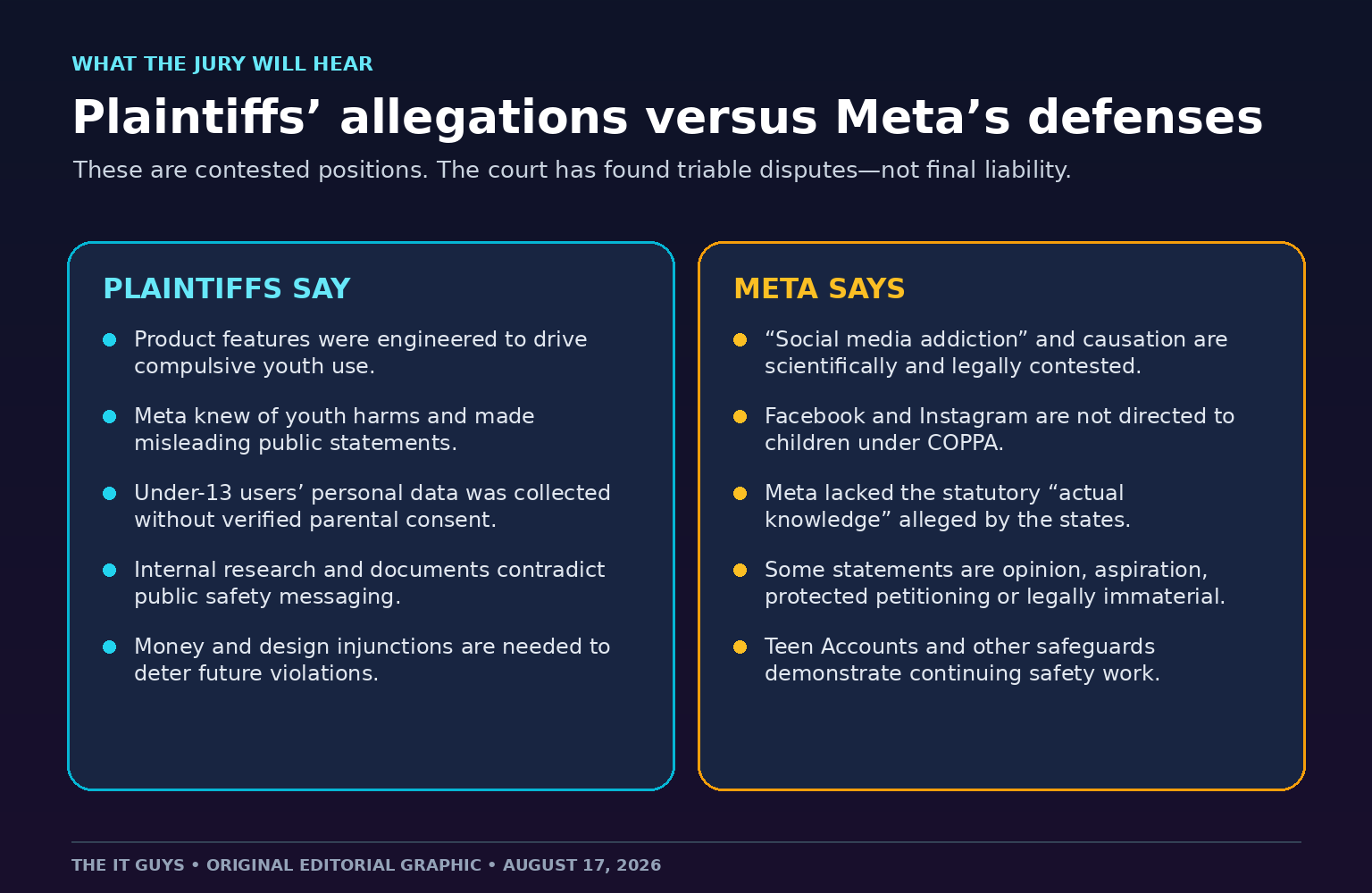
Attorneys general are expected to use company documents, testimony, expert analysis and public statements to argue that Meta understood youth engagement and harm risks, nevertheless prioritized growth, and misrepresented the safety of its products. The June order quotes internal materials discussing addiction, difficulty managing time, social comparison and the relationship between engagement and long-term revenue.
The states also point to Meta’s systems for identifying or linking accounts that might belong to the same young user. They argue that those systems undercut Meta’s claim that it lacked actual knowledge of children using its platforms.
Meta’s defense
Defense
Meta says the states distort both science and product history. In its public response, the company says it has listened to parents, worked with experts and law enforcement, conducted extensive research and introduced many protections. It expects the evidence to demonstrate a longstanding commitment to young people.
The court’s order summarizes several legal defenses. Meta argues that “social media addiction” is not an established diagnosis in the same manner as recognized substance or gambling disorders; that the states have not proved causation; that particular speakers did not knowingly make false statements; and that some challenged statements were opinions, aspirations, legally immaterial or protected petitioning activity.
Meta also invokes limits associated with Section 230 and the First Amendment. The surviving claims have been narrowed toward product design and company conduct rather than simply holding Meta responsible for everything third parties post. That line—between publishing another person’s content and designing a product feature—is one of the most consequential legal questions in the larger litigation.
What Meta has changed already: Instagram Teen Accounts
Meta’s defense is not only “we did nothing wrong.” It also points to product changes. The company’s official Teen Accounts documentation describes automatic protections that include:
- Private accounts by default for specified teen groups
- Stricter messaging controls
- The most restrictive sensitive-content setting
- Limits on who may tag or mention teens
- Hidden Words filtering
- A reminder to leave Instagram after 60 minutes each day
- Sleep mode from 10 p.m. to 7 a.m.
- Parental permission before users under 16 loosen protections
- Age-verification and age-assurance work intended to detect teens claiming adult birthdays
Meta says Teen Accounts have expanded globally and to additional apps. The states are likely to argue that later safeguards do not erase earlier conduct and may not go far enough. Meta is likely to argue that the measures demonstrate substantial, continuing safety investment and undermine demands for drastic court control.
Both can be debated at once: a product may have meaningful safeguards today while parties litigate whether earlier designs, representations or data practices violated the law.
How the litigation reached this moment
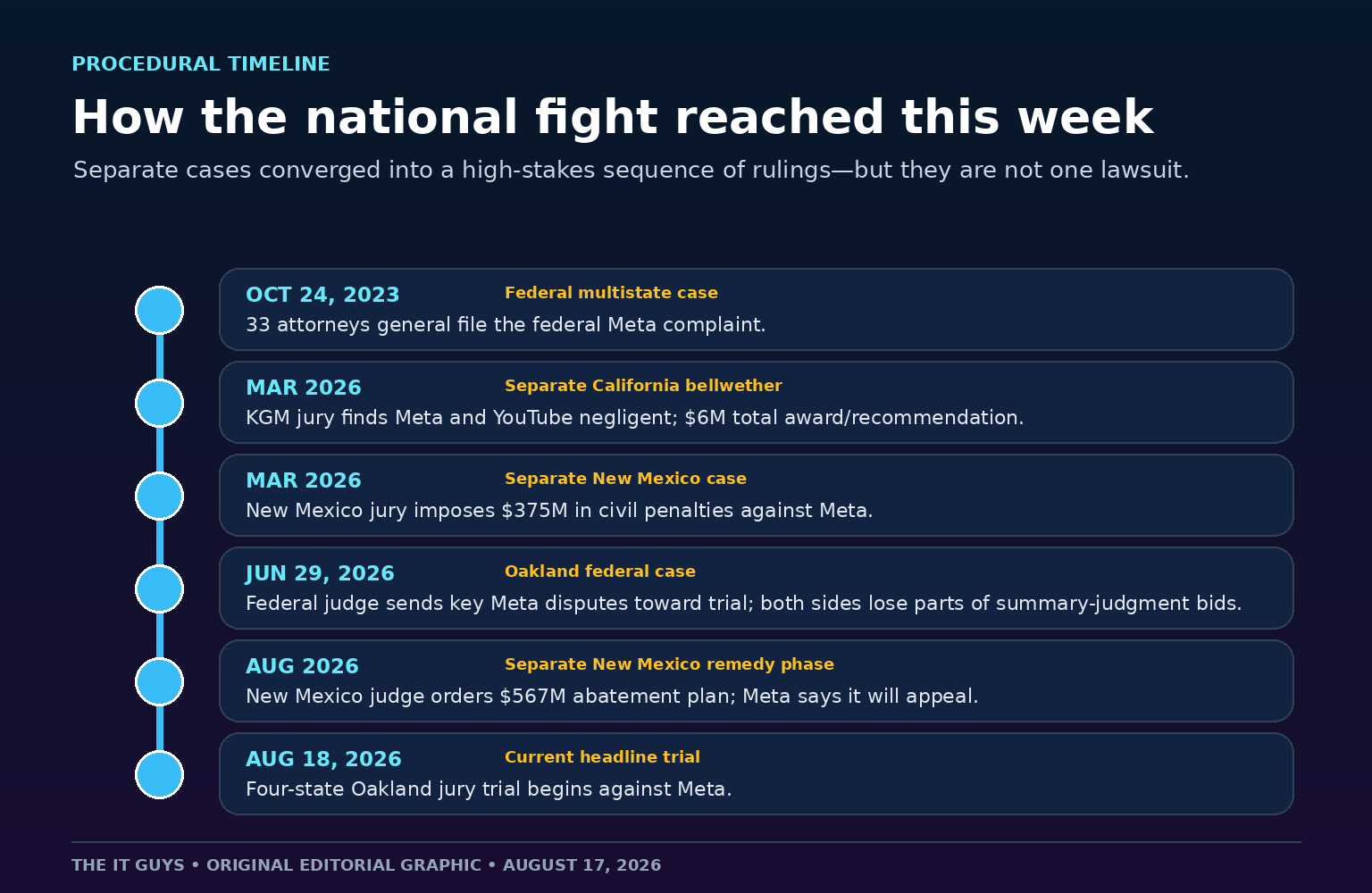
The original federal complaint was filed by 33 attorneys general. Current AP reporting says 29 states are in the federal MDL, with four going first and the other 25 scheduled for later trials. Eight additional attorneys general filed separate state actions on the same day as the 2023 federal complaint. The supplied public sources do not explain the change from 33 original federal plaintiffs to the current 29.
Then came a rapid sequence of 2026 results. A Los Angeles jury returned the KGM verdict against Meta and YouTube. A New Mexico jury returned a separate verdict against Meta. Judge Gonzalez Rogers allowed key portions of the federal states’ case to proceed. New Mexico’s court then imposed a detailed abatement plan. Finally, the first four federal states arrived at trial in Oakland.
These rulings can influence negotiating leverage and public expectations, but one trial does not automatically decide another. Different states invoke different statutes. Personal-injury plaintiffs must prove individualized elements. Evidence admissible in one courtroom may not be admitted in another. Appellate courts can also reshape the law.
The YouTube verdict: what happened in Los Angeles
In March 2026, a California jury heard a bellwether case brought by a young woman identified as KGM. She said she began using YouTube at six and Instagram at nine, became addicted to social media and suffered worsening mental-health problems.
According to AP’s verdict report, the jury found both Meta and YouTube negligent in the design or operation of their respective platforms and found that negligence a substantial factor in the plaintiff’s harm. Jurors also found failures to warn.
The jury awarded $3 million in compensatory damages and recommended another $3 million in punitive damages. It assigned 70% of responsibility to Meta and 30% to YouTube. TikTok and Snap had settled before trial.
Meta argued that the plaintiff’s mental-health history could not be reduced to one app and pointed to other circumstances in her life. Google argued that YouTube is a responsibly built video-streaming platform rather than a social network and cited the plaintiff’s usage patterns. Both companies disputed the verdict and indicated that legal challenges, including appeals, were possible.
The case is important because it tested whether plaintiffs could focus on product design rather than the content users posted. Jurors were instructed not to base their decision on the substance of videos and posts because Section 230 protects platforms from many claims arising from third-party content.
But it remains one bellwether involving one plaintiff. Its $6 million result cannot simply be multiplied into the Oakland states’ statutory case, and the Oakland $1.4 trillion model cannot be assigned to YouTube.
New Mexico: the largest concrete Meta result so far
The New Mexico case supplies a useful comparison between a headline number and an actual judgment. AP reports that a New Mexico jury imposed $375 million in civil penalties in March. In August, Judge Bryan Biedscheid ordered an additional $567 million abatement program, producing a combined reported obligation of $942 million.
The abatement money includes treatment, awareness, prevention, screening and implementation costs over several years. The court also ordered product and oversight measures involving age assurance, educational information, reporting and deletion of certain under-13 data. Meta says it will appeal and disputes the factual and legal basis of the ruling.
That distinction matters: New Mexico has a jury finding and judicial remedy order, subject to appeal. Oakland has a reported projection before verdict. They should never be described with the same degree of certainty.
Why the damages math becomes enormous
Consumer-protection laws often authorize a fixed amount “per violation.” A single misleading advertisement shown once might be one violation under one theory; a company and government can fiercely dispute whether the relevant unit is one statement, one user, one impression, one collection event, one day or one course of conduct. The unit selected can change the number by orders of magnitude.
California’s portion of the 2023 complaint illustrates the architecture. The state requests up to $2,500 for each proven violation of its False Advertising Law and another $2,500 for each proven violation of its Unfair Competition Law, described as cumulative, plus possible additional penalties for specified affected people. Colorado, Kentucky and New Jersey have different statutes and remedies.
COPPA adds another layer. The federal claim permits state attorneys general to seek injunctions, compliance orders, damages, restitution and other relief for their residents. The states’ complaint asks for all of those. But COPPA does not mechanically print a $1.4 trillion judgment. Applicability, knowledge, affected users, collection practices, limitations periods and remedy boundaries remain contested.
Why a trillion-dollar judgment would face enormous legal pressure
Even after a plaintiff proves statutory violations, courts examine whether the requested remedy is authorized and proportionate. A judgment approaching Meta’s market value would trigger extraordinary post-trial and constitutional challenges.
- Due process: Meta would argue that a crushing aggregate penalty is grossly disproportionate and lacks fair notice.
- Violation counting: The company would contest the unit and number of violations, duplication among statutes and geographic boundaries.
- Causation and materiality: Some state-law theories require proof that challenged conduct mattered to consumers or caused legally recognized harm.
- Statutes of limitation: Each claim has a time window, and conduct outside it may not support penalties.
- Equitable limits: Disgorgement and injunctions depend on state law, federal equitable principles and a connection between alleged misconduct and profits.
- Appeals: Section 230, First Amendment, COPPA interpretation, evidentiary rulings and remedies can all reach appellate courts.
That does not make the litigation symbolic. Even a small percentage of the theoretical ceiling could be historic, while a structural injunction may matter more to users than cash. The serious story is not “Meta will pay $1.4 trillion tomorrow.” It is that states believe existing laws can reach the underlying design and data machinery of two of the world’s largest platforms.
What changes could be ordered if the states win?
The complaint seeks permanent injunctions and compliance measures, while public reporting describes state demands aimed at the mechanics of youth engagement. The precise final order could be much narrower than the states request—or could be shaped by settlement and appeal.
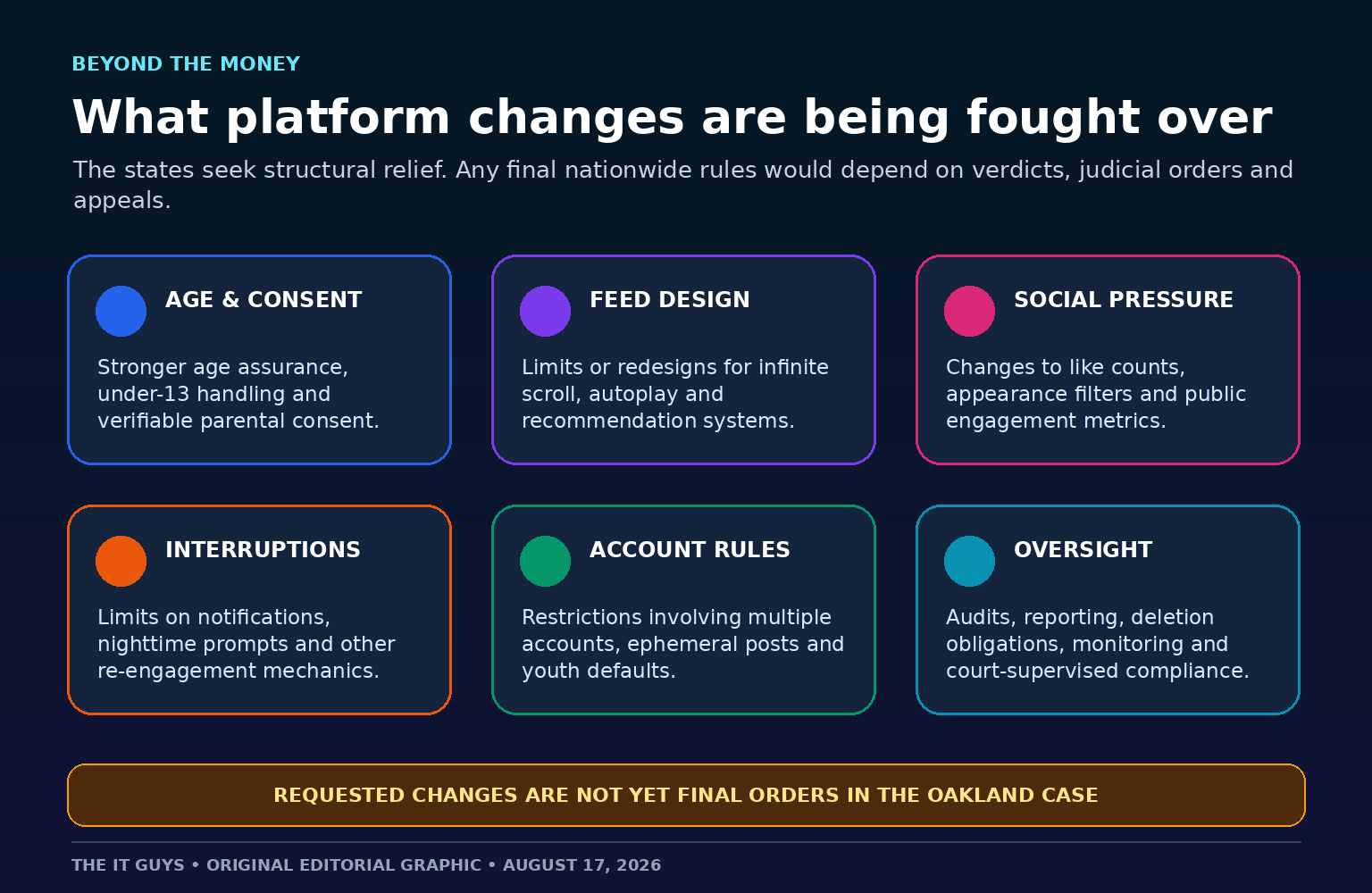
Age assurance and parental consent
A court could require stronger systems for identifying users’ ages, handling suspected under-13 accounts and obtaining verifiable parental consent. But age assurance itself raises privacy questions: the more proof a platform demands, the more sensitive information it may collect. New Mexico’s judge recognized this tension when tailoring that state’s remedy.
Recommendation and stopping cues
States may seek limits or redesigns involving engagement-based recommendations, autoplay and infinite scroll. A remedy could target teen defaults rather than removing the features for adults. Courts generally prefer orders tied to proven violations, not unlimited authority to redesign an entire service.
Social comparison and appearance features
Public like counts, appearance filters and engagement metrics sit at the center of allegations about social comparison, body image and validation loops. Potential changes could include hidden counts, stricter defaults or age-specific controls.
Notifications, sleep and re-engagement
Meta already uses sleep mode and reminders in Teen Accounts. The litigation could produce stricter limits on overnight notifications or prompts designed to bring minors back into an app.
Independent oversight
Reporting, audits, data deletion, outside monitors and court-supervised compliance can outlast a monetary penalty. New Mexico’s remedy offers one model; the Oakland judge is not bound to copy it.
What the case could mean for adults, advertisers and competing platforms
A youth-focused verdict could still reshape the broader internet. Platforms often build one national product rather than 50 state versions. If Meta must change feeds, age systems or defaults in four states, operational simplicity may push it toward a wider rollout.
Advertisers could see reduced youth inventory, less behavioral personalization, revised measurement and new compliance representations. Competitors would study whether courts treat infinite feeds, recommendations and notifications as neutral tools or actionable design decisions. TikTok, Snap and YouTube face overlapping private litigation, so Meta’s result can influence settlement strategy even when it is not legally binding on them.
Parents may gain more controls, but they may also face more verification steps and household conversations. Teens could encounter private defaults, reduced nighttime engagement and less personalized content. Adults might see few immediate changes unless Meta chooses a universal implementation.
What parents can do now—without waiting years for appeals
- Confirm that a teen’s stated birthday is accurate and that the account is enrolled in the correct youth experience.
- Review privacy, messaging, mention, tag and sensitive-content settings together.
- Use operating-system family controls in addition to each platform’s controls.
- Set device-free sleep and school periods; do not rely solely on an app reminder.
- Turn off nonessential push notifications and review notification permissions periodically.
- Talk about multiple accounts, private backup accounts and self-liking behavior without shame.
- Watch for sleep disruption, withdrawal, escalating secrecy, body-image distress or interference with daily life.
- Seek qualified medical help for mental-health concerns. A settings guide is not a substitute for care.
None of these steps assigns blame to a child or parent. Product design, family circumstances, peer relationships and individual health all interact. The lawsuits are important precisely because responsibility cannot be reduced to “parents should have watched more closely” or “one app caused everything.”
What to watch during the six-to-eight-week trial
AP expects the first Oakland trial to last roughly six to eight weeks. The most consequential moments may not be dramatic witness exchanges; they may be instructions and special-verdict questions that define exactly what jurors must decide.
- Which statements reach the jury? The judge has already criticized imprecision around the alleged misrepresentations.
- How is “actual knowledge” explained? The COPPA result may turn on what Meta knew about particular under-13 users.
- Can features be separated from content? Product-design claims must navigate Section 230 and First Amendment boundaries.
- What do experts say about addiction and causation? The court found a genuine scientific and factual dispute rather than resolving it before trial.
- How are violations counted? This is the bridge between liability and the trillion-dollar headline.
- Will the case be phased? Liability, monetary remedies and structural relief may be decided at different times.
- What happens after a verdict? Expect post-trial motions and, almost certainly, appellate activity if either side suffers a major loss.
Frequently asked questions
Has Meta been ordered to pay $1.4 trillion?
No. AP reports that Meta disclosed $1.4 trillion as theoretical potential exposure in a July 6 filing. No jury or judge has awarded that amount.
Are Instagram and Facebook separate defendants?
Instagram, LLC and several Meta entities are defendants. Facebook is a Meta platform. The corporate details matter, but the public-facing trial concerns Meta’s operation of Facebook and Instagram.
Is YouTube being sued for $1.4 trillion in this case?
No. YouTube is not a defendant in the first Oakland multistate trial. It was a defendant in the separate KGM personal-injury bellwether in Los Angeles.
What happened in the Meta and YouTube bellwether?
A California jury found Meta and YouTube negligent, awarded $3 million in compensatory damages and recommended $3 million in punitive damages. It assigned 70% responsibility to Meta and 30% to YouTube. The companies disputed the result, and post-trial proceedings or appeals may change it.
Is this only a privacy lawsuit?
No. COPPA privacy claims are central, but the states also allege deceptive statements and unfair product-design practices under state consumer-protection laws.
Did the judge already decide that Meta violated COPPA?
No. The court found no dispute that Meta had not used COPPA notice and consent procedures, but Meta argues those procedures were not legally required because the statute did not apply under the circumstances. Applicability, actual knowledge and child-directed status remain contested trial issues.
Could Instagram be shut down?
That is not a realistic description of the current requested relief. The states seek money and design/compliance changes. Any injunction would be shaped by proof, judicial authority and appeals.
Would changes apply nationwide?
Not automatically. The first trial involves four states. Meta could implement changes more broadly for operational reasons, and later trials or settlements could extend the practical impact.
How is the New Mexico result different?
New Mexico already has a separate jury verdict and remedy order totaling a reported $942 million, subject to Meta’s appeal. Oakland begins without a verdict and involves different states and legal claims.
When will there be a final answer?
Not soon. A six-to-eight-week trial could produce a verdict this fall, but remedies, post-trial motions and appeals may continue much longer.
Jennifer’s bottom line
The trillion-dollar headline is important—but not for the reason social media makes it sound important.
The United States is not collecting $1.4 trillion from Meta tomorrow. Instead, four states are asking a federal jury to decide whether Facebook and Instagram’s youth design, public representations and under-13 data practices crossed legal lines. If the states prove violations, the multiplication of statutory penalties could produce unprecedented exposure. If they fail, one of the most ambitious efforts to regulate social-media design through existing law may collapse or narrow.
YouTube belongs in the national story because its March bellwether verdict showed that a jury can hold platform design—not just third-party content—responsible for an individual plaintiff’s harm. But YouTube does not belong inside the Oakland damages calculation.
The most honest headline is therefore also the most consequential: Meta is facing a trial whose theoretical ceiling reaches $1.4 trillion, while the real battle is over whether courts can force the architecture of youth social media to change.
Primary documents and reporting
- California Attorney General: August 17 pretrial briefing
- California Attorney General: October 2023 filing announcement
- Federal multistate complaint (233-page PDF)
- June 29 summary-judgment order (38-page PDF)
- Associated Press: stakes and $1.4 trillion projection
- Associated Press: jury selection and procedural scope
- Associated Press: Meta and YouTube KGM verdict
- Associated Press: New Mexico abatement order
- BBC: independent analysis of possible platform changes
- Meta: Instagram Teen Accounts and company-described protections
- Federal Trade Commission: COPPA Rule
Editorial methodology: This report distinguishes allegations, defenses, procedural rulings, jury findings and final orders. Dollar figures are labeled according to their legal status. Original graphics were built for this article from the cited record and do not reproduce courtroom photography or platform interfaces. This article provides news analysis, not legal or medical advice.