

☀ Morning Good News for Today
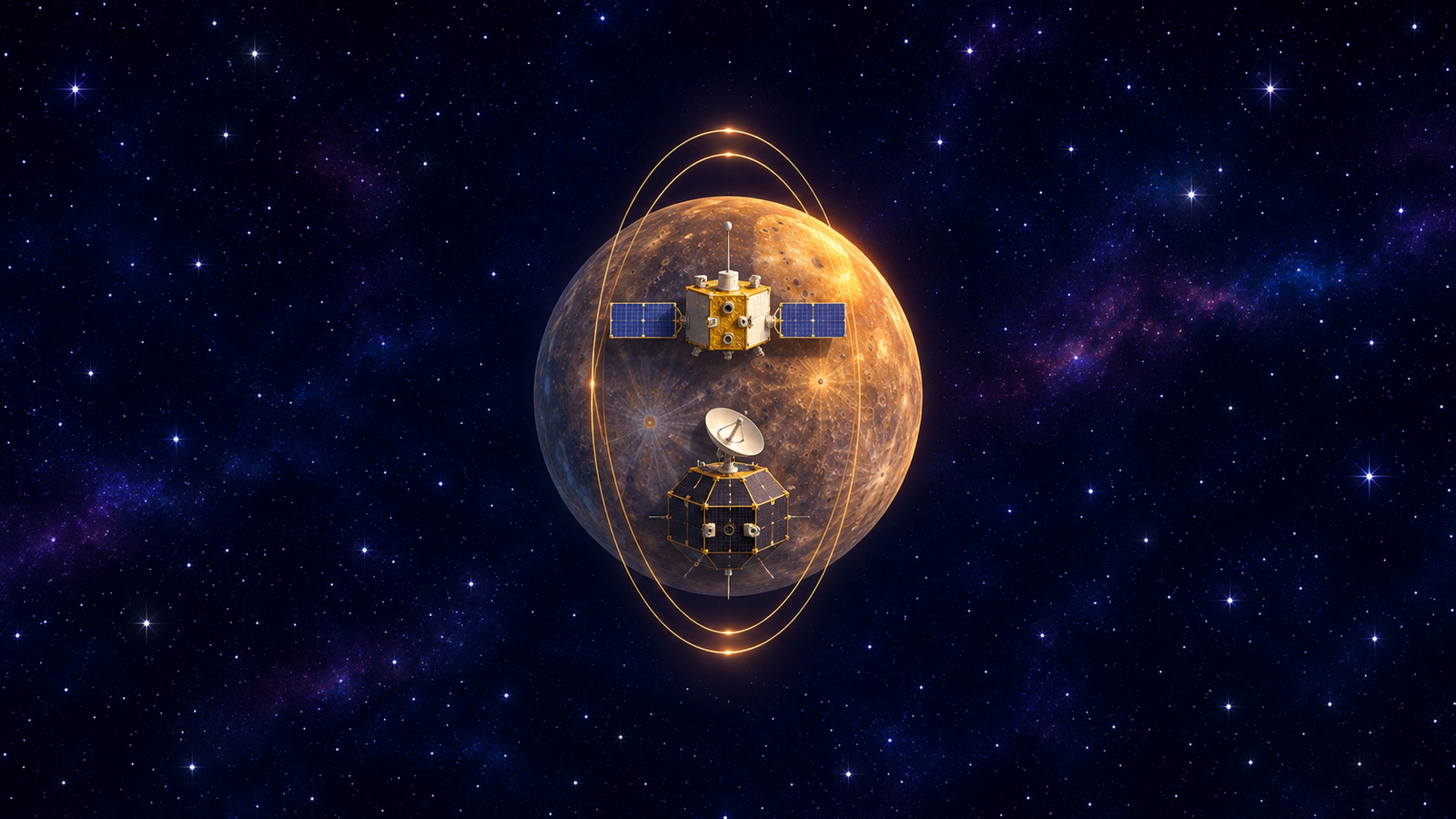
BepiColombo has reached orbit around Mercury after an eight-year journey.[1] That is a real completed engineering milestone.[1] After that commute, the spacecraft has earned the good parking spot.
Good news in 30 seconds
- Nature independently reports that the European-Japanese mission arrived at Mercury and that an ESA-built module inserted the stack into orbit on 21 November 2026.[1]
- ESA Operations said the insertion burn would last 37 minutes and continue through a closest approach 635 kilometres above Mercury’s surface.[2]
- ESA’s chronology schedules the MPO and Mio orbiters to separate on 9–10 December 2026, with the science phase set to begin in April 2027.[3]
What happened
After eight years travelling through the inner Solar System, BepiColombo arrived at Mercury.[1] Nature independently reports that a European-built module inserted the spacecraft stack into Mercury orbit on 21 November.[1] ESA Operations’ official post captured the start of the burn and its planned 37-minute duration through a 635-kilometre closest approach.[2]
Why this made us smile
Mercury finally has company.[1] These visitors brought two orbiters,[3] plenty of instruments, and apparently no interest in a quick weekend getaway.
What it could mean for everyday people
For Treasure Coast families, teachers and students, this gives a simple STEM watchlist: look for the planned MPO–Mio separation on 9–10 December 2026, then the planned science-phase start in April 2027.[3] Those dates are mission plans, not guarantees.[3]
Keep the confetti factual
Nature independently reports that orbit was achieved.[1] ESA’s 29 October chronology is useful for spacecraft names, separation dates and the planned science phase, but it is not proof that orbit was achieved.[3] The official ESA Operations post was captured through X’s public oEmbed response because direct X page access returned HTTP 403; it supports the burn’s 37-minute duration and 635-kilometre approach, not the later achieved-orbit result.[2] The exact official timestamp for confirmation of achieved orbit remained unknown in the opened official materials at the reporting cutoff.[2][3] The two science orbiters had not yet separated, and the science phase had not yet begun at that cutoff.[3]
One happy thing to carry with you
An eight-year journey reached its destination,[1] and the next chapter is now measured in orbits rather than kilometres to go.
Sources and reporting notes
- Nature — “BepiColombo finally reaches Mercury after eight-year odyssey” (independent achieved-orbit report)
- ESA Operations — official insertion-burn post (text captured through X public oEmbed)
- ESA — “Latest updates: BepiColombo’s arrival at Mercury” (mission chronology; not proof of achieved orbit)
Authoring transparency: This article was generated in a Hermes session using GPT-5.6 via OpenAI Codex and reviewed by Jennifer Hudsen before submission.