

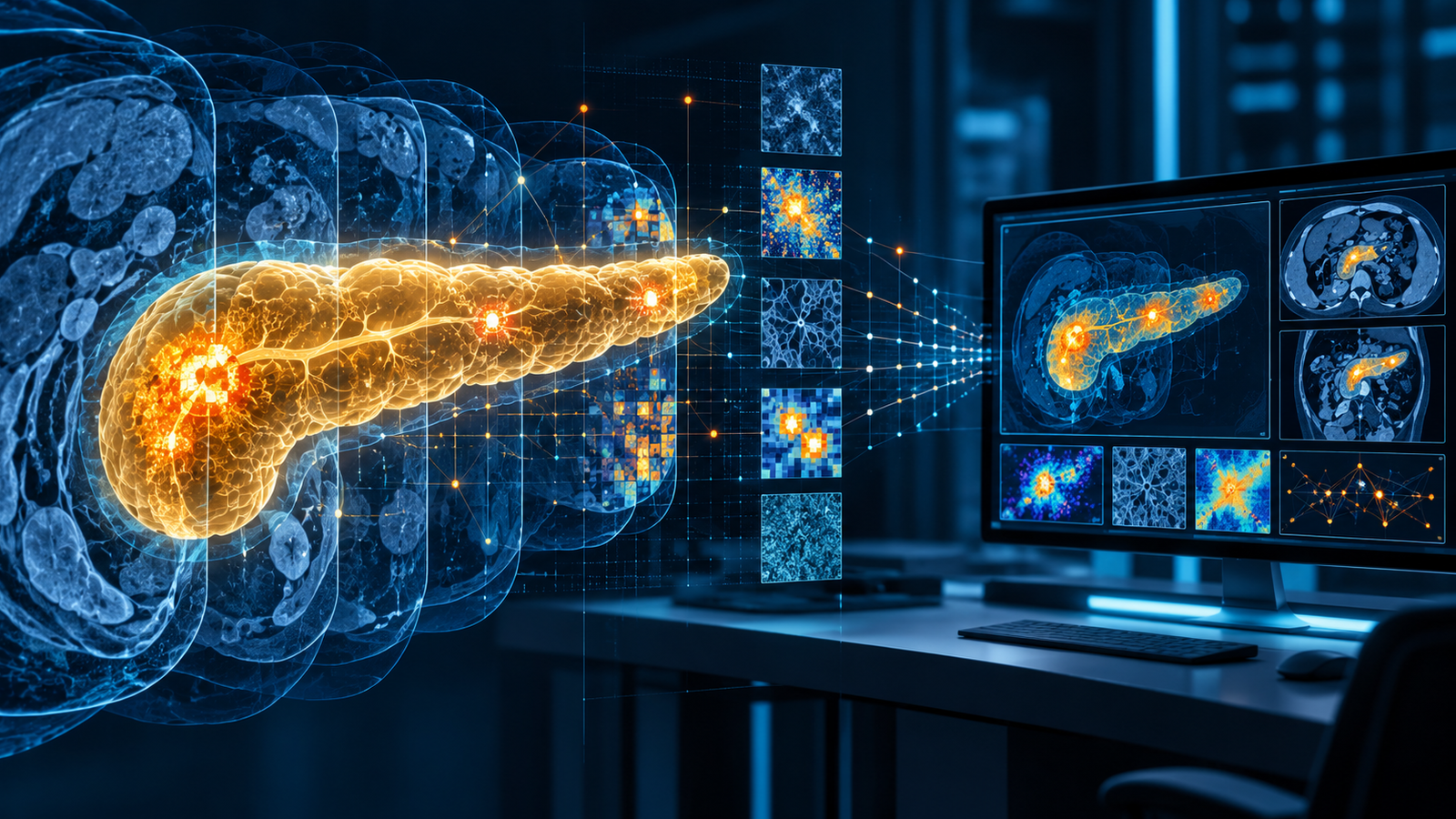
Mayo Clinic’s REDMOD AI Finds Hidden Pancreatic Cancer Signatures on Earlier CT Scans
A peer-reviewed retrospective study published online in Gut on April 28, 2026 found that Mayo Clinic’s REDMOD model detected pancreatic ductal adenocarcinoma-associated radiomic patterns on earlier abdominal CT scans that radiologists had read as showing no suspicious pancreatic mass.[1][2] ScienceDaily republished BMJ Group’s release on October 26; the underlying research is not new this week.[5]
Research update • Reporting cutoff: October 27, 2026, 7:58 p.m. EDT / 23:58 UTC
The bottom line
REDMOD is investigational: Mayo Clinic says it is not FDA-approved for clinical use or population screening.[3] The study shows retrospective detection of an imaging signature, not a current diagnosis tool and not proof that using the model prospectively improves survival.[1]
Verified facts
What the comparison showed
In a blinded comparison on the same independent test set, REDMOD sensitivity was 73.0% versus 38.9% for two board-certified abdominal radiologists (p<0.001).[1] For cases more than 24 months before diagnosis, the paper reports 13 of 19 cases detected (68.4%) in its detailed results, while its radiologist-comparison section rounds the REDMOD value to 68.0% versus 23.0% for radiologists.[1]
External and longitudinal checks
The paper reports 90%–92% concordance when REDMOD was applied to earlier serial scans from the same patients.[1] It also reported specificity of 81.3% in a 539-scan multi-institutional cohort and 87.5% in an 80-scan public NIH pancreas CT cohort.[1]
What the study does—and does not—establish
| Evidence | Boundary |
|---|---|
| The model associated subtle radiomic texture patterns with later pancreatic cancer in retrospectively selected scans.[1] | This is prediction/association in historical data, not a clinical diagnosis made at the time of scanning.[1] |
| The cohort included scans from multiple institutions and four major CT vendors, but it was not ethnically diverse.[1] | External specificity checks do not establish performance in every hospital or population.[1] |
| The paper reports funding from the National Institutes of Health, Funk Zitiello Foundation, Centene Charitable Foundation and Hoveida Family Foundation; it declares no competing interests.[1] | Funding and conflict disclosures describe study context, not proof of effectiveness.[1] |
What happens next
The paper says REDMOD needs prospective validation in high-risk cohorts.[1] NBC News reports that the model is being evaluated in a clinical trial.[4] NBC News reported that the trial may need three to five years of follow-up to determine who develops cancer and who does not.[4]
What this means for readers
Practical interpretation: this research does not change how a person should interpret symptoms or an old CT scan today.[1][3] This article is not medical advice. REDMOD is not FDA-approved for clinical use or population screening.[3] NBC News reported that it may be years before the model reaches the public.[4]
Sources
- Next-generation AI for visually occult pancreatic cancer detection in a low-prevalence setting with longitudinal stability and multi-institutional generalisability — Gut, published online April 28, 2026; DOI 10.1136/gutjnl-2025-337266.
- AI model detects very early normally “invisible” tissue changes of pancreatic cancer — BMJ Group, April 28, 2026.
- AI identifies pancreatic cancer years before diagnosis, offering potential for earlier treatment — Mayo Clinic, June 25, 2026.
- AI finds signs of pancreatic cancer before tumors develop — NBC News, May 2, 2026.
- AI detects “invisible” signs of pancreatic cancer years before diagnosis — ScienceDaily, October 26, 2026; material provided by BMJ Group.