


The Hacker Diaries · Case File 047 · October 30, 2026[31]
Nine files crossed the desk before the city lights went out: automated intrusion at scale, a support tool that can turn on its operator, a race through WordPress updates, a suspected hardware implant, a decade-old influence operation reaching sentencing, a poisoned coding extension, an exploited commerce flaw, two KEV alarms, and a crypto theft measured in billions. The common thread is not spectacle. It is the point where trust changes hands.[1][3][6][11][13][15][21][24][28][29][30][31]
Reporting cutoff: October 30, 2026, 7:38 p.m. America/New_York. Status statements and totals are bounded to the verified captures listed below.[31]
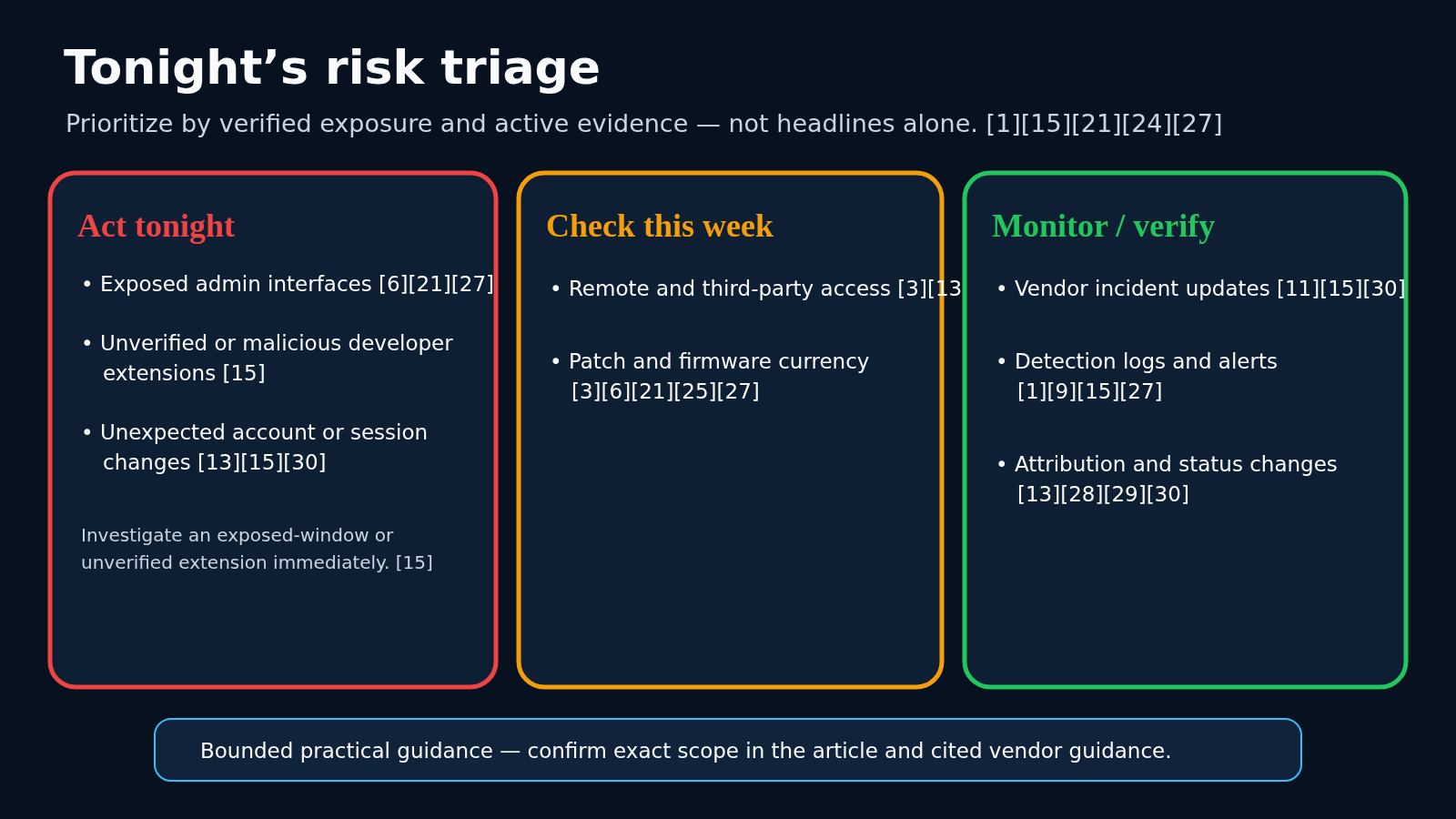
Tonight’s risk matrix
| Lane | Files | Decision |
|---|---|---|
| Act tonight[6][8][9][15][21][22][24][25][26][27] | Cursor Claude extension, Drupal Commerce, GitLab/Cisco KEV, exposed WordPress upgrade paths[6][8][9][15][21][22][24][25][26][27] | Preserve evidence, contain exposure, patch or rebuild, then verify the running state.[6][8][9][15][21][22][24][25][26][27] |
| Verify before the next session[3][4][11][12] | TeamViewer viewers, CryptoBilis-supplied wallets[3][4][11][12] | Check the connecting client or chain of custody; do not let a reassuring label substitute for the real boundary.[3][4][11][12] |
| Watch with attribution discipline[1][2][13][14][28][29][30] | ARTEX, Binance, Agha sentencing[1][2][13][14][28][29][30] | Separate vendor telemetry, court allegations, observed losses, frozen assets and historical lessons.[1][2][13][14][28][29][30] |
This is an editorial triage model, not a measured risk score. A local organization should rank its own exposed systems, privileged accounts, payment flows and recovery dependencies.[1][3][6][11][15][21][24][27][30]
Dossier 01 · AI-assisted intrusion operations[1][2]
ARTEX: automation did not erase the human campaign
CrowdStrike says VAPOR PANDA used ARTEX against more than 200 distinct organizations beginning October 17, while confirming post-exploitation at nine and separate spraying or scanning at at least twelve more. Those are three different populations, not one victim count.[1]
The same report says one intrusion consumed roughly 1.4 billion planning-agent input tokens and that the framework ran mainly with DeepSeek plus an unidentified subscription model. That number describes one observed workflow; it does not measure the entire campaign or prove autonomous success.[1]
Zscaler separately documented ARTEX use against South Korean financial institutions in a different campaign. That corroborates malicious use of the framework, but it does not independently confirm CrowdStrike’s actor label, target count or intrusion outcomes.[2]
What the evidence changes
Analysis: The noir version would make the machine the mastermind. The evidence is less theatrical and more useful: an operator had a framework, models, credentials, infrastructure and time. Automation can widen reconnaissance and retry loops, but the defensive questions remain familiar—what was exposed, what authenticated, what executed, and what persisted.[1][2]
CrowdStrike’s guidance includes rotating signing, preauthentication and service credentials after suspected exposure; enforcing SAML signature validation and IMDSv2; reducing cloud command-execution permissions; hunting named ARTEX markers; patching internet-facing appliances; and deploying real-time endpoint detection broadly.[1]
Local / SMB implications
Analysis: No source reviewed establishes that a local organization was observed in this campaign. The local relevance is conditional: small firms often depend on long-lived edge appliances, outsourced identity and a few administrators with wide cloud permissions. That makes credential and control-plane evidence more valuable than arguing over whether the attacker’s workflow deserves the word “agentic.”[1][2]
Immediate actions
Analysis: Bounded practical guidance — adapt to your environment and preserve evidence before remediation.[1][2]
- Export identity, edge, cloud-control and endpoint evidence before rotating or rebuilding; then replace exposed signing and service credentials from a clean administrative path.[1]
- Patch internet-facing appliances through the vendor-supported route and verify the active firmware or software after the maintenance window.[1]
Detection / verification
Analysis: Bounded practical guidance — these are triage signals, not proof by themselves.[1][2]
Recovery / escalation
Analysis: Bounded practical guidance — use clean systems and an incident-response owner.[1][2]
- If post-exploitation is confirmed, isolate affected systems, preserve forensic copies, revoke reachable trust, and rebuild high-trust components when integrity cannot be established.[1]
The good: the primary report provides bounded populations and defensive markers.[1][2]
The bad: automation can compress reconnaissance, credential testing and follow-on action into a repeatable operating loop.[1][2]
Confidence: high on what CrowdStrike says it observed; low on independent reproduction of its campaign totals and attribution.[1][2]
Dossier 02 · Viewer-side trust reversal[3][4][5]
TeamViewer: the computer you help can attack the helper
CVE-2026-111585 is an integer-overflow flaw in TeamViewer client screen processing. TeamViewer says a malicious remote host can crash the viewer or, depending on platform, potentially execute code with the viewer process’s privileges after the user establishes a remote-control session to an attacker-controlled or compromised host.[3][4]
Remedio reported laboratory code execution on shipping Windows binaries, but its disclosed demonstration used a host-side hook in place of the wire tile payload and heap-grooming step. That is meaningful exploit evidence, not a public end-to-end field exploit.[5]
TeamViewer said it was not aware of active exploitation in the wild at publication. The statement is time-bounded and does not erase the laboratory result.[3]
Exposure boundary
Analysis: This file reverses the usual remote-support story. The technician is not necessarily attacked because TeamViewer is listening on the internet; the dangerous moment begins after the technician accepts or starts a session to a hostile machine. The support workstation, its saved sessions and the technician’s identity become the assets at risk.[3][4][5]
Current Full Client, Portable and Android Remote Control builds before 15.83 are in the vendor’s affected scope, with separate fixed thresholds for maintained legacy lines. The bulletin covers other CVEs too, so Host rows in its broad table should not be misread as proof that TeamViewer Host is affected by this specific CVE.[3][4]
Local / SMB implications
Analysis: A small repair shop, MSP or internal help desk may connect from a privileged workstation into machines whose integrity is unknown by definition. That is why the viewer build, not only the customer’s host agent, belongs in inventory. No reviewed source reports a local victim.[3][4][5]
Immediate actions
Analysis: Bounded practical guidance — adapt to your environment and preserve evidence before remediation.[3][4][5]
- Update every connecting Full Client, Portable client and Android Remote Control app to 15.83 or later, or the exact fixed release for its maintained legacy line.[3][4]
- Until updated, avoid sessions to untrusted or plausibly compromised hosts; this reduces exposure but does not replace the fixed build.[3]
Detection / verification
Analysis: Bounded practical guidance — these are triage signals, not proof by themselves.[3][4][5]
Dossier 03 · Narrow upgrade window, broad scanning[6][7][8][9][10]
WordPress: attackers only need to win the update race once
WordPress 7.1.4 addresses a race in full-package core updates: affected releases extracted files into a predictable directory inside the web-served upgrade folder, and an unauthenticated attacker who reached the staged installer during that brief window could obtain remote code execution.[6][8]
Wordfence recorded more than 18,500 requests targeting staged setup-config.php paths in the first 21 hours after its rule deployment, with its first match nine minutes after deployment. Requests are not unique sites, victims or confirmed code execution.[9]
At the cutoff, the official GitHub advisory had no CVE value. Wordfence associated reserved candidate CVE-2026-119977, while the CVE Program endpoint remained RESERVED; this package therefore does not present that candidate as a conclusive published assignment.[8][9][10]
What the patch means
Analysis: The danger is temporal. A site can appear quiet for nearly every second of the day and still expose a decisive path while a complete package is unpacked. The fix makes the working directory unpredictable, keeps a guard in the upgrade directory and avoids promoting staged configuration. A directory-listing block alone would not answer a direct request to a known file.[6][7][8][9][10]
WordPress recommends immediate updating, and its documentation says WordPress 4.6 and earlier no longer receive security updates. Courtesy backports are not a reason to preserve an obsolete branch indefinitely.[7]
Local / SMB implications
Analysis: Small-business WordPress sites often update automatically at low-traffic hours, exactly when nobody is watching web and PHP logs. That does not mean a local site was attacked. It means the update event, staging path and post-update state deserve to be treated as one transaction rather than three unrelated checks.[6][7][8][9][10]
Dossier 04 · Suspected physical supply-chain implant[11][12]
Trezor and CryptoBilis: the seal is not the chain of custody
Trezor says it received a report alleging one hardware implant in a Trezor Safe 5 bought from CryptoBilis via Tokopedia in August. At the cutoff, Trezor had photos, a customer account and a video interview, but had not received or examined the device in its laboratory.[11]
The alleged extra board sits between the main board and screen, includes a cellular module and antenna, and reportedly reads displayed wallet-backup words and sends them over a mobile network when powered. Trezor explicitly labels that mechanism unverified by its own lab.[11]
Singapore Police separately reported tampered Ledger wallets with malicious hardware components capable of capturing recovery phrases or private keys. That establishes a related CryptoBilis-era supply-chain risk, not confirmation of the specific Trezor device.[12]
Evidence before remedy
Analysis: This is the file where curiosity can destroy the exhibit. Home disassembly, repeated powering and entering an old recovery phrase can each increase risk or damage what investigators need. Trezor says weight is not a reliable test and there is no dependable self-inspection method.[11][12]
Trezor’s precautionary cohort is broader than one serial number: customers who bought any Trezor model through CryptoBilis from March 2026 onward were told to secure funds, while the company reported no Trezor-linked fund loss to it at the cutoff. Absence of a report is not proof of absence in self-custody.[11]
Local / SMB implications
Analysis: No source says a local buyer is affected. The relevant question for a person, treasury or small business is provenance: reseller, marketplace, purchase date, receipt and every moment the device was outside trusted custody.[11][12]
Immediate actions
Analysis: Bounded practical guidance — adapt to your environment and preserve evidence before remediation.[11][12]
- If the device was initialized, use an uncompromised device to create a new wallet with a new recovery phrase and move assets after verifying the complete destination address.[11][12]
- If it was never initialized, do not power it to enter an existing seed; preserve the device, packaging and receipt and contact official support.[11]
Detection / verification
Analysis: Bounded practical guidance — these are triage signals, not proof by themselves.[11][12]
- Build a chain-of-custody record from reseller, marketplace, order date, serial and delivery evidence; do not rely on weight or home inspection to clear the device.[11]
- Monitor the old wallet and related accounts from a clean system, but never disclose the recovery phrase to a caller, form or “verification” service.[11][12]
The good: Trezor disclosed uncertainty instead of waiting for a perfect lab result.[11][12]
The bad: a screen-reading implant can defeat assumptions that the recovery phrase never leaves hardware.[11][12]
Confidence: moderate that the report warranted precaution; low until Trezor examines the specific device.[11][12]
Dossier 05 · Sentencing and influence operations[13][14]
Agha sentencing: one false post, six minutes of market confusion
The U.S. Department of Justice says a federal court sentenced Ahmad Umar Agha to 42 months for a hacking conspiracy it attributes to members of former Syrian President Bashar al-Assad’s inner circle. DOJ says the conduct ran from August 2011 through January 2014 and reached about 47 media, business, NGO and government targets.[13]
DOJ links Agha to the April 2013 compromise of the Associated Press Twitter account and the false claim of explosions at the White House. Contemporary CNBC reporting recorded a Dow fall of more than 140 points, a recovery within six minutes, and a Reuters estimate of $136.5 billion in temporary S&P 500 market-cap loss.[13][14]
Analysis: The measurement language matters. DOJ describes roughly $136 billion in temporary value loss among Dow components; the contemporaneous report cites a $136.5 billion temporary S&P 500 estimate. They describe a rapid market shock, not a permanent realized loss, and they should not be averaged into a cleaner-looking figure.[13][14]
The lesson left in the ashtray
Analysis: The operation was not only about breaking websites. Credential theft and social-account control converted a trusted publisher into a distribution channel. The technical compromise and the information effect were separate stages, which means defenses must be able to revoke access and correct the record through channels the attacker does not own.[13][14]
Local / SMB implications
Analysis: No reviewed source reports a local target. The transferable risk is present in every organization where one email account can reset a social profile, one agency can publish without independent approval, or one compromised vendor can change a high-impact message.[13][14]
Immediate actions
Analysis: Bounded practical guidance — adapt to your environment and preserve evidence before remediation.[13][14]
Detection / verification
Analysis: Bounded practical guidance — these are triage signals, not proof by themselves.[13][14]
The good: the historical record shows that rapid correction can reverse a market shock.[13][14]
The bad: six minutes is long enough for automated systems and human panic to act on a trusted lie.[13][14]
Confidence: high on the sentence and contemporary market movement; source-specific on command attribution and valuation method.[13][14]
Dossier 06 · Marketplace supply-chain compromise[15][16][17][18][19][20]
Claude Code on Cursor: uninstalling does not pull out the key
Cursor’s revised notice identifies malicious Anthropic.claude-code versions 2.1.312 and 2.1.313 for Windows and macOS in its VS Code Extension Marketplace and says those builds were not developed by Anthropic.[15]
Cursor says the malicious window ran from about 2:27 a.m. to 1:35 p.m. Pacific on October 29. The code collected host and user information, attempted to add an attacker SSH key, enable local SSH and create a reverse tunnel.[15]
Reuters reported Cursor’s ceiling as up to 5,000 affected users. That is an exposure ceiling, not a count of successful backdoors; heise reported that a macOS logic flaw generally prevented SSH enablement without administrator rights, while persistence, key drops and information collection could still occur.[17][19]
OpenSourceMalware found a malicious loader in a claimed 2.1.313 artifact but stated that the analyzed directory’s provenance was not established by the artifact alone. Socket found no matching append-only publication or removal event in the feed it reviewed, an unresolved distribution detail rather than proof the incident did not occur.[16][20]
Cursor says it removed the builds, shut down and rebuilt the marketplace, rotated keys and disrupted the malicious server. Anthropic’s release page showed 2.1.314 as latest, and heise described 2.1.314 as the clean minimum.[15][17][18]
Local / SMB implications
Analysis: Developers often hold source, deployment, cloud and signing access on one workstation. A marketplace extension therefore crosses several trust zones at install time. No source identifies a local victim, and a matching version alone does not prove execution; the install source and time window matter.[15][16][17][18][19][20]
Immediate actions
Analysis: Bounded practical guidance — adapt to your environment and preserve evidence before remediation.[15][16][17][18][19][20]
Detection / verification
Analysis: Bounded practical guidance — these are triage signals, not proof by themselves.[15][16][17][18][19][20]
- Search endpoint, network and extension-installation telemetry for the published indicators, unauthorized SSH keys, persistence scripts and tunnel processes.[15][16]
- Scope only installations from the Cursor marketplace during the stated window; do not label the npm package, Open VSX or Microsoft Marketplace artifact malicious without separate evidence.[15][16]
Recovery / escalation
Analysis: Bounded practical guidance — use clean systems and an incident-response owner.[15][16][17][18][19][20]
- Remove unauthorized keys and persistence, rotate reachable credentials and sessions from a trusted system, and rebuild hosts where backdoor execution cannot be excluded.[15]
The good: the exposure window, versions and response steps are unusually specific.[15][16][17][18][19][20]
The bad: developer workstations concentrate durable credentials, and persistence can survive extension removal.[15][16][17][18][19][20]
Confidence: high on Cursor’s notice; moderate on successful-access prevalence; unresolved on one registry-history detail.[15][16][17][18][19][20]
Dossier 07 · Actively exploited commerce authorization bypass[21][22][23]
Drupal Commerce: the cart crossed into the back office
Drupal’s advisory index says CVE-2026-118539 is being actively exploited in the wild and rates the Commerce Core issue Highly Critical, 21/25. The flaw is in the contributed Commerce module, not Drupal core.[21][22]
The CNA describes missing authorization that permits forceful browsing and lists affected Commerce Core ranges below 2.41 and from 3.0.0 below 3.3.13. Drupal’s own description warns of possible financial impact to the vendor; it does not establish remote code execution or full server compromise.[21][22]
The official patch comparison adds route and entity-field access restrictions, locked-order protections and cache-context corrections. It deliberately does not publish one clean exploit recipe, so suspicious order outcomes remain audit hypotheses rather than confirmed effects.[23]
Conflicting public signals
Analysis: A CISA enrichment field in the captured CNA record said exploitation “none” while Drupal’s earlier advisory made a positive active-exploitation statement. The cause is unexplained. A lagging or inconsistent enrichment field should not erase a direct vendor warning, but the conflict belongs in the record.[21][22][23]
Local / SMB implications
Analysis: An online shop does not need a spectacular server takeover to suffer consequential harm. Unauthorized order, cart, price, payment-state or customer-field changes can create loss and disputes. No reviewed source says which field attackers changed, and no local observation is claimed.[21][22][23]
Immediate actions
Analysis: Bounded practical guidance — adapt to your environment and preserve evidence before remediation.[21][22][23]
Detection / verification
Analysis: Bounded practical guidance — these are triage signals, not proof by themselves.[21][22][23]
- Audit order totals, line items, payment and cart state, customer identity, timestamps and administrative changes against payment-provider and fulfillment records.[21][23]
- Treat inconsistencies as triage leads and investigate the exact request and account path before assigning fraud or compromise.[21][22][23]
Dossier 08 · Two KEV entries, two different failures[24][25][26][27]
GitLab and Cisco: code execution in the workshop, denial of service at the gate
CISA’s October 30 catalog listed GitLab CVE-2026-97229 and Cisco CVE-2026-76418 with a November 1 federal remediation due date. Known ransomware use was marked unknown for both; the listing is a prioritization signal, not proof that every attempt succeeded.[24]
GitLab says a crafted regular expression in CI/CD configuration could let an unauthenticated user execute code on affected self-managed servers and fixed branches in 19.2.8, 19.3.5 and 19.4.2. GitLab.com and GitLab Dedicated were already patched in the captured release notice.[25]
Alpine reported eight worker crashes and four attempts that got partway through the chain. It found no evidence of successful execution but could not rule it out, and its custom image stayed vulnerable after a GitLab upgrade because the active standard Ruby lacked GitLab’s bundled patch.[26]
Cisco says CVE-2026-76418 can let an unauthenticated remote attacker reload an affected ASA or FTD device when the SSL VPN login service is reachable and secondary authentication is configured in the relevant tunnel-group scope. Cisco reported active exploitation and no workaround, only a temporary mitigation that disables secondary authentication.[27]
One queue, different consequences
Analysis: GitLab threatens server code execution and supply-chain trust. Cisco threatens VPN availability through a precise configuration conjunction. Flattening both into “KEV critical” loses the evidence needed to respond: GitLab demands runtime and artifact provenance; Cisco demands interface, tunnel-group, branch and HA-member checks.[24][25][26][27]
Local / SMB implications
Analysis: No local exploitation is claimed. A self-managed GitLab shop, MSP or business with exposed remote-access VPN has a direct decision to make tonight. Hosted GitLab customers and firms without the affected Cisco configuration should document that boundary rather than inheriting someone else’s emergency.[24][25][26][27]
Immediate actions
Analysis: Bounded practical guidance — adapt to your environment and preserve evidence before remediation.[24][25][26][27]
- For self-managed GitLab, verify the fixed GitLab branch, image digest and active Ruby in every process or container; preserve evidence before restarting suspected systems.[25][26]
- For Cisco ASA or FTD, identify exact builds, reachable SSL VPN login services and secondary-authentication scope, then use Cisco’s branch-specific fixed release guidance.[27]
Detection / verification
Analysis: Bounded practical guidance — these are triage signals, not proof by themselves.[24][25][26][27]
Recovery / escalation
Analysis: Bounded practical guidance — use clean systems and an incident-response owner.[24][25][26][27]
- When GitLab execution cannot be excluded, isolate and rebuild from trusted artifacts and rotate secrets from clean systems; validate repositories against records outside the affected control plane.[26]
- After Cisco upgrade, verify the active boot image on every HA member and retest VPN and secondary authentication; patching does not explain prior unexplained reloads.[27]
The good: both vendors published concrete exposure boundaries and fixed releases.[24][25][26][27]
The bad: a reassuring version label failed Alpine because the runtime underneath it remained vulnerable.[24][25][26][27]
Confidence: high on catalog status and vendor mechanics; bounded on success and campaign scale.[24][25][26][27]
Dossier 09 · Rapidly evolving crypto theft[28][29][30]
Binance: billions moved faster than the numbers could settle
TRM Labs says an attacker moved approximately $6.36 billion from Binance wallets across ten blockchains, mostly in about twenty minutes beginning at 20:05 UTC on October 29. TRM attributed the operation to TraderTraitor with high confidence; that is TRM’s assessment, not a Binance attribution.[28]
Elliptic’s later snapshot used $6.43 billion stolen and $2.84 billion frozen, or 44 percent, and described North Korea-linked involvement as likely. CNBC reported Binance’s figure of about $6.3 billion affected and around $3 billion frozen on-chain.[29][30]
Analysis: The totals should not be averaged. They came from different observers, methods and cutoffs. Frozen, protected, recovered and promised reimbursement are also different states. The honest picture is a moving ledger with large bounds, not one final ceremonial number.[28][29][30]
CNBC reported that Binance temporarily suspended withdrawals, revoked affected address authorizations, worked with law enforcement and blockchain-intelligence firms, and said deposits were unaffected. Binance also said it had found no evidence of a wallet private-key leak; “no evidence found” is narrower than proof that no key was exposed.[30]
Local / SMB implications
Analysis: The evidence does not establish compromise of a particular customer account or any local holder. Customers, treasuries and service providers should separate exchange operational status from their own account evidence, and should distrust opportunistic recovery messages that exploit the news.[28][29][30]
Immediate actions
Analysis: Bounded practical guidance — adapt to your environment and preserve evidence before remediation.[28][29][30]
Detection / verification
Analysis: Bounded practical guidance — these are triage signals, not proof by themselves.[28][29][30]
- Reconcile account balances and authorized addresses against your own records, and review sessions, API keys and withdrawal controls for unauthorized changes.[30]
- Organizations screening transactions should use current provider intelligence because attributed addresses and frozen totals can change after the reporting cutoff.[28][29]
Recovery / escalation
Analysis: Bounded practical guidance — use clean systems and an incident-response owner.[28][29][30]
- If an account-level compromise is suspected, lock down access through verified support, revoke API credentials from a clean system and preserve evidence for law enforcement and incident responders.[30]
The good: multiple analytics firms exposed their snapshots and attribution confidence.[28][29][30]
The bad: funds crossed chains and freeze boundaries while the incident cause remained under investigation.[28][29][30]
Confidence: high that a massive theft occurred; source-bounded on totals, frozen amounts and attribution.[28][29][30]
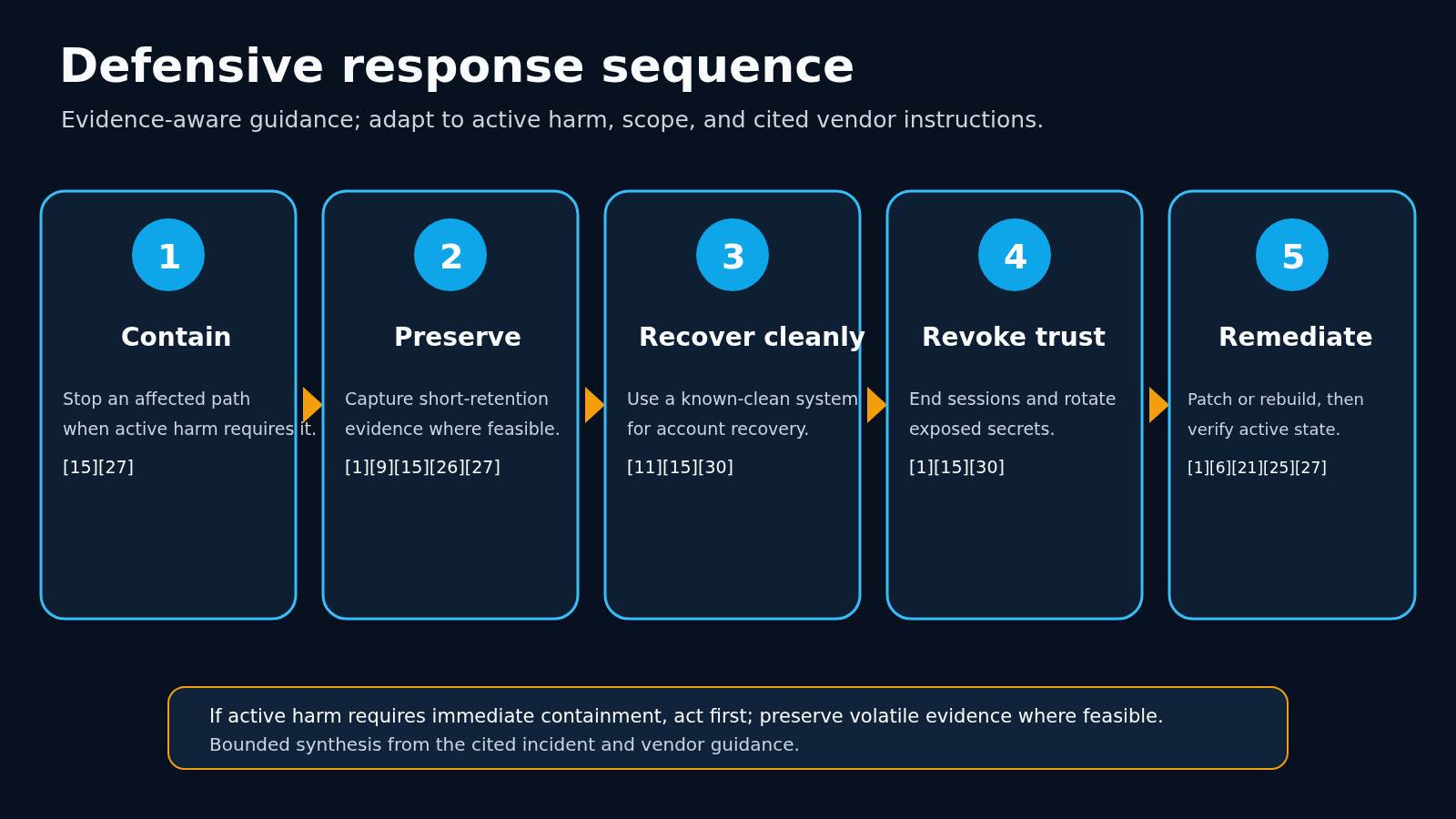
Do tonight
Bounded practical guidance — prioritize only the systems and chains of custody that exist in your environment.[1][9][11][15][21][25][26][27]
- Preserve short-retention identity, endpoint, web, VPN, marketplace and order evidence before reboots, uninstallations or cleanup.[1][9][15][21][26][27]
- Patch Drupal Commerce and exposed self-managed GitLab or Cisco systems after recording active versions, runtime provenance and configuration.[21][22][25][26][27]
- Check whether any Cursor marketplace installation matches versions 2.1.312 or 2.1.313 and the October 29 exposure window.[15]
- Verify WordPress core update completion and review the corresponding staging-path traffic before logs rotate.[7][8][9]
- If a CryptoBilis-supplied wallet was initialized, begin a clean-device migration to a new recovery phrase without dismantling the suspect device.[11][12]
Do this week
Bounded practical guidance — test these controls with harmless exercises and named owners.[1][3][13][14][21][23][28][29][30]
- Inventory remote-support viewer builds and separate support identities from everyday administrator accounts.[3][4]
- Test a false-post response through an independently controlled correction channel.[13][14]
- Audit cloud command roles, SAML validation and instance-metadata controls that could amplify automated intrusion tooling.[1]
- Reconcile commerce orders against payment and fulfillment records and document how suspicious changes are preserved before correction.[21][23]
- Document which crypto incident numbers are provider snapshots so future reports do not merge theft, freeze, recovery and reimbursement.[28][29][30]
FAQ
Does a KEV entry prove my system was breached?
No. It means CISA has evidence of exploitation and expects prioritization. Exposure, attempts, success and persistence remain separate questions.[24]
Should I patch before collecting evidence?
If active harm requires immediate containment, protect people and operations first. Where feasible, preserve volatile and short-retention evidence before a reboot, uninstall or rebuild because remediation can erase the timeline needed to scope the incident.[1][9][15][26][27]
Is the Trezor implant confirmed?
Not by Trezor’s laboratory at the cutoff. Trezor called the report credible enough for precautionary action, while related Ledger cases show that the broad hardware-supply-chain scenario is plausible.[11][12]
Were 5,000 Cursor users backdoored?
No such conclusion is supported. “Up to 5,000” is an exposure ceiling reported by Reuters; platform behavior and successful SSH access varied, and evidence must be checked per host.[15][17][19]
Was WordPress hit nearly 63,000 times?
The durable capture used here supports more than 18,500 matching requests in the first 21 hours. Requests are not unique sites or successful compromises, and this package does not promote a changing dashboard counter into a victim total.[8][9]
Do the Binance totals conflict?
They differ because observers used different methods and cutoffs. This article keeps each figure with its source rather than averaging them.[28][29][30]
Local relevance and help
This report does not claim that any person or business in our service area was observed in these incidents. Local relevance is conditional: if your environment uses the affected product, marketplace, reseller, exchange or publishing workflow, the evidence can guide a scoped check.[1][3][6][11][13][15][21][24][28][29][30]
For a broader service conversation, use the live public Small Business Services page. To review earlier coverage, use Search Articles or the verified public Case File 046. These links were resolved from the site’s public WordPress REST surfaces at the reporting cutoff; none was guessed.[32][33][34]
Methodology and transparency
The eligibility audit found exactly ten dated October 30 editorial cards before the homepage rolled to October 29. Nine qualified. The contributed “Why Urgent Security Fixes Aren’t Fixed” article was excluded, and undated sponsored RecoAI and Adaptive Security cards were outside the candidate set.[31]
Each dossier was rebuilt from the frozen vendor, project, government, research or contemporaneous-reporting captures in this package. The Hacker News pages were discovery and eligibility surfaces, not substantive proof. Every numbered marker points directly to a public source, while the private claim ledger binds each reviewed claim to an exact package-relative capture and a contiguous excerpt.[1][2][3][4][5][6][7][8][9][10][11][12][13][14][15][16][17][18][19][20][21][22][23][24][25][26][27][28][29][30][31]
Practical instructions are explicitly labeled bounded practical guidance. They are defensive synthesis, not a guarantee, and they keep evidence preservation ahead of destructive remediation where feasible. No exploit code, malware, exposed secret, suspicious extension or hardware device was downloaded, executed, opened or tested for this article.[1][3][6][8][9][11][15][21][23][25][26][27][30]
Sources
- 1. VAPOR PANDA Uses AI-Driven ARTEX to Scale a Global Espionage Campaign — CrowdStrike. Direct public source. Accessed 2026-10-30T19:38:14-04:00.
- 2. Threat Actor Abuses Agentic AI Pentesting Framework to Target South Korean Financial Institutions — Zscaler ThreatLabz. Direct public source. Accessed 2026-10-30T19:38:14-04:00.
- 3. TV-2026-1011 — Security Update for Vulnerabilities in TeamViewer Clients — TeamViewer. Direct public source. Accessed 2026-10-30T19:38:14-04:00.
- 4. CVE-2026-111585 — CVE Program / TeamViewer CNA. Direct public source. Accessed 2026-10-30T19:38:14-04:00.
- 5. Remote Code Execution in TeamViewer — Remedio. Direct public source. Accessed 2026-10-30T19:38:14-04:00.
- 6. WordPress 7.1.4 — WordPress.org. Direct public source. Accessed 2026-10-30T19:38:14-04:00.
- 7. Version 7.1.4 — WordPress.org Documentation. Direct public source. Accessed 2026-10-30T19:38:14-04:00.
- 8. GHSA-4w3m-c66w-69mg — WordPress project on GitHub. Direct public source. Accessed 2026-10-30T19:38:14-04:00.
- 9. WordPress 7.1.4 Patches Unauthenticated Upgrade-Window RCE — Wordfence. Direct public source. Accessed 2026-10-30T19:38:14-04:00.
- 10. CVE-2026-119977 reservation response — CVE Program. Direct public source. Accessed 2026-10-30T19:38:14-04:00.
- 11. Implant reported in a Trezor sold by CryptoBilis — Trezor. Direct public source. Accessed 2026-10-30T19:38:14-04:00.
- 12. Police Advisory On Tampered Cryptocurrency Hardware Wallets — Singapore Police Force. Direct public source. Accessed 2026-10-30T19:38:14-04:00.
- 13. Syrian Man Sentenced for Wide-Ranging Hacking Conspiracy — U.S. Department of Justice. Direct public source. Accessed 2026-10-30T19:38:14-04:00.
- 14. False Rumor of Explosion at White House Causes Stocks to Briefly Plunge — CNBC. Direct public source. Accessed 2026-10-30T19:38:14-04:00.
- 15. Security notice — malicious version of Anthropic.claude-code — Cursor. Direct public source. Accessed 2026-10-30T19:38:14-04:00.
- 16. Trojanized Claude Code Extension Plants an SSH Backdoor — OpenSourceMalware. Direct public source. Accessed 2026-10-30T19:38:14-04:00.
- 17. Claude Code extension infected with malware on Cursor marketplace — heise online. Direct public source. Accessed 2026-10-30T19:38:14-04:00.
- 18. Claude Code releases — Anthropic GitHub repository. Direct public source. Accessed 2026-10-30T19:38:14-04:00.
- 19. Cursor says up to 5,000 users affected — Reuters syndicated by The Star. Direct public source. Accessed 2026-10-30T19:38:14-04:00.
- 20. Cursor Removes Malicious Claude Code 2.1.313 Extension — Socket. Direct public source. Accessed 2026-10-30T19:38:14-04:00.
- 21. Security advisories 2026 index — SA-CONTRIB-2026-254 — Drupal.org. Direct public source. Accessed 2026-10-30T19:38:14-04:00.
- 22. CVE-2026-118539 — CVE Program / Drupal CNA. Direct public source. Accessed 2026-10-30T19:38:14-04:00.
- 23. Compare 3.3.12 to 3.3.13 — Drupal Commerce GitLab. Direct public source. Accessed 2026-10-30T19:38:14-04:00.
- 24. Known Exploited Vulnerabilities Catalog — CISA. Direct public source. Accessed 2026-10-30T19:38:14-04:00.
- 25. Critical Patch Release: 19.4.2, 19.3.5, 19.2.8 — GitLab. Direct public source. Accessed 2026-10-30T19:38:14-04:00.
- 26. GitLab security incident: attempted exploitation of CVE-2026-97229 — Alpine Linux. Direct public source. Accessed 2026-10-30T19:38:14-04:00.
- 27. ASA and FTD Remote Access SSL VPN Tunnel Denial of Service Vulnerability — Cisco. Direct public source. Accessed 2026-10-30T19:38:14-04:00.
- 28. North Korea Steals USD 6.36 Billion From Binance — TRM Labs. Direct public source. Accessed 2026-10-30T19:38:14-04:00.
- 29. The largest theft in history: North Korea likely behind the Binance hack — Elliptic. Direct public source. Accessed 2026-10-30T19:38:14-04:00.
- 30. Binance security incident and frozen assets — CNBC. Direct public source. Accessed 2026-10-30T19:38:14-04:00.
- 31. October 30, 2026 homepage eligibility observation — The Hacker News. Public homepage. Recorded 2026-10-30T23:44:21Z.
- 32. Small Business Services — The IT Guys. Public page.
- 33. Search Articles — The IT Guys. Public page.
- 34. Case File 046 — The IT Guys. Public article.