

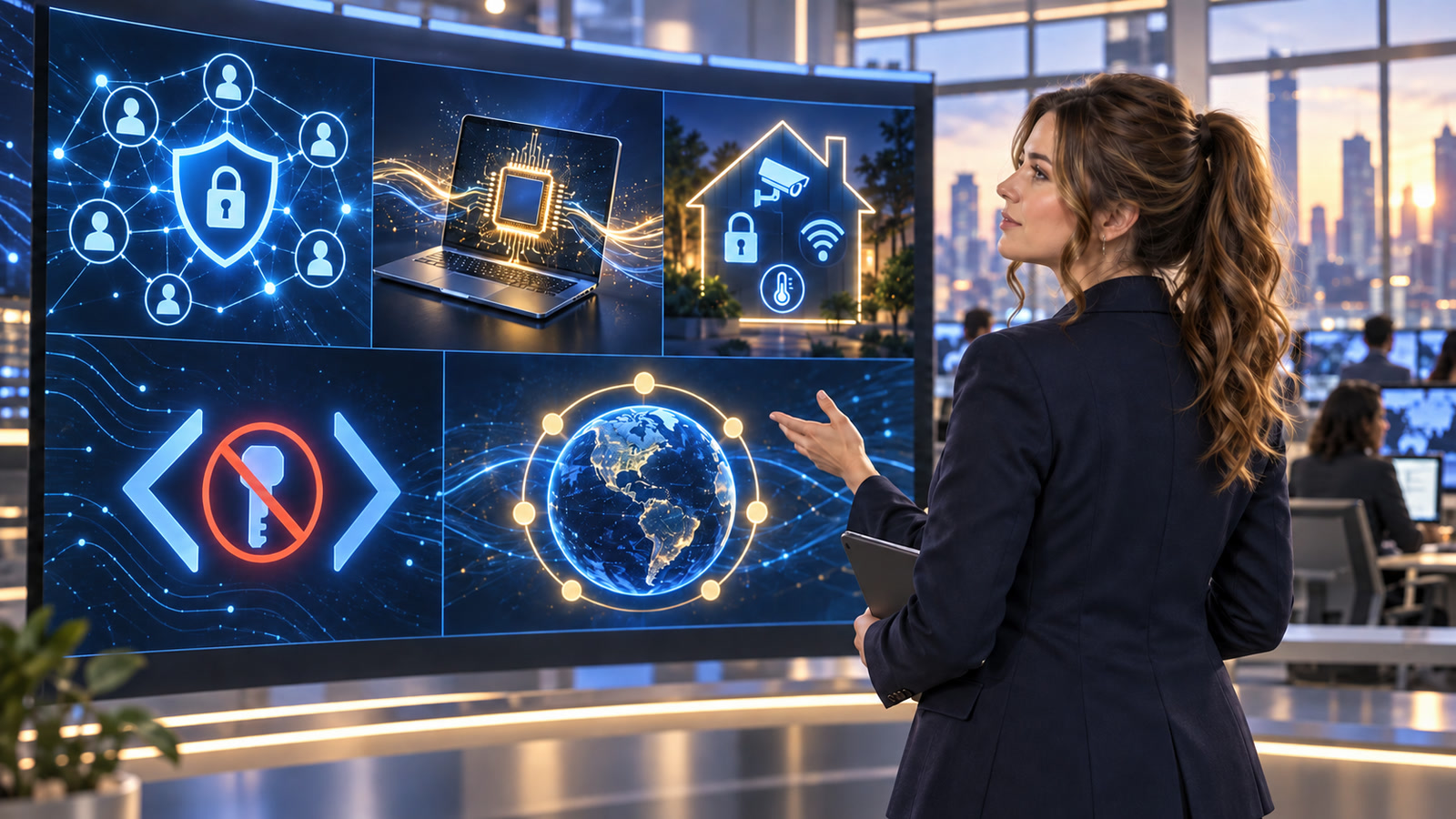
Tuesday’s 5 PM technology recap connects five developments that matter to people running real systems: Microsoft’s new defense report says AI is speeding up familiar cyberattack paths, NVIDIA is preparing a broad software stack for RTX Spark laptops, Apple is expanding its smart-home lineup, GitHub is blocking more exposed credentials by default, and scientists are asking for shared international rules around cyber-capable AI.[1][3][4][6][7]
Reporting window: October 12, 2026, 5:06:30 p.m. EDT through October 13, 2026, 6:34:49 p.m. EDT (22:34:49 UTC). All five stories were published October 13. Microsoft and NVIDIA figures are vendor-reported; Apple privacy and availability details are company claims; the AI-oversight proposal is an open-letter recommendation, not an adopted regulator.
Listen to the broadcast-ready recap
This KittenTTS Bella narration was synthesized locally from the same checked facts as the article.
Tonight’s five-story rundown
- Microsoft says AI is accelerating familiar attack paths.
- RTX Spark gets a launch-ready local-AI software stack.
- Apple Home Collection brings cameras, locks, and climate controls under Home.
- GitHub blocks Anthropic keys by default and adds Salesforce detection.
- Scientists propose international containment and incident reporting for cyber-capable AI.
1. Microsoft says AI is accelerating familiar cyberattack paths
Microsoft’s 2026 Digital Defense Report says 63% of the intrusions in its dataset involved data theft and that 73.3% of initial-access attempts involved user execution, valid accounts, social engineering, or phishing.[1][2] Those are Microsoft Threat Intelligence observations, not a census of every intrusion worldwide.
The report argues that AI is shrinking parts of sophisticated attack chains from days to seconds while also helping defenders hunt vulnerabilities, correlate signals, and automate response.[2] Its practical emphasis remains familiar: phishing-resistant authentication, least privilege, visibility into AI agents, rapid edge-device patching, regular attack simulations, and coordinated incident response.[2]
Practical action: review privileged identities, service accounts, API keys, exposed edge devices, and recovery time objectives together. The report’s strongest message is that identity, software supply chains, cloud services, and operational continuity now fail as one connected system.
2. RTX Spark gets a launch-ready local-AI software stack
NVIDIA says RTX Spark laptops are scheduled for October 16 with up to 128 GB of unified memory and 1 petaflop of AI compute.[3] Ahead of that hardware date, the company says PyTorch, Python, CUDA libraries, local agent tools, creative applications, and hundreds of games have been prepared or optimized for the platform.[3]
The most operationally useful launch detail is isolation: NVIDIA says local agents will use OpenShell and Microsoft Execution Containers, while several agent applications are adding local/cloud model routing.[3] NVIDIA also says Nemotron 3.5 Bolt 74B is due October 15 and that NVIDIA PAIR moved out of beta on October 13.[3]
Practical action: if RTX Spark is on your shortlist, inventory the exact applications and models you need, then test sandbox boundaries and outbound routing—not just model speed.
3. Apple Home Collection brings cameras, locks, and climate controls under Home
Apple announced a collection built with LG Electronics and Schneider Electric that includes indoor and outdoor cameras, a video doorbell, a smart lock, thermostats, and room sensors.[4] Apple says the accessories can be set up from an iPhone and managed in the Home app without a separate vendor account.[4]
The lineup starts in December, with some accessories following in early 2027. U.S. starting prices range from $39.95 for temperature sensors to $399.95 for the floodlight camera; the smart deadbolt starts at $349.95.[4] Independent same-day coverage also reported the wider HomeView, HomePod mini, and Apple TV 4K launch context.[5]
Apple says Home data is end-to-end encrypted and camera processing happens on a home hub or in Private Cloud Compute.[4] Camera history and AI search features still depend on eligible iCloud+ plans and compatible Apple hardware.[4]
Practical action: wait for exact model availability, confirm hub and iCloud+ requirements, and preserve mechanical entry plus a documented emergency-access plan.
4. GitHub blocks Anthropic keys by default and adds Salesforce detection
GitHub secret scanning now detects Anthropic service and user API keys, a Cloudsmith API key, and a Salesforce Marketing Cloud OAuth token.[6] For repositories with secret scanning enabled—including free public repositories—GitHub says commits containing the two Anthropic key types are now blocked by push protection by default.[6]
Salesforce also joined GitHub’s secret-scanning partner program. When a supported partner secret appears in a public repository, GitHub reports it to the issuer so the credential can be revoked or rotated.[6]
Practical action: confirm secret scanning and push protection policy on the repositories you own, then test with provider-approved dummy patterns rather than live keys.
5. Scientists propose international containment and incident reporting for cyber-capable AI
Reuters reported that roughly 400 scientists—including Geoffrey Hinton and Yoshua Bengio—called for an international body to set containment standards and maintain a registry of significant incidents involving advanced cyber-capable AI systems.[7] The letter recommends high-assurance containment, initially defaulting to air-gapping, plus independent oversight and public incident reporting.[7]
ABC’s independent coverage counted 350 scientists from more than 30 countries and described the same three recommendations: high-assurance containment, an international incident body, and public reporting.[8] The count difference appears to reflect how the outlets rounded or captured a growing signatory list; this article does not collapse them into one exact total.
The proposal is not law, and there is disagreement about diagnosis. Reuters noted that Yann LeCun did not sign and has argued that recent incidents were primarily engineering failures rather than evidence of existential AI risk.[7]
Practical action: organizations testing powerful agents do not need to wait for a treaty: isolate experiments, minimize credentials and network reach, retain logs, predefine stop conditions, and independently review containment escapes.
What to do next
- Security leaders: measure identity exposure, token rotation, edge-device patch latency, recovery readiness, and agent permissions together.
- Local-AI buyers: test the exact RTX Spark workload and its network/sandbox behavior before standardizing hardware.
- Smart-home shoppers: verify hub, subscription, wiring, local fallback, and emergency access before buying.
- Developers: enable push protection where available and treat any exposed credential as requiring rotation.
- AI evaluators: use isolated environments, minimum privileges, durable logs, and an incident-escalation path.
Need help securing, fixing, or planning your technology? Schedule The IT Guys
More from The IT Guys
Frequently asked questions
Does Microsoft say AI created entirely new attack methods?
No. Microsoft says the methods and targets are largely familiar; AI changes their speed, scale, and customization.[1]
Are RTX Spark performance and readiness claims independently proven here?
No. They are NVIDIA’s launch claims and roadmap. Test the exact software, model, power profile, and privacy boundary you need.[3]
Does Apple Home Collection avoid every subscription?
No. Apple says accessory control needs no separate vendor account, but camera history and certain Apple Intelligence features require eligible iCloud+ plans.[4]
Will GitHub push protection find every credential?
No. It covers supported patterns in repositories where the feature applies. Secret management, rotation, and incident response remain necessary.[6]
Has an international AI incident body been created?
No. The scientists proposed one; the recommendation has not become an adopted international regulator.[7][8]
Sources checked for this edition
- Microsoft — 2026 Digital Defense Report executive summary
- Microsoft Source Asia — report highlights and practical priorities
- NVIDIA — RTX Spark software ecosystem readiness
- Apple — Apple Home Collection announcement
- CGMagazine — same-day Apple launch coverage
- GitHub — secret-scanning expansion
- Reuters — scientists’ international AI oversight proposal
- ABC News Australia — independent coverage and signatory interview
Source state checked through October 13, 2026, 6:34:49 p.m. EDT / 22:34:49 UTC. Reuters blocked direct automated body retrieval; its canonical link and exact wire copy were checked through an attributed syndication page, then corroborated against ABC’s independently accessible report.