

☀ Morning Good News for Today
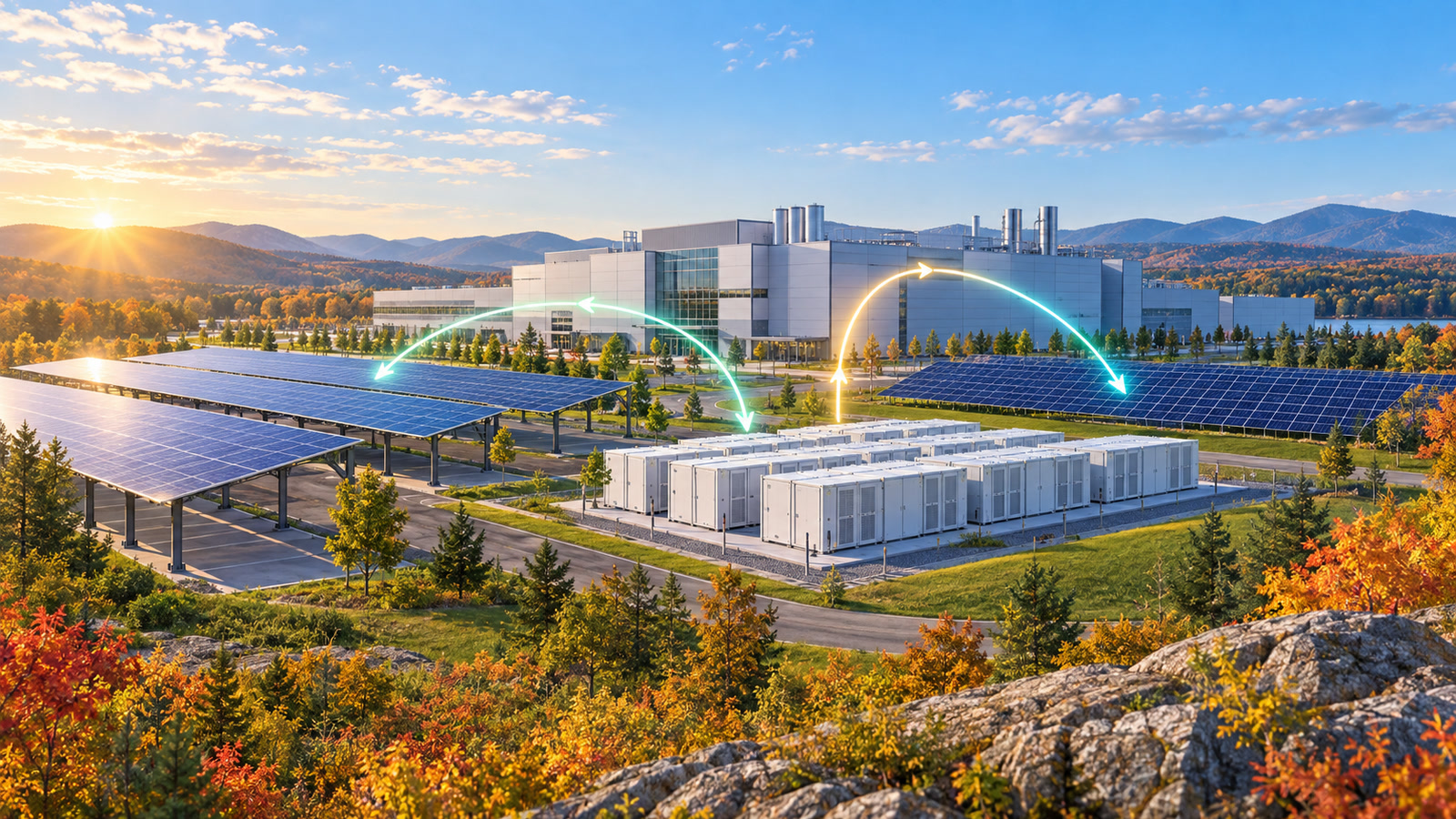
GlobalFoundries has marked the successful delivery of about 6 megawatts of on-site solar arrays and a 16-megawatt battery system at its Vermont semiconductor campus. [1] [2] [3] Those are real pieces of infrastructure, not a funding promise—but the official release says the systems will come fully online in the coming months, so the confetti stays politely behind the commissioning line. [1] [3]
Good news in 30 seconds
- The projects pair approximately 6 MW of solar with a 16 MW battery energy storage system at and around the Essex Junction site. [1] [3]
- The solar installations reuse more than 30 acres of previously developed or underused industrial land, including former parking areas. [1] [2] [3]
- Local reporting says the battery is designed to charge when demand is lower and discharge for up to four hours during peak periods, reducing the fab’s draw on the regional grid. [2] [3]
What happened
On October 5, GlobalFoundries publicly recognized delivery of two on-site solar projects and a large behind-the-meter battery at its Vermont manufacturing operation. Company leaders, state officials and project partners marked the milestone with a symbolic breaker close. WCAX described the systems as online, while both the official release and WPTZ said full operation is still expected in the coming months. We therefore describe the equipment as delivered and publicly marked—not fully commissioned. [1] [2] [3]
Chip fabrication is unusually sensitive to power quality. GlobalFoundries told WPTZ that even very brief voltage changes can affect equipment. A carefully engineered battery can shift part of the site’s grid demand away from peak periods without pretending that a factory can simply pause when the grid gets busy. [1] [3]
This project combines three practical ideas: build generation near the load, reuse already-developed land, and use storage to manage when a power-intensive facility draws from the regional grid. The hardware has been delivered, and the remaining commissioning language is visible rather than buried. That is the useful kind of optimism—bright, wired up and still wearing its safety glasses. [1] [3]
Why this made us smile
Semiconductor fabs are famous for precision, so it feels fitting that this good-news story comes with an important decimal point: “delivered” is not the same as “fully operational.” Even happy electrons deserve accurate paperwork.
What it could mean for everyday people
The everyday lesson is the difference between power and energy. Megawatts describe the rate at which equipment can deliver or absorb power; megawatt-hours describe energy delivered over time. The checked sources consistently support a 16 MW battery power rating and up-to-four-hour operation, but WCAX also labels it 16 MWh—a figure that does not reconcile with those two details. We therefore do not state a battery energy capacity. [1] [2] [3]
Keep the confetti factual
The solar and battery systems were not consistently described as fully operational at our cutoff. The 6 MW and 16 MW figures are power capacities, not measured solar generation, usable stored energy, verified peak reduction, savings or avoided emissions. Project participants call the battery Vermont’s largest, but the checked evidence does not independently audit that ranking. The sources also do not establish battery chemistry, round-trip efficiency, a final commissioning date or measured operating results. [1] [2] [3]
One happy thing to carry with you
A power-sensitive chip plant now has substantial solar and storage hardware on the ground, using old industrial space in a smarter way. Full operation and measured results still have to arrive—but concrete progress is allowed to be encouraging before it becomes a victory lap. [1] [3]
Sources and reporting notes
- GlobalFoundries — “GlobalFoundries marks milestone in its energy journey at Vermont site” (October 5, 2026)
- WCAX — “GlobalFoundries brings massive solar array, battery storage online in Essex Junction” (published October 5, 2026 at 3:42 PM EDT; updated 5:33 PM EDT)
- WPTZ/MyNBC5 — “GlobalFoundries marks milestone for new solar, Vermont’s largest battery system” (updated October 5, 2026 at 8:13 PM EDT)
How we know: GlobalFoundries provides the primary delivery record. WCAX and WPTZ independently reported from the milestone event and corroborate the equipment, land reuse and peak-support design. Where their operating-status wording differs, we use the more cautious official/WPTZ language. No checked source independently audits the statewide ranking or measured project performance.