

☀ Morning Good News for Today
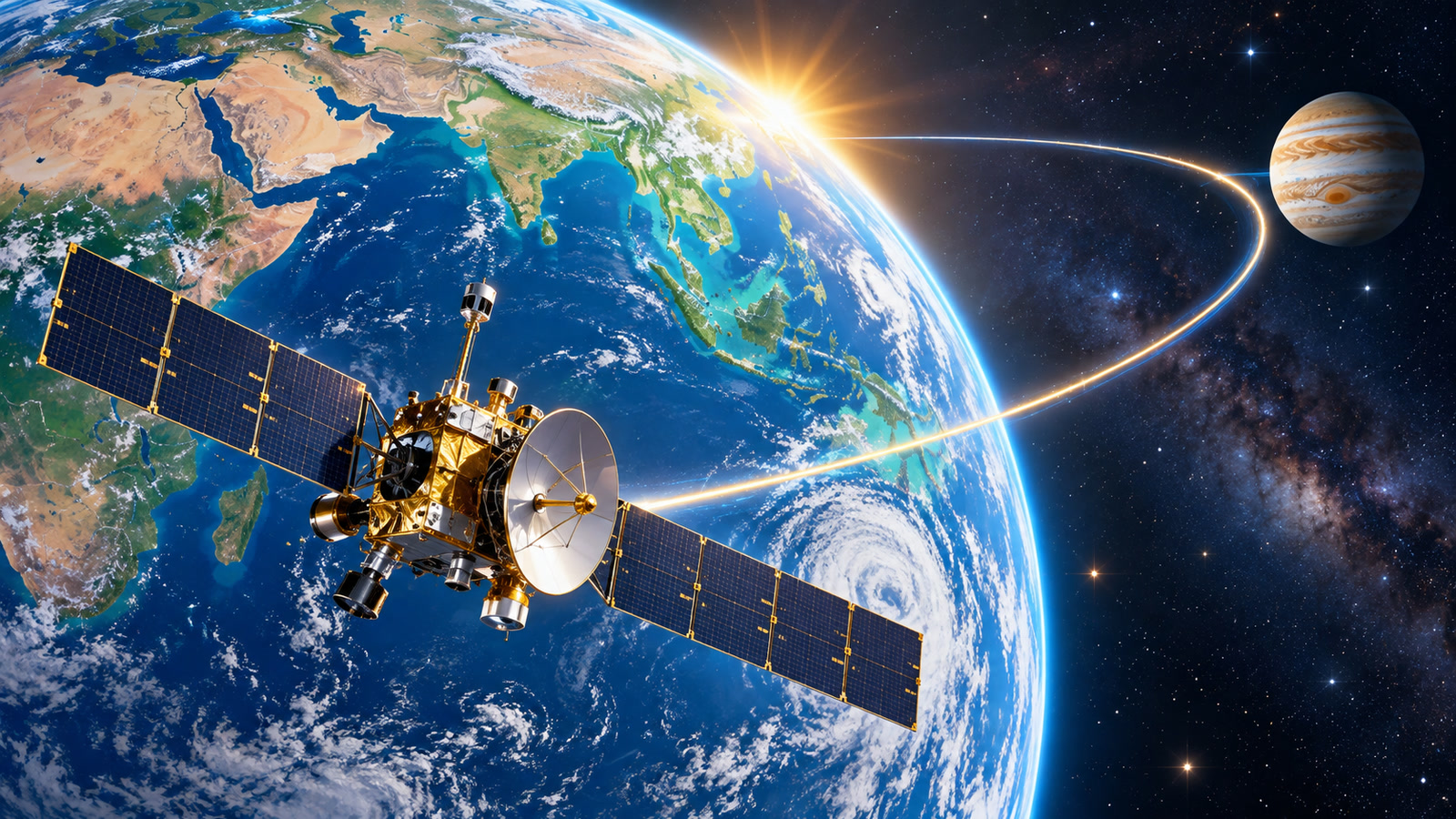
ESA’s Juice spacecraft completed a carefully planned Earth gravity assist on September 28, bending its route toward Jupiter while conserving precious onboard fuel. [1] [2] At closest approach, ESA says the probe passed about 8,640 kilometers (5,370 miles) above the Indian Ocean at 11:45 UTC. The maneuver was a cruise milestone rather than a science discovery—but it was a very elegant one. [1] [2]
Good news in 30 seconds
- ESA reports that Earth’s gravity deflected Juice’s trajectory by about 20 degrees. [1]
- The flyby increased the spacecraft’s speed by roughly 3.5 kilometers per second while using very little fuel. [1] [2]
- Juice remains on course for another Earth flyby in January 2029 and arrival at Jupiter in 2031. [1] [2]
What happened
Juice approached Earth from the nightside, crossed above the Indian Ocean and departed on a new path shaped by our planet’s gravity. ESA’s post-flyby report says the spacecraft’s trajectory changed by about 20 degrees and its velocity increased by about 3.5 km/s. Space.com reported the completed maneuver and the same central figures after the event; those numerical details still trace substantially to ESA rather than to a separate trajectory measurement. [1] [2]
Deep-space probes cannot carry unlimited propellant. A gravity assist uses a planet’s motion and gravity to change a spacecraft’s speed and direction, letting mission planners save fuel for later work. For Juice, that reserved propellant is intended to support years of operations around Jupiter and an eventual orbit around Ganymede. [1] [2]
This was measured progress, not a launch promise: the spacecraft reached the planned encounter, the major trajectory change occurred, and the mission continued toward its next waypoint. ESA also used the Earth-Moon encounter to help calibrate and validate science instruments against familiar targets. [1]
Why this made us smile
Earth provided a roughly 7,830-mph travel assist without asking the spacecraft to stop at a gas station. Somewhere, an orbital-mechanics spreadsheet is feeling extremely pleased with itself.
What it could mean for everyday people
The everyday lesson is that better planning can substitute for brute force. Space engineers carefully time these encounters so a spacecraft can “borrow” momentum instead of hauling all the fuel needed for every course change. That trade can mean more instruments, more operating time and more science at the destination. [1] [2]
Keep the confetti factual
Juice has not reached Jupiter and this flyby did not produce a new Jovian discovery. Another Earth assist is planned for January 2029, with Jupiter arrival expected in 2031. ESA said close tracking would continue through October 10; the final navigation-campaign assessment and detailed instrument-calibration findings were not available by our cutoff. Space.com corroborates that the maneuver occurred, but its operational figures rely substantially on ESA. [1] [2]
One happy thing to carry with you
A spacecraft passed Earth at exactly the right moment, let gravity do the heavy lifting and left with a better path toward Jupiter. Sometimes good technology news is simply a hard plan working beautifully. [1] [2]
Sources and reporting notes
- European Space Agency — “Successful Earth flyby improves Juice’s course to Jupiter” (September 28, 2026)
- Space.com — “Jupiter-bound JUICE spacecraft just got an 8,000 mph speed boost from Earth” (September 28, 2026)
How we know: ESA published the post-flyby operational account. Space.com independently reported that the flyby was completed, while relying substantially on ESA for the trajectory figures. No separate trajectory measurement was located.