

☀ Morning Good News for Today
Anthropic says a team of scientists used roughly 950 Claude agents to search a huge collection of reverse-transcriptase sequences and surface a previously uncharacterized biological pattern. [1] The result, called the array-associated reverse transcriptase system—or ART—is an intriguing, testable research lead, not a treatment or a finished gene-editing tool. [1] [3]
Good news in 30 seconds
- Anthropic reports that the AI search ran for 21 hours, gathered more than 200,000 reverse transcriptases, narrowed about 3,500 candidate systems to 20, and highlighted the pattern later named ART. [1]
- The company describes ART as a reverse transcriptase beside a partner gene and an orderly array of repeated DNA segments, found mainly in bacteriophages. [1]
- Initial human-run experiments found that the repeat array was expressed as short RNA molecules, but the system’s biological function remains unknown. [1] [3]
What happened
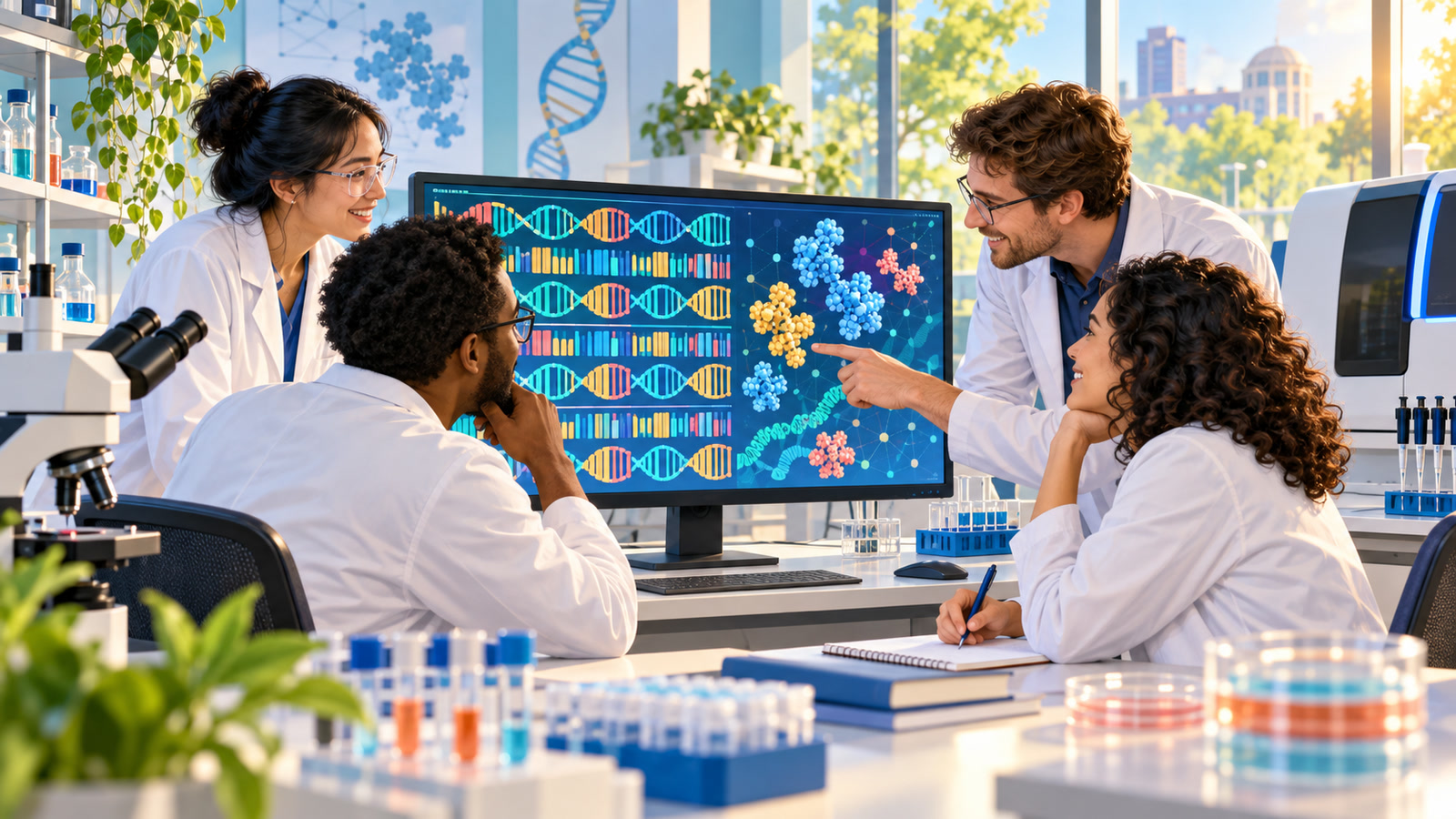
Anthropic’s September 23 announcement describes a human-plus-AI workflow: many Claude agents searched public sequence data, research agents reviewed and challenged the leads, and scientists then selected candidates for laboratory follow-up. The company says ART stood out because a reverse transcriptase repeatedly appeared beside a small partner gene and evenly spaced DNA repeats. Reuters reported the announcement and noted that the reverse transcriptase itself had appeared in earlier studies; Anthropic’s claimed novelty is the larger pattern linking the enzyme, partner protein, and repeat array. [1] [2]
The encouraging part is the workflow, not a miracle claim. Software sifted through an enormous sequence space and produced a concrete hypothesis that people could inspect and test. Anthropic also released a technical report so other researchers can examine the methods and evidence. [1]
Why this made us smile
The AI may have found a molecular needle in a DNA haystack; the scientists still have to learn whether that needle actually sews anything. That division of labor feels refreshingly honest.
What it could mean for everyday people
There is no product to buy and no health action to take. For everyday readers, the value is a clearer picture of where scientific AI can help today: organizing vast datasets, spotting unusual combinations, and giving researchers a smaller set of ideas worth testing. Whether ART becomes useful depends on many more experiments. [1] [3]
Keep the confetti factual
The technical report is a preprint, the discovery process is reported by Anthropic about its own model and laboratory, and no independent experimental replication was found before our cutoff. ART’s natural function is unknown. An outside microbiologist quoted by Al Jazeera said there is nothing yet indicating that ART rivals CRISPR technology or could become a therapeutic or practical application. [1] [3]
One happy thing to carry with you
A mountain of sequence data became one careful, testable question—and the next step belongs in the laboratory. That is modest progress, but it is real progress: better tools helping people notice where to look. [1]
Sources and reporting notes
- Anthropic — “Claude discovers a novel enzyme system with CRISPR-like repeats” (published September 23, 2026)
- Reuters syndication — “Anthropic says Claude AI helped discover novel enzyme system” (published September 23, 2026)
- Al Jazeera — “AI model Claude discovers CRISPR-like enzyme system, Anthropic says” (published September 24, 2026)
How we know: Anthropic is the primary source for the discovery process and lab observations. Reuters corroborates the announcement and chronology; Al Jazeera adds named outside-expert context. Neither outlet independently replicated the laboratory findings.