

☀ Morning Good News for Today
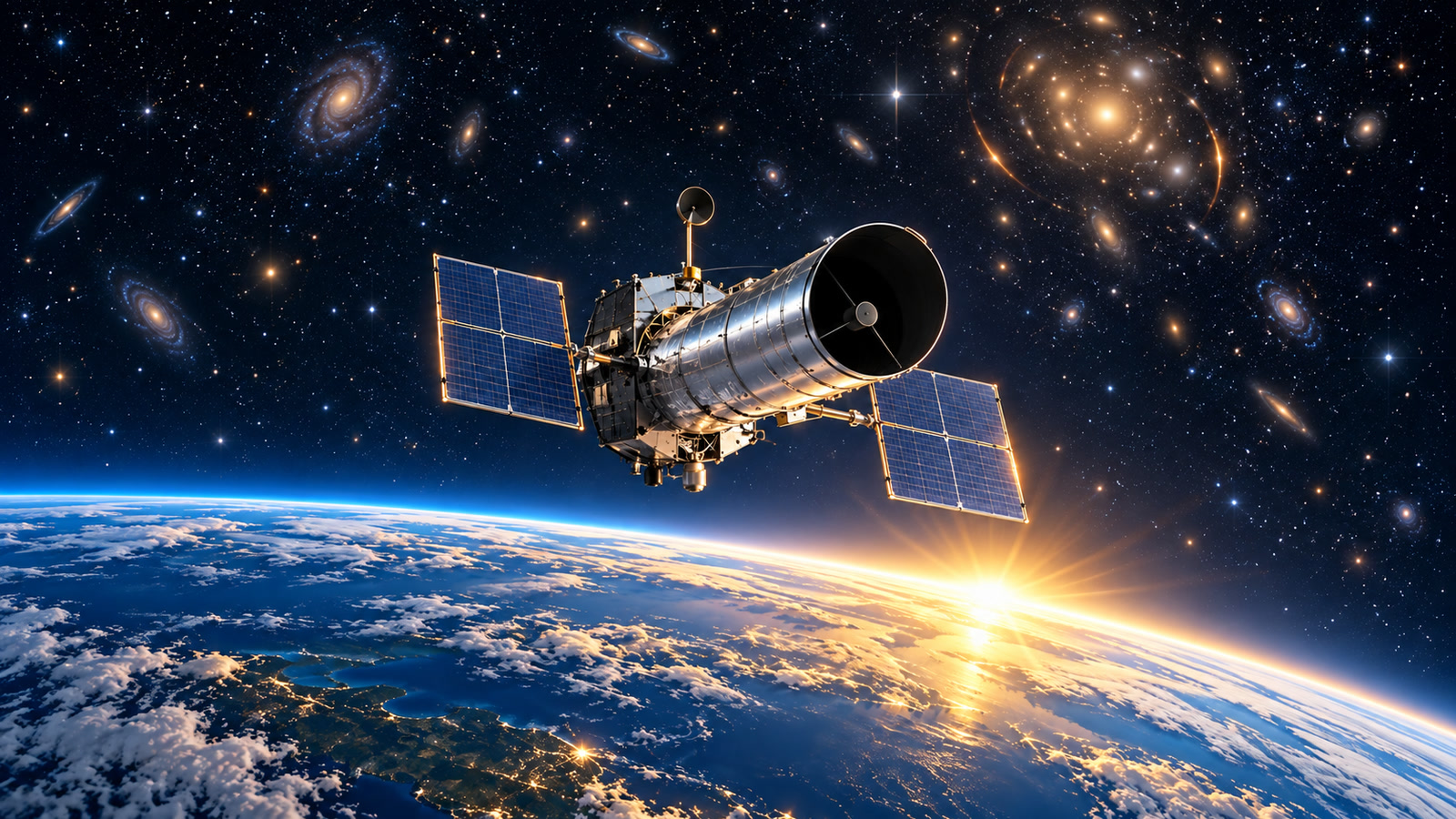
NASA says the Hubble Space Telescope completed its 200,000th orbit around Earth on September 19, 2026—and used the milestone day for another real science observation. [1] The agency disclosed the milestone on September 23 while describing an ongoing watch for the predicted return of a gravitationally lensed supernova nicknamed Athena. [1]
Good news in 30 seconds
- NASA reports that Hubble has traveled more than 5 billion miles around Earth and made more than 1.7 million observations during 36 years in orbit. [1]
- On the 200,000th-orbit date, Hubble observed galaxy cluster MACS J0417 as astronomers watched for Athena’s predicted reappearance. [1]
- NASA says astronomers request about seven times more Hubble observing time than is available each year. [1]
What happened
NASA’s September 23 feature says Hubble reached orbit number 200,000 on September 19. That day’s observation returned to MACS J0417, a massive galaxy cluster whose gravity bends and magnifies light from much farther objects. The repeat visit is part of a campaign to catch another image of supernova Athena if it reappears. [1]
Light from the same explosion can follow different paths around the cluster and arrive at Earth at different times. NASA says measuring that delay can help astronomers map the cluster’s mass and refine measurements related to the universe’s expansion. [1]
This is not merely a round-number lap. It is a 36-year-old observatory still doing oversubscribed, time-sensitive work: NASA says annual proposals request roughly seven times the observing time available. [1]
Why this made us smile
After 200,000 laps, Hubble still has a waitlist instead of a retirement party. That is a wonderfully nerdy kind of longevity: keep circling, keep looking, keep finding better questions.
What it could mean for everyday people
The useful lesson is that durable technology can create value long after launch day. Hubble’s advantage here is repetition: it can revisit the same patch of sky and compare what changes. For readers, that is a friendly reminder that some of science’s best tools are not one spectacular snapshot but careful observations collected over time. [1]
Keep the confetti factual
These figures and science details come from NASA; no meaningful independent report of the newly disclosed 200,000-orbit milestone was found before our cutoff. Athena’s reappearance is predicted, not yet observed: NASA places the expected window between now and early March 2027. [1] The source does not state the exact threshold-crossing time or promise how long Hubble will remain operational.
One happy thing to carry with you
A telescope launched in 1990 has completed 200,000 Earth orbits and is still being asked to do far more science than its calendar can hold. That is patient engineering paying dividends one careful look at a time. [1]
Sources and reporting notes
How we know: NASA’s live article is the complete primary source for the milestone, lifetime totals, observing demand, and Athena campaign. We found mirrors and republications, but no meaningful independent reporting that separately verified those details, so every consequential figure remains explicitly attributed to NASA.