

Morning Good News for Today
A Quantum Computer That Can Refill Its Missing Atoms Without Starting Over
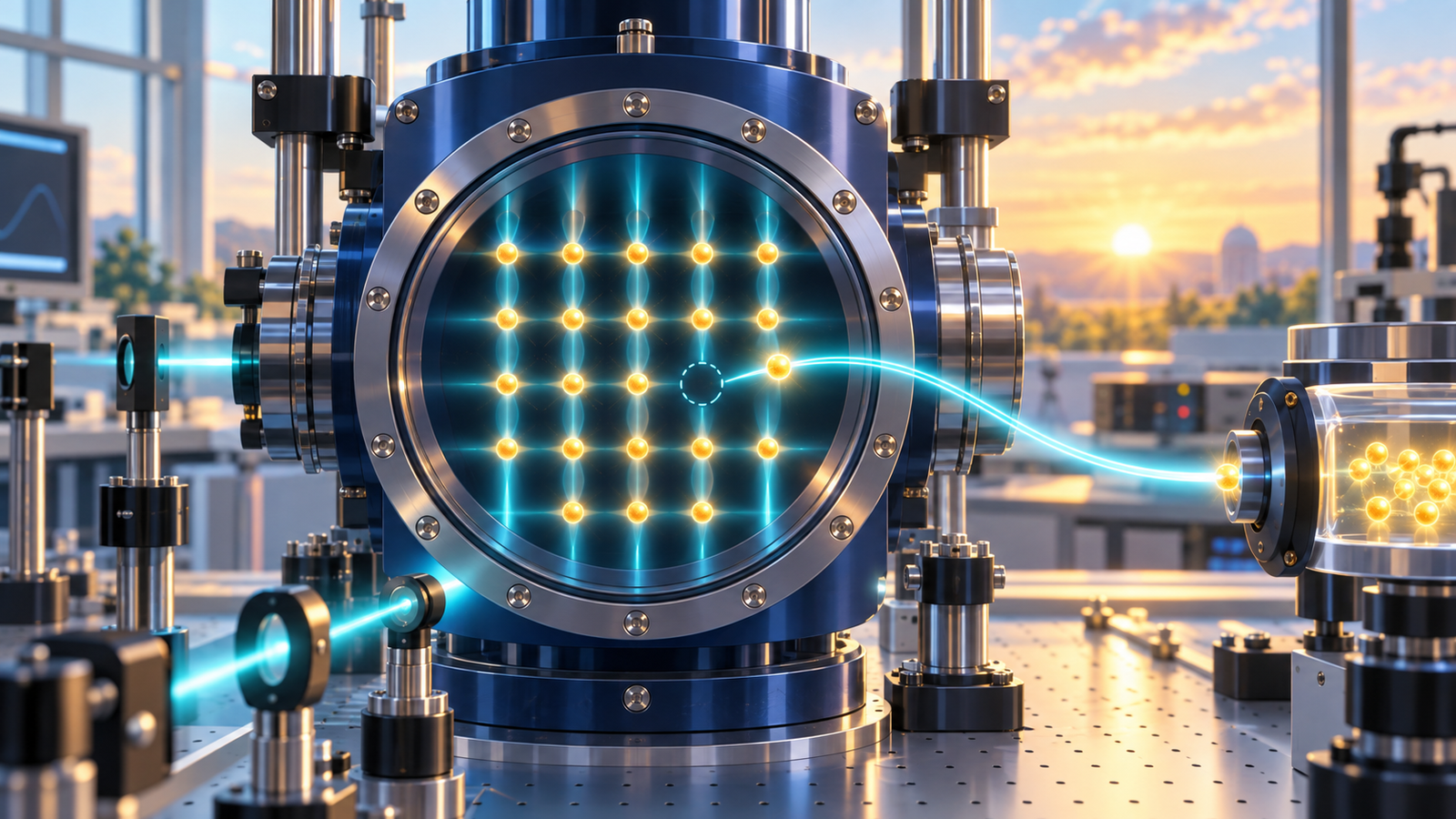
A Princeton team has demonstrated a way to replace lost neutral-atom qubits while nearby quantum information stays coherent.[1][2] The peer-reviewed paper appeared in the September 17 issue of Science; the underlying preprint was first posted in June 2025, so today’s news is publication and review—not a brand-new experiment.[1][2]
What changed
The experiment used ytterbium-171 atoms as qubits. A continuously supplied reservoir sat a few hundred micrometers from the computation zone, allowing optical tweezers to bring in replacement atoms on demand.[2]
The researchers reported extraction cycles up to 500 times per second. When single-atom preparation, nondestructive imaging and initialization were included, they prepared new randomly filled qubit arrays 30 times per second.[2][3]
Why that matters
Neutral-atom processors hold atoms in arrays of laser-made traps, but atoms can be lost during operation. Replacing them slowly—or rebuilding the array—can interrupt the long sequences needed for useful quantum error correction.[2][3]
The useful trick is not merely adding fresh atoms. The team reported that cooling, imaging and moving replacements did not measurably disturb the stored metastable qubits in its tests.[2]
A tiny repair crew for an unusually delicate machine
Think of the array as a workbench whose parts occasionally wander off. Earlier systems could pause and reload; this experiment brings the spare-parts shelf close enough to refill vacancies while the rest of the bench keeps its quantum composure. Quantum hardware is still fussy, but apparently it can now be fussy with on-site maintenance.
The paper’s coherence measurements compared reloading with a control sequence that omitted reloading. The reported survival and coherence results were indistinguishable within the experiment. The team also performed qubit rotations while replacement continued.[2]
Why this is encouraging
Fast replacement addresses one physical bottleneck: keeping an atom-array machine supplied without sacrificing the quantum state already stored nearby.[2]
A separate Harvard-led neutral-atom platform has also demonstrated continuous coherent operation and maintenance of an array exceeding 3,000 atoms for more than two hours.[4] That separate team’s peer-reviewed primary report shows continuous operation is a broader research direction; it does not independently verify Princeton’s exact measurements.
What everyday readers should expect
No quantum laptop is arriving in next week’s circular. If this approach scales and integrates with full error-correction systems, it could help future neutral-atom machines run longer computational sequences in tasks where atom or qubit loss is a limiting factor.[2] Those benefits remain prospective, not demonstrated consumer outcomes.
Keep the confetti factual
This is an experimental hardware result, not a commercial quantum computer and not proof of fault-tolerant quantum computing. The authors describe atom loss as one important obstacle; practical machines still need high-fidelity operations, scalable control and error-correction protocols that work together.[2]
The article also avoids calling the result “unlimited computation.” The paper uses “unlimited depth” to describe the architectural possibility of replacing lost atoms, but real circuit depth will remain constrained by every other error source and by whether complete error correction succeeds.[2]
No independent news report located in our review directly reproduced Princeton’s measurements. Our numerical claims therefore stay tied to the paper, its openly accessible manuscript and the team’s APS presentation; Harvard’s separate work is labeled as context rather than confirmation.
One happy thing to carry with you
Progress does not always look like a machine doing something spectacular. Sometimes it looks like the machine learning how to replace one missing part without forgetting what it was doing.
Sources
- Science: “Fast, continuous, and coherent atom reloading in a neutral-atom qubit array” — September 17, 2026.
- Open manuscript: “Fast, continuous and coherent atom replacement in a neutral atom qubit array” — first posted June 18, 2025.
- American Physical Society meeting archive: Princeton presentation abstract — June 3, 2026.
- Nature: “Continuous operation of a coherent 3,000-qubit system” — separate-team primary-source context.
Reporting cutoff: September 21, 2026, 8:26 a.m. Eastern. Research results can change as other teams test, reproduce and integrate the work.