

☀ Morning Good News for Today
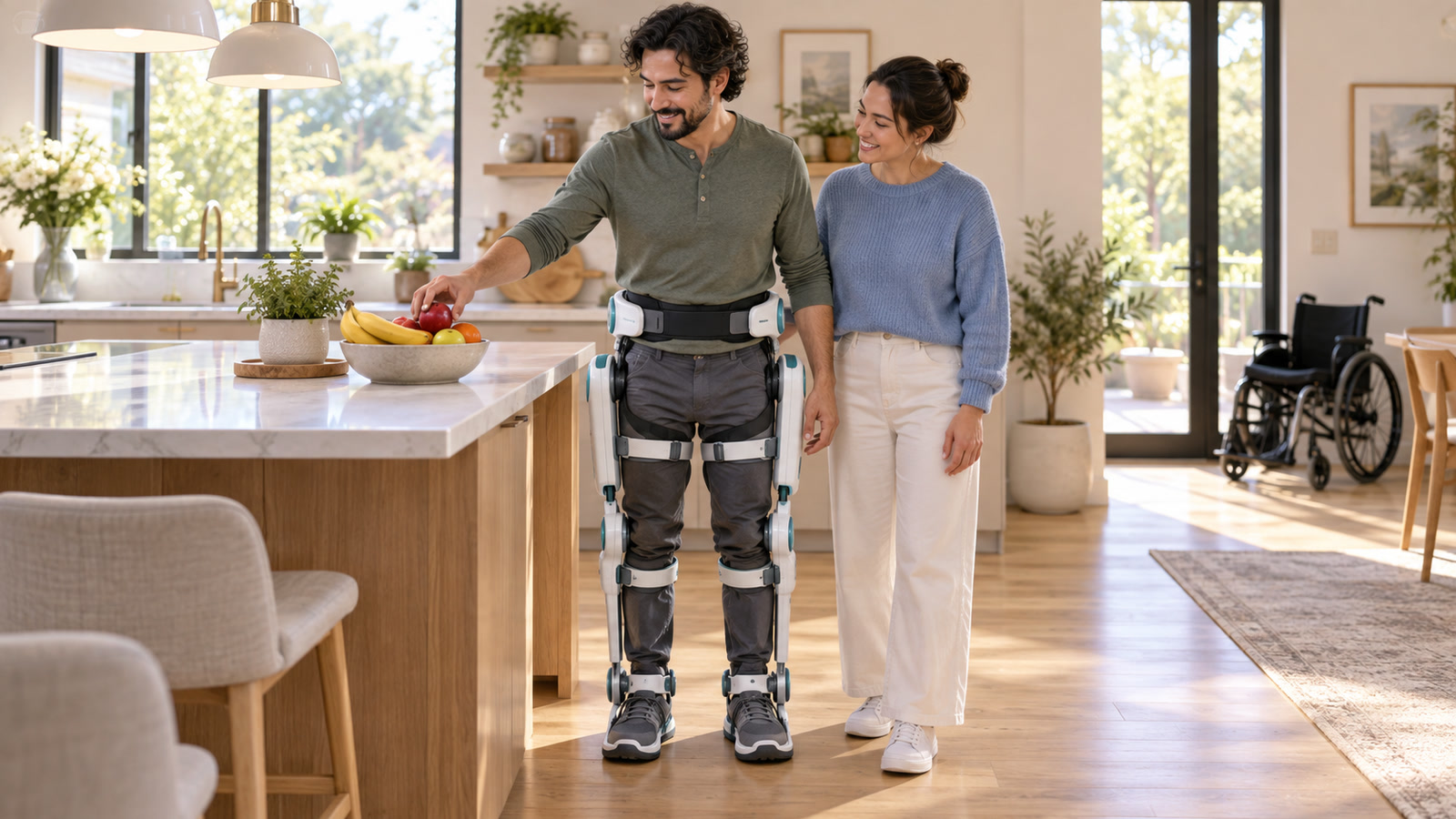
Wandercraft says Eve, its FDA-cleared self-balancing personal exoskeleton, became commercially available in the United States on September 17 for eligible adults with spinal cord injuries who can operate its controller. [1] The milestone moves a hands-free walking system cleared for specific home and building-connected settings toward prescribed personal use—while the FDA record keeps the limits refreshingly specific. [2]
Good news in 30 seconds
- The FDA classifies Eve as a Class II powered lower-extremity exoskeleton and cleared it through a 510(k) substantial-equivalence determination. [2]
- The cleared indication covers hands-free walking functions and activities of daily living using self-balancing technology, under a specially trained companion’s supervision. [2]
- The FDA summary says three clinical studies included 39 participants; 25 device- or procedure-related or possibly related adverse events were reported, all non-serious and resolved without sequelae. [2]
What happened
Wandercraft announced the U.S. commercial launch on September 17. The company says the process begins with a clinical evaluation and trial, followed—when successful—by a physician’s order, individual fitting and manufacturing, training, and delivery. [1] Independent medical coverage published before launch corroborated the FDA clearance, intended population, companion requirement, level-surface limits, and the planned September 17 availability date; it did not independently confirm completed deliveries. [3]
The FDA-cleared purpose is unusually practical: Eve is intended to support hands-free walking functions and activities of daily living for adults with spinal cord injuries who can operate the controller and tolerate standing. [2] It is designed to complement—not replace—a wheelchair, according to Wandercraft. [1]
The regulatory summary distinguishes Eve from Wandercraft’s rehabilitation-focused predicate device by clearing Eve for specified personal-use settings. [2] That is a meaningful shift from supervised rehabilitation toward carefully trained use at home and in certain building-connected open-air spaces.
Why this made us smile
The robot legs may handle the balancing act, but the fine print still keeps both feet firmly on level ground. That is not a buzzkill; it is what responsible progress looks like when technology is carrying a person.
What it could mean for everyday people
For a reader exploring mobility options, the useful questions are concrete: Am I medically eligible? Can I operate the controller? Who will serve as the trained companion? What evaluation, fitting, training, service, and payment steps apply? The company says a successful trial and physician’s order come before individual fitting and manufacturing. [1] A rehabilitation physician or qualified mobility team—not a headline—should determine whether the device fits one person’s needs.
Keep the confetti factual
Eve is not intended for stairs or sports, and its cleared use is limited to level, firm, dry, smooth surfaces indoors or in open-air areas that are part of a building’s structure. [2] The 510(k) decision is a substantial-equivalence determination, not proof that every person with spinal cord injury will qualify or benefit. [2] Commercial availability remains a Wandercraft statement: by our reporting cutoff, we had not found independent confirmation of completed deliveries, a public price, actual insurance or Medicare reimbursement outcomes, delivery counts, or long-term post-launch performance. [1] [3]
One happy thing to carry with you
The hopeful part is not a promise that one machine changes mobility for everyone. It is that a carefully bounded, self-balancing tool has moved from the rehabilitation world toward personal use—with its training, supervision, and surface limits stated in plain view. [1] [2]
Sources and reporting notes
- Wandercraft / GlobeNewswire — “Wandercraft Launches Eve™, the World’s First Self-Balancing Personal Exoskeleton, Bringing Hands-Free Upright Mobility to the Home” (company statement, September 17, 2026 at 9:00 a.m. ET; reopened through a September 18 Wayback snapshot)
- U.S. Food and Drug Administration — K260381 Eve 510(k) clearance letter and summary (August 3, 2026)
- MDSpire — “FDA Clears Exoskeleton for Spinal Cord Injury” (independent medical report, published August 12, 2026 and updated the same day)
Corroboration note: MDSpire independently corroborates the FDA clearance, intended users, trained-companion requirement, level-surface limits, and the planned September 17 availability date. The completed commercial launch remains attributed to Wandercraft.