

☀ Morning Good News for Today
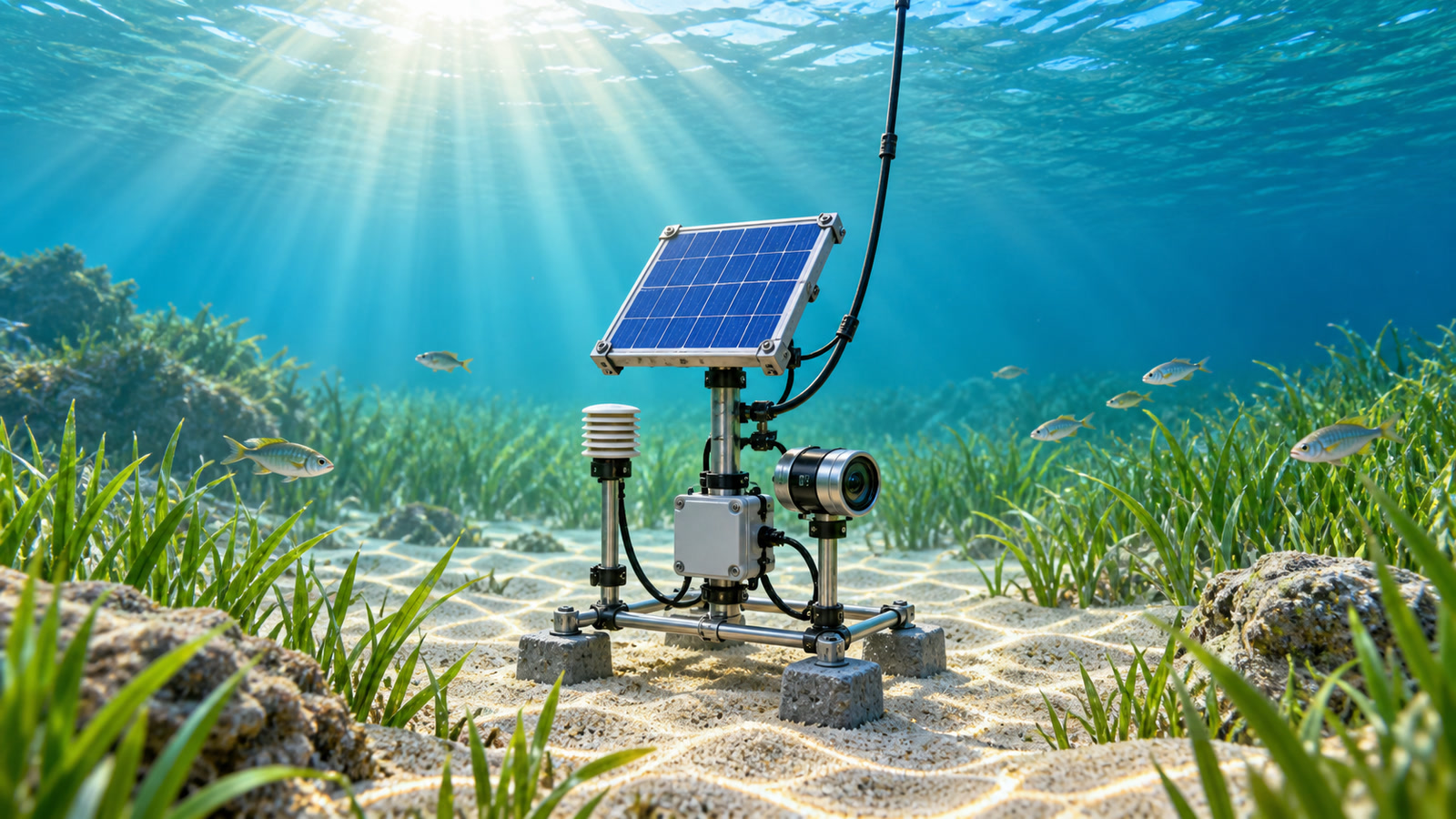
A newly published study reports that experimental perovskite solar modules generated power during a field test 10 meters beneath the sea. [3] The work points toward a future in which some submerged sensors, cameras, and communications gear could gather energy where they operate instead of depending entirely on shore cables or frequent battery trips. [3] It is research-stage progress, but it is a genuinely sunny result in a place where sunshine has to work overtime.
Good news in 30 seconds
- Crossref records the Joule article “Submerged solar harvesting with wide-band-gap perovskites for autonomous underwater energy systems,” with its scholarly record created September 11, 2026. [1]
- A Cell Press-supplied report says the team integrated its modules with underwater robots and field-tested them at 10 meters near the Weizhou Islands in the South China Sea. [3]
- That report says the modules produced 324 milliwatt-hours during two hours of underwater illumination. [3]
What happened
Researchers developed wide-band-gap perovskite solar cells designed to use the blue-to-orange light that reaches below the water’s surface. [3] The publisher-supplied account says the team moved beyond laboratory simulation by integrating modules with underwater robots and deploying them at a depth of 10 meters for a sea trial. [3] The accessible sources do not state the exact dates of that trial, so September 11 is the publication date—not a claimed test date. [1] [3]
Underwater instruments often need a cable, stored battery power, or a service visit. The study’s authors present submerged sensing, imaging, and communication as potential uses for local solar harvesting. [3] If later testing confirms durability and scaling, gathering even modest energy underwater could help some equipment stay useful farther from land. That is a possibility, not a measured deployment result.
The report describes both a real-water field test and longer controlled checks rather than relying on a computer model alone. [3] It says cells retained about 96% of initial efficiency after 300 days in nitrogen storage and showed almost no degradation through 1,160 hours of simulated 10-meter illumination. [3] Those are encouraging research measurements, while nitrogen storage and simulation are not the same as years in a living ocean.
Why this made us smile
These solar cells did not let ten meters of seawater throw shade on the experiment. More importantly, the team tested a practical idea in the environment it is meant to serve—a refreshing step beyond making a device look brave under laboratory lighting.
What it could mean for everyday people
For Treasure Coast readers, the most relatable possibility is better ocean monitoring. Locally powered sensors could eventually support work such as observing water conditions, aquaculture equipment, cameras, or communications, provided future studies establish reliability, environmental compatibility, maintenance needs, and cost. [3] Nothing in the reviewed sources says a consumer product is ready to install today.
Keep the confetti factual
The detailed performance figures come from a Cell Press-supplied report; no meaningful independent coverage was found before this article’s cutoff. [3] The canonical Joule page returned HTTP 403 to our unattended check, although Crossref currently confirms the paper’s identity and DOI. [1] [2] The reported 324 milliwatt-hours is a small research output, not evidence that the modules can power every underwater system. The accessible sources do not establish independent replication, standardized testing, deeper-water performance, long-duration real-ocean durability, scale-up cost, repairability, encapsulation lifetime, or full ecological and lifecycle effects. The report’s 5.5-year operating-life figure is a projection, not a completed 5.5-year sea trial, so we have not presented it as observed endurance. [3]
One happy thing to carry with you
A small solar module making useful electricity ten meters underwater is a lovely reminder that engineering progress can arrive quietly—sometimes with fish swimming past the test bench. [3] The next job is rigorous replication and longer real-ocean evidence; today, the field demonstration itself is worth a measured smile.
Sources and reporting notes
- Crossref — scholarly metadata for “Submerged solar harvesting with wide-band-gap perovskites for autonomous underwater energy systems” (record created September 11, 2026)
- Tech Xplore / Cell Press — “Underwater solar cells can operate 10 meters below the ocean’s surface” (publisher-supplied report, September 11, 2026; not independent corroboration)
- Joule / Cell Press — canonical article page for DOI 10.1016/j.joule.2026.102672 (HTTP 403 to our unattended verification; linked for readers)