

☀ Morning Good News for Today
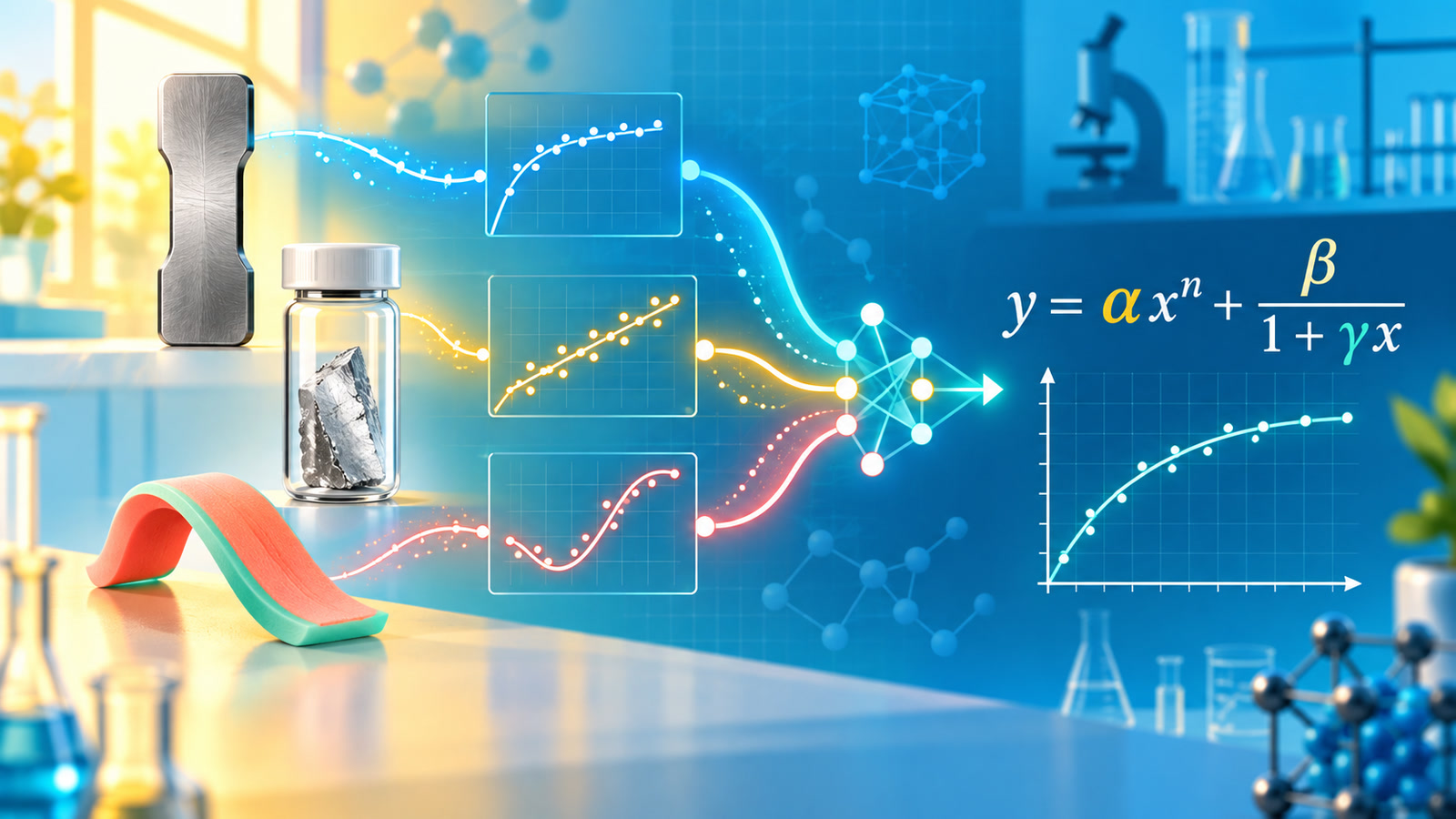
A peer-reviewed study published September 11 introduces GraphED, a framework that learns compact, readable engineering equations directly from experimental material data. [1] [3] The researchers report demonstrations with alloy steels, lithium metal, and filled rubbers, while keeping the discovered models explicit enough for engineers to inspect. [1] [3] In other words, the computer is doing algebra without hiding the answer key.
Good news in 30 seconds
- GraphED represents candidate equations as directed graphs, with nodes for operators and variables and edges for computational relationships. [1] [3]
- The paper reports learned constitutive models for strain-rate effects in alloy steels, deformation of lithium metal, and hyperelastic behavior of filled rubbers. [1] [3]
- Across those reported comparisons, the discovered models were more accurate than the empirical models used as baselines and retained compact analytical structures. [1] [3]
What happened
Science Advances published “Beyond empirical models: Discovering constitutive laws in solids with graph-based equation discovery” on September 11, 2026. [1] [3] The authors describe a system that searches free-form symbolic expressions and learns material-specific parameters from multiple experimental cases instead of requiring engineers to choose one fixed equation form in advance. [1] [3] An Eastern Institute of Technology release provides additional project context, but it is institution-supplied material rather than independent reporting. [2]
Constitutive laws are equations that describe how materials respond to forces and deformation; they are basic ingredients in solid-mechanics and materials models. [1] [3] A method that converts measurements into inspectable equations may help researchers model complicated behavior without surrendering the result to a black box. [1] [3] “May” is doing useful work there: the paper demonstrates a research method, not an approved design tool.
The authors report one framework spanning three quite different material problems while preserving explicit formulas and material-specific parameters. [1] [3] That combination—data-driven discovery plus a result humans can read—is a promising direction for research that must eventually be checked, explained, and challenged.
Why this made us smile
Materials engineers spend their careers asking steel, lithium, and rubber how they behave under pressure. GraphED appears to have brought a very organized notebook. The cheerful part is not that AI replaces engineering judgment; it is that the output is meant to stay visible to it.
What it could mean for everyday people
For everyday readers, the path to impact is indirect but understandable. Better material equations could eventually improve simulations used while designing structures, batteries, and flexible products—but only if later studies reproduce the results and real engineering workflows find the method reliable. [1] [3] Today’s practical win is smaller: researchers have published a concrete way to make some machine-discovered models easier to inspect.
Keep the confetti factual
This is a computational modeling study, not a shipped industrial tool, product certification, or proof of safer batteries or structures. [1] [3] The higher-accuracy result applies to the datasets and empirical baselines reported in the paper; it should not be generalized to every material or operating condition. [1] [3] Independent replication, performance outside the tested cases, compute cost, integration effort, and adoption timing remain unknown in the reviewed sources. No meaningful independent report was found before cutoff, so the factual claims here stay tightly bound to the peer-reviewed paper, Crossref record, and clearly labeled institutional release.
One happy thing to carry with you
Today’s bright spot is an AI research result that tries to show its work: experimental data goes in, and a compact equation an engineer can examine comes out. [1] [3] That is not the finish line—but it is a refreshingly readable step forward.
Sources and reporting notes
- Science Advances — “Beyond empirical models: Discovering constitutive laws in solids with graph-based equation discovery” (September 11, 2026)
- EurekAlert / Eastern Institute of Technology — “AI discovers interpretable constitutive laws in solids directly from data” (institution-supplied release, September 11, 2026; not independent corroboration)
- Crossref — metadata and abstract for DOI 10.1126/sciadv.aec0989 (live record checked September 12, 2026)