

Twenty-five years after September 11, 2001, remembrance begins with the people. The attacks killed 2,977 people at the World Trade Center, the Pentagon, and near Shanksville, Pennsylvania.[1] They were parents, children, spouses, siblings, friends, coworkers, public servants, travelers, firefighters, police officers, emergency medical personnel, and service members. Today we say their names, stand with those who love them, honor those who carried others toward safety, and remember the rescue, recovery, and relief workers whose sacrifice continued long after that morning.
This article contains no graphic images. It centers the victims and the documented courage of responders, workers, passengers, crews, and ordinary people who helped one another. The attackers do not deserve the center of this story; the people we remember do.
The Morning That Changed America
All times below are Eastern time. The sequence matters: the South Tower was struck second but collapsed first.[5][17][18]
The Lives Behind the Number
The National September 11 Memorial & Museum records 2,753 victims associated with New York, 184 at the Pentagon and aboard Flight 77, and 40 passengers and crew aboard Flight 93—a total of 2,977, excluding the 19 hijackers.[19] The number is essential to the historical record, but no total can contain a person’s story. The Memorial’s bronze parapets preserve individual names; the yearly commemoration returns those names to the air through the voices of family members.[1][2]
Courage in the Stairwells, Halls, Streets, and Sky
Within 17 minutes of the first impact, New York City and Port Authority responders had mounted what the 9/11 Commission called the largest rescue operation in the city’s history. Well over 1,000 first responders were deployed, many climbing upward with heavy protective equipment while thousands of civilians moved down.[18] NIST later estimated that about 17,400 people were in the Twin Towers and that approximately 87% evacuated successfully, including about 99% of those below the impact floors.[20] Those figures are estimates, and survival came through organized evacuation, training, individual judgment, responder courage, and people helping one another.
The Memorial’s institutional history records 441 first responders killed that day from more than 30 agencies.[19] Among them were 343 members of the FDNY, 37 Port Authority police officers, and 23 NYPD officers.[9][22][23] They were joined in service by emergency medical personnel, court officers, military and civilian Pentagon workers, dispatchers, hospital teams, engineers, chaplains, volunteers, and countless people whose acts were never fully recorded.
Welles Crowther: the Man in the Red Bandana
Welles Crowther was a 24-year-old equities trader and volunteer firefighter. Survivors described a calm man with a red bandana who appeared at the damaged 78th-floor sky lobby, led people to a working stairway, and returned repeatedly to help more. The 9/11 Memorial says he made three trips back before the South Tower fell.[4] His story is not heroic because of a disputed headcount; it is heroic because, with a way out available, he chose to go back.
Rick Rescorla: preparation that became a lifeline
Rick Rescorla, Morgan Stanley’s vice president for security, had created and rehearsed an evacuation plan after the 1993 World Trade Center bombing. On September 11, he supervised the company’s evacuation, using his voice and a bullhorn to steady people. The Memorial says he was last seen climbing back upstairs for a final sweep and credits his actions with thousands of lives.[3]
The Pentagon: colleagues carrying colleagues
At the Pentagon, survivors turned back to help others while civilian and military personnel, firefighters, police, medical teams, and regional agencies converged on the damaged building.[25] The Pentagon Memorial honors 184 people—59 passengers and crew aboard Flight 77 and 125 people in the building—with one illuminated bench for each life.[6]
Flight 93: a collective decision to act
Seven crew members and 33 passengers were aboard Flight 93. Phone calls brought news of the other attacks; passengers and surviving crew members voted, formed a plan, and fought back. The National Park Service concludes that their actions prevented the aircraft from reaching the terrorists’ intended target.[14] Their courage belongs collectively to all 40.
The Rescue and Recovery Did Not End That Morning
The World Trade Center rescue and recovery effort continued for nine months.[26] Across the three attack sites, workers spent days, weeks, and months extinguishing fires, clearing debris, and searching for survivors.[26] The Memorial Glade now honors rescue, recovery, and relief workers, survivors, and members of the lower Manhattan community who became ill or died after exposure to toxins at the site.[2] Remembering 9/11 therefore includes both those killed that day and those whose health and lives were altered by the work that followed—without collapsing those distinct histories into one statistic.
Stephen Siller and a Continuing Call to “Do Good”
FDNY firefighter Stephen Siller had finished his shift when he learned that an aircraft had struck the North Tower. According to the Tunnel to Towers Foundation, he returned for his gear; when the Brooklyn Battery Tunnel was closed, he strapped roughly 60 pounds of equipment to his back and continued through the tunnel on foot toward the World Trade Center. He died while trying to save others.[11] His family built the Tunnel to Towers Foundation around his example and the belief that, while there is time, people should do good.[11][27]
Support Tunnel to Towers Foundation
The link and original badge above lead to the Foundation’s official donation page. The IT Guys does not collect donation or payment information, receives no portion of donations, and is not presenting this link as a partnership, sponsorship, or endorsement.
Go to the official donation page →
Original editorial badge by The IT Guys; not the Foundation’s official logo. Verify the address begins with https://t2t.org/ before entering personal or payment information.
Watch: Official White House September 11 Observance
The official White House live page identifies today’s Arlington, Virginia program as “President Trump and the First Lady Participate in the 9/11 Observance Ceremony.”[8] The video below is uploaded by the White House and was live when verified for this article.[16] This is included as a public record of the observance, not as a political endorsement.
Open the official White House live page · Open the video directly on the White House YouTube channel
What the Memorial and One World Trade Center Ask Us to Remember
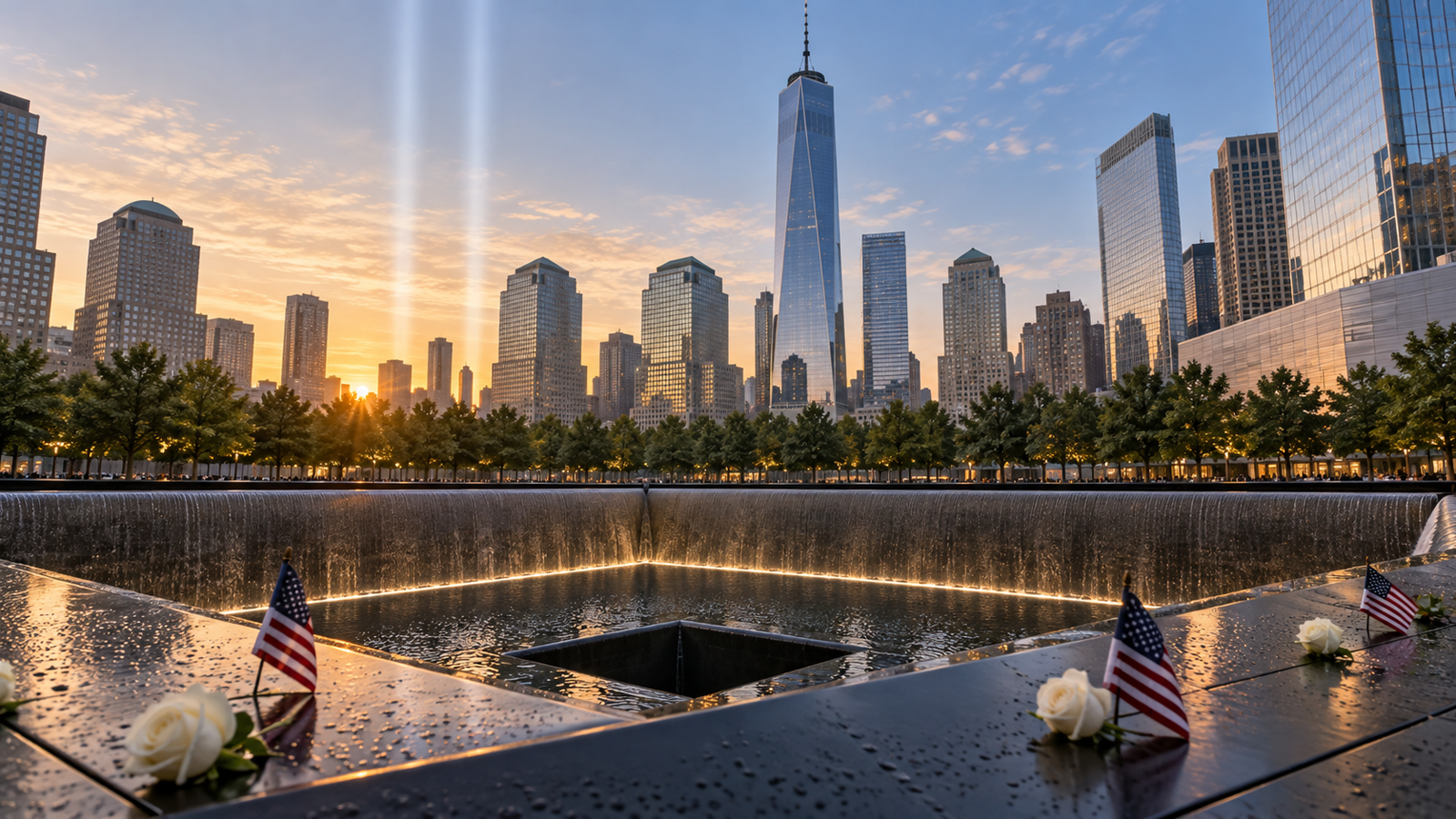
The Memorial’s twin reflecting pools occupy the footprints of the former towers. Water descends into central voids while the names remain visible at the edges—a design called Reflecting Absence. The Survivor Tree, nursed back to health after being found badly damaged, stands nearby as a symbol of resilience and perseverance.[21]
One World Trade Center now rises beside the Memorial. The Port Authority and Durst Organization built the 3.1-million-square-foot tower, and its completed spire brought the structure to a symbolic height of 1,776 feet.[12][24] It does not replace what was lost. It stands within a rebuilt neighborhood as a visible expression that remembrance and renewal can share the same ground.
A Promise Renewed
On this 25th anniversary, honoring September 11 can be quiet: pause for the lives lost; learn one person’s name and story; listen to survivors without asking them to relive more than they choose; thank the responders and caregivers still among us; support a responsible service organization; teach younger generations with verified history; and reject hatred directed at innocent people.
We remember the people who went to work, boarded flights, answered alarms, opened stairwell doors, gave directions, carried coworkers, treated the injured, searched the rubble, and returned again when leaving would have been easier. We remember those who came home changed and those who never came home. We hold their families in respect.
May every life be remembered. May every act of courage be honored. May we never forget.
Sources and Further Reading
- National September 11 Memorial & Museum: Commemoration
- National September 11 Memorial & Museum: The Memorial
- 9/11 Memorial: Recognizing Rick Rescorla
- 9/11 Memorial: Remembering the “Man in the Red Bandana”
- National Park Service: September 11, 2001 Timeline
- U.S. Department of Defense: National 9/11 Pentagon Memorial
- The White House: Live
- The White House: President Trump Honors 9/11 Heroes
- Tunnel to Towers Foundation: Donate
- Tunnel to Towers Foundation: Stephen’s Story
- World Trade Center: One World Trade Center
- National September 11 Memorial & Museum: Watch Live
- National Park Service: The Story of Flight 93
- The White House on YouTube: 9/11 Observance Ceremony
- 9/11 Commission Report, Chapter 1: “We Have Some Planes”
- 9/11 Commission Report, Chapter 9: “Heroism and Horror”
- 9/11 Memorial & Museum Institutional Backgrounder
- NIST World Trade Center Investigation
- 9/11 Memorial: About the Memorial
- NYPD: 9/11 Tribute
- Port Authority Police: Fallen Members
- Port Authority: One World Trade Center Reaches 1,776 Feet
- Defense Department Historical Office: Pentagon 9/11
- 9/11 Memorial: May 30, 2002 commemoration and recovery effort
- Tunnel to Towers Foundation: Siller family and Foundation history
Reporting cutoff: 9:18 AM EDT (13:18 UTC), September 11, 2026. The White House broadcast’s live/replay availability is time-sensitive; use the linked official page for its current state.