

☀ Morning Good News for Today
Researchers have demonstrated a smarter way to put heat where a hydrogen reactor needs it—and the same process produced highly graphitized solid carbon. The September 3 work is encouraging because it tackles a stubborn scale-up problem with measured results, while leaving the commercial victory lap for another day.[1]
Good news in 30 seconds
- A peer-reviewed Science paper reports an internally heated methane-pyrolysis reactor that uses part of its hydrogen output as fuel, improving heat delivery inside the reactor.[1]
- The authors report several-orders-of-magnitude higher modeled throughput at commercially relevant bed diameters, along with a carbon coproduct measured at 96.0% graphitization.[2]
- This is a promising research result—not a commercial plant, not universally zero-carbon hydrogen, and not proof that the graphite is ready for demanding battery applications.[3]
What happened
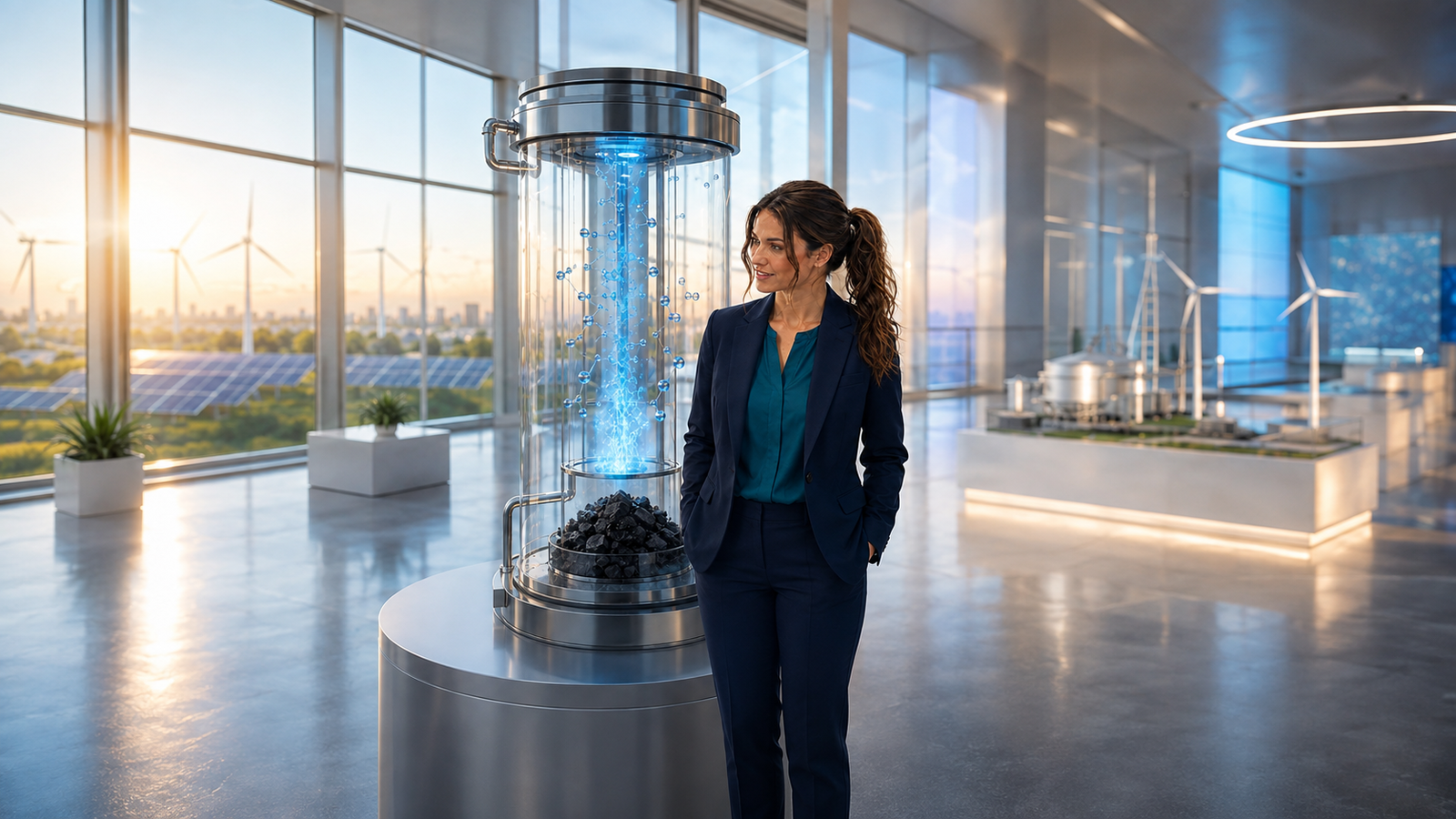
Methane pyrolysis separates methane into hydrogen gas and solid carbon instead of producing carbon dioxide as the reaction’s primary carbon-containing output. The reaction needs very high temperatures, however, and supplying that heat from outside a large reactor becomes less efficient as equipment grows. In the new work, the Stanford-led team heated a fluidized bed of low-cost iron-oxide catalyst from within by combusting hydrogen with oxygen. The journal’s summary says the reactor operated at about 950°C.[1]
That internal heating arrangement is the central advance. The publisher-deposited abstract says hydrogen-fueled autothermal operation enabled an increase of several orders of magnitude in modeled reactor throughput for commercially relevant bed diameters.[2] Stanford’s public explanation translates the comparison into a more intuitive claim: using the same amount of energy, the new heating method produced roughly the material output of ten conventionally heated reactors.[3] Interesting Engineering independently reported the same broad approach and tenfold-efficiency framing after reviewing the Stanford work.[4]
The solid-carbon result added a second encouraging piece. The paper abstract reports a coproduct with 96.0% graphitization that met graphite-precursor specifications.[2] That wording matters: a graphite precursor can be useful without already satisfying the purity and consistency requirements of a finished battery material. Stanford’s account explicitly says more work is needed before the material is pure enough for demanding battery applications.[3]
Why this made us smile
Industrial reactors are not normally famous for multitasking, but this one is trying: make hydrogen, recycle some hydrogen into useful heat, and turn the carbon into a solid material instead of sending it straight up a stack. It is less “free lunch” and more “the reactor finally brought a sensible packed lunch.”
What it could mean for everyday people
No one is installing a methane-pyrolysis tube next to the toaster—and that is excellent news for breakfast. The everyday value is upstream. Cleaner hydrogen could reduce the climate footprint of fertilizer and chemicals that quietly support food, manufacturing, shipping, and countless household products. A usable graphite coproduct could also improve project economics and diversify material supply, although the study does not establish a commercial graphite market or a battery-qualified product.[3]
The research also demonstrates a broader engineering lesson: sometimes the path to scaling is not simply building a larger version of the laboratory apparatus. It is redesigning where energy enters the system. By generating heat inside the reaction bed, the team addressed the distance that externally supplied heat must travel. That principle—putting energy closer to where it does useful work—can matter as much as finding a new catalyst.
The numbers worth keeping
The paper’s process-level life-cycle assessment estimates carbon intensity as low as 1.9 to 4.5 kilograms of carbon-dioxide equivalent per kilogram of hydrogen.[2] The journal summary describes an optimized process at roughly one-third the carbon intensity of steam methane reforming.[1] Those are modeled process estimates, not measurements from a mature commercial fleet, and outcomes would depend on methane leakage, electricity and oxygen production, plant design, operating conditions, and treatment or sale of the carbon.
The “several orders of magnitude” throughput statement is also a model-based scale comparison at commercially relevant bed diameters—not proof that a full-size factory has already delivered that throughput.[2] Keeping that distinction visible does not make the result less interesting; it identifies exactly what engineers must validate next.
Keep the confetti factual
The feedstock is still methane. Upstream leakage can erase part of the climate advantage, and the process is not automatically zero-carbon simply because its main reaction makes solid carbon instead of carbon dioxide. The team reports a strategy that can suppress direct emissions to near zero, but the same paper and journal summary account for residual carbon dioxide and evaluate a range of life-cycle outcomes.[1][2]
Industrial durability, maintenance, carbon removal, product consistency, economics, and full-scale throughput remain unproven in the retrieved evidence. The graphite is promising, but Stanford says it is not yet pure enough for demanding battery uses.[3] Interesting Engineering likewise presents further research as necessary rather than treating the demonstration as a finished commercial system.[4]
Readers should also know the researchers and institutions may benefit from successful commercialization. The Science record says Stanford University filed a provisional patent covering findings reported in the work. It also says one author, identified as E.M., holds an autothermal-pyrolysis patent (WO/2025/175109) and has a financial interest in CZero Inc., one of the funding organizations.[1] Those disclosures do not invalidate the research, but they belong beside optimistic coverage so readers can weigh the evidence with open eyes.
One happy thing to carry with you
Real progress does not have to arrive as a miracle. Sometimes it looks like moving the burner to the right place, measuring what comes out, publishing the limitations, and giving the next team a better problem to solve.
Sources and reporting notes
- Science — “Autothermal methane pyrolysis: Scalable heat integration for hydrogen and graphite production” — peer-reviewed paper, journal summary, funding, and competing-interest disclosures; published September 3, 2026.
- Crossref — AAAS-deposited record for DOI 10.1126/science.aed4911 — publisher-deposited abstract and quantitative results.
- Stanford Report — “New process boosts clean hydrogen production” — institutional explanation, scale-up cautions, graphite limits, funding, and competing interests.
- Interesting Engineering — “New heating trick makes hydrogen and graphite from methane 10x more efficiently” — independently written report published September 3, 2026.