

The Night Shift: Overnight Tech News with Jennifer Hudsen • 4:30 a.m. edition • Cutoff August 31, 2026, 4:42 a.m. EDT / 08:42 UTC
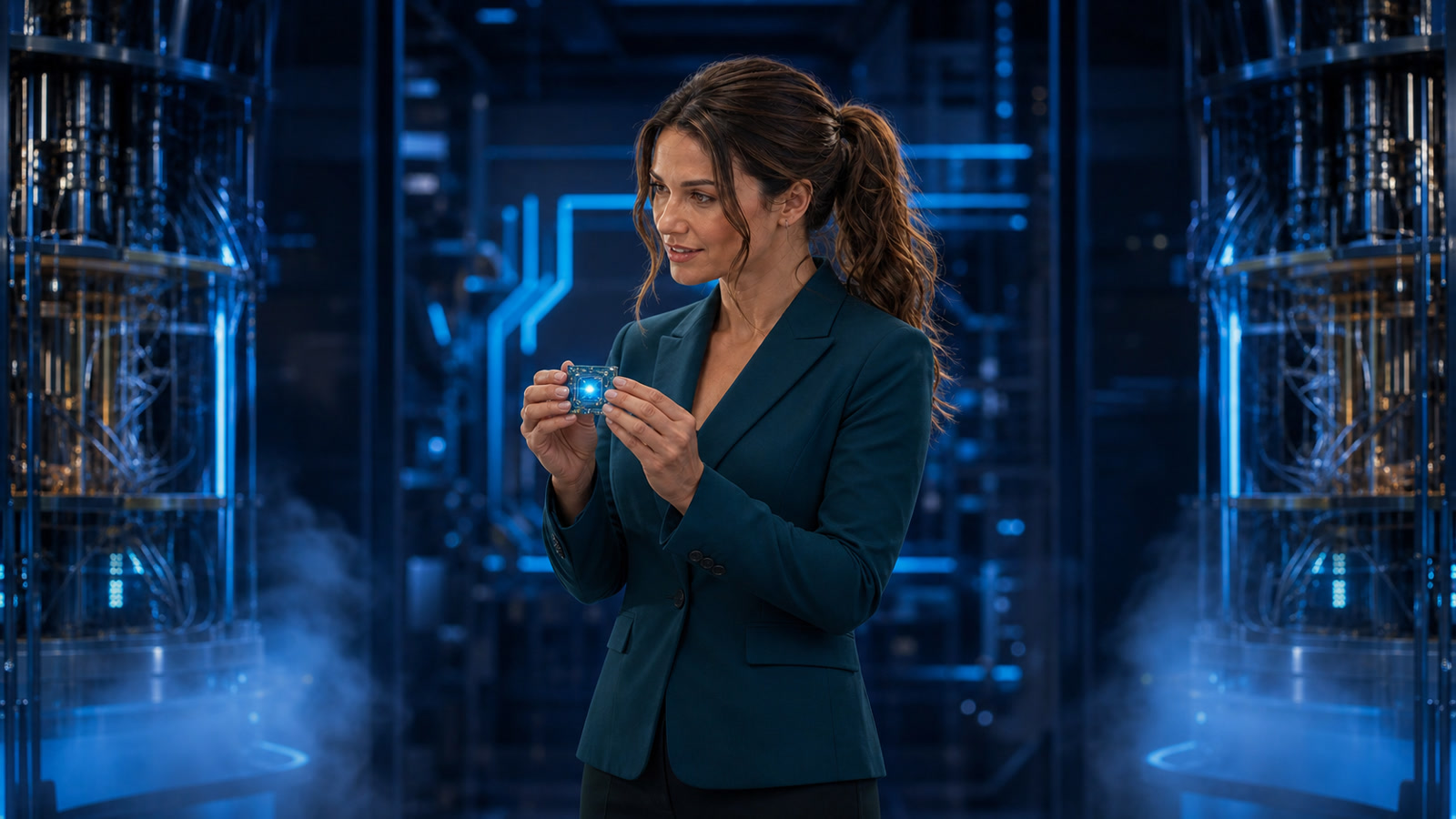
Original Jennifer newsroom concept art accompanies this report. It is not an official S-Transistors product image, working-device photograph, or VTT laboratory record.
Finland’s S-Transistors Raises €2.6 Million for Cryogenic Control Chips—The First Product Has Not Shipped
Status at cutoff: Finnish research organization VTT says its new spinout S-Transistors has raised €2.6 million to develop superconducting-transistor integrated circuits for cryogenic quantum-computer control. The company says a first multiplexer should reach early customers and partners within its first year, but it has not published independent product benchmarks, customer names, a shipment date, or evidence of a production deployment.[1]
What happened
VTT announced S-Transistors at 9:00 a.m. EEST on August 31, which was 06:00 UTC—nine minutes before this desk’s strict window opened. Tech.eu’s page metadata records publication at 07:13 UTC, inside the strict window, and the report described the same funding, product direction and first-year delivery plan.[1][2] This edition therefore treats the development as core-window reporting with a near-window primary announcement, not as an older story dressed up by a new headline.
According to VTT, the pre-seed round was led by Nordic early-stage investor Lifeline Ventures and included an angel investor. S-Transistors plans to spend the money on cryogenic signal-control prototypes, its own cryogenic laboratory, a pilot manufacturing line for its integrated circuits, and team growth.[1] PR Newswire’s release timestamp—3:38 a.m. EDT, or 07:38 UTC—corroborates that the announcement was circulating during the strict window, but it is syndication of the VTT material rather than independent technical validation.[3]
The proposed first product is a superconducting-transistor multiplexer intended to plug into existing cryogenic setups and help route signals during quantum-device development. VTT says the company intends to ship it to early customers and strategic partners within its first year of operation.[1] “Intends” matters: this is a roadmap statement from the organization launching the spinout, not proof of a finished commercial part.
Why the wiring problem matters
Many superconducting quantum processors live deep inside dilution refrigerators, where qubits operate at extremely low temperatures. A large share of their classical control electronics remains at room temperature, connected through many cables. As systems add qubits, those cables, connectors, signal paths and heat loads become harder to manage. VTT and Tech.eu both describe this control-and-routing layer as the problem S-Transistors wants to attack.[1][2]
The company’s thesis is that superconducting transistors could move more control and interface functions into the cryogenic environment, closer to the quantum processor, while dissipating less power than conventional electronics. VTT says its technology is already available at wafer scale and combines high-speed operation with low power dissipation.[1] Those are company and parent-research-organization claims. The reviewed sources do not provide a full benchmark package comparing switching speed, fan-out, noise, yield, heat load and reliability against cryogenic CMOS or other competing control architectures.
If the approach works outside the laboratory, it could reduce cable complexity and make test systems easier to expand. A multiplexer is a practical opening product because it routes multiple signals through fewer paths; researchers can evaluate it without waiting for the much larger “quantum motherboard” vision. That interpretation is analysis, not a measured outcome. The company still has to turn wafer-scale device availability into packaged circuits that integrate cleanly with real cryostats and sensitive qubits.
Who is affected
Quantum-hardware laboratories and equipment vendors are the closest audience. A plug-in cryogenic multiplexer could be useful for prototyping, test automation and signal routing if it meets performance and noise requirements. Early adopters should expect engineering samples and collaboration, not a drop-in consumer component.
Investors and technology buyers should separate three layers. The €2.6 million funding is reported as completed. The laboratory, pilot line and prototypes are planned uses of that capital. The first-year customer deliveries and eventual quantum motherboard are future goals.[1] Mixing those layers would turn a credible early-stage milestone into an unsupported claim of commercial readiness.
Ordinary computer users should not expect this funding round to change laptops, cloud bills or available quantum services soon. VTT mentions possible longer-term applications in classical computing, artificial intelligence hardware, spacecraft electronics and particle detectors, but S-Transistors is initially focused on quantum computing.[1][2] Those broader uses are potential markets, not announced products.[1][2]
What readers should do
For most readers, the practical action is simply to watch the evidence mature. Do not treat a pre-seed round as proof that quantum-computer scaling has been solved. Look for a dated product specification, measured cryogenic power dissipation, switching performance, fabrication yield, packaging details, supported temperature range and results from an identified external laboratory.
Teams evaluating cryogenic control hardware should ask whether the planned multiplexer works with their connector standard, signal bandwidth, impedance, magnetic environment and refrigeration power budget. They should also ask how the device affects qubit coherence and measurement fidelity. None of those integration questions is answered by the launch announcement, so procurement decisions should wait for engineering data and sample testing.
Upside, cautions and unknowns
Upside: The spinout is targeting a real bottleneck rather than proposing another abstract quantum algorithm. VTT says the funding supports prototypes, a dedicated cryogenic lab and a pilot manufacturing line, which are concrete steps toward testing manufacturability.[1] A first-year multiplexer also gives the company a narrower validation target before attempting a complete control platform.
Caution: All detailed performance and readiness language reviewed here originates with VTT, S-Transistors or reporting based on their announcement. Tech.eu independently published the story but cites the same company claims; it does not report hands-on testing.[2] “Wafer scale” does not by itself establish high yield, affordable packaging, reliable volume production or compatibility with commercial quantum processors.
Unknown: The sources do not identify the angel investor, early customers, fabrication partner, pilot-line capacity, pricing, exact delivery month, transistor material stack, independent benchmark results, or customer acceptance criteria.[1][2][3] They also do not establish that this architecture will outperform cryogenic CMOS, superconducting digital logic or other multiplexing approaches across every workload.
Evidence ladder
| Claim surface | Evidence state at 08:42 UTC | What would strengthen it |
|---|---|---|
| €2.6 million pre-seed round | Reported by VTT and Tech.eu as raised; led by Lifeline Ventures with an angel participant.[1][2] | Investor or corporate filing details, if publicly available |
| Technology available at wafer scale | VTT/S-Transistors claim; no reviewed independent yield or performance data.[1] | Foundry data, die yield, process details and third-party measurements |
| First multiplexer delivery | Planned within the company’s first year; not yet shipped.[1] | Named sample recipient, dated shipment and acceptance test |
| Quantum motherboard | Longer-term platform vision, not a released product | Integrated prototype operating beside a QPU with measured system results |
Frequently asked questions
Did S-Transistors launch a finished quantum-computer motherboard?
No. The company describes the quantum motherboard as its larger vision. Its planned first product is a superconducting-transistor multiplexer for existing cryogenic setups, with delivery to early customers and partners intended within the first year.[1]
Is the technology independently proven?
Not by the sources reviewed for this edition. The announcement provides technical rationale and development plans, while Tech.eu repeats the core description. Neither source publishes third-party benchmark results or reports an independent deployment.[1][2]
Why not just put normal silicon chips inside the refrigerator?
VTT says some silicon transistors can operate at deep cryogenic temperatures, but combining the necessary performance with very low power consumption is difficult. Heat introduced near fragile qubits can interfere with operation.[1] The exact trade-off depends on the chip, circuit and quantum system.
Will this make quantum computers useful soon?
The funding may help test one part of the scaling stack; it does not establish a timetable for commercially useful quantum computing. Qubit quality, error correction, fabrication, control electronics, software and system reliability all remain part of the problem.
Sources
- VTT — “S-Transistors raises €2.6 million pre-seed round to introduce a unique superconducting transistor platform for scalable orchestration of quantum computers”, displayed August 31, 2026, 09:00 EEST; checked at cutoff.
- Tech.eu — “S-Transistors raises €2.6M for superconducting quantum computing platform”, page metadata records publication August 31, 2026, 07:13 UTC and modification at 07:14:08 UTC.
- PR Newswire — VTT announcement syndication, published August 31, 2026, 03:38 EDT / 07:38 UTC. This is distribution of the primary announcement, not independent validation.
Reporting cutoff: August 31, 2026, 4:42 a.m. EDT / 08:42 UTC. Strict window: 2:09 a.m.–4:42 a.m. EDT (06:09–08:42 UTC). VTT’s primary announcement appeared nine minutes before that boundary; Tech.eu’s report appeared inside it. This one subject was checked against The IT Guys’ daytime and prior Night Shift coverage.