

☀ Morning Good News for Today
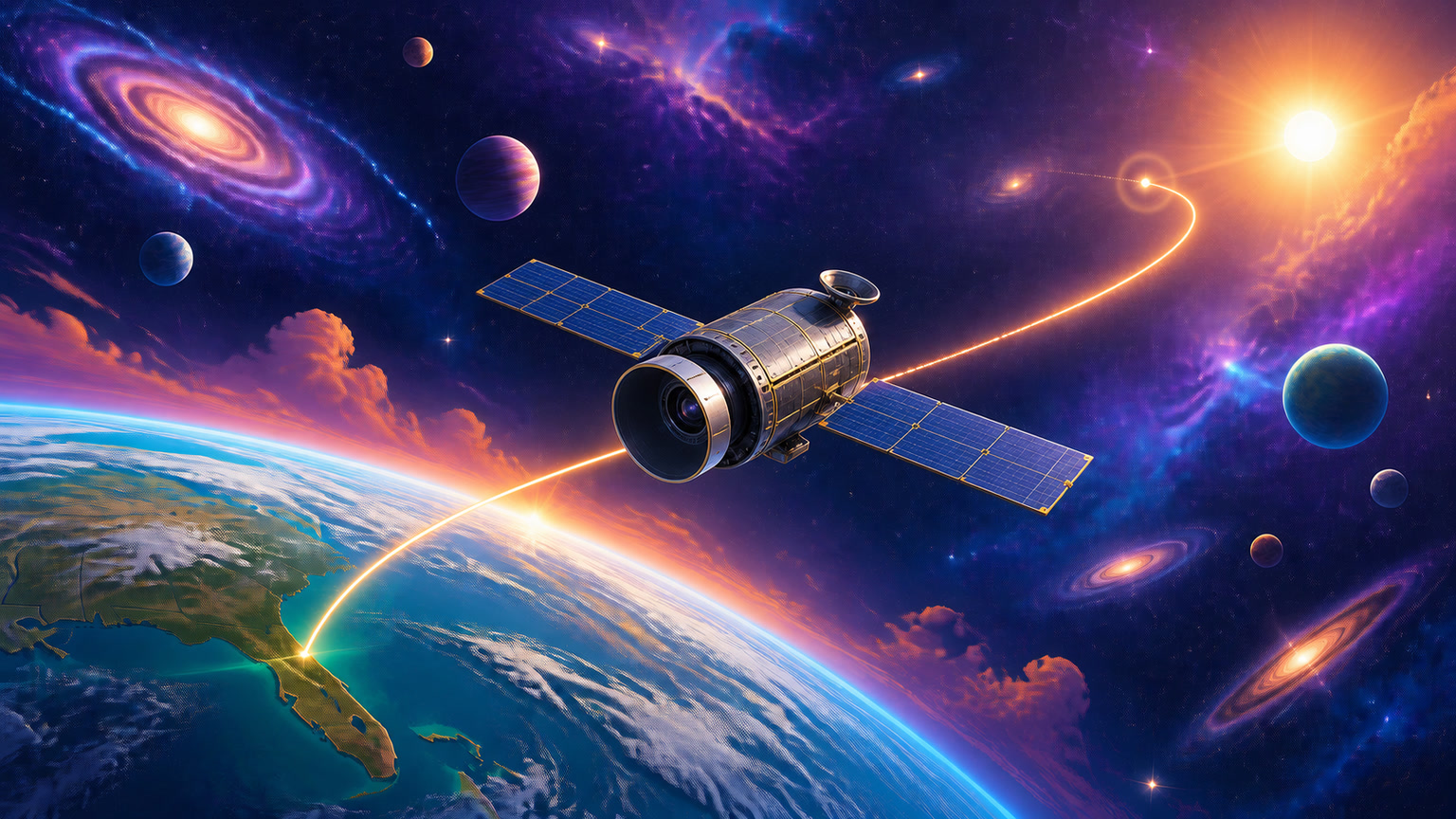
NASA’s Nancy Grace Roman Space Telescope launched successfully, established communications, separated from its rocket, and began deploying key systems on August 30. [1] The independent postlaunch account also reported Roman flying on its own toward the Sun-Earth L2 region with mission leaders describing systems as nominal and the early deployments as successful. [2] A million-mile commute is still a commute, but this one began with remarkably little traffic.
Good news in 30 seconds
- Roman lifted off from Kennedy Space Center at 7:26 a.m. EDT aboard a Falcon Heavy and separated from the launch vehicle about 31 minutes later. [1] [2]
- NASA began receiving telemetry seven minutes after launch and confirmed deployment of Roman’s solar panels and lower instrument sun shade an hour and 23 minutes after launch. [1]
- The observatory still faces roughly three months of travel, additional deployments, course corrections, activation, calibration, and testing before science operations. [1] [2]
What happened
Roman left Florida on August 30 and is now heading toward an orbit around the second Sun-Earth Lagrange point, commonly called L2. NASA says the rocket performed as expected, the spacecraft established telemetry, and its first major postlaunch deployments succeeded. [1] The independent Starlust report matched the launch time, separation sequence, L2 journey, and early deployment status while attributing its health assessment to NASA and mission leaders. [2]
NASA describes Roman’s primary Wide Field Instrument as a 300-megapixel infrared camera and says the observatory is designed to survey the universe about 1,000 times faster than Hubble while returning roughly 1.4 terabytes of data per day. [1] Those are mission capabilities and design expectations—not science results already collected.
The launch, separation, communications link, and initial deployments are completed engineering milestones. [1] [2] They move a major public science observatory from the launchpad into the careful commissioning phase where teams can prepare it to study dark energy, exoplanets, and wide regions of the infrared sky.
Why this made us smile
Roman is built to take a very wide view of the universe, which feels like a healthy response to a week when most of us are still hunting for the TV remote. The smile comes from the teamwork: years of engineering turned into a clean launch and a spacecraft talking back from space.
What it could mean for everyday people
There is nothing consumers need to buy or install. The practical value is shared knowledge: if commissioning succeeds, Roman is intended to produce large public datasets that researchers can use to study how the universe changes, discover distant worlds, and investigate questions that smaller fields of view cannot address as quickly. [1]
Keep the confetti factual
Roman has launched and completed several early deployments; it has not yet completed its journey or commissioning. Additional deployments, course corrections, instrument activation, calibration, and testing remained ahead at this reporting cutoff. [1] [2] NASA’s survey-speed and data-volume figures describe the observatory’s intended performance, not completed discoveries. The opened sources also gave different general timing for first images, so we are not asserting a precise release date. The mission’s eventual science performance and unexpected discoveries remain unknown.
One happy thing to carry with you
A new observatory is awake, communicating, and headed for deep space. That is enough good news for one morning—and a promising first chapter for the wide-screen universe Roman is built to explore.