

The Night Shift: Overnight Tech News with Jennifer Hudsen • 4:30 a.m. edition • Cutoff August 30, 2026 at 4:36 a.m. EDT / 08:36 UTC
Pony.ai and FutureLink Plan 200 Level 4 Robotaxis for Korea—Certification Comes First
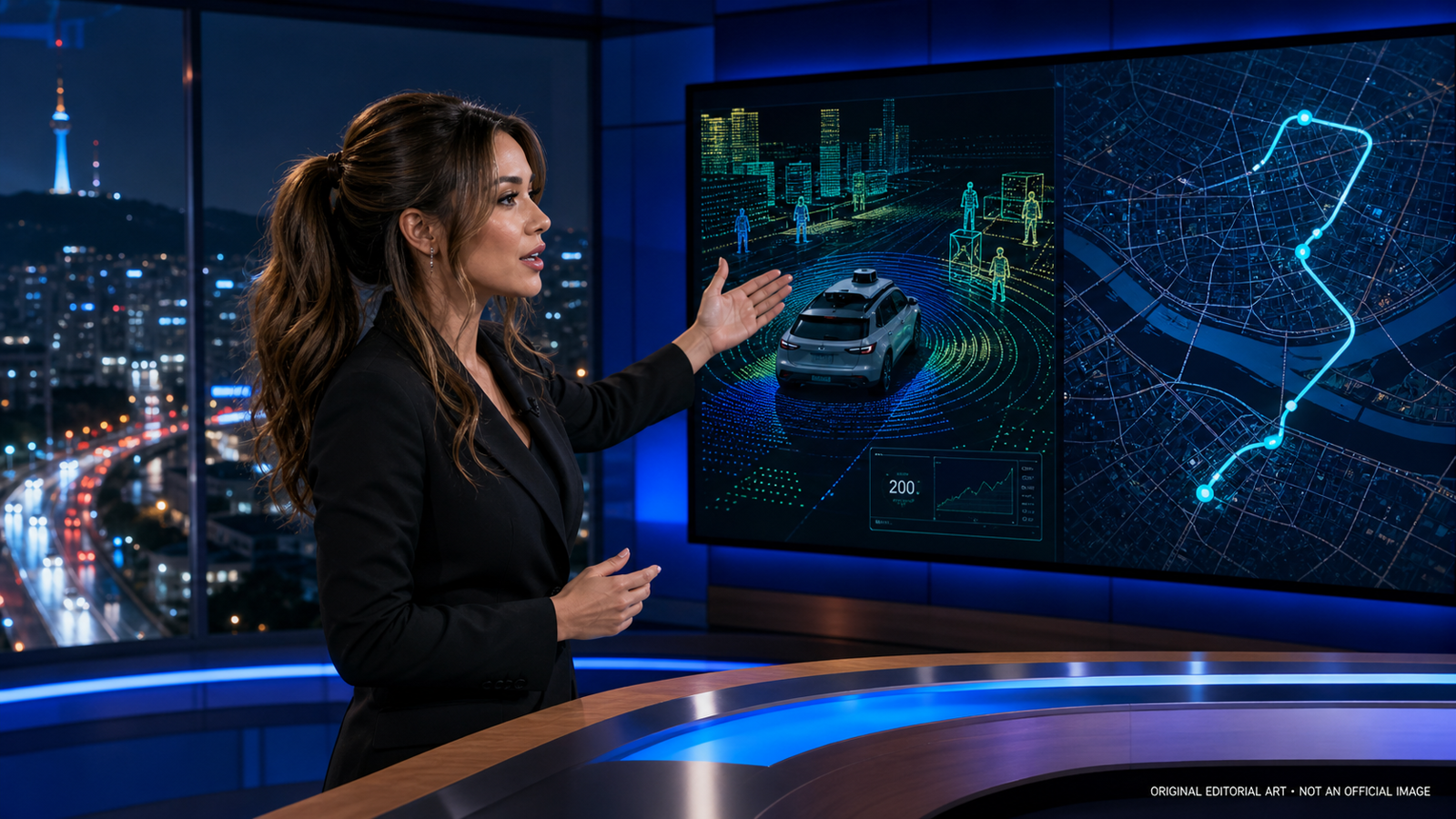
South Korean mobility firm FutureLink says it signed a strategic cooperation agreement with Pony.ai to bring 200 Level 4 robotaxis to Korea by around 2028. [1] The plan starts with 10 vehicles for Korean certification, followed by 190 more only after that process is completed, according to The Korea Times. [2] This is an announced deployment plan—not proof that 200 driverless taxis are licensed, operating, or carrying passengers today.
What happened
Aju Press published its report at 3:49 p.m. Korea Standard Time on August 30, or 06:49 UTC, inside this desk’s strict window beginning at the prior 2:15 a.m. EDT cutoff. [1] It reports that FutureLink announced the agreement Sunday after the companies signed it Friday in Seoul. The Korea Times published a separate report at 4:38 p.m. KST and updated it at 4:48 p.m. KST. [2]
The reports describe a staged plan. FutureLink would handle Korean certification, market entry, vehicle and service operations, data management, and localization. Pony.ai would provide its seventh-generation autonomous-driving vehicles and technology. The first 10 vehicles would be used for certification; another 190 would follow after certification. [2]
The planned starting point is Seoul’s autonomous-driving pilot zone in Gangnam, with broader expansion across Seoul, the metropolitan region, and other major cities envisioned later. Aju Press says the parties also intend to establish a joint venture. [1] Neither report establishes a final certification date or a firm commercial launch date.
Why it matters
The announcement is a concrete attempt to move imported Level 4 robotaxi technology from trials into a Korean commercial-service pathway. That is more consequential than a demonstration because certification, local operations, data handling, and service responsibility are assigned to a named Korean partner. But the pathway remains conditional: regulators must certify the vehicles, and the partners must turn an agreement into a functioning service.
“Level 4” does not mean a car can drive itself everywhere under every condition. SAE’s automation framework describes Level 4 as high driving automation within a defined operational design domain. [3] In practical terms, geography, weather, roads, speeds, mapping, and operating rules can define where the automated system is intended to handle the driving task. Readers should not translate “Level 4” into unrestricted nationwide autonomy.
The vehicle plan is also notable because the reports say the initial fleet will use a BAIC Group model with Pony.ai’s seventh-generation system integrated during production rather than retrofitted later. [2] Pony.ai has previously said that generation uses redundant braking, steering, and power systems and lower-cost hardware. Those are company claims about design and cost; this desk did not independently test the vehicles.
Who is affected
Seoul residents and visitors may eventually encounter the first service in Gangnam’s pilot zone. Nothing in the reports says ordinary passengers can hail these vehicles now. Availability, fares, operating hours, accessibility features, pickup rules, and safety-driver requirements remain unannounced.
Korean regulators and city planners will face the near-term work. Certification has to address the vehicle, automated-driving system, local road environment, incident procedures, cybersecurity, data governance, and operations. FutureLink’s assigned localization and data-management role makes those questions central rather than incidental.
Taxi drivers and mobility companies may see a new competitive model if commercial service launches. The labor and market effect cannot be measured from a 200-vehicle plan alone. Deployment may remain geographically limited, require remote support, or change during certification.
Fleet and technology buyers should watch the difference between a signed partnership, certified vehicles, pilot operations, and a fare-charging commercial service. Those are separate milestones. Treating them as interchangeable can turn a conditional plan into a misleading claim of completed deployment.
What readers should do
- Do not assume the service is live. Check FutureLink, Pony.ai, Seoul authorities, and Korean transport regulators for a certified launch notice before planning a trip around it.
- Read the operating boundary. When service details arrive, look for the exact zone, hours, weather limits, passenger rules, accessibility support, and whether a safety operator or remote-assistance team is involved.
- Treat safety and cost figures as company claims. Ask for regulator decisions, public operating data, incident reporting, and independently comparable metrics.
- Protect personal information. A robotaxi app can collect account, payment, trip, location, camera, and support data. Review the Korean service’s actual privacy notice rather than importing assumptions from another country’s deployment.
- Watch the certification milestone. The planned additional 190 vehicles depend on the first phase clearing certification; that is the most important near-term gate.
Upside, cautions and unknowns
Upside: A staged introduction can let regulators and operators test localization before scaling. If the service works as planned, it could add mobility capacity, generate Korean operating data, and create a clearer route for evaluating Level 4 systems in dense urban traffic.
Caution: The 200-vehicle figure is a plan attributed to the companies. [1] Certification, deployment timing, passenger availability, commercial terms, safety performance, and expansion are not guaranteed. The reported 80,000 kilometers of prior Gangnam testing without an accident is a FutureLink claim, not an independently audited safety rate. [2]
Unknown: The reports do not provide the regulator’s decision schedule, exact launch date, final service area, fare model, remote-assistance design, safety-driver policy, insurance structure, public incident-reporting process, or retention rules for vehicle and passenger data.
| Milestone | Reported state | Not established |
|---|---|---|
| Agreement | FutureLink says the parties signed Friday in Seoul. [1] | Joint-venture formation or final commercial contracts. |
| First vehicles | 10 planned for domestic certification. [2] | Certification completion date. |
| Full fleet | 190 more planned after certification, for 200 total. [2] | Purchase, delivery, registration, or active-service proof. |
| Commercial service | Targeted around 2028, starting in Gangnam. [1] | Exact date, fares, hours, passenger rules, or final operating domain. |
The sequence matters for accountability. An agreement can establish intent; certification can establish regulatory permission for a defined configuration; a pilot can establish limited operation; and commercial launch can establish passenger availability. None alone proves long-term safety, citywide coverage, financial viability, or public acceptance. This desk will treat each later milestone as a separate evidence event rather than backdating success to the partnership announcement.
Frequently asked questions
Are 200 robotaxis already driving in Seoul?
No. The reports describe a plan beginning with 10 certification vehicles and adding 190 after certification. [2]
Does Level 4 mean the car works anywhere?
No. Level 4 automation is bounded by an operational design domain. [3] The Korean plan begins in a defined Gangnam pilot zone.
Who operates the Korean service?
The reports assign certification, localization, market entry, operations, and data management to FutureLink, while Pony.ai supplies vehicles and autonomous-driving technology. [1]
Is 2028 guaranteed?
No. The reports use target language, and The Korea Times says certification and commercial-launch timing have not been finalized. [2]
What is the next proof point?
A public certification decision and authenticated operating notice for the first 10 vehicles. That would be stronger evidence than the partnership announcement alone.
Sources
- Aju Press: “Chinese robotaxis to hit Seoul roads by 2028 under Pony.ai deal”, posted August 30, 2026 at 3:49 p.m. KST (06:49 UTC).
- The Korea Times: “Pony.ai to bring 200 Level 4 robotaxis to Korea by 2028”, published August 30, 2026 at 4:38 p.m. KST and updated at 4:48 p.m. KST.
- SAE International: J3016 driving-automation framework update, background defining Level 4 terminology.
Reporting cutoff: August 30, 2026 at 4:36 a.m. EDT (08:36 UTC). Aju Press’s 06:49 UTC report falls inside the strict window beginning at the preceding desk’s actual 06:15:51 UTC cutoff. This one-subject report was checked against The IT Guys’ prior 36-hour coverage, earlier Night Shift output, the shared subject ledger and Jennifer’s knowledge base.