

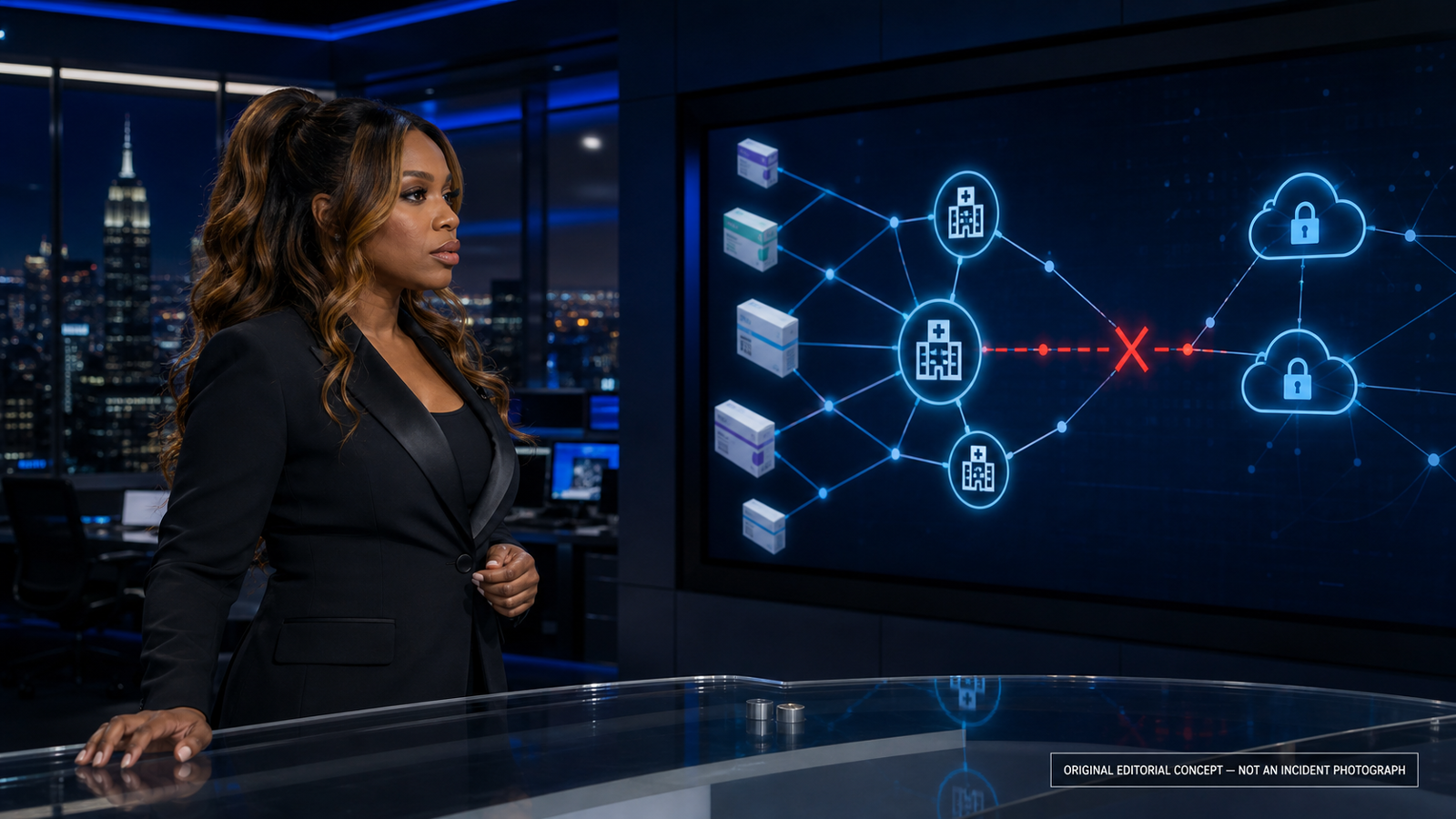
The Night Shift: Overnight Tech News with Jennifer Hudsen • 9:00 p.m. EDT edition • Cutoff 9:05 p.m. EDT August 28 / 01:05 UTC August 29
McKesson Confirms Data Exfiltration—The Claimed 284 Million Patient-Record Figure Is Not Verified
Status at cutoff: McKesson says it is investigating unauthorized access to third-party applications and the exfiltration of data. The company has not published a verified victim count, confirmed the full data set, or said the incident is financially material. A threat actor’s claim of 284 million patient records remains an allegation, not a confirmed census. [2] [1]
What happened
McKesson Corporation filed a Form 8-K with the U.S. Securities and Exchange Commission on Friday after discovering a cybersecurity incident on August 25. The filing says the event affected its information systems and that the investigation is in its early stages. It also says McKesson had not determined, as of the filing, that the incident was material or had—or was reasonably likely to have—a material effect on its financial condition or operating results. That wording is a point-in-time corporate assessment, not proof that the event is small or finished. [1]
A separate McKesson customer notice provides the more operationally important detail: the incident involves third-party applications plus unauthorized access and exfiltration of data. McKesson says it activated incident-response procedures, launched an investigation, brought in outside cybersecurity specialists, and is still determining the nature and scope. Customers may experience intermittent service degradation, which the company says it believes is related to the incident; McKesson says it is not proactively disconnecting systems and directs customers needing help to their normal support channels. [2]
The disclosure entered the Night Shift window through independent security reporting published at 6:40 p.m. EDT, after the approximately 6:30 p.m. core boundary. BleepingComputer connected the SEC filing and McKesson notice to a claim from the ShinyHunters extortion group that it stole 284 million patient records. McKesson has not validated that number. [3]
Why it matters
McKesson sits deep inside healthcare distribution and technology workflows. That makes confirmed exfiltration consequential even before anyone can responsibly state how many people or organizations are affected. Data in a third-party business application can be useful for targeted phishing, fraudulent billing messages, vendor-payment redirection, fake prescription notices, and impersonation of a pharmacy or healthcare provider. Those are plausible risk paths, not confirmed outcomes of this incident.
The distinction between a record count and a person count is especially important. CyberInsider reported that the threat actor claimed more than 284 million patient records and described access through voice phishing and third-party cloud services. The outlet said it reviewed privately supplied samples that appeared consistent with the actor’s description, but a sample cannot establish the completeness, uniqueness, provenance, or total population of a much larger claimed data set. McKesson’s public materials do not confirm the actor, initial-access method, named cloud platforms, ransom demand, categories of personal information, or the 284 million figure. [4] [2]
That uncertainty cuts both ways. Readers should not dismiss the event simply because the first SEC filing says materiality has not been determined. They also should not treat the threat actor’s promotional number as an official breach notification. Early incident reports often change as duplicate rows, test records, historic exports, subsidiaries, and overlapping customer data are reconciled.
Who is affected
Confirmed affected population: unknown at the reporting cutoff. McKesson’s notice is addressed to customers and says partners, customers, and patients are central to its response, but it does not identify specific organizations or people whose data was taken. [2]
- McKesson customers and partners: watch established account channels for service notices and use McKesson’s normal support channels when help is needed. Intermittent degradation is company-confirmed; a blanket outage is not. [2]
- Healthcare and pharmacy IT teams: treat unusual support, credential-reset, payment-change, export, and integration requests as potentially higher risk while scope is unresolved. This is practical defensive guidance, not evidence those tactics have occurred.
- Patients: do not assume you are included merely because you used a pharmacy or provider connected to McKesson. Wait for a notice that names the affected organization, explains what data was involved, and gives a verifiable response channel.
- Investors and vendors: preserve the SEC’s exact language: McKesson had not determined materiality at filing time. That is different from declaring no material impact will emerge. [1]
What readers should do
- Use a known route. Type McKesson’s domain yourself or use an existing customer portal bookmark. Do not follow a surprise “breach check” link from email, text, an ad, or social media.
- Verify operational requests out of band. If a message asks for a password reset, payment change, new bank details, patient export, or remote access, call a trusted number already on file—not a number inside the message.
- Follow your incident-response process immediately. Business IT teams should preserve suspicious messages, headers, authentication logs, application audit logs, and timestamps when safe to do so, but evidence collection must not delay containment, access revocation, or other urgent actions directed by the response team.
- Review identity and healthcare paperwork. Patients can watch statements, explanations of benefits, pharmacy messages, and credit reports for unfamiliar activity. A precautionary review does not mean your information was taken.
- Act on verified exposure, not rumors. If an official notice later confirms Social Security number or identity-document exposure, use the Federal Trade Commission’s recovery plan at IdentityTheft.gov and consider a credit freeze through the three credit bureaus. [5]
Upside, cautions and unknowns
Upside: McKesson has publicly acknowledged the event, supplied a customer information center, engaged specialists, and given customers a place to watch for updates. Those steps improve the chance that organizations can distinguish an authentic instruction from opportunistic phishing. [2]
Caution: the investigation is early. The public record does not yet establish the number of affected people, exact data categories, subsidiaries or applications involved, duration of access, initial vector, identity of the attacker, or whether stolen data has been independently matched to McKesson systems.
Unknown: whether McKesson will issue individual notifications, whether regulators will publish a confirmed count, how long intermittent service degradation will last, and whether later filings will revise the company’s materiality assessment.
Evidence snapshot
| Claim surface | What is established | What is not established |
|---|---|---|
| SEC filing | Incident discovered August 25; investigation early; no material-impact determination at filing time. [1] | Scope, actor, data types, victim count, final impact. |
| McKesson customer notice | Third-party applications; unauthorized access and exfiltration; possible intermittent degradation. [2] | Named applications, affected organizations, individual-notice population. |
| Threat-actor allegation | Security outlets report a 284 million patient-record claim. [3] | McKesson has not verified the figure, actor, access method, or claimed data inventory. |
Frequently asked questions
Was McKesson breached?
McKesson confirms unauthorized access to third-party applications and exfiltration of data. It calls the matter a cybersecurity incident and says the scope remains under investigation. [2]
Were 284 million patients affected?
That has not been verified. It is a threat-actor claim repeated by security outlets. Neither McKesson’s SEC filing nor its customer notice supplies a victim or record count. [1] [3]
Is McKesson down?
McKesson says some customers may experience intermittent service degradation. It does not describe a complete shutdown and says it is not proactively disconnecting systems. [2]
Should I freeze my credit now?
A credit freeze is a strong protective control, but this article cannot establish that your identity data was exposed. If a verified notice identifies sensitive identity information, use the FTC’s official recovery process and evaluate a freeze based on that confirmed exposure. [5]
What should organizations watch next?
Look for a McKesson update that defines affected applications, organizations, data categories, service status, notification obligations, and a confirmed population. Treat later SEC filings, regulator notices, and direct customer communications as stronger evidence than reposted threat-actor claims.
Sources
- McKesson Corporation Form 8-K, filed August 28, 2026
- McKesson Customer Cybersecurity Information Center: “Cybersecurity Incident Investigation Underway,” August 28, 2026
- BleepingComputer: “McKesson discloses breach after ShinyHunters claims patient data theft,” August 28, 2026, 6:40 p.m. EDT
- CyberInsider: “ShinyHunters claims McKesson data breach exposing 284 million patient records,” published August 28, 2026; updated 22:24 UTC
- Federal Trade Commission: IdentityTheft.gov recovery planning
Reporting cutoff: 9:05 p.m. EDT on August 28, 2026 (01:05 UTC on August 29). The 6:40 p.m. EDT BleepingComputer report is inside the Night Shift core window; the underlying August 25 discovery and earlier August 28 primary disclosures are background. This is one subject checked against The IT Guys’ prior 36 hours and earlier Night Shift coverage. Featured image: original Jennifer Hudsen newsroom concept art, not an incident photograph.