

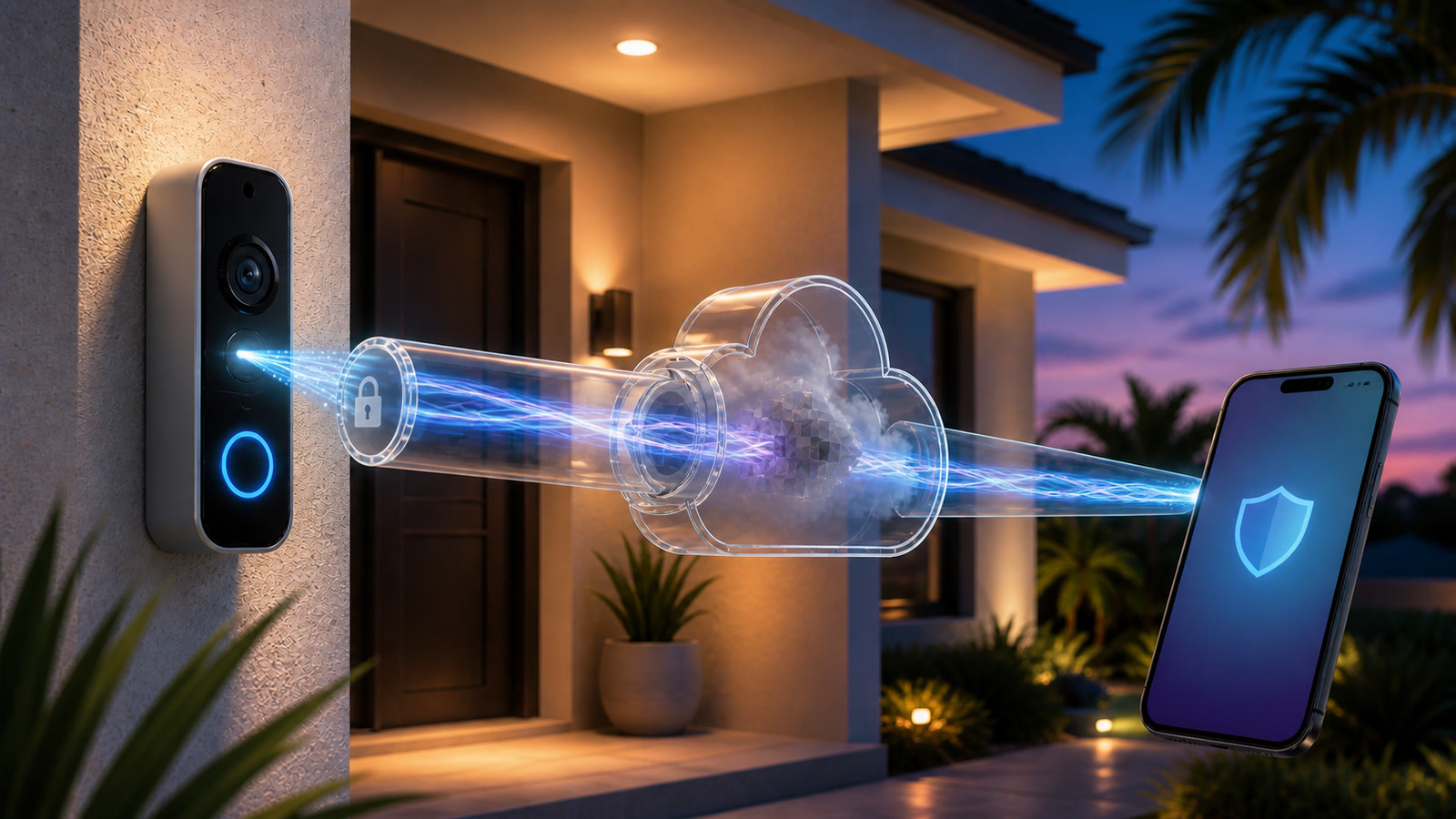
Smart home privacy • the key trade-off
Ring says its new Throw Away the Key Encryption, or TAKE, will become the default for supported Ring camera customers worldwide after a phased rollout beginning in September 2026.[1][3] It is designed to narrow cloud access to video keys while keeping cloud features working—but it is not end-to-end encryption, and it does not erase every privacy or security risk.[2][3]
Under TAKE, Ring says each camera uses frequently changing keys; a cloud member can obtain keys inside an AWS Nitro Enclave only to run features active on the account, and Ring’s managed copy is deleted on a rolling 24-hour schedule.[2] The white paper says content keys rotate every five minutes and the key-management database has no backups.[2]
What TAKE changes
Cryptographic design TAKE builds its group key management on Messaging Layer Security, the IETF’s RFC 9420, while Ring adds its own Privacy Enforcement Policy, cloud-member, video-frame, enclave, retention, and recovery mechanisms.[2] Using an open standard for the foundation does not by itself independently validate Ring’s full implementation or its custom key-deletion system.[3]
The feature bargain
TAKE: cloud features stay on
TAKE is designed to retain Shared Users and cloud processing such as Smart Alerts, Video Search, and Video Descriptions.[2][4] Ring can therefore access decrypted content temporarily when an enabled service needs it.[2]
E2EE: Ring never gets the keys
In Ring’s optional E2EE mode, its cloud stores and transmits encrypted video but does not hold the keys needed to decrypt it.[2] The trade-off is losing Shared Users and cloud-dependent analysis such as Video Search, Smart Video Descriptions, and cloud Smart Alerts.[2][3]
Independent reporting The Verge’s central caution is that TAKE reduces Ring’s access compared with today’s default but still leaves a cloud-camera privacy trade-off: Ring has key access during the initial window and can receive a key again when an authorized app initiates processing of older video.[3] TechCrunch likewise describes TAKE as a default that preserves cloud features while E2EE remains a manual option.[4]
What Ring says it cannot access
Ring claim Ring says that once its retained copy of a content key has been deleted, it cannot process that older video on its own; an authorized Ring app must push the needed key when the customer starts an action such as playback, sharing, transcoding, or older-video analysis.[2] Ring told The Verge that under TAKE it could respond to valid legal process with non-video information and encrypted video files, rather than decrypted video.[3]
That statement is Ring’s description of what its architecture permits; it is not proof of immunity from subpoenas, warrants, account demands, customer-approved sharing, or access to data outside the encrypted video itself.[3] TAKE’s white paper explicitly excludes video a customer chooses to share with Ring or third parties, including share links, Neighbors, and video-donation tools.[2]
Recovery is useful—and consequential
Cryptographic design Ring describes recovery through iCloud Keychain or Android backup mechanisms, approval from another authorized device, a 12-word passphrase, a compatible passkey, and—under TAKE on compatible hardware—camera-based recovery that is enabled by default but can be disabled.[2] Not every recovery method will be available at launch; Ring says the full set arrives when TAKE is fully rolled out.[2]
Unknown / trade-off If every recovery path is lost, Ring says old encrypted video becomes inaccessible; an encryption-account reset restores future recording only and requires cameras to be set up again.[2] That makes recovery setup part of the security decision, not just a convenience toggle.[2]
Compact checklist for Ring owners
- Check your actual mode per camera. TAKE is phased, and Ring says customers will be notified when eligible; do not assume every camera has switched yet.[2]
- Choose features versus key exclusivity. Keep TAKE if you rely on Shared Users or cloud AI; consider E2EE per compatible camera if preventing Ring from ever holding video keys matters more than those features.[2][3]
- Audit Shared Users and signed-in devices. Ring says TAKE provides an Activity Log for group membership changes, and removed devices lose access to future content.[2]
- Set up more than one recovery path. Store the recovery passphrase safely and confirm which cloud backup, passkey, device-approval, or camera-based options are available to you.[2]
- Review sharing before sending a clip. Once video is exported or shared outside Ring, the recipient’s security and retention rules apply instead of TAKE’s video-key controls.[2]
What remains unknown
- The cited material does not provide a completed independent security audit of Ring’s TAKE implementation or custom deletion architecture; Ring points instead to the reviewed MLS foundation and its own technical white paper.[3]
- Ring has not published an exact worldwide completion date in these sources, and feature compatibility plus recovery methods will vary during the phased rollout.[1][2]
- The sources do not establish that TAKE prevents compromise of a Ring account, an authorized phone or browser, a camera, a recovery channel, or metadata and subscriber information outside the protected video payload.[2][3]
Bottom line
TAKE is best understood as a new default designed to reduce how long Ring can independently decrypt video without giving up its cloud intelligence.[2][3] It is a meaningful architectural claim, not absolute privacy: E2EE remains Ring’s stronger key-control option, and real confidence in TAKE will depend on rollout behavior, implementation quality, recovery hygiene, and independent scrutiny.[2][3]
Sources and reporting notes
- About Amazon / Ring — “Ring introduces TAKE, setting a new industry standard for default encryption and control” (August 26, 2026, 12:00:07 UTC; primary company announcement)
- Ring — “Throw Away the Key Encryption | End-to-End Encryption” white paper (August 26, 2026; technical design published by Ring, not an independent audit)
- The Verge — “Ring says its new encryption limits what it can give police” (August 26, 2026, 12:55 p.m. UTC; independent reporting with responses from a Ring spokesperson)
- TechCrunch — “Ring introduces a new encryption standard, makes it the default for cloud features” (August 26, 2026, 7:44 a.m. PDT; independent summary of the announcement and white paper)
Reporting cutoff: August 28, 2026, 3:16 p.m. UTC. The article has zero inline hero media; its featured image is an original editorial illustration, not a Ring product image or security proof.