

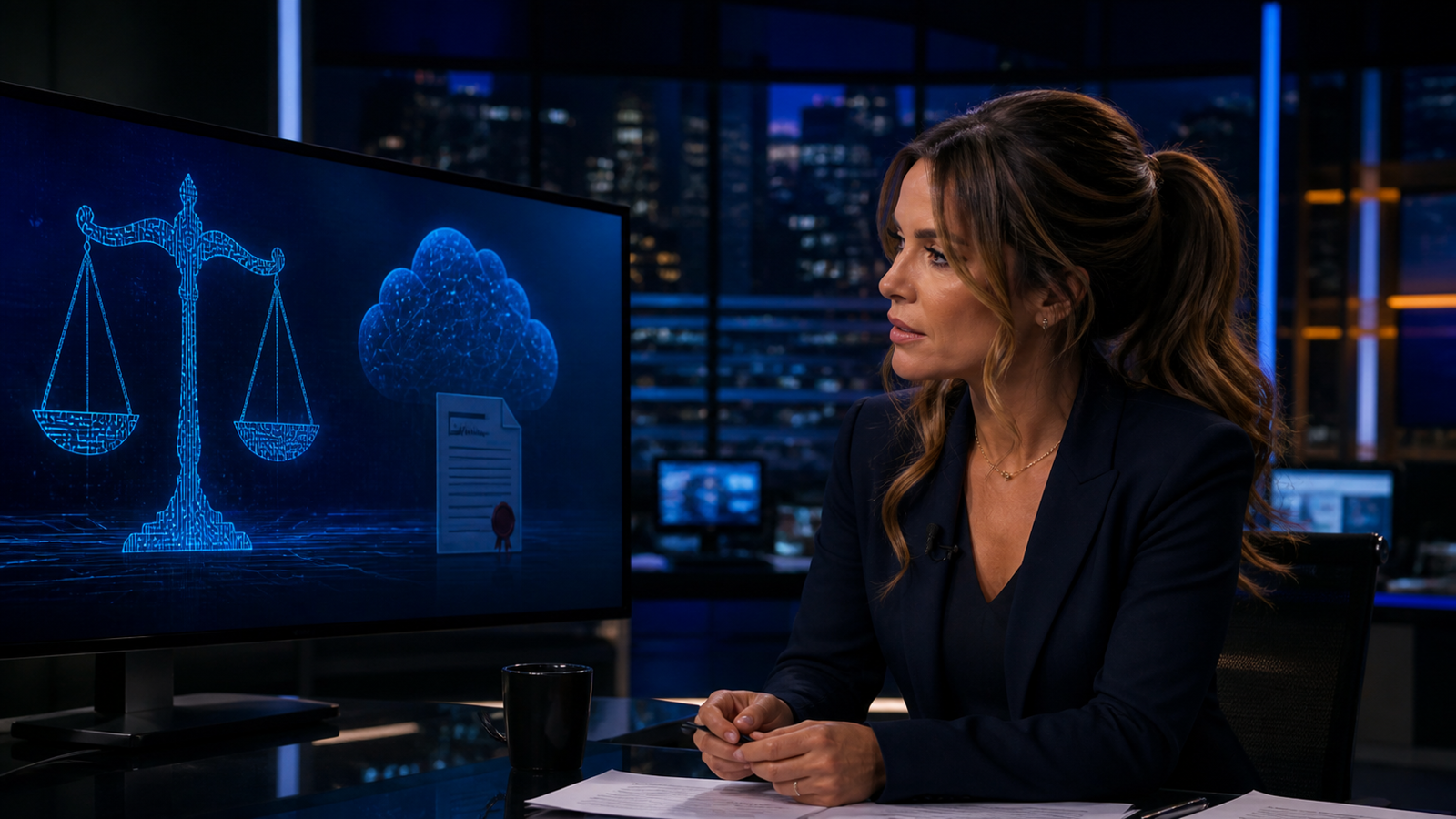
The Night Shift: Overnight Tech News with Jennifer Hudsen • 2:00 a.m. edition • Cutoff Aug. 28, 2026, 2:10:30 a.m. EDT / 06:10:30 UTC
Featured image disclosure: original Jennifer Hudsen newsroom concept art by The IT Guys. The generic circuit-scale and court-document imagery is illustrative, contains no official seal, and is not a courtroom photograph.
A federal judge voided one Pentagon blacklist of Anthropic—but a separate case still keeps the status complicated
U.S. District Judge Rita F. Lin granted Anthropic summary judgment against several federal actions that had labeled the AI company a national-security supply-chain risk. The 59-page order, filed Aug. 27 in the Northern District of California, calls the challenged measures “illegal and baseless,” but it does not compel the military to buy or keep using Claude. [1]
This is a disclosed near-window fallback. Reuters syndication metadata shows its report published at 00:32:09 UTC, 5 hours 38 minutes 21 seconds before this desk cutoff and outside the roughly 150-minute core window that began at 03:30:33 UTC. [3]
What happened
Lin’s order concerns Anthropic PBC v. U.S. Department of War, case 3:26-cv-01996-RFL. It grants Anthropic summary judgment on its First Amendment retaliation claim, Fifth Amendment due-process claim, and key Administrative Procedure Act claims. It directs the relevant defendants to rescind the challenged directives, communications and instructions, and it vacates the supply-chain designation made under 10 U.S.C. § 3252. [1]
The court did not accept every claim Anthropic advanced. Summary judgment went to the government on Anthropic’s ultra vires separation-of-powers claim and on claims against agencies that did not take relevant final action or took only interim measures. That narrower detail matters: this was a major merits victory for Anthropic, not a ruling that every defendant lost on every theory. [1]
The dispute began after negotiations over military use of Claude broke down. Anthropic had publicly refused to remove two restrictions: uses involving fully autonomous weapons and mass domestic surveillance. The government said its concern was contractual reliability and national security; Anthropic alleged retaliation for its public criticism and a lack of notice or a meaningful chance to respond. The order records both positions before ruling for Anthropic on the challenged California-case actions. [4] [1]
Why it matters
The ruling sits at the intersection of AI procurement, vendor speech, model-use restrictions and government cybersecurity authority. The court acknowledged that the government deserves deference on serious national-security questions, while concluding that the administrative record did not establish an articulable basis to believe Anthropic would sabotage its model. The order says contemporaneous words and actions instead showed an effort to make a public example of the company for criticizing the government. [1]
For technology suppliers, the practical issue is broader than one chatbot. Federal agencies often need discretion to reject a vendor, especially when software touches sensitive systems. This order does not erase that discretion. It says the government cannot use a supply-chain statute and sweeping secondary consequences in the way this record showed, while bypassing constitutional and statutory limits. That distinction may influence how future disagreements over AI safeguards are documented and litigated, although one district-court order does not automatically set a nationwide rule for every procurement dispute.
CNBC independently reported the California decision and Anthropic’s statement welcoming it. CNBC also highlighted a critical unresolved point: the Pentagon relied on two distinct legal designations, and a related proceeding in Washington, D.C., remains pending. Its report says Anthropic technically remains designated under that separate path while the second case continues. [2]
Who is affected
Anthropic and federal contractors are the most directly affected. The California order vacates and requires rescission of the challenged actions within that case’s scope. Companies that use Claude in federal work should not interpret a headline as a complete operational clearance, because the related D.C. proceeding and any agency-specific contract terms still need to be checked. [2]
Ordinary Claude users are not being told to install a patch, migrate data or change passwords because of this ruling. It is a procurement and constitutional-law development, not a newly disclosed product vulnerability or service outage. Anthropic previously said the vast majority of customers were unaffected by the designation and that its reading limited the relevant statute to Claude used directly in Department of War contract work; that was Anthropic’s legal position, not an independent guarantee for every contract. [5]
What readers should do
- Do not treat “blacklist blocked” as “all restrictions ended.” The California case produced a final merits order on the challenged actions there, while the related D.C. case remains unresolved in the sources checked at cutoff. [2]
- Federal contractors should verify current written direction. Check the contracting officer, applicable clause, agency guidance and counsel before changing an approved AI toolchain. This is practical risk-control guidance, not legal advice.
- Preserve the exact authority. Case number 3:26-cv-01996-RFL and Document 250 identify the Aug. 27 order. A March preliminary injunction is background, not the new decision. [1]
- Watch for appeal or follow-on orders. The checked sources did not establish that the government had appealed this Aug. 27 merits ruling by the 06:10:30 UTC cutoff.
- Separate product safety from procurement status. The ruling does not certify Claude for autonomous weapons, domestic surveillance, classified workloads or any particular agency use.
Upside, cautions and unknowns
Upside: the decision provides a detailed public record rather than leaving a consequential AI-procurement conflict at the level of social-media statements. It also reinforces that agencies can choose vendors while still being required to follow the statute and constitutional process identified by the court. [1]
Caution: the decision is not the end of every Anthropic-government dispute. A separate D.C. matter addresses another designation, and appellate activity could change the practical state. CNBC’s report explicitly says the separate litigation means Anthropic still technically remains a supply-chain risk at its reporting time. [2]
Unknown at cutoff: no source opened for this article established a new government appeal, a final D.C. ruling, complete agency implementation of the rescission directions, or restoration of any particular contract. Absence from the checked record is not proof that none of those actions will occur.
| Question | Verified at cutoff | Important limit |
|---|---|---|
| What did the judge decide? | Anthropic won summary judgment on First Amendment, due-process and key APA claims. [1] | Not every claim and defendant was resolved for Anthropic. |
| Was a designation vacated? | Yes, the order vacates the § 3252 supply-chain designation challenged in the California case. [1] | A separate designation is being litigated in D.C. |
| Must the military use Claude? | No. The order expressly says the Department remains free to choose its AI vendor. [1] | Vendor choice must still comply with law. |
| Is the entire dispute over? | No. CNBC reported related D.C. litigation was still ongoing. [2] | Later appeals or orders may change the state. |
Frequently asked questions
Did the judge merely pause the blacklist?
No. The Aug. 27 order grants summary judgment on the merits and vacates the challenged § 3252 designation. A March order had supplied preliminary relief; readers should not confuse that older stage with Document 250. [1]
Does the ruling force federal agencies to buy Claude?
No. The order says the Department of War remains free to select the AI vendor of its choice. The legal defect found by the court concerned the broad challenged measures and the basis and process used for them. [1]
Is Claude now approved for every military use?
No. The ruling does not certify the model for any particular mission. Anthropic’s two disputed restrictions and the government’s procurement choices remain separate from the court’s decision about the legality of the challenged actions.
Why call this a near-window fallback?
The Reuters syndication copy was published at 00:32:09 UTC. That is outside the core window beginning at the previous desk cutoff of 03:30:33 UTC, but inside the permitted six-hour fallback measured to this run’s 06:10:30 UTC cutoff. [3]
Sources
- U.S. District Court order, Anthropic PBC v. U.S. Department of War, Document 250 — filed Aug. 27, 2026; 59 pages.
- CNBC: “Judge blocks Pentagon blacklist of Anthropic as supply chain risk” — published Aug. 28, 2026, 01:51:24 UTC; updated 02:50:45 UTC.
- Reuters syndication at SRN: “US judge blocks Pentagon’s Anthropic blacklisting” — published metadata Aug. 28, 2026, 00:32:09 UTC; updated 04:05:48 UTC.
- Anthropic: “Statement from Dario Amodei on our discussions with the Department of War” — Feb. 26, 2026.
- Anthropic: “Where things stand with the Department of War” — March 2026; company position.
Reporting cutoff: Aug. 28, 2026, 2:10:30 a.m. EDT / 06:10:30 UTC. This is one subject selected from the newest verified global technology developments and checked against The IT Guys’ daytime and prior Night Shift coverage.